What Do Red Wood Ants Eat? The Forest’s Voracious Guardians
Written from an ant keeper’s perspective, with peer-reviewed sources. Last updated: June 2026.
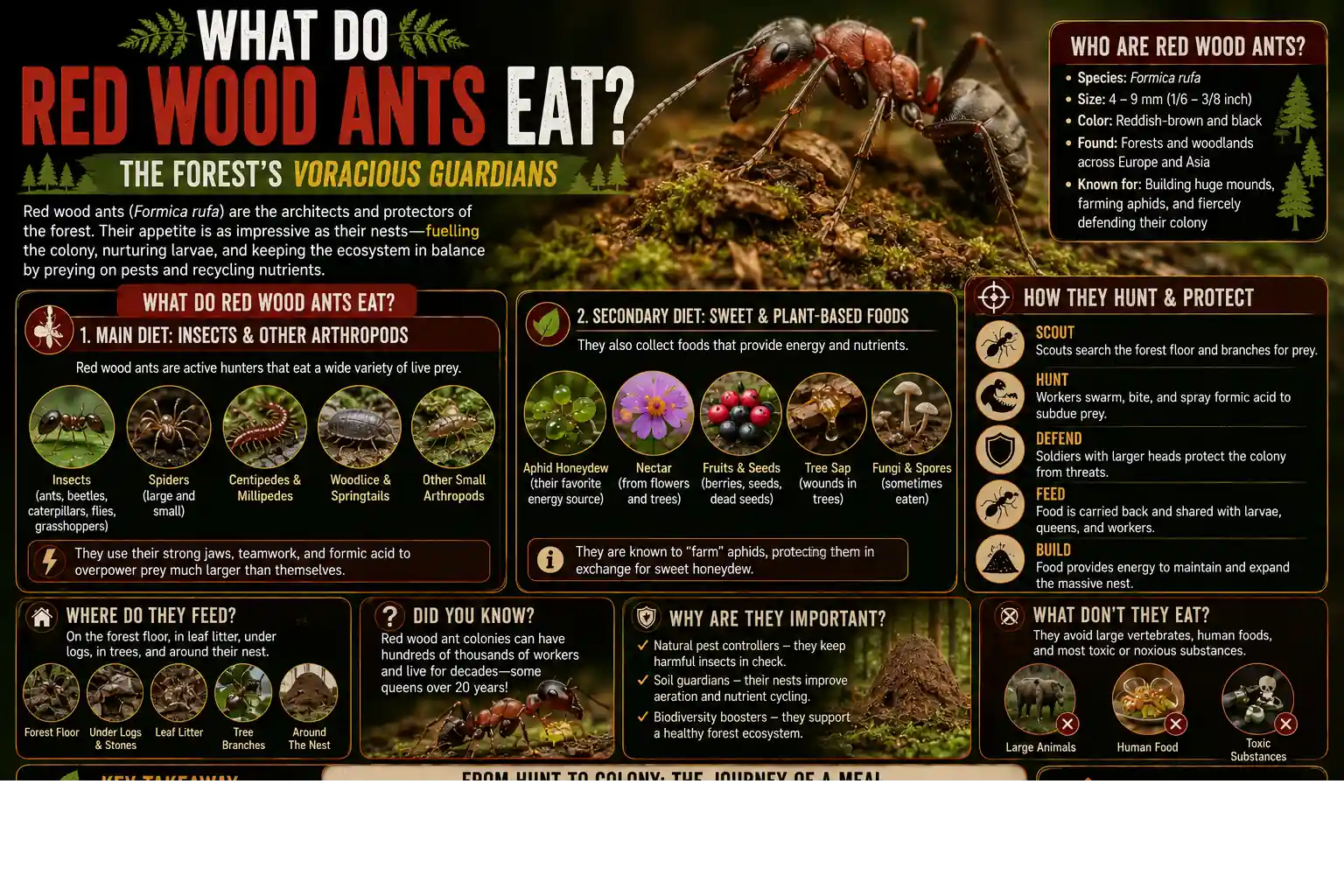
Red wood ants are the great mound-builders of European woodlands, and despite their name, the one thing they do not eat is wood. So what do red wood ants eat? Mostly sugar. The bulk of their diet is honeydew, the sweet liquid they harvest by farming aphids high in the canopy, and the rest is a vast number of hunted insects that they feed to their young. A single large nest works through millions of prey insects and hundreds of kilograms of honeydew every year, which is exactly why these ants are one of the most important natural pest controllers a forest has. Their diet is the engine of a whole woodland ecosystem.
Quick answer: Red wood ants (the Formica rufa group) are omnivores whose diet is roughly two-thirds honeydew and one-third hunted insects, plus a little plant material and carrion. They “milk” honeydew from aphids and other sap-sucking insects that they protect like livestock, using it as the main energy source for the workers, and they hunt large numbers of insects such as caterpillars, flies, and sawfly larvae as protein for the brood and queens. They do not eat wood, and they have no sting, defending themselves by spraying formic acid.
Note: red wood ants are a protected, declining species in much of Europe. If you are thinking of keeping them, read the conservation note first.

The short answer: honeydew and hunted insects
Red wood ants are the big, reddish-brown, mound-building ants of the Formica rufa group, famous for the dome-shaped “thatched” nests of conifer needles and twigs they pile up on the forest floor. Their diet has two main parts, and the split is the opposite of what most people guess.
Like other ants, they need carbohydrate to fuel the workers and protein to raise the brood. What surprises people is the balance: red wood ants get most of their food, by most estimates around two-thirds, as sugary honeydew, not meat. The hunted insects everyone pictures make up roughly the other third. So the honest one-line answer is that red wood ants run mostly on sugar harvested from aphids, topped up with a huge volume of hunted insects for protein.
The honeydew farmers: the sugar that fuels the colony
The single biggest item in the red wood ant diet is honeydew, and the way they get it is one of the best examples of farming in the animal world.
Honeydew is the sugary liquid that aphids and other sap-sucking insects excrete as they feed on plant sap. Red wood ants tend herds of these aphids high in the trees, “milking” them by drumming and caressing them with their antennae to coax out the droplets, then carrying the sweet liquid back to the nest.
In return, the ants act as bodyguards, protecting the aphids from ladybugs, hoverflies, and other predators. It is a true mutual partnership, and the ants depend on it heavily: studies of the Formica rufa group have found that honeydew can make up anywhere from around 60 to over 90 percent of their diet, and that a single colony can carry several hundred kilograms of it back to the mound in a year.
This sugar is the workers’ fuel. It is rich in carbohydrate, with a little amino acid content, and it powers the constant foraging, building, and defending that a giant wood-ant colony requires. Without their aphid herds, the colony could not run.
The hunters: protein for the brood
The other third of the diet is what gives red wood ants their reputation as fearsome predators, and it is delivered on a staggering scale.
Red wood ants are generalist hunters that catch enormous numbers of other insects: caterpillars, flies, beetles, sawfly larvae, and many other small invertebrates, along with the occasional bit of carrion. This protein is not mainly for the workers. It goes to the growing larvae and to the queens, fueling the egg production that keeps a colony of hundreds of thousands or even millions of ants supplied with new workers.
The numbers are remarkable. Research on these ants estimates that a single large nest of around a million workers can take roughly 30 kilograms of insects in a year, which works out to something like 10 million individual prey items hauled back to the mound. That is a colossal amount of hunting, concentrated in the canopy and on the forest floor around the nest, and it leads directly to the red wood ant’s most valuable role.
The science competitors miss: the forest’s guardian
Here is the standout, and it is the reason foresters have prized these ants for centuries. Because a red wood ant nest hunts millions of insects a year, the colony is one of the most effective natural pest controllers in the entire forest.
Many of the insects red wood ants hunt are the foliage-feeders that strip leaves and conifer needles and, left unchecked, can defoliate and damage trees. By preying on them in huge numbers in the canopy, red wood ants help keep outbreaks of these forest pests under control (Fürjes-Mikó and colleagues, 2025). Their value was recognized so long ago that, historically, wood-ant nests were deliberately moved into European forests as a form of biological pest control, generations before modern pesticides.
The diet drives still more. By dragging organic material and prey remains into their mounds, red wood ants enrich and aerate the soil around the nest, which can benefit nearby trees. They disperse the seeds of woodland plants like violets, which carry a fatty attachment called an elaiosome that the ants harvest as food, leaving the seed to grow in a new spot. Their colonies even become biodiversity hotspots, sheltering hundreds of specialized “ant-loving” insects found nowhere else. Every one of these ecosystem services flows from how and what these ants eat.
Formic acid, not a sting
Red wood ants have a distinctive way of subduing prey and defending the colony, and it is worth knowing because it is so noticeable in the field. They do not sting. Instead, they spray formic acid, a sharp-smelling chemical they can squirt from the tip of the abdomen, sometimes over a surprising distance.
A wood-ant nest poked by a curious animal or person will release a haze of formic acid, which you can actually smell. The ants use it to overpower struggling prey and to repel attackers. Some birds even exploit it: woodpeckers and jays will deliberately sit on a nest and let the ants spray them, or rub ants through their feathers, a behavior called “anting” that is thought to help control feather parasites.
Do red wood ants eat wood?
No. This is the most common misconception about them, and it is worth stating plainly: red wood ants do not eat wood and do not damage timber for food. The name refers to where they live, the woodland, and to the woody material they build with, not to what they eat.
Their nests are made by piling up conifer needles, small twigs, leaf fragments, and bits of resin into the famous thatched dome, with a network of chambers below ground. The resin they add even has a mild antibacterial effect that helps keep the crowded nest healthy. But the wood and needles are construction material, not a meal. Their actual food, as we have seen, is honeydew and hunted insects. If you have a red wood ant nest near a building or timber, it poses no risk to the wood.
Should you keep red wood ants?
This is the rare ant where the answer is about conservation, not danger or invasiveness.
A conservation note: Red wood ants are a declining group that is legally protected across much of Europe. They have been protected in Switzerland since 1966, and they are a species of conservation concern in the United Kingdom and many other countries, where disturbing or destroying their nests can be illegal. Their colonies are slow to build, ecologically vital, and easily harmed, and a wild nest taken or damaged is a real loss to the forest. For all these reasons, red wood ants are not a species to collect or keep. The responsible thing is to leave their nests undisturbed and admire these remarkable ants in the wild.
If you want to keep ants with a similar love of honeydew and hunting, there are responsible, non-protected species available to hobbyists. To match a feeding plan to a species you can legally and ethically keep, try our interactive ant food finder, and for the wider picture start with our pillar guide, What Do Ants Eat?. You can also compare other honeydew lovers in What Do Argentine Ants Eat? and another woodland predator in What Do Carpenter Ants Eat?
What do red wood ants eat? The short version
If you take one thing away, make it this: red wood ants run mostly on sugar, and they eat no wood at all. About two-thirds of their diet is honeydew, farmed from aphids they tend and protect like livestock, and this sweet liquid fuels the workers.
The other third is hunted insects, caterpillars, flies, sawfly larvae, and more, which they feed to the brood and queens, and they catch them in astonishing numbers: a single big nest can take some 10 million prey insects and hundreds of kilograms of honeydew in a year. That appetite makes red wood ants one of the forest’s most important pest controllers and ecosystem engineers. Understand their diet, and you understand why a healthy woodland needs them.
FAQ
What do red wood ants eat in the wild?
Red wood ants eat mostly honeydew, the sugary liquid they harvest from aphids they farm in the trees, which makes up roughly two-thirds of their diet and fuels the workers. The other third is hunted insects such as caterpillars, flies, and sawfly larvae, fed mainly to the larvae and queens as protein, along with a little carrion.
Do red wood ants eat wood?
No. Despite the name, red wood ants do not eat wood or damage timber. They build their large mound nests from conifer needles, twigs, and resin, but this is construction material, not food. Their diet is honeydew and hunted insects. The name refers to their woodland home, not their diet.
Do red wood ants eat honeydew?
Yes, it is their main food. They tend aphids and other sap-sucking insects, stroking them with their antennae to make them release honeydew, and protect them from predators in return. Honeydew can make up well over half of a red wood ant colony’s diet and is the workers’ main energy source.
Do red wood ants sting or bite?
They do not have a functional sting. Red wood ants defend themselves and subdue prey by spraying formic acid from the tip of the abdomen, which has a sharp smell and can be sprayed some distance. They can also give a small nip with their jaws, but the formic acid is their real weapon.
Are red wood ants good for the forest?
Very. By hunting millions of insects a year, including many tree-damaging pests, red wood ants are powerful natural pest controllers, and forests were once seeded with their nests for this reason. They also enrich the soil, disperse plant seeds, and support a huge range of other species, making them a keystone species of healthy woodland.
Can you keep red wood ants as pets?
Generally no. Red wood ants are a protected, declining species in much of Europe, and disturbing or collecting their nests can be illegal. Their colonies are slow-growing and ecologically important, so the responsible choice is to leave them in the wild rather than keep them.