What Do Yellow Crazy Ants Eat? The Diet That Devastates Islands
Written from an ant keeper’s perspective, with peer-reviewed sources. Last updated: June 2026.
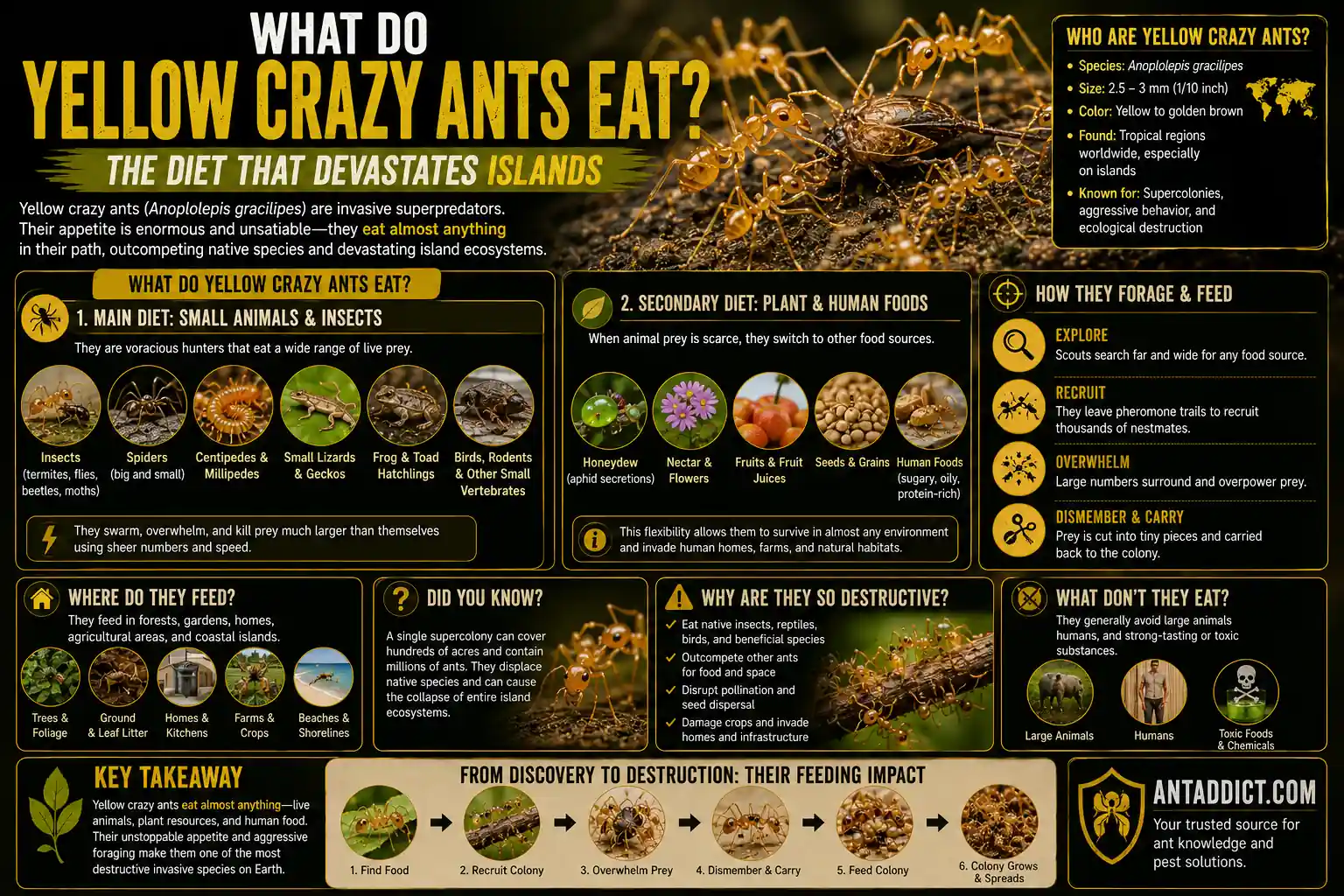
The yellow crazy ant is one of the most destructive invasive species on Earth, and its diet is the reason why. So what do yellow crazy ants eat? Almost anything. They are extreme generalists that hunt and scavenge a huge range of food, from seeds and insects to carrion and even land crabs, while farming sap-sucking insects for sugar. That last part is the secret. Their appetite for honeydew is the hidden fuel behind the gigantic “supercolonies” that have wiped out wildlife on islands like Christmas Island, which makes their diet not just a list of foods, but the on-off switch for an ecological catastrophe.
Quick answer: Yellow crazy ants (Anoplolepis gracilipes) are omnivorous “scavenging predators” with a very broad diet. They hunt and dismember a wide range of invertebrates (insects, spiders, millipedes, snails, earthworms, and even land crabs), scavenge carrion, and eat seeds and grains. For energy, they rely heavily on carbohydrate, especially honeydew from scale insects and aphids that they farm and protect, plus plant nectar. They do not bite or sting; instead they spray formic acid to subdue prey and defend themselves.
This article covers the wild diet of an invasive species. If you are wondering about keeping them, read the serious warning first: you should not.
The short answer: a scavenging predator that eats almost anything
Yellow crazy ants have exactly the kind of diet you would expect from one of the world’s worst invaders: enormous and flexible. Scientists describe them as “scavenging predators,” and that broad, opportunistic appetite is a big part of why they take over wherever they land.
Their diet includes:
- Hunted invertebrates: insects, spiders, isopods, millipedes, snails and slugs, earthworms, and other small animals, which they attack and dismember
- Larger prey: remarkably, they can swarm and kill animals far bigger than themselves, including land crabs many times their size
- Carrion: decaying animal matter, including vertebrate corpses
- Plant material: seeds and grains
- Carbohydrate: plant nectar and, above all, honeydew from sap-sucking insects
A generalist diet like this is a classic feature of invasive ants. Because they can eat almost anything, yellow crazy ants are never short of food in a new habitat, which lets their numbers explode. But the single most important item on that list is the one people least expect: sugar.
The honeydew engine: the diet that builds supercolonies
Here is the standout, and it is the key to understanding the entire yellow crazy ant problem. These ants run on sugar, and that sugar is what powers their notorious supercolonies.
Like all ants, yellow crazy ants need protein to raise their brood and carbohydrate to fuel their workers. But they depend on carbohydrate to an extraordinary degree, and they get most of it by farming honeydew, the sugary waste excreted by sap-sucking insects such as scale insects and aphids. The ants tend these insects like livestock, “nannying” and protecting them from predators and even spreading them to new plants, in exchange for a constant supply of honeydew. They rely on this relationship so heavily that a shortage of scale insects can actually limit how much the ant population can grow.
Researchers have shown just how central this sugar is. In laboratory studies, yellow crazy ant colonies with plentiful sugar reared more fertile queens, kept more of their workers alive, and behaved more aggressively and adventurously than sugar-starved colonies. In the field on Christmas Island, physically blocking the ants from reaching their scale insects, by banding the tree trunks they climbed, made their ground activity crash by 95 percent within a month. And when the ants themselves were removed, the whole partnership unraveled: the scale insect population collapsed (Abbott and Green, 2007).
In other words, honeydew is the on-off switch for a supercolony. This is why the main biological control program against these ants does not target the ants directly at all. Instead, it targets their food: a tiny host-specific wasp is released to kill the scale insects that supply the honeydew, cutting off the ants’ sugar at the source. The diet is the weak point.
No sting, but a chemical weapon
Yellow crazy ants have an unusual way of subduing the prey in their diet. Unlike fire ants or bullet ants, they have no functional sting and they do not bite in any meaningful way. Instead, they spray formic acid.
A foraging yellow crazy ant can squirt formic acid from the tip of its abdomen, both to defend itself and to overpower prey. On its own, one ant’s spray is minor. But at the densities these ants reach, with thousands of workers in a small area, the combined formic acid becomes a devastating weapon, able to disable animals vastly larger than any individual ant. This is exactly how they take down prey like land crabs, and it leads directly to their most infamous act.
The Christmas Island catastrophe
No account of the yellow crazy ant diet is complete without Christmas Island, where their appetite triggered one of the most famous ecological disasters in modern conservation.
On Christmas Island, in the Indian Ocean, yellow crazy ants formed supercolonies of staggering density, with research recording over two thousand foraging ants per square meter (Abbott, 2005). These ants turned their formic acid on the island’s famous red land crabs, blinding and killing them by the millions. Estimates suggest the ants have killed or displaced on the order of 15 to 20 million red crabs, and the rotting crab bodies then became yet another meal for the colony.
That mattered far beyond the crabs themselves, because red crabs are a keystone species that shape the whole forest by eating seedlings and leaf litter and turning the soil. With the crabs gone, seedlings and weeds ran wild, the forest floor changed, and meanwhile the ants’ farmed scale insects multiplied unchecked, sickening and killing canopy trees through honeydew-fueled overgrowth. Scientists named this cascade an “invasional meltdown,” a runaway collapse in which the invader transforms an entire ecosystem (O’Dowd and colleagues, 2003). Every step of it traces back to what these ants eat.
Why their diet makes them such a successful invader
Put the pieces together and you can see why the yellow crazy ant is on the IUCN list of the 100 worst invasive species in the world. Its diet is built for conquest.
The broad, generalist menu means it can feed itself almost anywhere. The heavy reliance on honeydew gives it a high-energy fuel supply that drives explosive colony growth and aggression. And because these ants form unicolonial supercolonies, with many cooperating queens, little fighting between nests, and reproduction by budding, all that food energy gets poured into relentless expansion rather than internal competition. A flexible diet plus a sugar engine plus a supercolony structure is a recipe for ecological dominance, which is precisely what the world has seen from this species.
How to recognize a yellow crazy ant
It helps to know what you are actually looking at, because the “crazy” in the name is a real identification clue. These ants are named for their frantic, erratic movement: when disturbed, they dart around in fast, jerky, zigzag paths rather than marching in tidy lines like most ants.
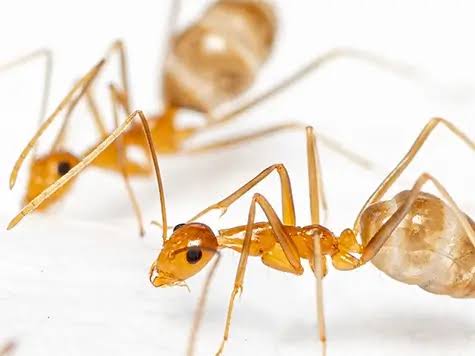
Physically, the yellow crazy ant is slender and relatively large for a tramp ant, at roughly 4 to 5 millimeters long. It has a yellow to orange or yellowish-brown body that can look slightly translucent, unusually long legs, very long antennae (often as long as the body or longer), and large dark eyes. The waist has a single segment. They have no sting, and instead carry an acid-spraying pore at the tip of the abdomen. Long legs, long antennae, a yellowish body, and that hyperactive scuttle together make a fairly distinctive ant.
Where yellow crazy ants have spread
The yellow crazy ant’s exact native range is uncertain, with tropical Asia most often suggested, but what is certain is how far it has traveled. Carried around the world in shipping and freight, it has invaded tropical and subtropical regions across the globe.
Notable invaded areas include Christmas Island and the Cocos Islands, the Seychelles, Mauritius, Madagascar and Réunion in the Indian Ocean, Hawaii, French Polynesia, New Caledonia, Vanuatu and other Pacific islands, the Galapagos, parts of the Caribbean, and northern Australia, where significant populations exist in Queensland’s Wet Tropics and in Arnhem Land in the Northern Territory. It readily colonizes disturbed habitats and agricultural systems such as coconut, citrus, coffee, and cinnamon plantations. This global reach, combined with the diet that fuels it, is why the species sits on the IUCN list of the 100 worst invaders and why biosecurity agencies treat any new sighting so seriously.
Should you keep yellow crazy ants?
The answer here is a flat no, stronger than for any other ant we cover.
A serious warning: Yellow crazy ants are one of the most destructive invasive species on the planet, listed among the world’s 100 worst invaders. They form supercolonies that devastate native wildlife, and they are a regulated or prohibited pest in many countries, where importing, keeping, or moving them is illegal. They are not a pet. Keeping them risks an escape that could establish a supercolony and cause serious ecological harm, and it may be a criminal offense where you live. If you think you have found yellow crazy ants, the right response is not to collect them but to report them to your local biosecurity or invasive-species authority.
If you want to keep ants with a similar love of sugar and honeydew but without the danger, there are far better and fully responsible choices. To match a feeding plan to a species you can legally and safely keep, try our interactive ant food finder, and for the full picture start with our pillar guide, What Do Ants Eat?. You can also read about other sweet-loving species in What Do Argentine Ants Eat? and What Do Ghost Ants Eat?
What do yellow crazy ants eat? The short version
If you take one thing away, make it this: yellow crazy ants eat almost anything, but they run on sugar. Their broad diet of hunted invertebrates, carrion, seeds, and even land crabs feeds the colony, while honeydew farmed from scale insects and aphids is the high-energy fuel that powers their explosive supercolonies.
They subdue prey not with a sting but by spraying formic acid, a tactic that, multiplied across millions of ants, has wiped out tens of millions of red crabs and triggered an ecological “meltdown” on Christmas Island. Their diet is the engine of their destruction, which is exactly why scientists fight them by cutting off their sugar. Understand what they eat, and you understand why they are so dangerous.
FAQ
What do yellow crazy ants eat in the wild?
Yellow crazy ants are omnivorous scavenging predators with a very broad diet. They hunt and dismember insects, spiders, millipedes, snails, earthworms, and even land crabs, scavenge carrion, and eat seeds. For energy they rely heavily on honeydew from scale insects and aphids, plus plant nectar.
Do yellow crazy ants eat honeydew?
Yes, and it is the most important part of their diet. They farm sap-sucking insects like scale insects and aphids, protecting them in exchange for sugary honeydew. They depend on this so heavily that cutting off the honeydew supply causes colonies to crash, which is the basis of efforts to control them.
Do yellow crazy ants bite or sting?
Neither, in the usual sense. Yellow crazy ants have no functional sting and do not bite meaningfully. Instead they spray formic acid to subdue prey and defend themselves. In large numbers, this acid can blind and kill animals far bigger than the ants, including land crabs.
Do yellow crazy ants really kill crabs?
Yes. On Christmas Island, yellow crazy ants have killed or displaced an estimated 15 to 20 million red land crabs by spraying them with formic acid, then feeding on the carcasses. The loss of these keystone crabs helped trigger a wider ecological collapse known as an invasional meltdown.
Why are yellow crazy ants so hard to control?
Largely because of their diet and colony structure. Their broad menu means they rarely run short of food, their honeydew supply fuels explosive growth, and they form vast multi-queen supercolonies that spread by budding. Effective control often targets their sugar source, the scale insects, rather than the ants directly.
Can you keep yellow crazy ants as pets?
No. They are one of the world’s worst invasive species and are regulated or illegal to keep in many places. Keeping them risks a damaging escape and may be against the law. If you find them, report them to a biosecurity authority rather than collecting them.