What Do Weaver Ants Eat? The Treetop Hunters and Farmers
Written from an ant keeper’s perspective, with peer-reviewed sources. Last updated: June 2026.
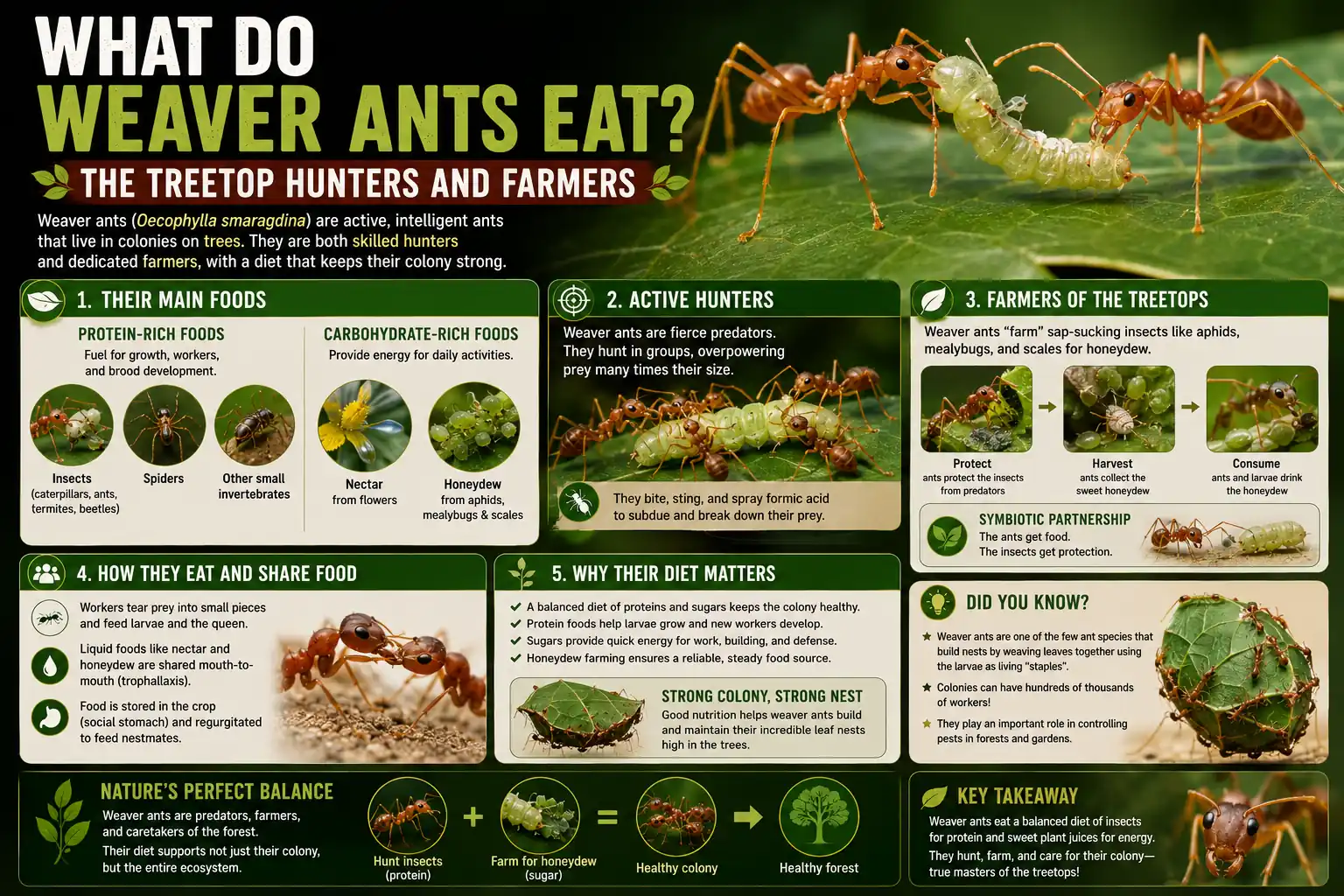
High in the tropical canopy, weaver ants run one of the most aggressive and best-organized food operations in the insect world. So what do weaver ants eat? They live a double life: they are fierce predators that hunt insects for protein, and they are ranchers that farm sap-sucking bugs for sugary honeydew. That combination of meat and sugar feeds a colony that can fill a whole tree, and it powers the silk their larvae spin to weave the nest together. It is also the reason weaver ants became the oldest known form of biological pest control, put to work in Chinese orchards more than 1,700 years ago.
Quick answer: Weaver ants (genus Oecophylla, the green tree ants) are predatory omnivores. They hunt and kill a wide range of insects and other small arthropods for protein, which feeds their larvae and queen, and they collect carbohydrate-rich honeydew from scale insects, mealybugs, aphids, and other sap-feeders that they guard and “farm.” They also take plant nectar. Their relentless hunting makes them powerful natural pest controllers, while the honeydew supplies the energy that sustains their enormous colonies.
The two-part diet: prey for protein, honeydew for energy
Weaver ants follow the same basic split as most ants, protein for the brood and carbohydrate for the adults, but they fill both halves in dramatic fashion. They are not kitchen scavengers. They are dominant hunters of the treetops, and they are also disciplined livestock farmers. Understanding both roles is the key to understanding their diet.
- Protein comes from hunting: insects and other small arthropods, killed and carried home to feed the larvae and queen.
- Carbohydrate comes from honeydew, the sugary liquid excreted by sap-sucking insects that weaver ants tend like herds, plus some plant nectar.
What is striking about weaver ants is how the balance actually works in the canopy. Live prey is often scarce up in the treetops relative to the sheer number of ants, while honeydew is abundant and reliable. Research in Australian rainforest canopy found that this steady supply of sugar is likely what allows weaver ant colonies to grow so enormous and energetically demanding (Blüthgen and Fiedler, 2002). In other words, hunting provides the protein to raise young, but honeydew is the fuel that runs the colony.
The hunters: aggressive predators of the canopy
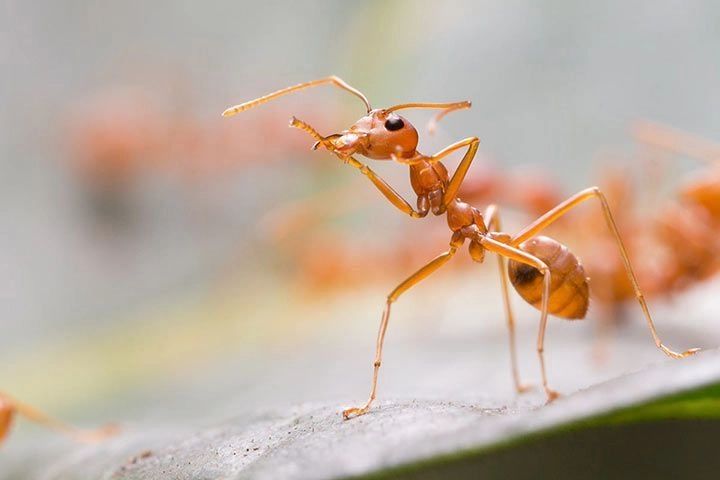
Weaver ants are among the most formidable insect predators in the tropics, and their hunting is genuinely organized teamwork.
When workers find prey, they swarm it and pin it down using their mandibles and the hooked claws on their feet. A group of ants will each grab a different part of the victim and pull in opposite directions, stretching the prey until it is spread-eagled and helpless, then dismembering it. If a tough insect resists, weaver ants spray formic acid onto its leg joints to weaken them. The prey is then cut up and carried back to the nest to be fed to the colony. They will attack almost any insect that enters their territory, including other ants unlucky enough to wander in.
This hunting is mostly the work of the large major workers, which patrol the colony’s territory aggressively and bring captured prey home. The protein they deliver goes primarily to the growing larvae, which need it to develop, and to the queen.
The ranchers: farming honeydew
The other half of the weaver ant diet is sugar, and they secure it the way many ants do, by farming.
Weaver ants tend herds of honeydew-producing insects, mainly sap-sucking Hemiptera such as soft scales, mealybugs, aphids, and treehoppers, and even some honeydew-producing caterpillars. The ants protect these insects from predators like ladybugs and spiders, and in return they harvest the sweet honeydew the herds excrete. This farming relationship, called trophobiosis, gives the colony a dependable carbohydrate stream. Weaver ants also drink nectar directly from flowers and from special nectar glands on their host plants.
The contrast with a species like the harvester ant is sharp. Harvester ants gather scattered seeds; weaver ants ranch living insects for liquid sugar while hunting other insects for meat. Same broad nutritional needs, completely different strategy.
The diet that builds the nest: the silk economy
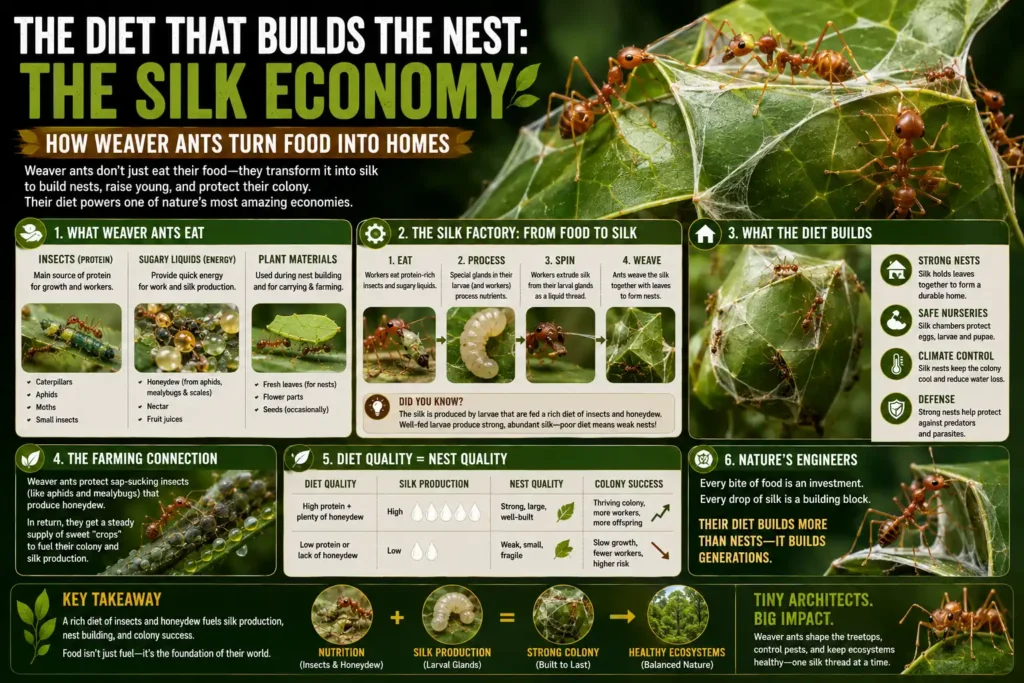
Here is where the weaver ant’s diet connects to the behavior that gives the ant its name, and it is a feeding story at its core.
Weaver ants build their nests by stitching living leaves together with silk. But adult weaver ants cannot make silk. Only the larvae can, producing it from glands near their mouths. So the workers use their own larvae as living tools: a worker picks up a nearly mature larva, carries it to the leaf edges being joined, and gently taps its head to make it release a thread of strong silk. The larva is passed back and forth like a living shuttle, gluing the leaves together, and thousands of these silk strands are woven into the waterproof walls of the nest.
This is why the diet matters so much. Those silk-producing larvae are exactly the colony members that depend on captured insect protein to grow. The prey the hunters bring home becomes the larvae, and the larvae become both the next generation of workers and the silk that holds the colony’s home together. The weaver ant’s hunting diet quite literally builds its architecture. Feed the colony well, and it can raise more brood, spin more silk, and expand across more leaves.
How the work is divided
Weaver ant colonies have two sharply different worker sizes, with little in between, and the diet is split along those caste lines.
The large major workers, roughly 8 to 10 millimeters long, are the hunters, foragers, and soldiers. They leave the nest to capture prey, tend distant honeydew herds, patrol territory, and defend the colony. The smaller minor workers, about half that size, mostly stay within the nests, where they care for the brood and tend honeydew insects housed inside the colony. So the protein and sugar flowing into a weaver ant colony are gathered, processed, and distributed by a workforce divided neatly between field hands and nurses.
The oldest pest control in history
This is the standout, and it follows directly from the weaver ant’s predatory diet. Because weaver ants are such voracious hunters of other insects, humans figured out how to put them to work an astonishingly long time ago.
More than 1,700 years ago, citrus growers in southern China were deliberately moving weaver ant colonies into their orchards to protect the fruit from insect pests. The practice was written down by Ji Han around 304 AD, who called them “citrus ants,” which makes Oecophylla the earliest documented biological pest control agent in the world (Huang and Yang, 1987; Van Mele, 2008). Growers bought weaver ant nests from collectors and even strung bamboo bridges between trees so the ant patrols could move freely through the orchard.
This is not just history. Weaver ants are still used today across Africa, Asia, and Australia to protect crops like citrus, cashew, mango, coconut, cocoa, and coffee, controlling more than fifty pest species across more than a dozen tree crops. The African weaver ant, for instance, is a key natural enemy of the coconut bug, a pest capable of destroying a large share of a coconut harvest. Every bit of that pest-control power is simply the weaver ant doing what it does naturally: hunting insects to feed its brood.
A note on humans eating weaver ants
Weaver ants are a spectacular display species, and feeding them follows directly from their wild diet once you know which species you are dealing with.
A quick keeping note: True Oecophylla weaver ants are very difficult to keep, because their colonies are huge, fiercely territorial, and spread across many leaf nests. The “weaver ant” most people actually keep is Polyrhachis dives, the Asian or black weaver ant, which also builds silk nests with its larvae but forms smaller, more manageable colonies and is far more beginner-friendly. Whichever you keep, remember that these are tropical, non-native species in most of the world. Do not release them or let them escape, and check your local import and keeping laws first, since non-native ants can become invasive.
The feeding principle is the same as in the wild: protein for the brood, sugar for the workers, and water.
Carbohydrates (offer constantly)
- Sugar water (about one part sugar to three parts water)
- Diluted honey water (never thick honey, which traps ants)
- Commercial ant nectar or sugar jelly
Protein (offer when brood is present)
- Feeder insects such as crickets, roach nymphs, fruit flies, and mealworms, offered freshly killed or pre-frozen
- Weaver ants are enthusiastic hunters, so many keepers offer live or freshly killed feeders to trigger natural hunting behavior
Water, humidity, and nesting material
Provide a constant water source and good humidity, since these are tropical, moisture-loving ants. Give them foliage or structures to build silk nests on, which is one of the great joys of keeping this group.
A simple keeper feeding guide
| Colony stage | Carbohydrate | Protein | Notes |
|---|---|---|---|
| Founding queen | Small drop of sugar water | Tiny protein item | Minimal disturbance, warmth and humidity |
| Small colony with first workers | Sugar water always available | Small feeder insect | Protein 1 to 2 times per week |
| Growing colony with larvae | Sugar water always available | Feeder insects | Protein 2 to 3 times per week |
| Large colony | Sugar water always available | Generous feeder insects | Protein as brood and silk-building demand |
For matching feeding plans to other species you keep, try our interactive ant food finder. For the wider picture, start with our pillar guide, What Do Ants Eat?, or compare very different feeders in What Do Harvester Ants Eat? and What Do Leafcutter Ants Eat?
What do weaver ants eat? The short version
If you take one thing away, make it this: weaver ants are hunters and ranchers at once. They hunt insects and other arthropods for the protein that feeds their larvae and queen, and they farm honeydew from scale insects, mealybugs, and aphids for the carbohydrate that fuels their giant colonies, topped up with a little plant nectar. That protein does double duty, because the larvae it raises are also the silk factories that weave the colony’s leaf nests together. And it is exactly this predatory appetite that made weaver ants the oldest biological pest control on record, working in orchards for more than 1,700 years.
For a keeper, the takeaway is simple: offer constant sugar water, feeder insects when there is brood, water, and humidity, and give them something to weave on. Understand the hunt and the harvest, and you understand the animal.
FAQ
What do weaver ants eat in the wild?
Weaver ants eat two main things: insect prey they hunt for protein, and honeydew they harvest from sap-sucking insects like scale, mealybugs, and aphids for carbohydrate. They also drink some plant nectar. The protein feeds their larvae and queen, while the honeydew fuels the adult workers.
Are weaver ants predators?
Yes. Weaver ants are aggressive, highly effective predators that hunt insects and other arthropods throughout the tree canopy. They work in teams to overpower prey, sometimes spraying formic acid to subdue it, and carry it back to the nest. This predatory diet is why they are used as natural pest control.
Do weaver ants eat honeydew?
Yes, honeydew is a major part of their diet. Weaver ants farm herds of sap-sucking insects such as mealybugs, scale insects, and aphids, protecting them from predators in exchange for the sugary honeydew they excrete. This carbohydrate supply is what sustains their very large colonies.
Do weaver ants eat leaves?
No. Weaver ants use leaves to build their nests, stitching them together with silk from their larvae, but they do not eat the leaves. Their food is insect prey and honeydew, not plant tissue.
How are weaver ants used as pest control?
Their natural appetite for insects makes them powerful crop protectors. Farmers introduce weaver ant colonies into orchards, where the ants hunt and drive off pest insects. The practice dates back more than 1,700 years in China and is still used today in crops like citrus, mango, cashew, and cocoa.
What do you feed pet weaver ants?
A constant sugar or honey water source for the workers, plus feeder insects (such as crickets, roaches, fruit flies, or mealworms) for protein when there is brood, along with water and humidity. The commonly kept “weaver ant” is Polyrhachis dives. Always check local laws, since these are non-native tropical ants.