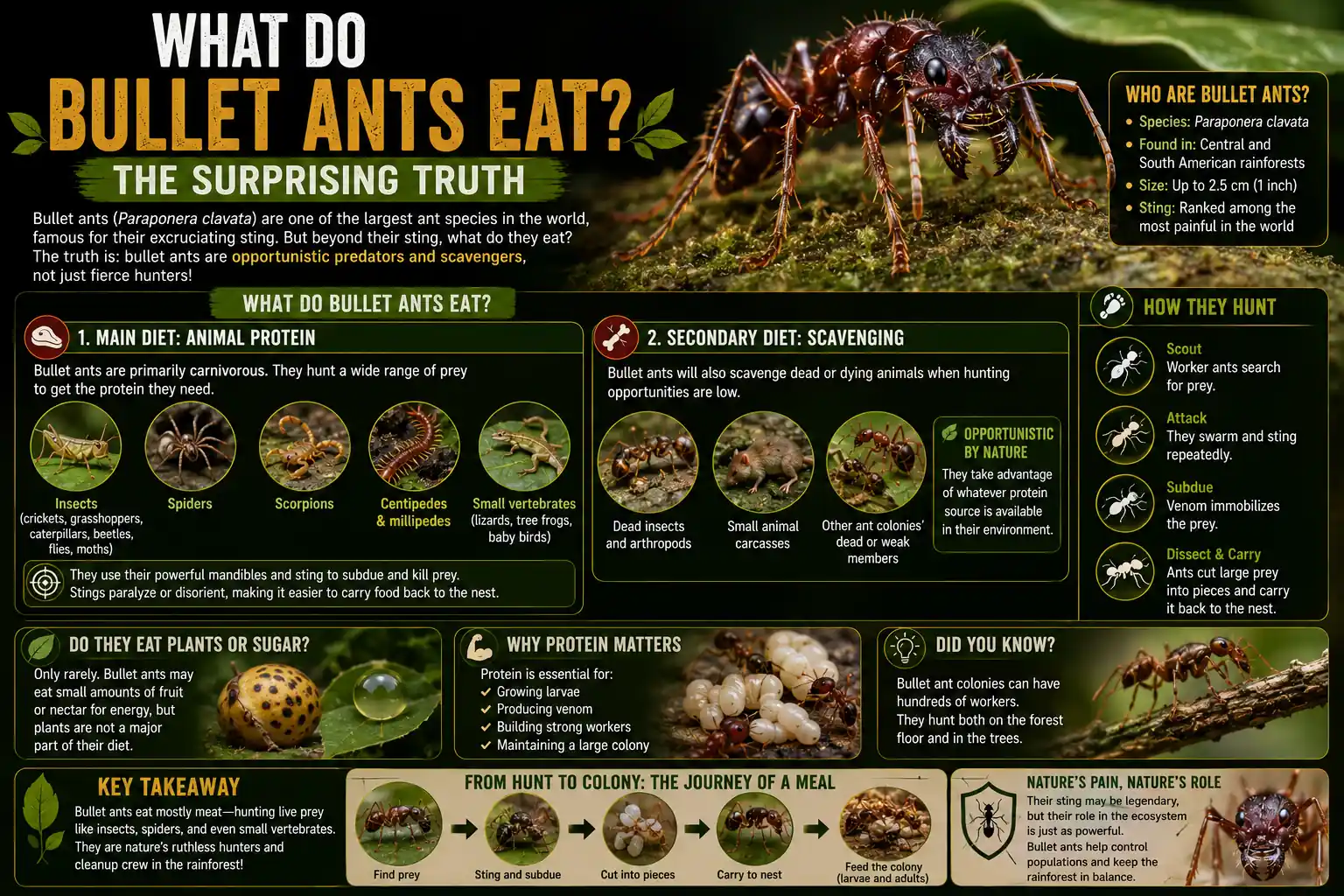
What Do Bullet Ants Eat? The Shocking Truth
Written from an ant keeper’s perspective, with peer-reviewed sources. Last updated: June 2026.
The bullet ant is famous for one terrifying thing: the most painful sting of any insect on Earth, said to feel like being shot. So you might expect its diet to be just as fearsome. It is not. The surprising answer to what do bullet ants eat is that the planet’s most feared ant is, for the most part, a nectar drinker. Bullet ant workers run mainly on sugary plant liquids, and they hunt insects mostly to feed their young. There is an even stranger twist hidden in the science: foraging is so costly for these giant ants that a colony barely breaks even on energy, which may be exactly why their colonies stay small.
Quick answer: Bullet ants (Paraponera clavata) are omnivores that feed at two very different tables. Adult workers feed mostly on nectar, especially extrafloral nectar, along with plant sap, fruit juice, and honeydew. They also hunt small invertebrates such as insects, spiders, and termites, and scavenge carrion, and this protein is collected mainly to feed the larvae. They forage at night, high in the rainforest canopy, carrying nectar home as a droplet held between their jaws.
If you are wondering about keeping bullet ants, read the serious safety note first. This is not a beginner’s ant.
The surprising answer: a feared predator that runs on sugar
There is a real mismatch between the bullet ant’s reputation and its diet, and it is the most interesting thing about what these ants eat.
Bullet ants are huge, heavily armed, and notoriously aggressive in defense of their nest. You would assume they are relentless hunters living on meat. In reality, their day-to-day fuel is sugar. Like most ants, they split their diet by who needs what: the adult workers burn carbohydrate for energy and get it from nectar and other plant liquids, while protein from hunted prey goes mostly to the growing larvae. The difference with bullet ants is just how much the balance tips toward sweet liquid, and how far they will travel to get it.
So the honest one-line answer is this: bullet ants eat nectar to fuel themselves and hunt insects to feed their brood, rounding out the menu with whatever carrion and sap they find.
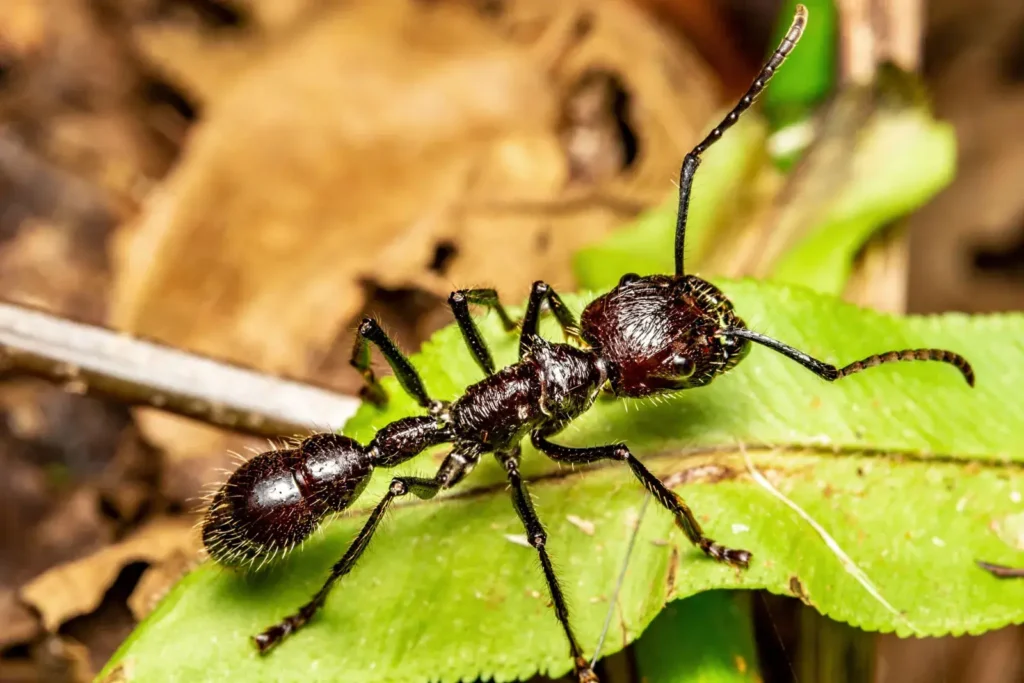
The two-part diet: nectar for the workers, prey for the brood
Breaking the diet into its two halves makes the whole picture clear.
Carbohydrates (for the adult workers):
- Extrafloral nectar, the sugary liquid produced by glands on stems and leaves rather than inside flowers, is a primary food
- Flower nectar, plant sap, and fruit juice
- Honeydew from sap-sucking insects
This sugary liquid is the energy that powers foraging, nest defense, and daily colony life. Workers carry it home in a way that is unusual and memorable: rather than only storing it internally, a bullet ant often clasps a glistening droplet of nectar between its mandibles and walks it back to the nest.
Protein (mostly for the larvae):
- Live invertebrate prey, including insects, spiders, and other arthropods, with termites recorded as an important staple
- Occasional small vertebrates when the opportunity arises
- Carrion, scavenged from dead animals
Bullet ants subdue prey with their powerful mandibles and their famous sting, then carry small items home whole and cut larger ones into pieces. Extrafloral nectar and water are also brought back specifically to feed the larvae, so even the brood’s diet is part sugar. The protein, though, is what builds the next generation.
How bullet ants forage
The way bullet ants gather food is as distinctive as what they gather.
They are mainly nocturnal, foraging from dusk to dawn, though they will venture out on dark, overcast days. They forage high in the trees, climbing at all heights through the canopy and only rarely hunting on the ground, which is unusual for such a large ground-nesting ant. Their nests sit in the soil at the base of a tree, and the trunk becomes their highway to the canopy pantry above.
Bullet ants are also long-distance foragers. Individual workers travel a long way from the nest on each trip, averaging well over a hundred meters, one of the longest foraging ranges of any ant. They lay pheromone trails to guide nestmates to good food, though tropical rain regularly washes these trails away and forces the search to start over. Interestingly, bullet ant workers do not come in different sizes the way many ants do. Instead, they split their work by behavior: some workers focus on hunting prey while others handle tasks closer to home, and individuals rarely swap jobs.
The science competitors miss: a colony living on the energetic edge
Here is the detail that turns the bullet ant’s diet from a list of foods into a genuinely surprising story, and it comes straight from the research.
Foraging is not free. It costs an animal energy to go out and collect food, and the question is whether the food is worth the trip. Scientists actually measured this for bullet ants, comparing the energetic benefit of a foraging trip against its cost (Fewell and colleagues, 1996). What they found is striking. For a bullet ant collecting nectar, the benefit-to-cost ratio was only about 3.9. For one hauling insect prey it was around 67. Compare that to a seed-harvesting ant, whose foraging can return a ratio of over a thousand, and the bullet ant looks almost inefficient.
Why so low? Three reasons stack up against the bullet ant: each nectar trip returns relatively little energy, the foraging distances are very long, and the ant’s huge body is expensive to move, costing far more energy per meter than a small ant. Put together, the researchers found that a bullet ant colony’s daily energy intake is roughly equal to what it spends, leaving little surplus, and they suggested this tight energy budget may directly limit how large the colony can grow and how much it can reproduce.
That is a remarkable reframing of the diet question. Bullet ants are not living in abundance. They are running a careful energy economy on a knife-edge, where a giant body and long canopy treks mean each meal barely pays for the effort of getting it. It helps explain why bullet ant colonies stay relatively small, often only several hundred to around a thousand workers, rather than the hundreds of thousands seen in some other ants. To save energy on the long haul home, foragers have even been observed relaying liquid food from ant to ant rather than each carrier making the full trip.
Feeding the young: trophic eggs
There is one more food source worth knowing, and it appears at the very start of a colony’s life.
When a newly mated bullet ant queen founds a colony, she raises her first batch of workers almost entirely alone, even leaving the nest to forage by herself early on. To help feed that first brood, she lays special unfertilized “trophic eggs,” eggs that are never meant to hatch and exist purely as food for the developing larvae. It is a way of converting the queen’s body reserves directly into nourishment for the young, and it helps the fragile new colony survive until the first workers can take over foraging.
A note on the sting
Because almost everyone who asks about bullet ants is really thinking about the sting, it is worth addressing directly, while being clear that this is about defense and hunting, not diet.
The bullet ant’s sting earns the top rating, a 4 plus, on entomologist Justin Schmidt’s sting pain index, the highest of any insect he tested. The pain comes from a venom containing a paralytic compound called poneratoxin, and it can last up to 24 hours, which is why one local name for the ant translates to “24-hour ant.” The ants use this venom to subdue prey and, above all, to defend the colony.
The sting is also central to a famous coming-of-age ritual of the Sateré-Mawé people of the Amazon, in which initiates wear gloves filled with bullet ants. None of this is about feeding, but it is the reason the bullet ant is so well known, and it is what makes the ant’s gentle, nectar-sipping daily diet such a surprise.
Should you keep bullet ants?
This section comes with a serious warning rather than a cheerful feeding guide.
Safety and legal note: Bullet ants are not a suitable pet for the vast majority of people. Their sting is medically significant and ranks as the most painful of any insect, capable of causing hours of severe pain along with possible swelling, trembling, and other reactions. They are large, tropical, non-native animals in most of the world, and importing or keeping them is restricted or illegal in many places. They should only ever be considered by highly experienced keepers who fully understand the risk and the law, with appropriate precautions. If you are not certain you fall into that category, the responsible choice is to admire bullet ants in documentaries and reputable collections, not to keep them.
For the small number of expert keepers who do maintain them legally, the feeding principle follows directly from the wild diet: a constant carbohydrate source such as sugar water or diluted honey water for the workers, feeder insects for protein when there is brood, and fresh water at all times, in a warm, humid setup. The challenge with bullet ants is never what to feed them. It is handling them safely.
For the wider picture on ant diets, start with our pillar guide, What Do Ants Eat?, or match a plan to the species you keep with our interactive ant food finder. The bullet ant’s costly, barely-break-even foraging makes a sharp contrast with the seed-harvesters in What Do Harvester Ants Eat?, and with another tropical hunter in What Do Weaver Ants Eat?
What do bullet ants eat? The short version
If you take one thing away, make it this: despite their fearsome reputation, bullet ants eat mostly nectar. Adult workers run on sugary plant liquids, chiefly extrafloral nectar, plus sap, fruit juice, and honeydew, while protein from hunted insects, spiders, termites, and scavenged carrion goes mainly to the larvae. They forage at night, high in the canopy, on some of the longest food trips of any ant, often carrying nectar home as a droplet in their jaws. And because their giant bodies make those trips so costly, a colony barely breaks even on energy, which is likely why bullet ant colonies stay small.
The takeaway is a satisfying contradiction: the insect with the most painful sting on Earth spends its life quietly sipping sugar in the treetops. Understand that, and you understand the bullet ant.
FAQ
What do bullet ants eat in the wild?
Bullet ants eat mainly nectar and other sugary plant liquids, which fuel the adult workers, plus hunted invertebrate prey such as insects, spiders, and termites, which mostly feeds the larvae. They also take honeydew, plant sap, fruit juice, and scavenged carrion.
Do bullet ants eat meat?
Yes, in the sense that they hunt and eat other invertebrates, and occasionally small vertebrates, and they scavenge carrion. But this protein is collected largely to feed the brood. The adult workers themselves run mostly on nectar and other sugary liquids.
Are bullet ants predators or herbivores?
They are omnivores. Bullet ants are capable, well-armed predators of insects and other small animals, but a large part of their actual diet, especially the workers’ own fuel, comes from plant nectar. So they are best described as predators that live largely on sugar.
How do bullet ants find and carry food?
They forage mostly at night, high in the rainforest canopy, traveling long distances and laying pheromone trails to guide nestmates. They often carry nectar back to the nest as a droplet clasped between their mandibles, and they cut larger prey into pieces to transport it.
Do bullet ants eat their own eggs?
Founding queens lay special unfertilized “trophic eggs” that are not meant to hatch but serve as food for the first larvae. This helps the queen feed her first brood before there are any workers to forage.
Why is the bullet ant’s diet surprising?
Because its reputation is built entirely on its extremely painful sting, most people assume it is a ferocious meat-eater. In reality, bullet ant workers feed mainly on nectar, and research shows their energy budget is so tight that foraging barely pays for itself.
What do you feed pet bullet ants?
Bullet ants are an expert-only species with a dangerous, medically significant sting, and keeping them is restricted in many places. For experienced keepers who maintain them legally, the diet mirrors the wild: a sugar or honey water source for the workers, feeder insects for protein when brood is present, and constant water.