What Do Trap-Jaw Ants Eat? The Fastest Jaws in Nature
Written from an ant keeper’s perspective, with peer-reviewed sources. Last updated: June 2026.
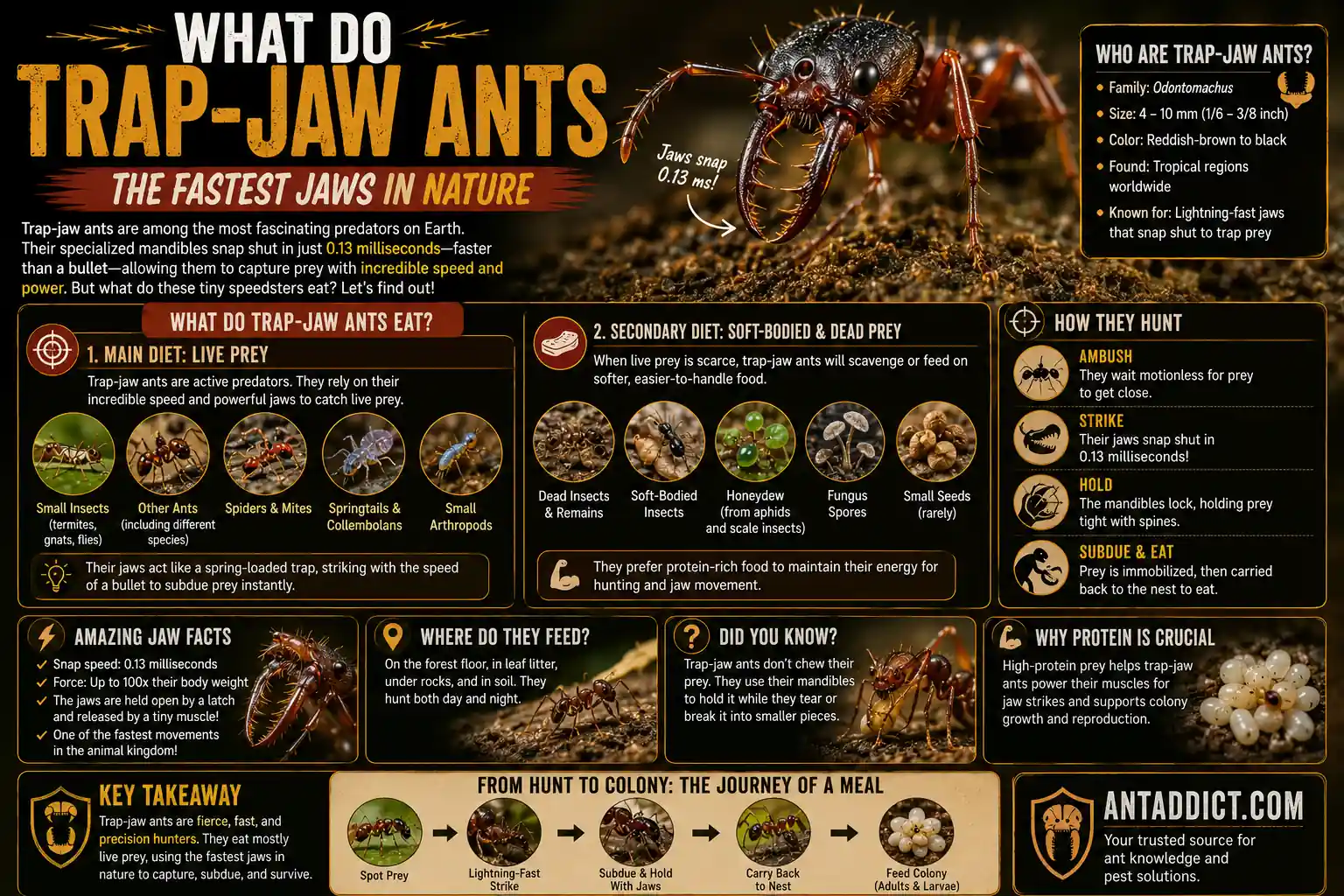
Trap-jaw ants are living mousetraps. They stalk through the leaf litter with their enormous mandibles cocked wide open, and when prey trips the trigger, those jaws snap shut faster than almost any movement in the animal kingdom. So what do trap-jaw ants eat? They are hunters, pure and simple: they catch and eat live prey, using the fastest bite ever measured to grab small, fast, sometimes dangerous animals that ordinary ants would miss. They round that out with a little nectar for energy, and because they are spectacular to watch, they are also a favorite in the ant-keeping hobby.
Quick answer: Trap-jaw ants (mainly the genera Odontomachus and Anochetus) are predatory carnivores. They hunt live prey, including small insects, other ants, and fast-moving arthropods like springtails, catching them with mandibles that snap shut at extraordinary speed. The protein from this prey mostly feeds the larvae, while the adult workers also take nectar and other sugary liquids for energy. In captivity, they thrive on feeder insects plus a sugar source, and they are a popular, rewarding species to keep.
If you keep trap-jaw ants, jump to what to feed pet trap-jaw ants, because there is one keeper challenge unique to this group.
The short answer: high-speed hunters
Most of the ants we cover run on something plant-based: sugar, honeydew, seeds, or fungus. Trap-jaw ants are predators. Their diet is built around catching and eating other animals, and almost everything interesting about them comes back to how they do it.
The name “trap-jaw” covers several groups of ants that independently evolved the same astonishing weapon, most famously the genera Odontomachus and Anochetus, along with others like Strumigenys and Myrmoteras. What they share is a pair of long, straight mandibles that lock open and then fire shut at blistering speed to seize prey. Like all ants, they split their diet by need: protein from hunted prey goes mainly to the growing larvae, while the adult workers also fuel themselves on nectar and sugary liquids. But the heart of the trap-jaw diet is the hunt.
What trap-jaw ants actually eat
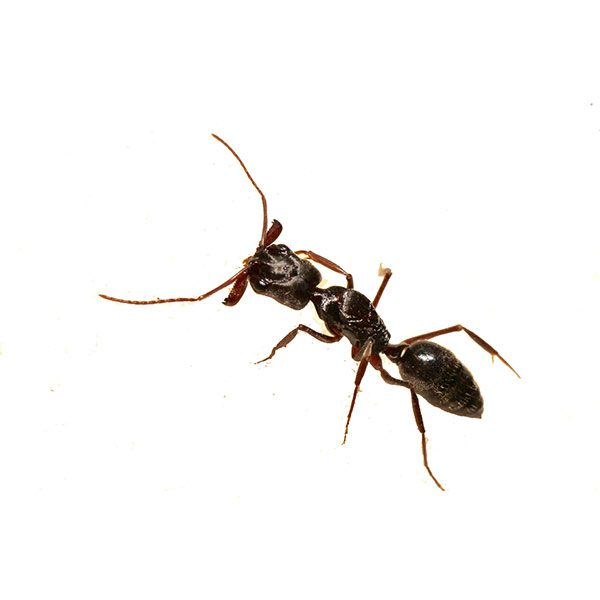
Trap-jaw ants are generalist predators of live, small prey. Out in the leaf litter and soil where they forage, their menu includes:
- Small insects and their larvae, the everyday staple
- Other ants and termites, which they readily attack and eat
- Springtails and other fast, elusive arthropods, the kind of jumpy, quick prey that most ants cannot catch
- Other small soil and litter invertebrates
Alongside this protein, adult workers also drink nectar, honeydew, and other sugary liquids for carbohydrate, and they will scavenge suitable dead prey as well. But trap-jaw ants are first and foremost active hunters, not scavengers or farmers.
That focus on fast prey is the key to the whole group. The trap-jaw mechanism is widely thought to have evolved in part to capture quick, hard-to-grab animals like springtails, which can rocket away in a fraction of a second. A normal pair of jaws would be far too slow. A trap-jaw is not.
The science competitors miss: the fastest jaws on Earth
Here is the standout, and it is the real answer to how trap-jaw ants eat anything at all. Their mandibles are among the fastest moving body parts known in the entire animal kingdom.
When biologists filmed the strike of the trap-jaw ant Odontomachus bauri with high-speed cameras, they recorded the mandibles closing at speeds between 35 and 64 meters per second, reaching well over 100 miles per hour, and completing the strike in an average of just 0.13 milliseconds (Patek and colleagues, 2006). That is faster than any other documented predatory strike in nature. The jaws generate forces more than 300 times the ant’s own body weight (Larabee and Suarez, 2015).
No muscle can contract that fast, so the trap-jaw does not rely on muscle power directly. Instead it works like a crossbow or a mousetrap: the ant opens its mandibles to nearly 180 degrees and locks them with an internal latch, while big muscles slowly load elastic energy into the head. Sensitive trigger hairs on the inside of the jaws detect when prey is in range. The instant they fire, the latch releases and all that stored energy unleashes at once, snapping the jaws shut on the prey before it can react. The trap-jaw ant has essentially turned its face into a spring-loaded trap.
The double-duty jaw: hunting and escaping
There is a remarkable bonus to this mechanism that no care sheet explains. The same strike that catches prey can also launch the ant through the air.
If a trap-jaw ant fires its mandibles straight down against the ground, or against an attacker, the force flings its whole body backward and upward in a sudden leap. Researchers call this the “bouncer defense” jump, and it serves as an escape mechanism. One study watching Odontomachus ants face down their natural predators, antlions, found that these mandible-powered jumps measurably increased the ants’ odds of surviving an attack (Larabee and Suarez, 2015). So the trap-jaw is multifunctional: a tool for predation and a tool for propulsion, both powered by the same extraordinary snap.
How trap-jaw ants hunt
Trap-jaw ants are mostly solitary hunters, which sets them apart from swarm-raiding army ants or trail-following sugar ants. A worker patrols alone, walking with its jaws held wide open and latched, scanning for prey.
When the long trigger hairs at the front of the open mandibles brush against a suitable target, the ant fires. The strike either kills or stuns the prey outright, or pins and flips it so the ant can follow up. Odontomachus and their relatives also have a functional sting, which they use to subdue struggling prey and to defend themselves, so the jaws and the sting work together to bring down catches that may be fast, armored, or capable of fighting back. Once subdued, the prey is carried back to the nest and fed to the colony, with the protein directed mainly to the larvae.
What to feed pet trap-jaw ants
Trap-jaw ants are one of the most rewarding ants to keep, precisely because you get to watch that famous strike up close. Feeding them is straightforward once you understand they are predators, but there is one quirk that catches new keepers out.
The diet follows directly from the wild: protein for the brood, carbohydrate for the workers, and water.
Protein (feeder insects)
This is the main event, and live or freshly killed feeders trigger natural hunting behavior:
- Fruit flies (flightless are easiest), small crickets, roach nymphs, and mealworms
- Offer prey appropriately sized for your species, and pre-killing or freezing feeders first is perfectly fine and often easier and safer
Carbohydrates
- Sugar water (about one part sugar to three parts water) or diluted honey water
- Commercial ant nectar or sugar jelly
Water and warmth
Provide a constant water source and keep the setup warm and humid, since most kept trap-jaw species are tropical or subtropical.
The keeper quirk: they can jump out
Here is the catch unique to this group: trap-jaw ants can use that bouncer jump to launch themselves clear out of an open feeding arena. An outworld that would contain most ants will not necessarily contain a startled Odontomachus. Use a well-sealed enclosure or a generous slippery barrier, and be calm and tidy during feeding so you do not trigger escape jumps.
A simple keeper feeding guide
| Colony stage | Protein | Carbohydrate | Notes |
|---|---|---|---|
| Founding queen | Tiny feeder (or none early) | Small drop of sugar water | Minimal disturbance, warmth, humidity |
| Small colony with first workers | A small feeder insect | Sugar water available | Protein every 2 to 3 days |
| Growing colony with larvae | Feeder insects | Sugar water available | Increase protein with brood |
| Large colony | Generous feeder insects | Sugar water available | Watch for jump-escapes at feeding |
A responsible note: A few trap-jaw species, such as Odontomachus haematodus, are non-native and established in places like the southern United States. Never release trap-jaw ants or let them escape outdoors, and check your local rules before acquiring a non-native species.
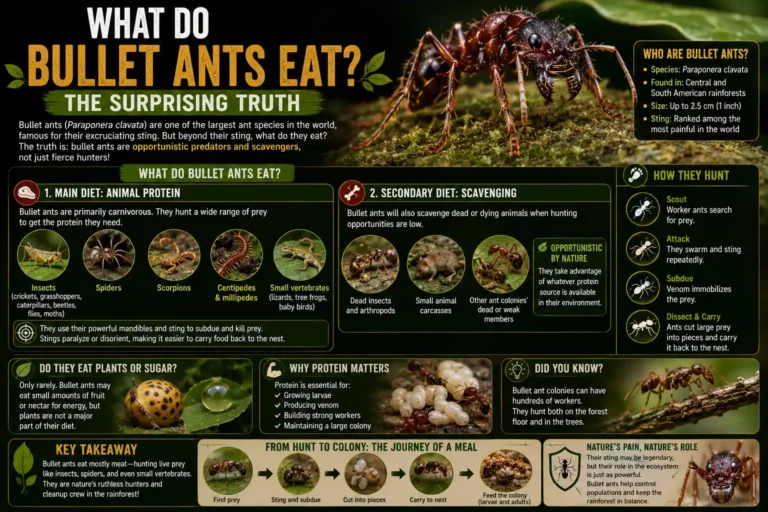
For matching feeding plans to other species you keep, try our interactive ant food finder. For the wider picture, start with our pillar guide, What Do Ants Eat?, or compare other predators in What Do Bullet Ants Eat? and What Do Fire Ants Eat?
What do trap-jaw ants eat? The short version
If you take one thing away, make it this: trap-jaw ants are high-speed predators. They hunt live prey, small insects, other ants, and quick, elusive animals like springtails, and they catch it with mandibles that snap shut at up to around 60 meters per second, the fastest predatory strike ever measured, generating forces hundreds of times their body weight. That same spring-loaded snap doubles as an escape jump. The hunted protein feeds the larvae, while the adult workers also sip nectar for energy. In captivity, that translates to feeder insects plus a sugar source, with one warning: these are the ants that can literally jump out of the bowl. Understand the strike, and you understand the trap-jaw ant.
FAQ
What do trap-jaw ants eat in the wild?
Trap-jaw ants are predators that hunt live prey, mainly small insects, other ants, and fast-moving arthropods like springtails, using their high-speed jaws. The protein mostly feeds the larvae, while adult workers also drink nectar and other sugary liquids for energy.
How fast are a trap-jaw ant’s jaws?
Extremely fast. In the species Odontomachus bauri, the mandibles were recorded closing at 35 to 64 meters per second, reaching well over 100 miles per hour, in about 0.13 milliseconds, the fastest predatory strike measured in the animal kingdom. The jaws produce forces over 300 times the ant’s body weight.
Do trap-jaw ants eat springtails?
Yes, and they are unusually good at it. Springtails are tiny, fast, jumping arthropods that most ants struggle to catch, but the trap-jaw’s lightning strike is well suited to grabbing them. The trap-jaw mechanism is thought to have evolved in part to capture exactly this kind of quick, elusive prey.
Can trap-jaw ants jump?
Yes. By firing their mandibles against the ground or an attacker, trap-jaw ants can launch themselves through the air in a “bouncer defense” jump. It is used to escape predators, and studies show it improves their survival. It also means they can jump out of an open feeding arena.
What do you feed pet trap-jaw ants?
Feeder insects such as fruit flies, small crickets, roach nymphs, or mealworms for protein (live or pre-killed), plus a sugar or honey water source for carbohydrate, and constant water in a warm, humid setup. Use a well-sealed enclosure, because they can jump out.
Do trap-jaw ants sting?
Yes. Odontomachus and related trap-jaw ants have a functional sting that they use to subdue prey and to defend the colony. It can be painful to a person, though it is not considered medically dangerous like a bullet ant’s sting.
Are trap-jaw ants good to keep?
They are a popular and rewarding species for intermediate keepers, prized for their dramatic hunting strikes. Feeding is simple, but they require a secure, escape-proof enclosure because of their jumping ability, and a couple of species are non-native and should never be released.