What Do Argentine Ants Eat? The Sugar-Fueled Invader
Written from an ant keeper’s perspective, with peer-reviewed sources. Last updated: June 2026.
Argentine ants are one of the most successful invasive insects on Earth, and the question people ask first, whether they have found a trail across the kitchen counter or are keeping a colony, is the same: what do Argentine ants eat? The short version is that they are sugar specialists. Adult workers run almost entirely on liquid carbohydrate, above all honeydew, while protein goes to the brood and the colony’s many queens. There is a fascinating twist that no pest guide mentions: in the places they invade, Argentine ants actually feed lower on the food chain than the native ants they wipe out, because they conquer by drinking sugar rather than by hunting.
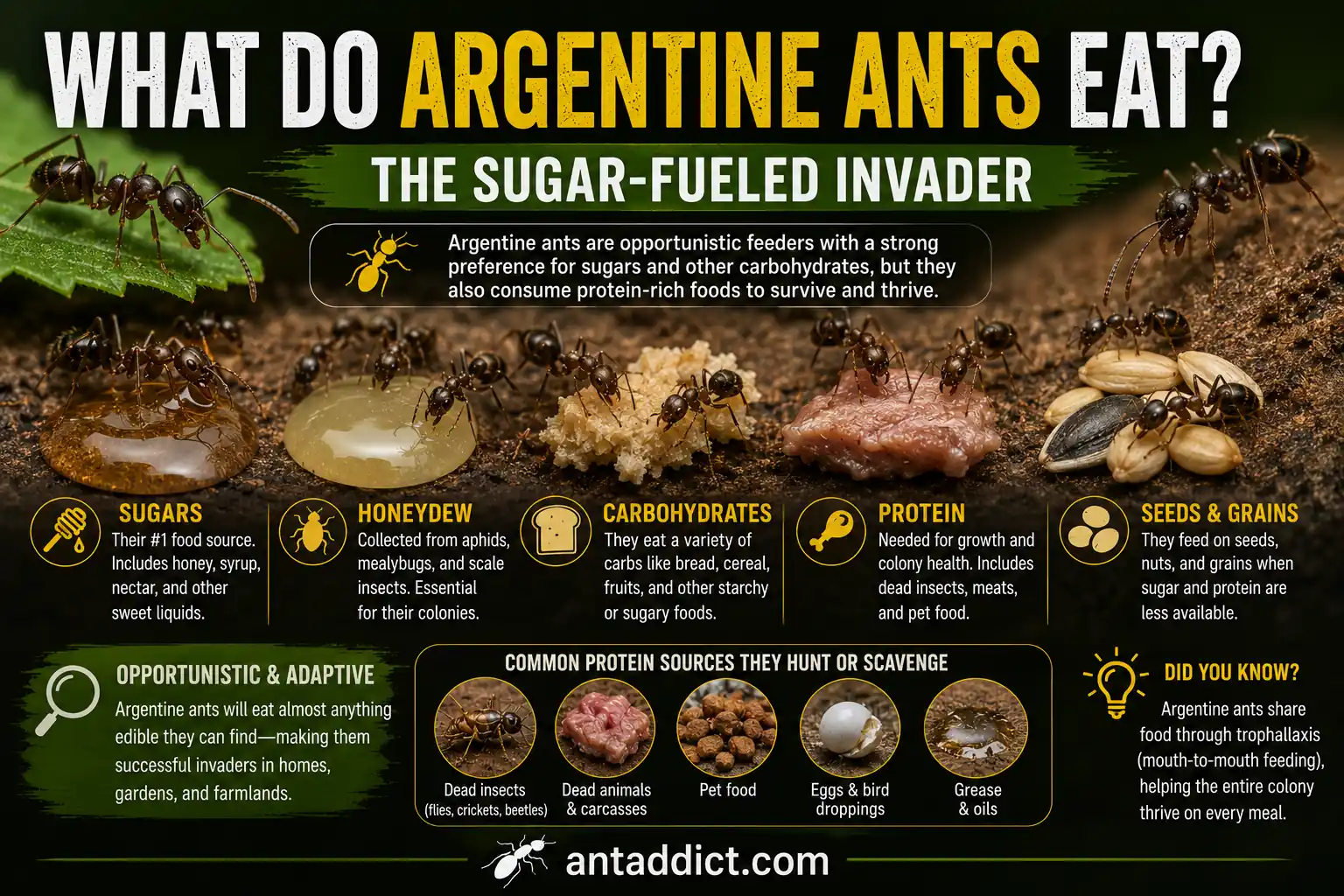
Quick answer: Argentine ants (Linepithema humile) are omnivores with a strong sweet tooth, which is why they are sometimes called “sugar ants.” Adult workers feed on liquid carbohydrates, mainly honeydew harvested from aphids, scale insects, and mealybugs, plus nectar, fruit, and any sugary human food. Protein, from insects, carrion, meats, dairy, and eggs, is collected mostly to feed the larvae and the colony’s numerous queens. Their diet shifts with the seasons, leaning toward protein when brood is developing and toward sugar the rest of the time.
The two-part diet: sugar for the workers, protein for the brood
To answer what do Argentine ants eat in any real depth, you have to look at who in the colony is being fed. Like all ants, an Argentine ant colony divides its diet along caste lines, but this species leans on sugar harder than most. The workers that do the foraging are sterile adults that burn carbohydrate for energy, while the only members that need large amounts of protein are the growing larvae and the egg-laying queens, which never forage.
So the colony collects two broad categories of food:
- Carbohydrates (honeydew, nectar, fruit, sugary spills) to fuel the adult workers
- Protein (insects, carrion, meats, eggs, dairy) for the larvae and the queens
What makes Argentine ants distinctive is how far the balance tips toward sugar. They are so carbohydrate-driven that researchers studying their foraging found the ants would consistently choose sugar over protein, reserving protein collection for the specific windows when brood needs it. This sugar focus is not a quirk. As we will see, it is the fuel behind one of the most aggressive invasions in the insect world.
What adult workers eat: honeydew and the insects they farm
The single most important food in the Argentine ant diet is honeydew, the sugary liquid excreted by sap-feeding insects. Argentine ants tend aphids, scale insects, and mealybugs, guarding them from predators and parasites and harvesting the honeydew they produce. This partnership, called trophobiosis, gives the colony a steady, renewable carbohydrate supply, and Argentine ants defend their honeydew herds aggressively.
During the warm season, workers climb high into trees and shrubs to collect honeydew, and they will follow these sugar sources for remarkable distances. Foraging trails have been measured at over 350 feet in field studies. Beyond honeydew, adult workers also drink:
- Plant nectar, from flowers and from extrafloral nectaries on stems and leaves
- Juice from ripe and rotting fruit
- Human sugars: soda, syrup, juice, candy, and any sweet spill, which is exactly why they invade kitchens
The “sugar ant” nickname is well earned. Indoors, an Argentine ant trail almost always leads to something sweet.
What the brood and queens eat: protein, and lots of mouths to feed
Protein is the colony’s building material, and Argentine ant colonies have an unusual amount of building to do. A mature colony can hold hundreds of queens and well over a million workers, and with so many queens laying eggs at once, there is no single reproductive bottleneck. All those laying queens and developing larvae create a steady protein demand, met by:
- Live insects and other small arthropods, hunted by foraging workers
- Carrion, including dead insects and animal remains
- Protein-rich human foods: meats, eggs, dairy, and animal fats, which is why a contaminated pantry item is best discarded
The protein is funneled to the brood and the queens rather than consumed by the foragers themselves. And unlike most ants, Argentine queens are not passive egg machines sealed away from the work. They help groom and feed the developing young, so protein flowing into the nest reaches both the larvae and the reproductive core of the colony.
The science competitors miss: an invader that eats like a herbivore
Here is where the Argentine ant diet gets genuinely surprising, and where every other guide stops at “they like sweets.”
You would assume that an aggressive, dominant invader sits high on the food chain as a fierce predator. The data say the opposite. Using stable nitrogen isotopes, which record how high in a food web an animal feeds, Tillberg and colleagues (2007) compared Argentine ants in their native Argentina with invasive populations in California. In the places they invade, Argentine ants feed at a markedly lower trophic position than they do at home, behaving more like plant-feeding herbivores than predators. Tracking a single California invasion front over eight years, the researchers watched the ants’ trophic position drop steadily as they displaced the native ants around them.
The explanation is honeydew. In the invaded range, Argentine ants lean so heavily on sugar harvested from sap-feeding insects that their diet is effectively plant-based, routed through the aphids and scale insects in between. They are, in a real sense, “secondary herbivores.” They are not conquering new continents by out-hunting the locals. They are doing it by drinking sugar.
Sugar is the fuel of the invasion
That sugar habit is not just a curiosity, it is the engine of the Argentine ant’s ecological dominance, and the research on this point is striking.
Grover and colleagues (2007) ran controlled experiments varying how much carbohydrate Argentine ant colonies received. They found that carbohydrate scarcity directly compromised the ants’ aggression and activity. In other words, the more sugar a colony has access to, the more aggressive and active its workers become, which the researchers linked to the competitive dominance that lets Argentine ants displace native species. A later study by Wittman and colleagues (2018) reinforced the pattern at the landscape scale: carbohydrate supply drives colony size, aggression, and the ecological impact of the invasion.
This is the missing link that ties the whole story together. The Argentine ant’s relationship with honeydew-producing insects is not a side hustle. The sugar those insects provide is what powers the aggression and sheer numbers that let Argentine ants overrun native communities. Cut the sugar, and the invasion stalls. Field experiments have shown that carbohydrate availability can determine whether Argentine ants successfully push into natural habitat at all.
How Argentine ants find and share food
Argentine ants are textbook trailing ants. Foraging workers lay chemical pheromone trails that nestmates follow with unusual fidelity, producing the dense, ribbon-like columns people see streaming along baseboards and up tree trunks. Because the colonies are so large and interconnected, these trails can run hundreds of feet and cross multiple properties.
Once food is back at the nest, it moves by trophallaxis, the mouth-to-mouth sharing of liquid food from one ant’s social stomach (crop) to another. A single forager’s honeydew haul can feed many nestmates, including the queens and larvae. This colony-wide food sharing is precisely why sugar-based baits work against them: a worker that takes the bait shares it, and the toxicant, throughout the colony.
The scale of this sharing is hard to overstate. Argentine ants are famously “unicolonial,” meaning separate nests cooperate instead of fighting. In southern Europe, this has produced a single enormous supercolony whose nests stretch for thousands of kilometers along the Mediterranean and Atlantic coasts, with workers from distant nests treating each other as family (Giraud, Pedersen, and Keller, 2002). A food source found by one nest feeds a cooperative network of staggering size.
Seasonal diet shifts: the menu follows the brood
The Argentine ant diet is not static through the year. It tracks the colony’s reproductive cycle, and a careful field study captured exactly how.
Abril and colleagues (2007), studying Argentine ants on Mediterranean cork oaks, found that the workers retuned their shopping list to the brood calendar. When the queens were laying and larvae were growing, in spring and autumn, the colony went after protein. When the next generation of males and workers was emerging instead, it shifted back to carbohydrate, mostly honeydew. Carbohydrate flowed in across the whole warm season, because adults always need fuel, but protein collection spiked precisely when there were hungry larvae and laying queens to provision. In winter, cold temperatures cut foraging sharply and little food entered the nest.
This is the same caste-driven pattern seen across ants: carbohydrate for the standing workforce, protein pulses timed to brood production. The classic foraging work on this species (Markin, 1970) put it plainly: the workers burn carbohydrate for their own energy and channel protein into rearing the young.
Why their diet matters: ecological fallout
The Argentine ant’s diet is the reason it is one of the world’s most damaging invasive species, and that impact runs far beyond a few ants in the kitchen.
By tending and protecting aphids, scale insects, and mealybugs for honeydew, Argentine ants boost populations of these plant pests, which can increase damage to crops and ornamental plants. By aggressively displacing native ants, they unravel ecological jobs those ants performed. In many regions, native ants disperse and plant seeds, and Argentine ants do not fill that role, so plant communities that depend on ant seed dispersal suffer. And because specialist predators such as the coast horned lizard rely on native ants for food, wiping out those ants starves the predators that ate them. The sugar-fueled aggression that makes Argentine ants such effective competitors is exactly what makes them so disruptive.
What do pet Argentine ants eat?
A clear note first, because this is an invasive species.
Responsible-keeping note: The Argentine ant (Linepithema humile) is a damaging invasive species across much of the world. It is not federally quarantined in the United States the way the red imported fire ant is, and it is a popular, hardy beginner species in the ant-keeping hobby where keeping it is legal. But it is a serious pest, and in places like Australia and New Zealand it is regulated and actively targeted for eradication. Never release Argentine ants or their colonies into the wild, never transport them between regions, and check your local laws before keeping them. If a colony outgrows you, freeze it down humanely rather than releasing it.
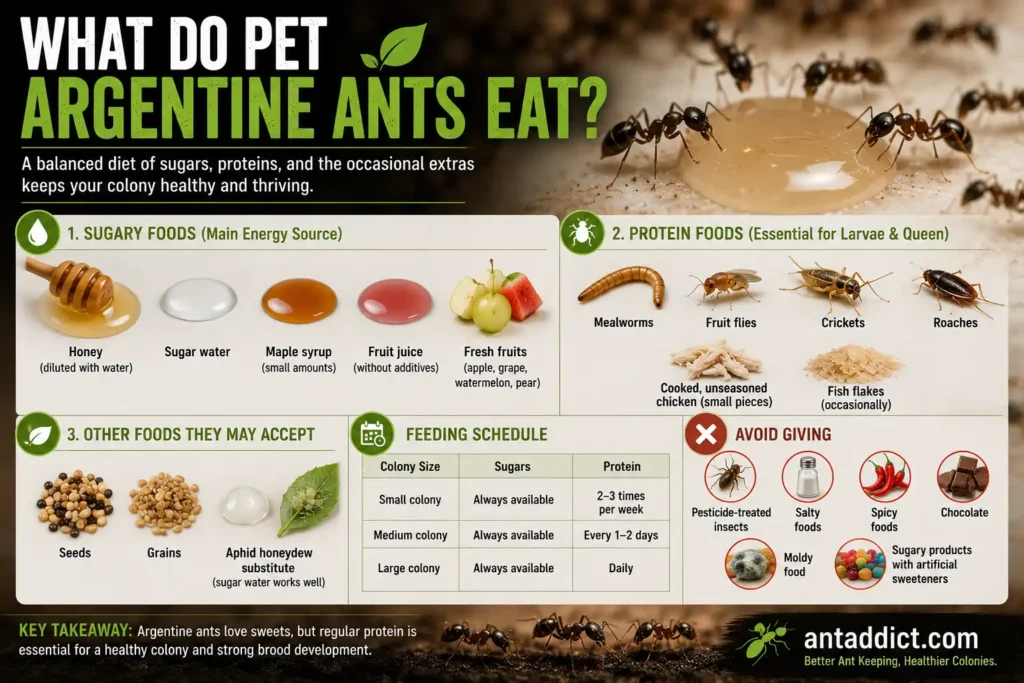
With that understood, Argentine ants are genuinely easy to feed, because everything above tells you what they want. In fact, when researchers keep them in the lab, they use exactly this approach: water, a sugar solution, and a protein source such as fruit flies, mealworm larvae, boiled egg, or tuna.
Carbohydrates (offer constantly)
This is the daily fuel, and Argentine ants will take it endlessly:
- Sugar water (roughly one part sugar to three parts water)
- Diluted honey water (never thick honey, which traps ants)
- Commercial ant nectar or sugar jelly
Protein (offer when brood is present)
Protein drives brood and queen production, so offer it regularly when larvae are present:
- Feeder insects: fruit flies (Drosophila), small roach nymphs, and mealworms, offered freshly killed or pre-frozen
- Other protein: a small piece of boiled egg or plain cooked meat, removed before it spoils
- Protein-fortified ant jelly as a convenient backup
Water
Provide a constant, separate water source (a water-filled test tube plugged with cotton works well), independent of the sugar source. Argentine ants are strongly drawn to moisture.
A simple keeper feeding guide
| Colony stage | Carbohydrate | Protein | Frequency |
|---|---|---|---|
| Founding queens | Sugar water available | Small protein item | Light feeding; do not overfeed |
| Small colony with first workers | Sugar water always available | Small feeder insect | Protein 1 to 2 times per week |
| Growing colony with larvae | Sugar water always available | Feeder insects | Protein 2 to 3 times per week |
| Large, established colony | Sugar water always available | Vary protein with brood | Protein as larvae demand |
For matching a feeding plan to other species you keep, try our interactive ant food finder. For the wider picture, start with our pillar guide, What Do Ants Eat?, or compare with other feeders in What Do Carpenter Ants Eat? and What Do Fire Ants Eat?
What do Argentine ants eat? The short version
If you take one thing away, make it this: what Argentine ants eat is overwhelmingly sugar. Adult workers run on liquid carbohydrate, above all the honeydew they farm from aphids, scale insects, and mealybugs, while protein from insects, carrion, and rich human foods goes to the larvae and the colony’s many queens, peaking seasonally when brood is developing. The deeper story is that this sugar dependence is the engine of the invasion: carbohydrate fuels the aggression and the enormous colonies that let Argentine ants displace native species, even though it means they feed lower on the food chain than the ants they replace.
For a keeper, that biology makes them one of the easiest species to feed: a constant sugar source, protein when there is brood, water always, and a firm commitment never to release an invasive ant. Understand the sweet tooth, and you understand the animal.
FAQ
What do Argentine ants eat in the house?
Indoors, Argentine ants are after sweets and moisture above all. They feed on sugar, syrup, honey, juice, soda, and any sweet spill, and they will also take greasy or protein-rich foods like meat and pet food. A trail in the kitchen almost always leads to something sweet or to water.
Why are Argentine ants called sugar ants?
Because they strongly prefer sweet, carbohydrate-rich foods. Adult workers run on liquid sugar, mainly honeydew from aphids and scale insects, so they are powerfully drawn to anything sweet. “Sugar ant” is a common nickname for several species, including the Argentine ant.
Do Argentine ants eat wood?
No. Argentine ants do not eat or tunnel through wood for food. They nest in soil, mulch, leaf litter, and other moist sheltered spots, and forage for sugar and protein. They are a contamination nuisance, not a wood-damaging pest.
Do Argentine ants eat other insects?
Yes. They hunt live insects and other small arthropods and scavenge dead ones, mostly to feed their larvae and queens. They are also aggressive toward other ants and will kill and displace competing ant species, which is a major part of their ecological impact.
What is an Argentine ant’s favorite food?
Honeydew, the sugary liquid produced by aphids, scale insects, and mealybugs. Argentine ants tend and protect these insects to harvest it, and this carbohydrate source is so important that it fuels the aggression and colony growth behind their invasions.
How do Argentine ants share food?
Through trophallaxis, mouth-to-mouth sharing of liquid food from one ant’s crop to another. A single forager can feed many nestmates, including queens and larvae. This food sharing is why sugar-based baits are effective: the bait spreads through the colony before it takes effect.
Can you keep Argentine ants as pets?
In some regions yes, and they are a hardy, easy beginner species, but they are a damaging invasive ant. Keeping them may be restricted or illegal where you live, and in countries like Australia and New Zealand they are targeted for eradication. Check local laws, and never release or transport them.
What do Argentine ants drink?
Water and water-soluble sugars, which they store in the crop and share with the colony. They are strongly attracted to moisture, which is why they often appear at sinks, pipes, and other damp spots indoors.