What Do Acrobat Ants Eat? The Sweet-Toothed Treetop Acrobats
Written from an ant keeper’s perspective, with peer-reviewed sources. Last updated: June 2026.
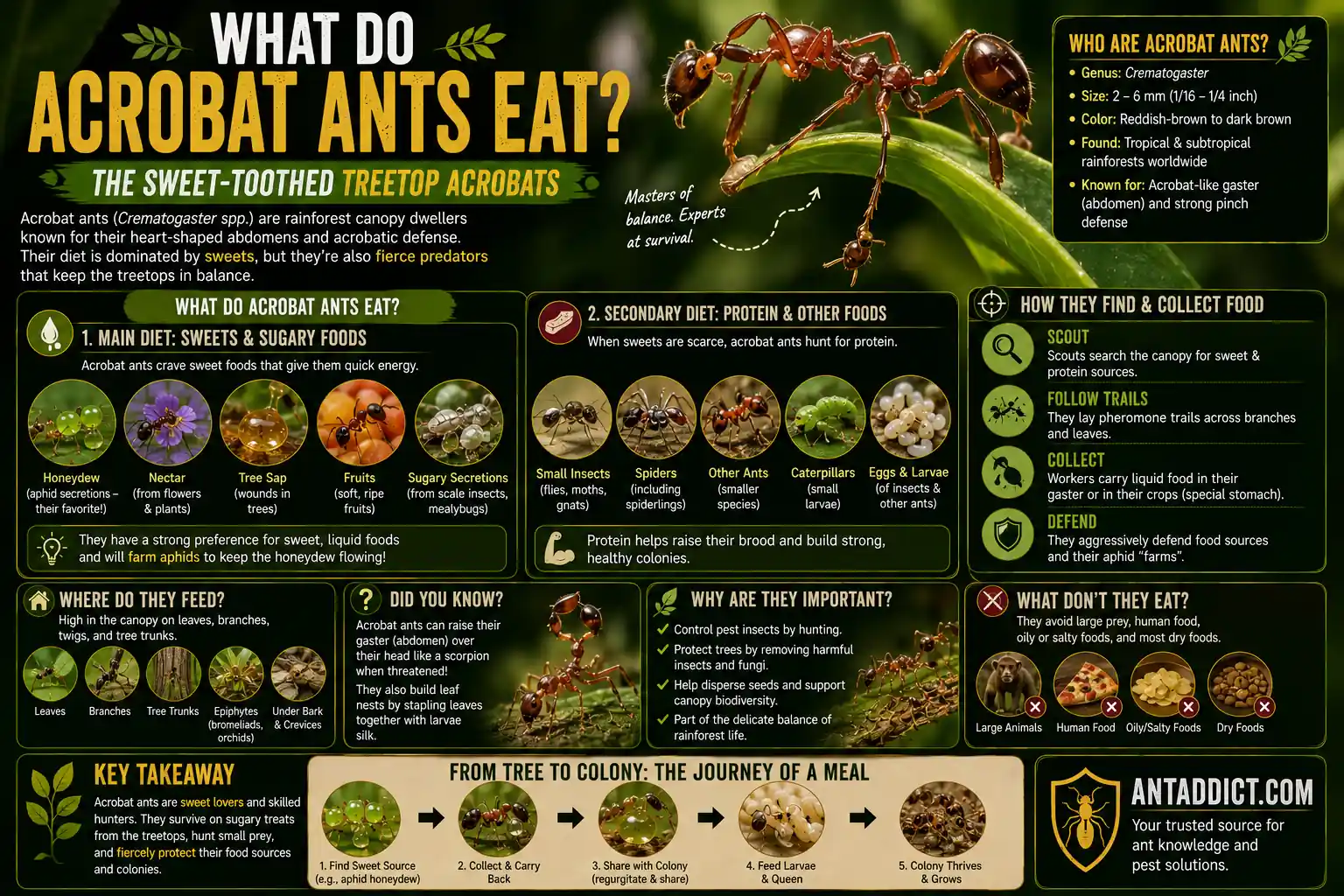
Acrobat ants are named for their party trick: when alarmed, they flip their heart-shaped abdomen up over their heads like a tiny gymnast. So what do acrobat ants eat? Mostly sugar. These small, arboreal ants are honeydew-loving omnivores, harvesting the sweet liquid from aphids and scale insects they farm in the trees, then rounding out the diet by hunting live insects, scavenging dead ones, and raiding sweets and grease indoors. But the truly remarkable part is not just what they eat, it is how they find it: acrobat ants lay their scent trails to food with their hind legs, not their abdomen, a quirk found in almost no other ant.
Quick answer: Acrobat ants (genus Crematogaster) are omnivores whose diet is dominated by honeydew, the sugary liquid they harvest from aphids and scale insects they tend and protect. They also drink nectar, eat the fatty part of seeds, hunt live insects (stunning prey with venom), scavenge dead insects, and readily eat sweet and greasy human foods indoors. The protein feeds the brood, while the sugar fuels the workers. They are a genuine, keepable hobby ant, though a few species can be household pests.
If you keep acrobat ants, skip to what to feed pet acrobat ants.
The short answer: honeydew lovers that also hunt
Acrobat ants belong to the genus Crematogaster, a worldwide group of mostly tree-dwelling ants instantly recognizable by the heart-shaped abdomen that earns them nicknames like “cocktail ant” and “Saint Valentine ant” as well as “acrobat ant.” Their diet is the familiar two-part ant menu, but with a strong sweet tilt.
Like all ants, they need carbohydrate to fuel the workers and protein to raise the brood. For acrobat ants, the carbohydrate comes mainly from honeydew, which makes up a large portion of the diet, while the protein comes from hunting and scavenging other insects. So the short answer is that acrobat ants run mostly on sugar harvested from aphids, backed up by a hunter’s appetite for insect prey.

What acrobat ants actually eat
Acrobat ants are true omnivores with a broad, opportunistic menu. In the wild and around buildings, their diet includes:
- Honeydew: the biggest single part of the diet, harvested from aphids and scale insects they farm
- Nectar: especially from extrafloral nectaries, the nectar glands plants grow outside their flowers
- Seeds: they take the fatty attachment on certain seeds, called an elaiosome, and leave the seed itself
- Live insects: active predators, they hunt and stun prey, including other insects and even wasps
- Dead insects: they readily scavenge carrion and dead arthropods
- Human foods: indoors, they go for sweets and greasy or protein-rich foods
That breadth is why acrobat ants thrive in so many places, from forest canopies to kitchen walls. But the heart of the diet is the sugar, and the way they get it is a story of farming.
The honeydew farmers
The single largest part of the acrobat ant diet is honeydew, the sugary waste that sap-sucking insects excrete as they feed on plants. Acrobat ants are dedicated farmers of these insects.
They tend herds of aphids, including species like the apple aphid, along with soft scale insects such as calico and magnolia scale. The ants protect their herds from predators and parasites, and in return they harvest the steady flow of honeydew the insects produce. It is a classic mutual partnership, and it is the carbohydrate engine of the colony.
This farming has a side effect that matters to gardeners and growers. Because acrobat ants shield aphids and scale insects from the predators that would otherwise control them, they can indirectly increase damage to plants and crops. Studies of ant-exclusion as a pest-control method have shown that keeping ants like these away from plants helps natural enemies knock the scale insects back. In other words, the acrobat ant’s sweet tooth can make it an accidental ally of plant pests.
The science competitors miss: they lay food trails with their hind legs
Here is the standout, and it is genuinely one of the strangest things about how any ant finds food. Acrobat ants lay their scent trails to food from their hind legs, not from the tip of the abdomen like nearly every other ant.
Almost all trail-following ants mark the path to a food source by dragging the tip of the gaster along the ground, depositing pheromone as they go. Acrobat ants cannot do this. Their heart-shaped gaster is carried tipped upward and simply cannot reach the surface they are walking on. Evolution’s workaround is remarkable: the trail-pheromone gland sits in their hind legs instead, in the tibia, and the ant lays its scent through its feet, walking with a distinctive, slightly awkward gait as it marks the route (Animal Diversity Web).
This is not folklore, it is well documented. Researchers who identified the trail pheromone of the Mediterranean acrobat ant Crematogaster scutellaris confirmed that the active compound comes specifically from the hind-leg glands, not the abdomen (Scientific Reports, 2024). So when you watch a line of acrobat ants running to a food source, you are watching ants follow a scent road that was painted by feet, not by tails. It is a direct, physical consequence of that famous heart-shaped rear end.
The acrobatic gaster: defense and a venom smear
The heart-shaped abdomen does more than dictate how they lay trails. It is also the source of the behavior that gives acrobat ants their name, and it ties into how they handle prey and threats.
When an acrobat ant is alarmed, the flexible joint between its waist and abdomen lets it swing the gaster up and over its head, waving it in the air. This is not just for show. Raising the abdomen points the tip of a specialized, spatula-shaped sting forward, which the ant uses to smear defensive venom onto a threat rather than injecting it like a bee or a typical stinging ant. Acrobat ants also use venom to stun the live insects they hunt, and they release alarm pheromones to rally nestmates to a fight. So the acrobatic display, the venom, and the hunting are all parts of the same toolkit.

Do acrobat ants eat wood?
No. This is a common worry because acrobat ants are often found in wood, and people lump them in with carpenter ants and termites. But acrobat ants do not eat wood. Their food is honeydew and insects, not cellulose.
What they do is nest in wood that is already soft, damp, or damaged, often in galleries left behind by carpenter ants or termites, and they may enlarge those cavities a little, which can add to existing damage. They also nest in foam insulation and tight gaps around a building. So acrobat ants can be a sign of a moisture or wood problem, but they are not the cause of the wood damage and they are not eating the timber.
What draws acrobat ants indoors
When acrobat ants come inside, it is the same diet that brings them. They forage for sweets above all, along with greasy and protein-rich foods, following their hind-leg scent trails in from a nest in a wall void, behind siding, in foam insulation, or around door and window frames. They tend to trail along structural lines and wires. They are usually a nuisance rather than a danger, though they can deliver a noticeably painful bite if handled, and they give off a sharp odor when disturbed.
What to feed pet acrobat ants
Acrobat ants are a rewarding species to keep, especially the European acrobat ant Crematogaster scutellaris, which is popular for its hardiness, its arboreal habits, and that endlessly watchable gaster-flipping display. Feeding them is simple once you know they are sugar-loving omnivores.
Carbohydrates (the staple)
- Sugar water or diluted honey water as the everyday energy source, standing in for wild honeydew
- Commercial ant nectar or sugar jelly
Protein (for the brood)
- Feeder insects such as flightless fruit flies, small crickets, and roach nymphs, offered live or pre-killed
- Increase protein when there is brood to raise
Water and setup
Provide constant water, keep the setup warm, and give them height and things to climb, since they are naturally arboreal and will use vertical space.
A simple keeper feeding guide
| Colony stage | Carbohydrate | Protein | Notes |
|---|---|---|---|
| Founding queen | Tiny drop of sugar water | Usually none early | Warmth, humidity, minimal disturbance |
| First workers | Sugar water available | A small feeder insect | Protein every few days |
| Growing colony | Sugar water available | Feeder insects | Increase protein with brood |
| Established colony | Sugar water available | Regular feeder insects | Give vertical climbing space |
A responsible note: Some acrobat ant species are household pests, and a few are tramp species spread by humans. Keep only species that are legal and appropriate where you live, never release ants or let them escape, and never introduce a non-native species to your local environment.
For matching feeding plans to other species you keep, try our interactive ant food finder. For the wider picture, start with our pillar guide, What Do Ants Eat?, or compare other honeydew lovers in What Do Ghost Ants Eat? and the ant people most often confuse with wood-eaters in What Do Carpenter Ants Eat?
What do acrobat ants eat? The short version
If you take one thing away, make it this: acrobat ants are honeydew-loving omnivores. The biggest part of their diet is the sugary honeydew they harvest by farming aphids and scale insects, and they top it up with nectar, the fatty part of seeds, hunted and scavenged insects, and sweets and grease indoors. The protein feeds the brood, while the sugar fuels the workers.
Two things make them special: they flip their heart-shaped abdomen over their heads when alarmed, smearing venom from a spatula-shaped sting, and they lay their food trails from glands in their hind legs because that same heart-shaped abdomen cannot reach the surface they walk on. Understand the sweet tooth and the acrobatics, and you understand the acrobat ant.
FAQ
What do acrobat ants eat in the house?
Indoors, acrobat ants go for sweets first, along with greasy and protein-rich foods. They follow scent trails from a nest in a wall void, foam insulation, or around door and window frames to whatever food they can reach in the kitchen. They are a nuisance pest rather than a danger.
Do acrobat ants eat honeydew?
Yes, it is the largest part of their diet. Acrobat ants farm aphids and scale insects, protecting them from predators in exchange for the sugary honeydew they produce. This honeydew is the main energy source for the worker ants.
Do acrobat ants eat wood?
No. Despite often living in wood, acrobat ants do not eat it. They nest in wood that is already soft, damp, or damaged, sometimes enlarging existing cavities, but their food is honeydew and insects. They are a sign of a moisture or wood problem, not the cause of it.
Do acrobat ants bite or sting?
Both, in their own way. Acrobat ants can give a noticeably painful bite, and rather than injecting venom with a typical sting, they raise their abdomen and smear defensive venom from a spatula-shaped sting. They also use venom to stun the insects they hunt.
Why are they called acrobat ants?
Because of a distinctive defensive display: when alarmed, they swing their heart-shaped abdomen up over their head and wave it in the air, looking like a tiny acrobat. The same trait gives them other names, including cocktail ant and Saint Valentine ant.
What do you feed pet acrobat ants?
A sugar or honey water source as the staple, standing in for wild honeydew, plus feeder insects such as fruit flies, small crickets, or roach nymphs for protein, and constant water. Keep them warm and give them height to climb, since they are naturally arboreal.