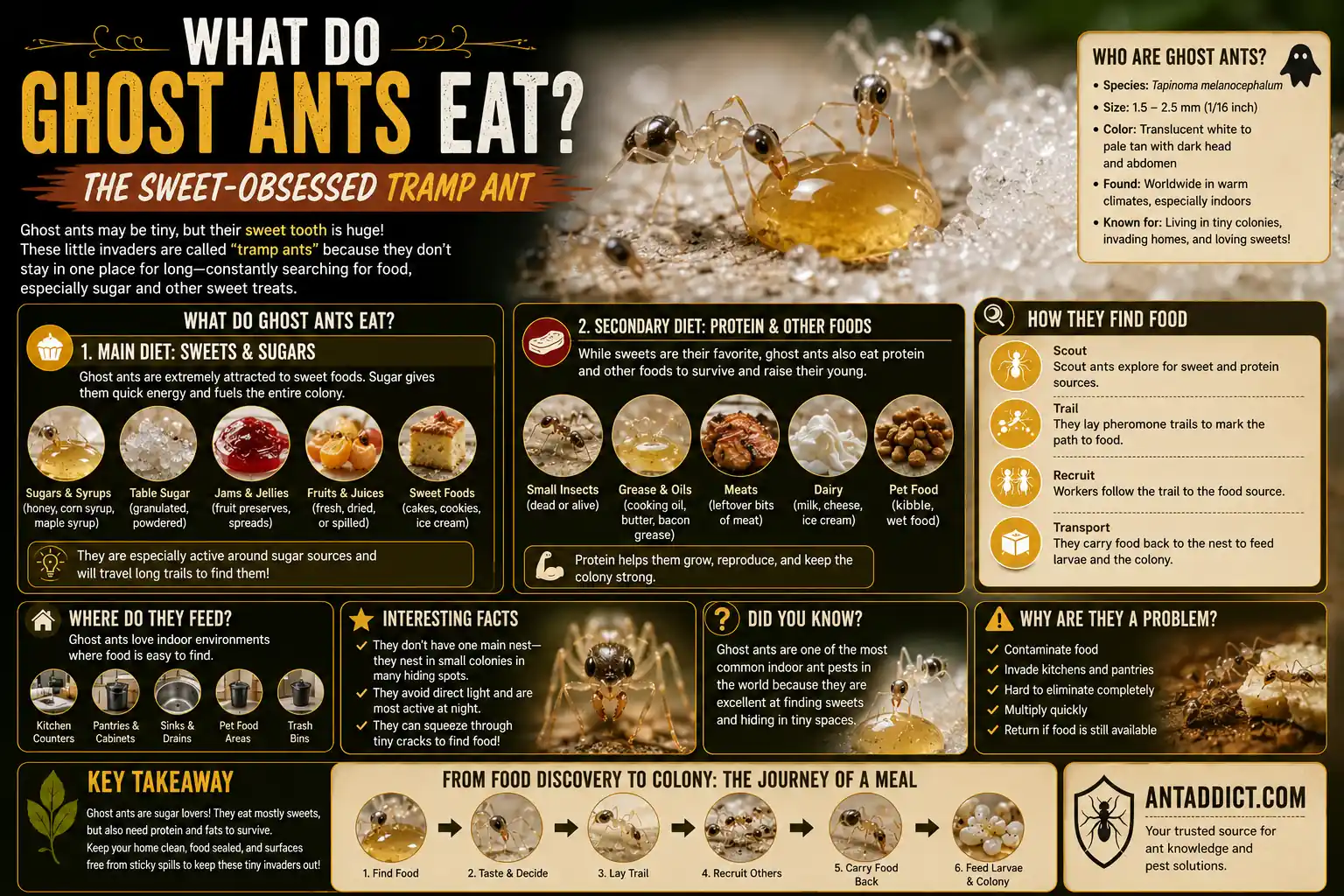
What Do Ghost Ants Eat? The Sweet-Obsessed Tramp Ant
Written from an ant keeper’s perspective, with peer-reviewed sources. Last updated: June 2026.
Ghost ants are so tiny and pale that you often notice the sugar before you notice the ant. So what do ghost ants eat? Above all, sweets. These tiny tropical tramp ants are among the most sugar-driven house ants there are, running on honeydew and any sweet liquid they can find, and farming sap-sucking insects to harvest it. They are not strictly sweet-only, though: they also collect protein to raise their young, and they are surprisingly picky about which sugars they prefer. The result is a sweet specialist with a few genuinely fascinating tricks that no pest-control page bothers to explain.
Quick answer: Ghost ants (Tapinoma melanocephalum) are sweet-loving omnivores. Their diet is dominated by carbohydrate: honeydew from aphids, mealybugs, and other sap-feeding insects they tend, plus sugary household foods, syrups, and greasy residues. They also collect protein from living and dead insects (including other small pests) to feed their larvae. They forage fast, recruit quickly to food, and trail readily to water, and they belong to the same sweet-toothed ant lineage as Argentine and odorous house ants.
If you are thinking about keeping ghost ants, read the cautionary note first, because this is an easy ant to lose control of.
The short answer: a sweet specialist
Among the small ants that invade kitchens, ghost ants stand out for how strongly they lean toward sugar. While many household ants are flexible omnivores that swing between protein and carbohydrate, ghost ants are carbohydrate specialists first and foremost. Their daily fuel is liquid sugar, and the single most importxant source is honeydew, the sweet excretion of sap-sucking insects.
That sweet tooth is exactly why ghost ants turn up around spilled soda, syrup, honey, fruit, and sugary residues, and why sweet liquid baits are the standard way to control them. But “loves sweets” is only the headline. The interesting part is how selective and sophisticated that sweet feeding actually is.
The honeydew connoisseur
Here is the detail that separates a real account of the ghost ant diet from a pest-control checklist: ghost ants are not just honeydew drinkers, they are honeydew connoisseurs.
Ghost ants tend herds of sap-sucking insects, mainly aphids and mealybugs, protecting them from predators and harvesting the honeydew they excrete. This farming relationship gives the colony a steady carbohydrate supply. But the ants are choosy about it. In a controlled study, researchers found that ghost ants leaned clearly toward mealybug honeydew rather than aphid honeydew, and that the deciding factor was sucrose: the specific sugar profile of the honeydew, not just its presence, drove which herd the ants chose to tend (Florida Entomologist, 2015).
In other words, ghost ants taste-test their sugar sources and preferentially farm the ones that suit them best. That is a far more refined picture than “they like sweets,” and it reflects just how central high-quality carbohydrate is to this species. A ghost ant colony is, in effect, running a managed sugar operation and optimizing its yield.
They do eat protein, too
It is a common oversimplification to say ghost ants eat only sugar. They do not. Like all ants, a ghost ant colony needs protein to raise its larvae, and ghost ants collect it.
They are omnivores that feed on both living and dead insects and have been recorded consuming various insect larvae. Indoors, they will scavenge greasy residues around stovetops and trash as well as sweets. There is even a beneficial twist: ghost ants have been documented preying on the two-spotted spider mite, a serious plant pest, which can make them a minor natural ally in greenhouses despite being a nuisance elsewhere.
The accurate way to put it is this: ghost ants are overwhelmingly carbohydrate feeders, with protein collected mainly to feed the brood. That heavy tilt toward sugar is real, and it is why sweet baits work so well, but it is a strong preference, not an inability to eat protein.
The science competitors miss: a family of sugar lovers
Why are ghost ants built like this? The answer lies in their family tree, and it ties them directly to other ants you may know.
Ghost ants belong to the subfamily Dolichoderinae, the same lineage as Argentine ants and odorous house ants. Within it, they sit in the genus Tapinoma, a group of opportunistic foragers known for their taste for honeydew and their habit of tending sap-sucking insects (Insect Systematics and Diversity, 2025). Nearly everything distinctive about the ghost ant diet is a family trait of this sweet-loving lineage: the obsession with honeydew, the farming of Hemiptera, and the many-queened colonies that bud rather than swarm.
Even the ghost ant’s famous defensive smell comes from this heritage. When crushed, ghost ant workers give off an odor often compared to rotten coconuts or blue cheese, produced by the same kind of pungent defensive chemistry that gives odorous house ants their name. So the ghost ant is not a one-off oddity. It is a tiny, tropical, supercharged member of a whole ant dynasty built around sugar. If you have read our guide on what Argentine ants eat, the pattern will look familiar.
How ghost ants find and share food
Ghost ants are fast, restless foragers. Their workers dart around in seemingly erratic paths, and because their bodies are so pale and small, their trails are genuinely hard to see, especially on light surfaces. Despite that, they are highly efficient at locating food and recruiting nestmates to it quickly, and they trail readily to water as well as food.
Once food is found, it moves through the colony by trophallaxis, the mouth-to-mouth sharing of liquid food from one ant to another. This is why sweet baits are so effective: a worker that takes the bait shares it throughout the colony, including with the queens and brood.
It is also why spraying ghost ants backfires. Ghost ant colonies are polygynous (many queens) and reproduce by budding, in which a queen and a group of workers split off to start a new nest. When the colony is disturbed or sprayed with repellent insecticides, it responds by budding into multiple satellite nests, turning one problem into several. The diet and the spread are linked: their food-sharing, many-nest biology is exactly what makes patient sweet-baiting work and quick spraying fail.
Do ghost ants eat wood?
No. This is a common worry, because people lump small house ants together with carpenter ants and termites, but ghost ants do not eat wood and do not damage it for food. They nest opportunistically in pre-existing spaces, such as wall voids, potted plant soil, and gaps around the home, rather than excavating timber. Their food is sugar and protein, not cellulose. If you are seeing tiny ants and worrying about structural damage, ghost ants are a nuisance, not a wood-destroying pest.
Ghost ants vs “sugar ants”
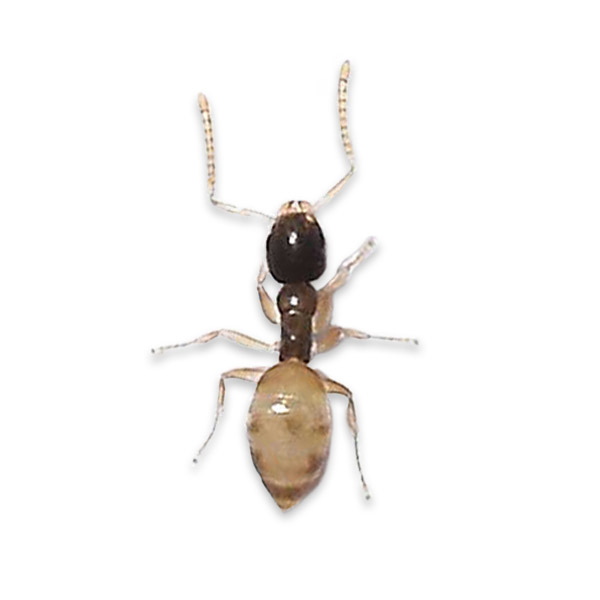
People often call ghost ants “sugar ants,” but that nickname usually refers to odorous house ants in North America. The two are easy to confuse because both are small, both love sweets, and both belong to the same dolichoderine family. The quickest tell is size and color: ghost ants are extremely tiny (around 1.3 to 1.5 mm) with a dark head and a pale, translucent abdomen and legs, while odorous house ants are larger and uniformly dark. Both give off that coconut or blue-cheese smell when crushed. As far as diet goes, both are sweet-driven, but the true generalist “sugar ants” tend to switch to protein more readily than the strongly sugar-focused ghost ant.
Should you keep ghost ants?
This one comes with a real caution rather than an enthusiastic feeding guide.
A serious caution: Ghost ants are a tropical “tramp” ant, one of the world’s most successful hitchhiking pests. They are kept by a few experienced hobbyists because they are small, fast, and interesting, but they are very easy to lose control of. Their tiny size lets them slip through the smallest gaps, and their budding, many-queened biology means an escaped fragment with a queen can establish a new colony in a building. In most temperate regions they cannot survive outdoors, so any escape tends to mean an indoor infestation. They are not a good beginner ant, you should never release them, and you should check local rules before acquiring any non-native species.
For the experienced keepers who do maintain them in secure setups, the feeding follows the wild diet exactly: a constant sugar or honey water source as the staple, small feeder insects for protein when there is brood, and fresh water at all times, in a warm, humid enclosure. The challenge with ghost ants is never getting them to eat. It is containment.
If you want a sweet-loving ant you can keep more responsibly, far better options exist. To match a plan to a species you can keep safely, try our interactive ant food finder, and for the full picture start with our pillar guide, What Do Ants Eat?. You can also compare another honeydew specialist in What Do Harvester Ants Eat? for a completely different diet strategy.
What do ghost ants eat? The short version
If you take one thing away, make it this: ghost ants are sweet specialists. They run on honeydew and sugary foods, they farm aphids and mealybugs to harvest it, and they are picky enough to prefer the honeydew with the best sugar profile. They still collect protein from insects to feed their larvae, but the colony is built around carbohydrate, which is why sweet baits beat them and sprays only scatter them. All of this traces back to their family, the sugar-loving dolichoderine lineage that also includes Argentine and odorous house ants. Understand the sweet tooth, and you understand the ghost ant.
FAQ
What do ghost ants eat in the house?
Indoors, ghost ants go for sweets above all: sugar, honey, syrup, soda, fruit, and sweet spills. They will also feed on greasy residues around stovetops and trash and scavenge dead insects. They are strongly drawn to anything sugary, and they trail readily to water.
Do ghost ants prefer sweets or protein?
Strongly sweets. Ghost ants are carbohydrate specialists whose main food is honeydew and sugary liquids. They do collect protein from living and dead insects, but mainly to feed their larvae. This heavy sugar preference is why liquid sweet baits are the most effective control.
Do ghost ants eat wood?
No. Ghost ants do not eat or damage wood. They nest in existing spaces like wall voids, potted plants, and gaps around the home, rather than tunneling into timber. They are a nuisance pest, not a wood-destroying one like carpenter ants or termites.
Do ghost ants eat honeydew?
Yes, honeydew is their most important food. Ghost ants tend aphids, mealybugs, and other sap-sucking insects, protecting them in exchange for the sugary honeydew they produce. Research shows ghost ants even prefer some honeydews over others based on their sugar content.
Are ghost ants the same as sugar ants?
Not exactly. “Sugar ant” is a nickname often applied to odorous house ants and to ghost ants alike, because both are small and love sweets, and both belong to the same family. Ghost ants are tinier, with a dark head and a pale, see-through abdomen, and are even more strongly sugar-focused.
Why are ghost ants so hard to get rid of?
Because of their biology and diet. They have many queens, reproduce by budding, and spread into multiple nests when sprayed. Their sweet-sharing colony makes patient liquid sugar baits effective, while repellent sprays just cause the colony to split and scatter.
What do you feed pet ghost ants?
For experienced keepers maintaining them securely, the diet is sugar or honey water as the staple, small feeder insects for protein when there is brood, and constant water. Be aware that ghost ants are an escape-prone tramp species and are not recommended for beginners.