What Do Leafcutter Ants Eat? The Farmers of the Ant World
Written from an ant keeper’s perspective, with peer-reviewed sources. Last updated: June 2026.
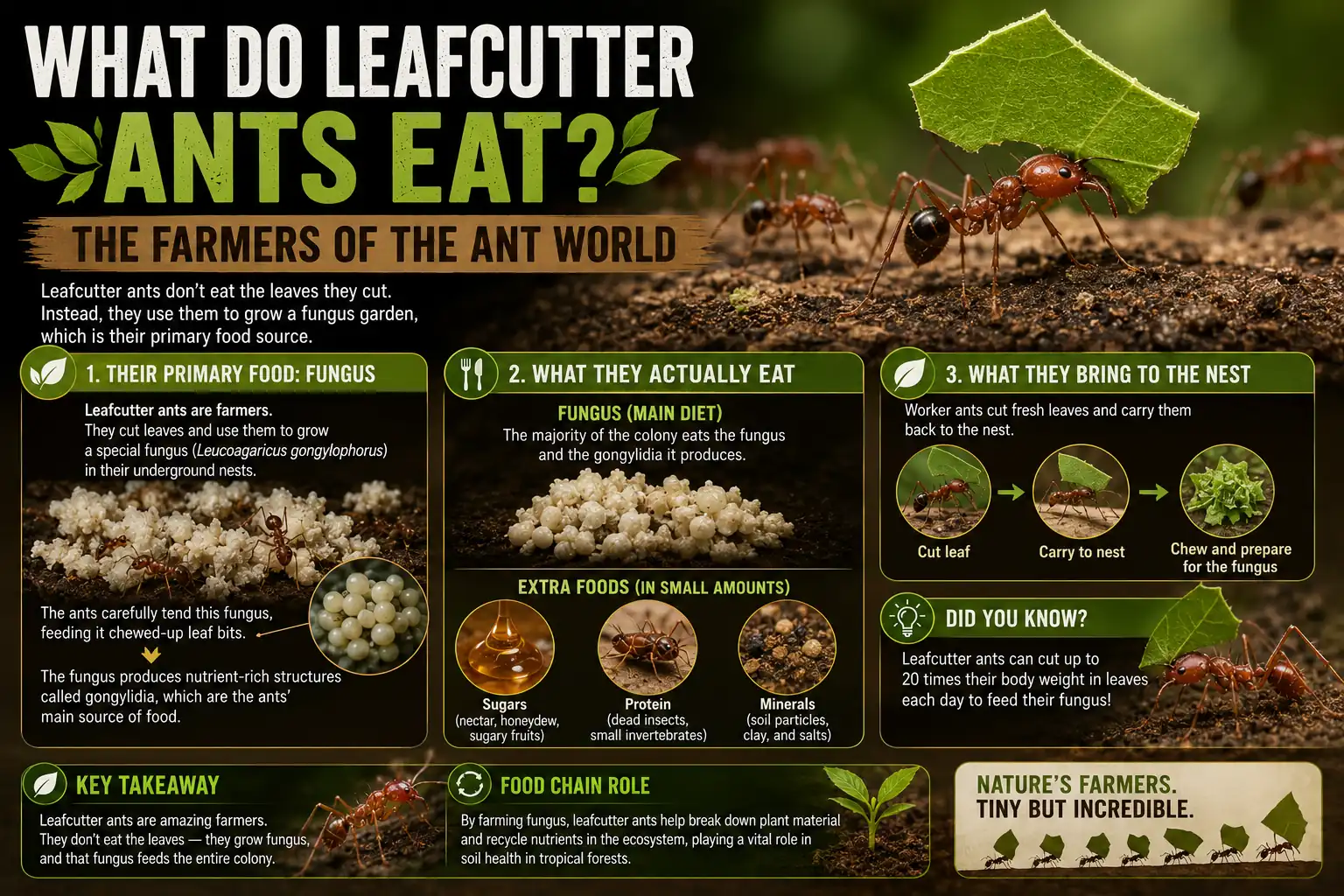
Leafcutter ants march across the rainforest floor carrying neat green leaf fragments overhead, so the obvious assumption is that the leaves are lunch. They are not. The real answer to what do leafcutter ants eat is one of the strangest and most sophisticated stories in the animal kingdom: leafcutter ants do not eat leaves at all. They are farmers. They use the leaves to grow a special fungus, and they eat the fungus. They belong to an ant lineage that has farmed fungus for around 55 million years, tens of millions of years before humans existed.
Quick answer: Leafcutter ants (genus Atta and Acromyrmex) eat a fungus they cultivate, not the leaves they cut. Workers carry plant material underground and use it as compost to grow a single crop fungus (Leucoagaricus gongylophorus). The fungus grows nutrient-rich swollen tips called gongylidia, and those are the actual food, eaten by the larvae and most workers. The fungus digests the tough plant matter the ants cannot, and the colony even protects its crop with antibiotic-producing bacteria. Adult foragers also sip sugary sap from the leaves they cut for extra energy.
The big twist: leafcutter ants do not eat the leaves
This is the single most important thing to understand, and it is the opposite of what almost everyone assumes. The leaf fragments streaming into a leafcutter nest are not food. They are raw material for a farm.
Deep underground, leafcutter ants run sprawling fungus gardens: spongy, grayish masses that fill chamber after chamber of the nest. The ants feed fresh plant material to this fungus, tend it, weed it, and harvest it, exactly the way a human farmer manages a crop. The fungus, Leucoagaricus gongylophorus, exists nowhere in the wild on its own anymore. It is a domesticated organism, so dependent on its ant farmers that it has lost the ability to live free, and the leafcutter ants are equally dependent on it. Neither can survive without the other.
This partnership is ancient. The fungus-farming lineage of ants (the attines) has cultivated fungus for roughly 55 million years, and the leafcutters are the most advanced farmers among them. Their agriculture predates human farming by tens of millions of years.
What they actually eat: the fungus, and one special part of it
So leafcutter ants eat fungus. But they do not just graze on the fungal threads at random. The crop has evolved to feed them in a remarkably targeted way.
The fungus produces tiny swollen tips at the ends of its threads called gongylidia, which grow in bundles called staphylae. These structures are essentially the fungus’s way of paying its farmers. Gongylidia are packed with carbohydrates, energy-rich lipids, and other nutrients, and they are the primary food of the colony. Garden workers and the developing larvae feed almost exclusively on gongylidia. Larvae, in particular, are entirely dependent on the fungus and eat nothing else.
In other words, the precise answer to what leafcutter ants eat is not “leaves” and not even “fungus” in general. It is gongylidia: the nutrient-rich tips of a crop they grow themselves.
The fungus digests what the ants cannot
Here is why the whole farming system exists in the first place. Leaves are tough. They are built from cellulose and other plant polymers that most animals, including leafcutter ants, simply cannot digest. Leafcutter ants have no way to extract nutrition from raw leaf material.
The fungus can. Leucoagaricus gongylophorus breaks down the cellulose and other compounds in the plant matter and converts them into food the ants can actually eat. The colony has effectively outsourced its digestion to a fungus. The ants supply leaves they cannot eat, and the fungus turns those leaves into gongylidia they can. It is one of nature’s clearest examples of two species each doing what the other cannot.
The science competitors miss: the ants recycle their crop’s enzymes
This is where the leafcutter system goes from impressive to astonishing, and where essentially no general guide goes.
The plant-digesting enzymes that do the hard work are produced by the fungus and concentrated inside the gongylidia. When the ants eat gongylidia, they swallow those enzymes too. And here is the remarkable part: the ants’ digestive systems are specially adapted not to break those particular enzymes down. The enzymes pass all the way through the ant’s gut completely intact and come out in the ant’s fecal droplets (Aylward and colleagues, 2015).
The leafcutter ants then deposit those enzyme-loaded droplets directly onto the fresh leaf pulp as they add it to the garden. The recycled fungal enzymes immediately begin pre-digesting the new plant material, giving the fungus a head start before it even grows onto the leaves. The colony is, in effect, fertilizing and pre-treating its crop with digestive enzymes it has routed through its own bodies. The leafcutter ant is a living conveyor belt for its crop’s chemistry.
To top it off, the gardens host nitrogen-fixing bacteria that pull nitrogen from the air and feed it into the system (Pinto-Tomás and colleagues, 2009), which helps explain how a colony of millions can be sustained on a diet of nitrogen-poor leaves. The leafcutter “diet” is really the output of an entire managed ecosystem.
A correction to the textbooks: foragers also drink sap
For decades, leafcutter ants were described as having a strict “fungus-only” diet. Recent research has refined that picture, and it is worth getting right.
The larvae and the garden-tending workers really do eat fungus and nothing else. But the foraging workers, the ones out cutting and carrying leaves, do something extra: they drink the sugary sap that wells up from the leaves as they slice into them. Stable-isotope work by Shik and colleagues (2018) found that the fungus supplies only a fraction of a forager’s energy, with much of the rest coming directly from plant sap consumed on the job. So the colony as a whole runs on fungus, but the hardest-working foragers top up their fuel with plant juice at the cutting site.
This is exactly the kind of detail that separates a current, authoritative page from one repeating an outdated textbook line.
The antibiotic bodyguards that protect the food
A farm is only as good as its protection from disease, and a leafcutter fungus garden is constantly under threat from a specialized parasitic mold called Escovopsis, which attacks and consumes the crop and can collapse an entire colony if it takes hold.
Leafcutter ants fight back with living antibiotics. They carry bacteria of the genus Pseudonocardia on their bodies, cultured on special patches of their exoskeleton, and these bacteria produce antifungal compounds that suppress Escovopsis. This was first described by Currie and colleagues in 1999, and it revealed the leafcutter food system as a multi-way partnership: the ant, the crop fungus, the parasite, and the antibiotic bacterium, locked in an evolutionary arms race that has run for tens of millions of years (Heine and colleagues, 2018). Leafcutter ants are not just farmers, they are farmers who wear pharmacies.
It is worth pausing on what this means for the diet question. A leafcutter colony’s food does not come from a simple act of eating. It is produced by a managed network of organisms: a crop fungus that digests leaves, bacteria that fix nitrogen and make antibiotics, and ants that coordinate the whole operation. Remove any partner and the food supply fails.
They farm for the crop, not for themselves
One of the most counterintuitive consequences of fungus farming is how leafcutter ants choose which plants to cut. They are not selecting leaves that taste good to them. They are selecting leaves that are good for their fungus.
Leafcutters will reject otherwise harmless plant species if those plants contain compounds that harm the cultivar. Researchers studying leaf rejection have found that spurned plants tend to be high in substances with antifungal properties, even when those substances pose no problem to the ants themselves. The colony’s food preferences are really the fungus’s food preferences, expressed through the ants. Workers also match their effort to leaf quality and toughness, with larger workers cutting tougher leaves, and they avoid material that would foul the garden.
The smaller items on the menu
Fungus is overwhelmingly the story, but a few other things enter a leafcutter colony’s diet:
- Water: colonies drink water, especially when their food is dry, and they manage humidity carefully to keep the garden healthy.
- Trophic eggs: when a queen is founding a new colony alone, she lays special infertile eggs that are not meant to hatch but to be eaten, feeding her first brood. She also consumes some of her own eggs during this lean founding period.
- Plant sap and nectar: as noted, foragers drink sap directly, and the leafcutter ants harvest some flower and fruit material too, which appears to help the fungus’s nutrition.
- Sodium and minerals: workers will seek out scarce nutrients like salt when available, which may go to the ants or to the garden.
- Carrion, occasionally: leafcutters are overwhelmingly herbivorous farmers, but they have been recorded opportunistically exploiting insect or animal remains.
How leafcutters gather their raw material
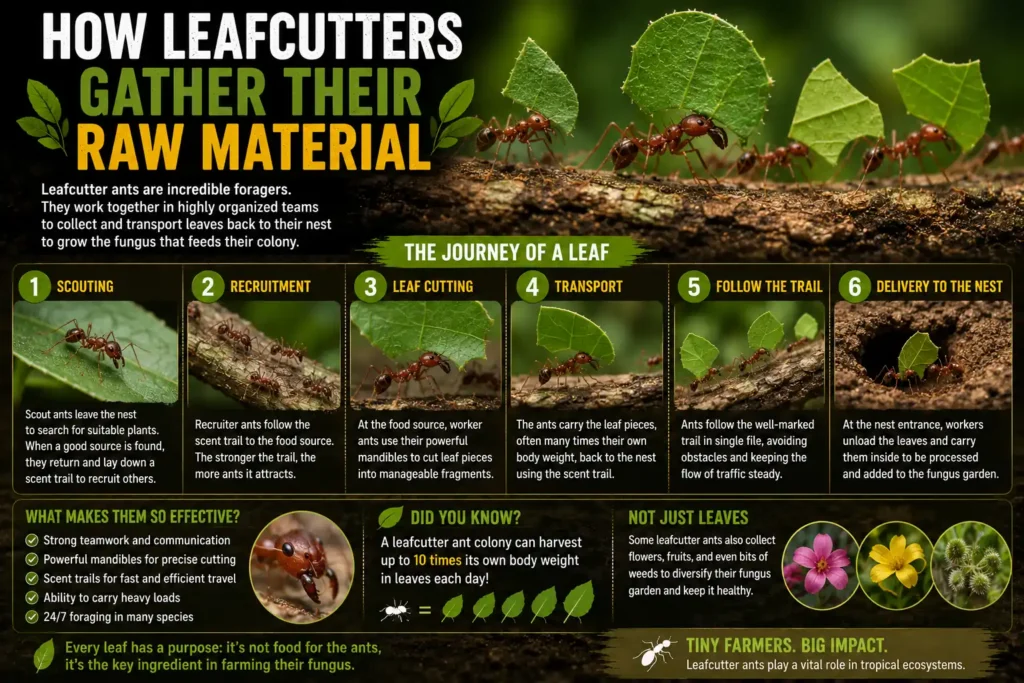
Although the leaves are not food, gathering them is the foundation of the whole diet, and leafcutters are spectacular at it. Foragers travel well-worn trails up to around 120 meters (about 390 feet) from the nest, climb into the canopy, and cut leaf sections with serrated mandibles, taking 20 to 50 bites to free a single fragment. They carry loads many times their own body weight back to the nest, holding the pieces aloft in the famous parasol marches. Inside, other workers shred the fragments into tiny bits, clean them, and graft fungus onto them to expand the garden.
Because they harvest so much living plant material, leafcutter ants are among the dominant plant-eaters of the American tropics and serious agricultural pests, capable of stripping a young tree or a crop field with surprising speed. Their “diet,” in the ecological sense, removes an enormous amount of vegetation, even though almost none of it is eaten directly.
What do pet leafcutter ants eat?
A clear warning before anything else, because leafcutters are a specialist’s ant.
Responsible-keeping note: Leafcutter ants are challenging to keep and are tightly regulated in some regions. In the United States, Atta leafcutters are treated as serious agricultural pests, and importing, transporting, or keeping them generally requires USDA permits and is restricted or prohibited in many states. They are kept legally by experienced hobbyists in parts of the UK and Europe, but they demand high humidity, stable warmth, a constant supply of fresh untreated leaves, and a healthy fungus garden, and a colony that drops below a sustainable size will fail. This is not a beginner ant. Always check your local laws and import rules before acquiring one, and never release a leafcutter colony or its fungus.
The key thing to understand as a keeper is that you are not really feeding the ants. You are feeding the fungus. Everything you provide is substrate and supplement for the garden, which then feeds the colony.
Fresh plant material (the core “food”)
Offer a rotating supply of fresh, pesticide-free leaves and plant matter, such as:
- Bramble (blackberry) leaves, a hobby staple
- Rose, hawthorn, oak, privet, and hibiscus leaves
- Petals and some flowers
Always wash leaves to remove any chemical residue, and avoid anything that may have been sprayed, as well as strongly aromatic or citrus foliage that can harm the fungus.
Supplements
Many keepers offer extras that the fungus can use, in small amounts:
- Dried oats, cornmeal, or rice
- Small pieces of fruit (apple, berries)
Humidity and water
Leafcutters need high humidity (often 70 to 95% depending on setup) and a reliable water source. A drying garden is a dying garden, so moisture management matters more than with almost any other kept ant.
A simple keeper feeding guide
| Colony stage | Main provision | Supplements | Notes |
|---|---|---|---|
| Founding queen with starter fungus | Do not feed leaves yet; protect the tiny garden | None | Extremely fragile; minimal disturbance |
| Small colony (first workers and garden) | A few fresh leaves at a time | Tiny amounts of oats or fruit | Remove anything moldy or uneaten |
| Growing colony | Daily fresh leaves, increasing with garden size | Occasional oats, cornmeal, fruit | Match leaf supply to garden growth |
| Large colony | Steady, generous fresh leaf supply | As the garden demands | High humidity and space become critical |
For matching feeding plans to other species you keep, try our interactive ant food finder. For the wider picture, start with our pillar guide, What Do Ants Eat?, or compare very different feeders in What Do Carpenter Ants Eat? and What Do Fire Ants Eat?
What do leafcutter ants eat? The short version
If you take one thing away, make it this: leafcutter ants do not eat the leaves they cut. They are farmers that use leaves to grow a crop fungus, Leucoagaricus gongylophorus, and they eat the fungus, specifically its nutrient-rich tips called gongylidia. The fungus digests the tough plant matter the ants cannot, the ants recycle the fungus’s own enzymes through their gut to pre-digest each new batch of leaves, antibiotic bacteria guard the crop against disease, and nitrogen-fixing bacteria help feed the whole system. Adult foragers add a little plant sap on the side, but the colony runs on fungus.
For a keeper, the lesson is simple and unusual: you feed the garden, not the ants. Provide clean fresh leaves and stable humidity, keep the fungus healthy, and the colony feeds itself. Understand the farm, and you understand the animal.
FAQ
Do leafcutter ants eat leaves?
No. This is the most common misconception. Leafcutter ants cut and carry leaves, but they cannot digest them. They use the leaves as compost to grow a fungus, and they eat the fungus instead.
What is the fungus that leafcutter ants grow?
It is Leucoagaricus gongylophorus, a single domesticated crop fungus that leafcutter colonies cultivate underground. It grows nutrient-rich tips called gongylidia that the ants harvest and eat, and it can no longer survive in the wild without its ant farmers.
What do leafcutter ant larvae eat?
Leafcutter larvae are entirely dependent on the fungus. They are fed the gongylidia, the swollen nutrient-rich tips of the crop fungus, and eat nothing else.
Do leafcutter ants eat anything besides fungus?
The colony runs almost entirely on fungus, but foraging workers also drink sugary sap from the leaves they cut, and the ants will take some nectar, fruit material, minerals like salt, and occasionally carrion. Founding queens also eat special trophic eggs.
Why do leafcutter ants carry leaves if they do not eat them?
The leaves are food for their fungus, not for themselves. The ants feed fresh plant material to their fungus garden, and the fungus converts the tough leaf matter into food the colony can actually eat.
Are leafcutter ants harmful to plants?
Yes. Because they harvest huge amounts of living vegetation to feed their gardens, leafcutter ants are among the most significant plant-eaters in the American tropics and can be serious agricultural and garden pests, capable of defoliating plants quickly.
What do you feed pet leafcutter ants?
You feed the fungus, not the ants. Keepers provide fresh, pesticide-free leaves (such as bramble, rose, oak, or hawthorn), sometimes with small supplements like oats or fruit, plus high humidity and water. Leafcutters are an advanced species and are legally restricted in some regions, including much of the United States.
How do leafcutter ants protect their food?
They carry antibiotic-producing Pseudonocardia bacteria on their bodies that suppress a parasitic mold (Escovopsis) which attacks the fungus garden. Combined with constant weeding, cleaning, and strict waste disposal, this keeps their crop healthy.