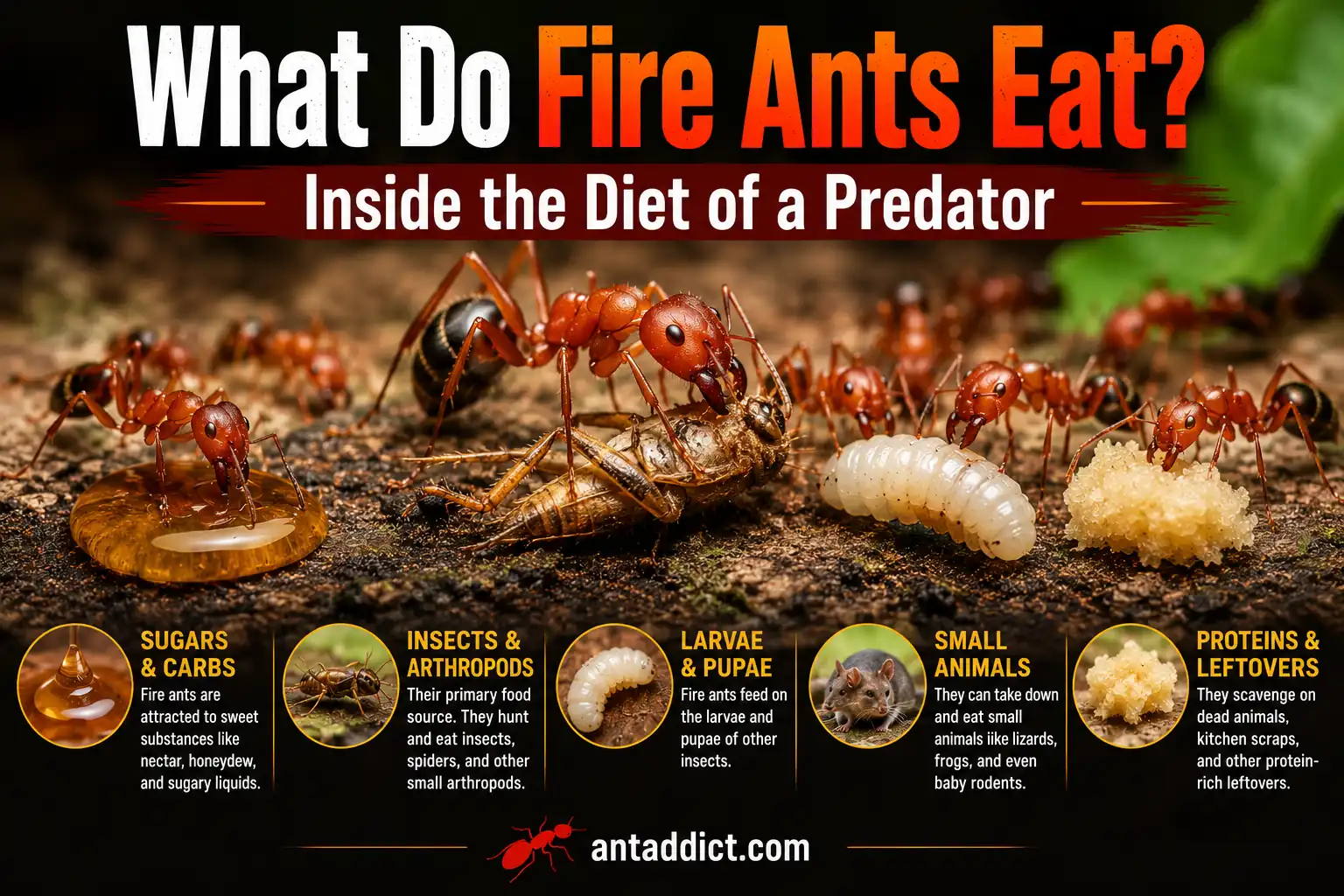
What Do Fire Ants Eat? Inside the Diet of a Predator
Written from an ant keeper’s perspective, with peer-reviewed sources. Last updated: June 2026.
Fire ants are one of the most aggressive and successful insects on the planet, and anyone who has stumbled onto a mound wants to know the same thing: what do fire ants eat? The short version is that they are omnivores that lean toward a hunter’s diet, feeding their brood on protein from insects and small animals while the adults run on sugar, much of it harvested from insects they farm. They even dry and stockpile prey like jerky. Here is the complete, research-backed answer.
Quick answer: Fire ants (Solenopsis invicta and related species) are omnivores. The growing larvae and queen are fed protein and fats from insects, other small animals, carrion, and seeds, while adult workers run almost entirely on liquid carbohydrates, especially honeydew that they harvest by tending aphids, scale insects, and mealybugs. Adults physically cannot swallow solid food, so only the final-stage larvae can digest solids, acting as the colony’s shared stomach. Fire ants also desiccate insect prey into a kind of jerky and stockpile it inside the mound.
The two-part diet: protein for the brood, sugar for the adults
Like most ants, a fire ant colony does not eat one thing. Its diet splits along the same line that runs through every social insect: the members that forage are not the members with the highest demand for growth.
Adult workers are sterile, fully grown, and burn carbohydrate for the energy to forage, dig, and defend the nest. The larvae are the only members actively building body tissue, and growth requires protein. The queen, a sustained egg-laying machine, needs protein and fat to keep producing eggs. So the colony collects two broad categories of food:
- Protein and lipids (insects, other small animals, carrion, seeds) for the larvae and queen
- Carbohydrates (honeydew, nectar, plant exudates, any sugar) for adult worker fuel
There is one important way fire ants differ from a sugar-focused ant like the carpenter ant. Fire ants are far more predatory. Insects and other invertebrates are often described as their preferred food, and newly founding or brood-heavy colonies actively favor high-protein, high-lipid foods (Stein et al. 1990; Vander Meer et al. 1995). That hunter’s streak is a big part of why they are so ecologically destructive, which we will come back to.
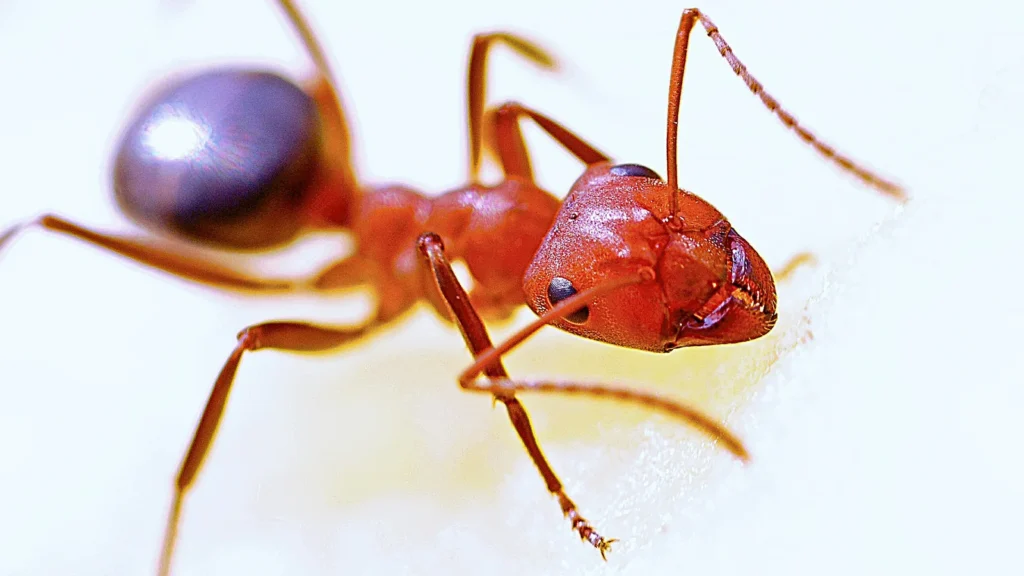
What adult workers eat: honeydew and the insects they farm
Adult fire ants need carbohydrate, and their single most important source is not a flower or a fallen fruit. It is honeydew, the sugary liquid excreted by sap-sucking insects.
The honeydew mutualism
Fire ants tend aphids, scale insects, and mealybugs, protecting these insects from predators and parasites in exchange for the honeydew they produce. This is a true mutualism, and for fire ants it is enormously important. Research by Helms and Vinson (2002) documented how widely Solenopsis invicta associates with honeydew-producing insects, and a follow-up study (Helms and Vinson 2008) showed just how much it matters: colonies given insect prey plus honeydew grew substantially larger than colonies given unlimited insect prey alone. In their experiments, access to a honeydew source pushed colony growth dramatically higher than protein could on its own.
In other words, the sugar is not a side dish. Honeydew is rocket fuel for colony growth, and the fire ant’s willingness to farm for it is one of the reasons a single colony can explode into hundreds of thousands of workers.
Other carbohydrate sources
Beyond honeydew, adult workers drink:
- Plant nectar from flowers and from extrafloral nectaries on stems and leaves
- Plant sap and exudates, sometimes from crop plants they have damaged
- Fruit juices and any sugary plant material
- Human sugars indoors and outdoors: soda, syrup, candy, grease, and sweet spills
If you have ever seen fire ants swarm a dropped popsicle or a greasy chip within minutes, you have watched this sugar drive in action.
What the brood and queen eat: insects, seeds, and meat
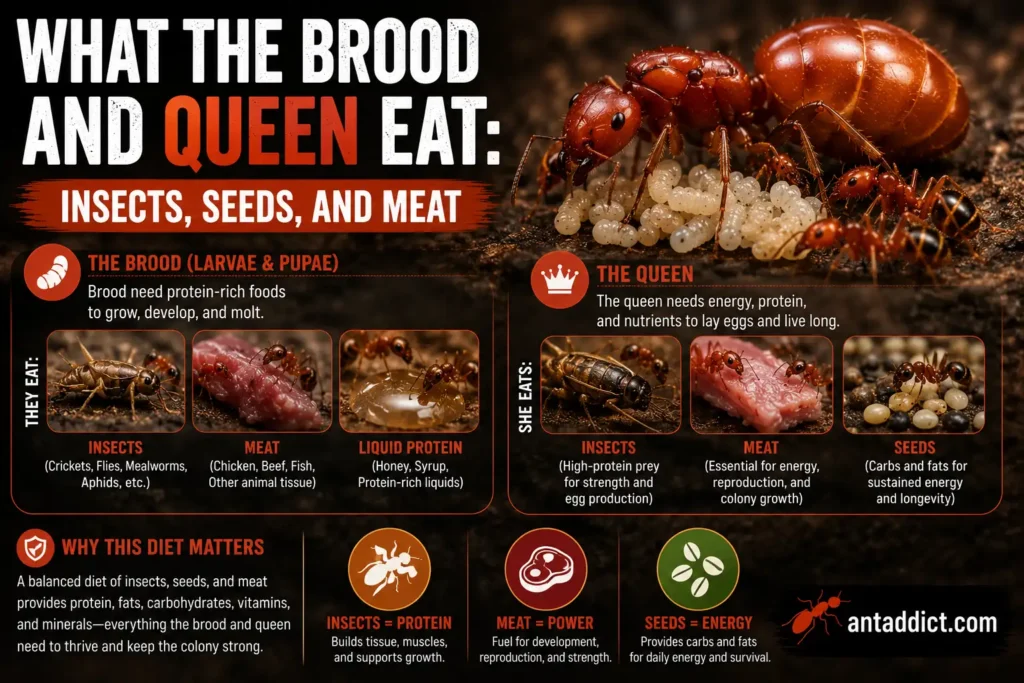
Protein and fat are the colony’s building materials, and fire ants are relentless about collecting them. Their protein and lipid sources include:
- Live insects and other arthropods: fire ants are active predators of almost anything they can overpower, including ticks and chiggers
- Carrion: dead insects and animal carcasses of any size
- Small vertebrates: they prey on the eggs and helpless young of ground-dwelling animals (more on this below)
- Seeds: especially valued for their high protein and oil content, which is why fire ants damage crop seed and seedlings
A nice detail that surprises people: a newly mated queen, sealed alone in her founding chamber, eats nothing at all from outside. She raises her first batch of workers on energy drawn from her own body, especially her now-useless flight muscles, which she breaks down for fuel. Only once those first small workers emerge and begin foraging does outside food start flowing into the new colony.
The science competitors miss: only the larvae can eat solid food
Here is where fire ant feeding gets genuinely strange, and where almost every other guide stops at a single sentence.
Adult fire ants cannot eat solid food. They have a filter in the throat (the infrabuccal filter) that strains out any particle larger than about 0.88 microns, far smaller than a grain of table salt, so an adult worker physically cannot swallow a crumb of meat or seed. Everything an adult ingests must be liquid.
So how does solid protein get into the colony? Through the larvae. Only the fourth and final larval instar is capable of digesting solid food (Petralia and Vinson 1978). The system works like an assembly line:
- A foraging worker carries a solid food particle back in its mandibles.
- The worker tucks the particle against the belly of a final-stage larva, into a cradle of inward-pointing hairs that holds it in place.
- The larva coats the pellet in digestive saliva, partly liquefying it.
- Workers collect the resulting liquid and pass it around the colony, mouth to mouth, by trophallaxis (Cassill and Tschinkel 1995, 1999).
In effect, the colony’s larvae are its communal stomach. The brood does the digesting that the adults cannot, then hands the processed nutrients back up to the workers and the queen. Fire ant colonies do not even build food-storage structures the way honeybees build honeycomb. Food is stored inside the ants themselves, mostly in the crops of the larger workers.
Even more remarkable, the larvae regulate their own diet. Cassill and Tschinkel (1999) showed that fire ant larvae track protein, amino acids, and sugar as separate appetites, and that they favor concentrated solutions over watery ones. A larva that has eaten its fill of one nutrient will still take another, because it meters each one on its own. The colony is not just feeding its brood, it is letting the brood fine-tune the colony’s nutrition.
Insect jerky: the fire ant pantry
Most ants eat or share their food quickly. Fire ants do something almost no other ant is known to do: they preserve and store meat.
When a colony hits a windfall of prey it cannot process all at once, workers squeeze the liquid from the tissue, cut what remains into small pieces, and dry them, producing what one Florida State University study literally called insect “jerky” (Gayahan and Tschinkel 2008). These dried fragments are cached near the top of the mound, the warmest and driest zone, where they keep without rotting, and a single cache can hold anywhere from a few pieces to hundreds. Using fluorescent dye tracers, the researchers showed the payoff: when fresh prey stopped arriving, starved colonies fed these stored fragments to their larvae for weeks afterward. The fire ant, in effect, runs a meat pantry.
This is the kind of detail that separates a real authority page from a thin one. Fire ants are not just opportunistic feeders, they are food processors and food storers, drying meat for a rainy day. No pest-control brochure will tell you that.
How fire ants find and share food
Fire ant foraging is a model of efficiency. Foraging tunnels radiate underground in all directions from the mound and open to the surface several feet to many feet away, which is why you rarely see a hole in the top of an active mound. Workers fan out from these exits, and a single forager will travel more than one hundred feet from the nest in search of food. Foraging is temperature-driven, happening most actively between about 70 and 90°F, by day or night (UF/IFAS).
When a worker finds a small food item, it carries it straight home. When it finds a large prize, it lays a chemical pheromone trail back to the mound, recruiting a stream of nestmates that reinforce the trail until a column of workers is dismantling the find. Once food is back in the nest, the trophallaxis network distributes it: liquids stored in workers’ crops are shared mouth to mouth across the whole colony, eventually reaching the queen and the youngest larvae. This colony-wide food sharing is exactly why slow-acting baits work so well against fire ants. A single worker that picks up bait will share it, and the poison, throughout the nest before anyone realizes there is a problem.
Fire ants as predators: why their diet matters
The fire ant’s diet is not just trivia. It is the reason this insect is one of the most damaging invasive species in the world, and that ecological weight is something the pest-control pages reduce to a sales pitch.
Fire ants subdue prey with a potent venom and overwhelm it with numbers, which makes them a dominant predator wherever they establish. Where dense fire ant populations move in, native ant and arthropod diversity drops sharply (Porter and Savignano 1990), and populations of ground-dwelling vertebrates can fall significantly. Allen and colleagues (1995) documented at least two-fold reductions in animals such as field mice, snakes, and turtles in heavily infested areas.
The hardest-hit victims are the eggs and newly hatched young of ground-nesting animals, which cannot flee a swarm:
- Reptiles: fire ants prey on hatchling gopher tortoises (Landers et al. 1980) and consume the eggs of lizards such as the six-lined racerunner (Mount et al. 1981).
- Birds: ground-nesting birds like the northern bobwhite quail are especially vulnerable, with fire ants attacking chicks at hatching. They also remove the insects that quail chicks rely on for food.
- Mammals: newborn fawns and other young mammals that instinctively stay motionless are attacked on the ground.
On the plant side, their taste for seeds and seedlings damages crops and can reshape local seed banks and plant communities. The same flexible, aggressive diet that makes fire ants successful is exactly what makes them ecologically dangerous.
How the diet shifts with the colony
Fire ant feeding is not static through the year or across the colony’s life:
- A founding queen eats nothing external, living off her wing muscles until her first workers forage.
- Young and fast-growing colonies lean heavily on protein and fat to build brood and workforce.
- Established colonies balance a constant carbohydrate intake (for the standing army of adult workers) with protein pulses timed to brood production.
- Honeydew availability can swing a colony’s intake hard toward carbohydrate, and as Helms and Vinson showed, that sugar windfall translates directly into faster colony growth.
What do pet fire ants eat?
This section needs a clear warning first, because fire ants are not an ordinary hobby ant.
Important legal note: The red imported fire ant (Solenopsis invicta) is a federally regulated invasive species in the United States, and it is illegal to keep or transport it across quarantine lines. Many other countries, including Australia and members of the European Union, treat it as a serious biosecurity threat and run active eradication or exclusion programs. Do not collect, keep, or move red imported fire ants. If you find a suspected fire ant colony in a regulated or eradication area, the responsible action is to report it to your local agricultural authority, not to keep it.
With that said, fire ants are a broad group. Some native Solenopsis species are not regulated, and in regions where keeping a given species is legal, the feeding principles follow directly from the biology above. For a colony you can legally keep:
Carbohydrates (offer constantly)
The daily fuel for adult workers. Keep a sugar source available at all times:
- Sugar water (roughly one part sugar to three parts water)
- Diluted honey water (never thick honey, which traps ants)
- Commercial ant nectar or sugar jelly
Protein (offer when brood is present)
Protein drives brood growth, so offer it regularly when larvae are present and ease off when they are scarce:
- Feeder insects: small crickets, roach nymphs, mealworms, and fruit flies, offered freshly killed or pre-frozen
- Protein-fortified ant jelly as a convenient backup
Water
Provide a constant, separate water source (a water-filled test tube plugged with cotton works well), independent of the sugar source.
A simple keeper feeding guide
| Colony stage | Carbohydrate | Protein | Frequency |
|---|---|---|---|
| Founding queen (claustral) | None needed; she lives off body reserves | None | Do not disturb |
| Small colony, first workers | Sugar water always available | Small feeder insect | Protein 1 to 2 times per week |
| Growing colony with larvae | Sugar water always available | Feeder insects | Protein 2 to 3 times per week |
| Large or winding-down colony | Sugar water always available | Reduce protein | Protein as brood demands |
For matching a feeding plan to other species you may legally keep, try our interactive ant food finder. For the bigger picture, start with our pillar guide, What Do Ants Eat?, or compare a very different feeder in What Do Carpenter Ants Eat?
What do fire ants eat? The short version
If you take one thing away, make it this: what fire ants eat is decided by who in the colony is being fed. The larvae and queen get protein and fat from insects, carrion, seeds, and small animals, while adult workers run on liquid carbohydrate, above all the honeydew they farm from aphids, scale, and mealybugs. Because adults cannot digest solids, the final-stage larvae act as the colony’s shared stomach, and the colony even dries and stockpiles surplus insect prey like jerky. That flexible, aggressive, protein-and-sugar diet is the engine behind both the fire ant’s success and its damage to native wildlife.
For a keeper, that biology reduces to a simple rule: sugar for the adults, protein for the brood, water at all times, and a careful check of which fire ants you can legally house before you keep anything. For everyone else, the same diet explains two things at once, why fire ants are so hard to starve out, and why they reshape the ground they invade. Understand what is on the menu, and you understand the animal.
FAQ
What do fire ants eat in the house?
Indoors, fire ants are mostly after the same two things they want outdoors: sugar and grease. They will feed on sweet spills, syrup, soda, candy, pet food, and greasy residue. They are not after your home’s structure, only the food in it.
Do fire ants eat wood?
No. Unlike termites or carpenter ants, fire ants have no interest in wood as food and do not tunnel through sound wood to nest. They build soil mounds and forage for insects, sugars, seeds, and carrion.
What is a fire ant’s favorite food?
Fire ants are often described as preferring insects and other protein, which they collect for their brood, but adult workers depend heavily on the sugary honeydew they harvest from aphids, scale insects, and mealybugs. Research shows that honeydew access dramatically boosts colony growth, so sugar is arguably just as important as prey.
Do fire ants eat meat?
Yes. Fire ants are active predators and scavengers. They hunt live insects and other small animals, feed on carrion, and will even dry small pieces of insect prey and stockpile them inside the mound for later.
How do fire ants feed their larvae?
Workers carry solid food to the final-stage larvae, the only colony members that can digest solids. The larvae liquefy the food with saliva, and workers then share the resulting liquid throughout the colony mouth to mouth. Liquid foods like honeydew are shared directly by this same process, called trophallaxis.
Do fire ants eat other ants?
Yes. Fire ants are aggressive competitors and predators that attack and consume other ants, including rival fire ant colonies and native ant species. Their ability to overwhelm and displace native ants is a major part of their ecological impact.
Can you keep fire ants as pets?
The red imported fire ant is a regulated invasive species, and keeping or transporting it is illegal in the United States and many other countries. Some non-regulated native Solenopsis species may be legal to keep in certain regions. Always check your local agricultural and biosecurity laws before keeping any fire ant, and report suspected red imported fire ants to authorities.
What do fire ants drink?
Fire ants take in water and water-soluble sugars as liquids, storing them in a stretchy internal pouch called the crop. They need a reliable water source and will recruit nestmates to a good one, which is also why they often appear around moisture indoors.