What Do Carpenter Ants Eat ? A Complete, Science-Backed Guide
Written from an ant keeper’s perspective, with peer-reviewed sources. Last updated: June 2026.
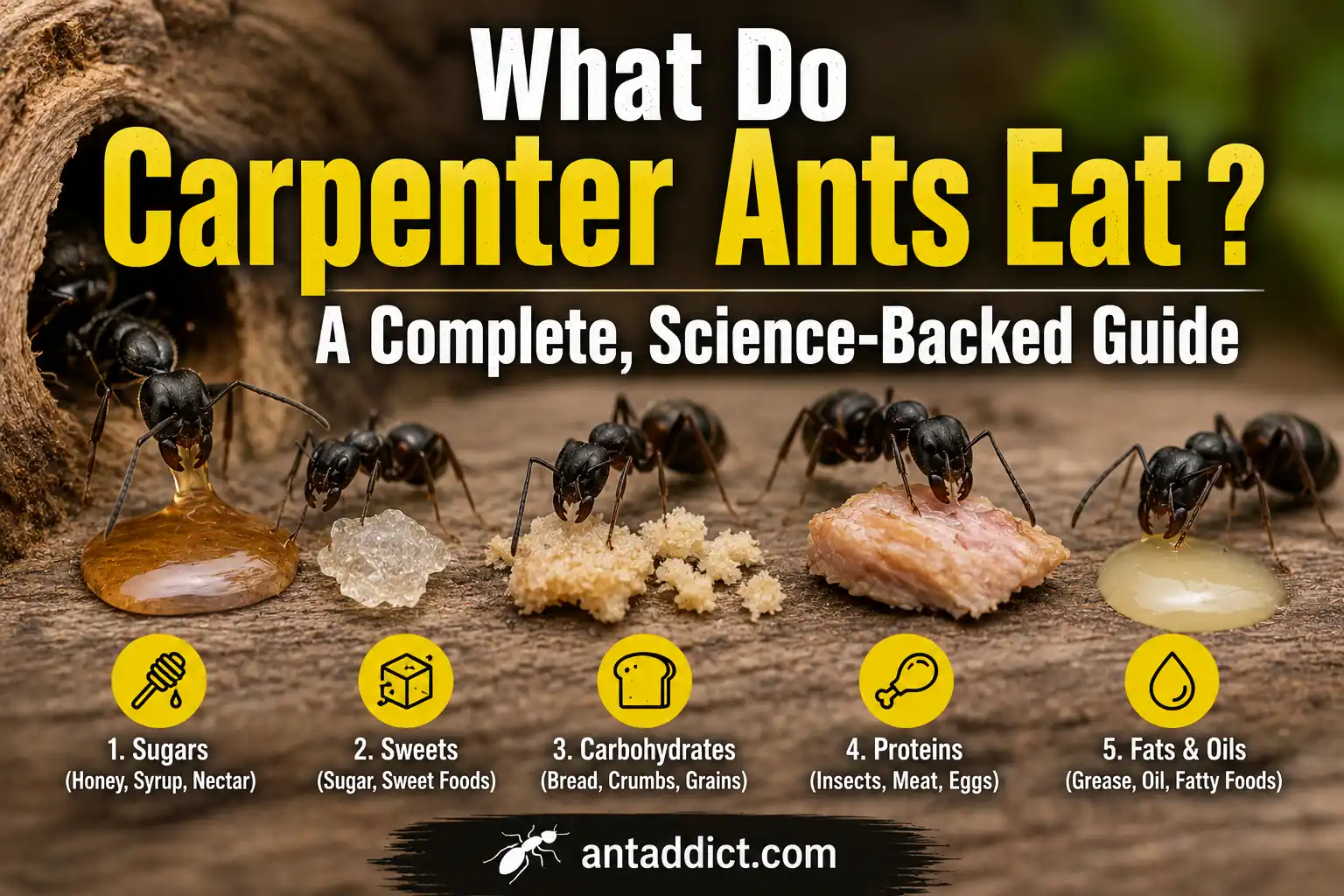
Carpenter ants are among the most misunderstood insects around the home and among the most rewarding to raise in the hobby, and the question that comes up first is almost always the same: what do carpenter ants eat? The short version is that they are omnivores with a serious sweet tooth, and despite their reputation, they do not eat wood. Here is the complete, research-backed answer.
Quick answer: Carpenter ants (genus Camponotus) are omnivores. Adult workers run almost entirely on liquid carbohydrates: honeydew from aphids, plant nectar, fruit juices, and any sugary spill they can find. The growing larvae and the egg-laying queen need protein, which workers supply by hunting and scavenging other insects. Carpenter ants do not eat wood. They chew through it only to hollow out nest galleries, then push the shavings back out. One detail almost every guide misses: a population of symbiotic bacteria living inside the ants’ gut manufactures essential amino acids for them, which is why their diet looks so flexible.
If you keep Camponotus in a formicarium, skip to What to Feed Pet Carpenter Ants.
Carpenter ants do not eat wood (the myth that won’t die)
This is the single most common misconception, so it is worth settling first. Termites digest cellulose, the structural carbohydrate in wood, with the help of gut microbes. Carpenter ants cannot. They have no way to extract energy from wood fiber.
What they do instead is excavate. Workers chew tunnels and chambers, called galleries, to expand the nest. The removed wood comes out as a coarse, fibrous sawdust called frass, often mixed with insect parts and bits of insulation. Finding frass below a baseboard or window frame is one of the clearest signs of an active nest, and it is also the easiest way to tell carpenter ants from termites, which leave behind mud rather than clean shavings.
So the wood is real estate, not food. The food is something else entirely, and it comes in two very different forms.
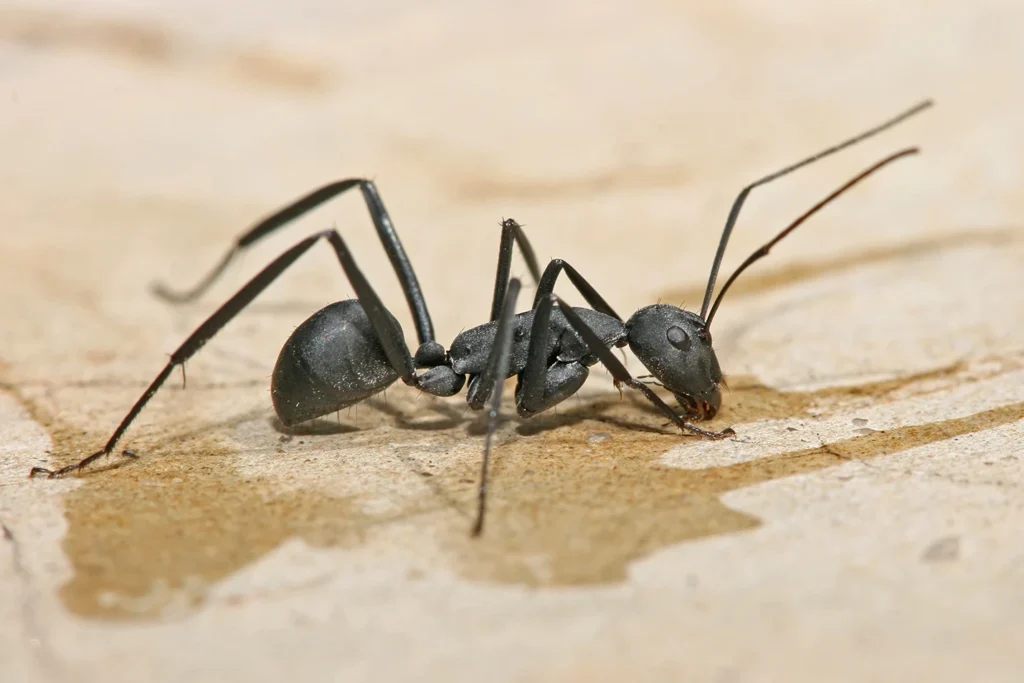
The two-part diet: sugar for the adults, protein for the brood
Almost everything about what carpenter ants eat makes sense once you understand a basic fact of colony life: the ants that go out and collect food are not the ants with the highest nutritional demand.
Adult workers are high-energy engines. They burn carbohydrate for the fuel to forage, build, defend, and travel. The members that actually need to grow, the larvae, cannot leave the nest at all, and growth requires protein. The queen, busy converting food into eggs, also needs a steady protein supply. So the colony’s diet splits cleanly down the middle:
- Carbohydrates (sugars): fuel for adult workers
- Protein: building material for larvae and the queen
We do not have to guess at the ratio. In a field study of black carpenter ants (Camponotus pennsylvanicus) published in Environmental Entomology, Cannon and Fell (2002) chemically analyzed what foragers carried back to the nest across a full season. Workers hauled back about 2.3 times as much carbohydrate as protein on each trip, with only trace amounts of fat. That figure tells you where a carpenter ant’s daily calories actually come from: liquid sugar, not meat.
What adult workers eat: liquids, sugar, and a farming partnership
Adult carpenter ants do not so much eat as drink. Their diet is overwhelmingly liquid and sweet.
Honeydew and the aphid partnership (trophobiosis)
The largest single sugar source for many wild colonies is honeydew, a sugary waste liquid excreted by aphids, scale insects, and other sap-sucking bugs. Carpenter ants do not simply raid these insects. They tend them. Workers protect aphid colonies from predators and parasites, and in return they harvest the honeydew the aphids produce. Entomologists call this relationship trophobiosis, and it is essentially a form of livestock farming. The ants get a reliable carbohydrate stream, the aphids get bodyguards.
This relationship is so central that in tropical regions some Camponotus species are described in the research literature as “secondary herbivores.” Feldhaar et al. (2007) note that these ants draw most of their nutrition from plant-derived sources, either directly from plant nectaries or indirectly through trophobiosis, and obtain relatively little nitrogen from hunting.
Nectar, plant sap, and fruit
Beyond honeydew, workers drink:
- Floral and extrafloral nectar: sugary secretions from flowers and from special glands on stems and leaves
- Plant sap from wounds in stems and bark
- Juice from ripe or rotting fruit
Human sugar
Indoors, all of that translates into a sweet tooth that homeowners know well. Carpenter ants will feed on honey, syrup, jelly, soda, sugar, and grease. The Animal Diversity Web account for C. pennsylvanicus notes that the species scavenges almost anything humans leave behind, from tuna to cookies. For a keeper, the practical takeaway is simple: a carpenter ant will almost never refuse a drop of sugar water.
What the larvae and queen eat: protein and predation
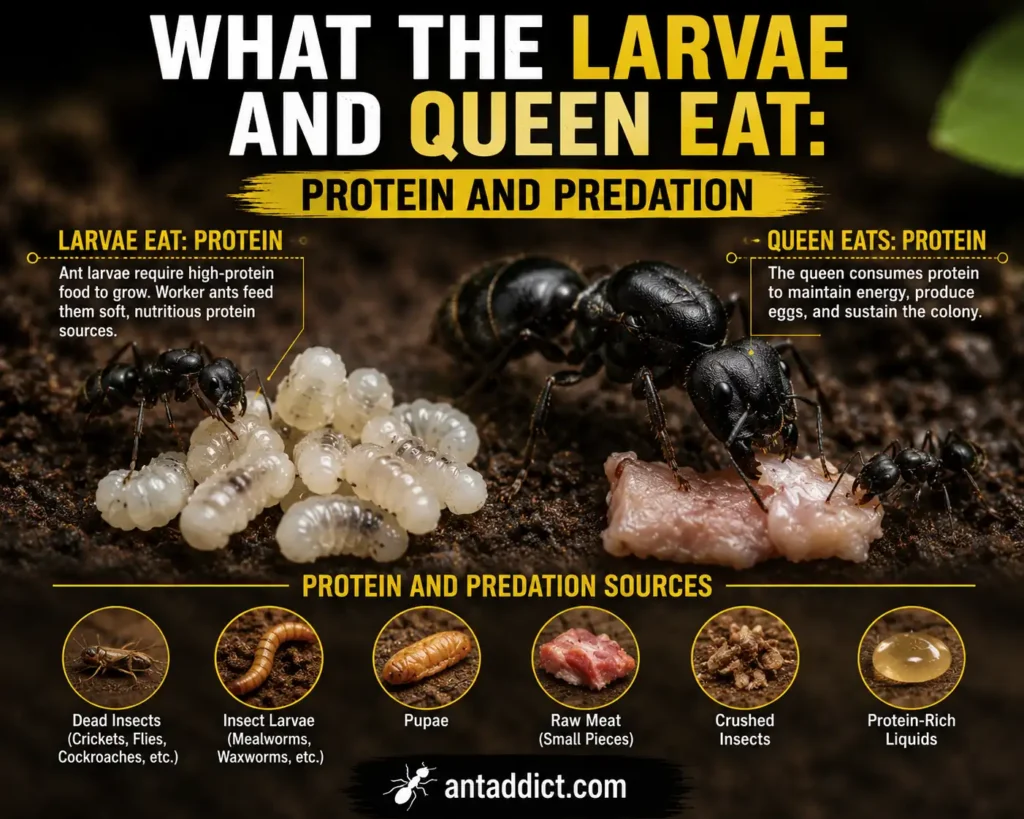
Protein is the colony’s construction material, and carpenter ants are capable hunters and scavengers to get it.
Their protein comes from:
- Live prey: other insects, including flies, caterpillars, and even other ants
- Carrion: dead insects and other small animal remains
- Scavenged protein indoors: meat scraps, pet food, grease, and crumbs
Carpenter ants are also genuinely useful predators in forest ecosystems, a fact the pest-control framing tends to bury. Sanders and Pang (1992) documented carpenter ants preying on spruce budworm, a major forest pest, in the boreal forests of northwestern Ontario. In other words, these ants help keep destructive insect populations in check. That ecological role is part of why ant keepers and naturalists view Camponotus very differently from the way an exterminator does.
The protein nearly always goes to the same place: the brood. The larvae are the colony’s only members that can process solid food, which leads to one of the strangest and most overlooked parts of how these ants feed.
The hidden helper: bacteria that build amino acids inside the ant
Here is where carpenter ants get genuinely remarkable, and where almost every other guide stops short.
Carpenter ants carry an obligate bacterial partner called Blochmannia living inside specialized cells (bacteriocytes) in the lining of their midgut. This is not an infection. It is a deep, ancient partnership that the entire tribe Camponotini depends on, and it directly shapes what these ants can eat.
When researchers sequenced the genome of Blochmannia floridanus (the symbiont of the Florida carpenter ant), they found something striking. Despite a drastically shrunken genome, the bacterium has held onto the genetic machinery to synthesize nearly all of the essential amino acids its ant host needs, plus a functional urease enzyme for recycling nitrogen (Gil et al. 2003; Degnan et al. 2005). In plain terms, the bacteria can manufacture nutrients the ant cannot make on its own and cannot reliably get from a sugar-heavy diet.
Feldhaar et al. (2007) tested whether this actually matters, in a 90-day feeding experiment. They raised worker groups on chemically defined diets, some with essential amino acids and some without, and treated some groups with antibiotics to suppress the bacteria. The result was clean:
- Workers that kept their bacteria raised brood successfully even on a diet missing essential amino acids.
- Workers whose bacteria were knocked out raised significantly less brood on that same deficient diet, and only recovered when the missing amino acids were added back.
Using nitrogen isotope labeling, the team confirmed the bacteria were genuinely recycling nitrogen and building amino acids inside the ants. Their conclusion: Blochmannia nutritionally upgrades the carpenter ant diet, and this partnership may be a big part of why the genus Camponotus became so successful and so widespread.
Why does this belong in an article about diet? Because it explains the carpenter ant’s flexibility. A colony can lean heavily on sugar and still rear healthy brood, because its internal bacteria patch the protein and nitrogen gaps. It is the biological reason carpenter ants can thrive on a diet that looks, on paper, too sweet to support growth.
How carpenter ants actually eat: trophallaxis and the social stomach
Adult carpenter ants cannot swallow solid food. Their waist (the petiole) is so narrow that solid particles physically cannot pass into the abdomen for digestion. This single anatomical fact drives the colony’s entire feeding system.
Carpenter ants effectively have two stomachs:
- A personal stomach (the midgut) for the food the individual ant digests for itself.
- A social stomach, or crop, which is a storage tank. Liquid food held here is not digested by the worker. It is carried back to the nest and shared.
Back at the nest, workers transfer this stored liquid mouth to mouth in a behavior called trophallaxis. One ant regurgitates a droplet from its crop, and a nestmate drinks it. Through this chain, a single forager can feed dozens of nestmates, including the queen and larvae. The Cannon and Fell (2002) study captured this beautifully: barely one forager in a hundred returned carrying solid food in its jaws. Almost the entire haul arrived as liquid stored in the crop.
Solid protein follows a different route. Workers carry solid prey items back for the larvae, which can digest solids. The larvae then partly digest that protein and can regurgitate liquid nutrients back up to the adults, returning protein to members that could not otherwise process it. The flow of food in a carpenter ant colony runs in both directions.
Trophallaxis does more than move calories. The shared crop fluid also spreads compounds that support colony immunity, so this constant mouth-to-mouth feeding helps keep the whole nest healthier, not just fed.
Seasonal diet shifts: why the menu changes through the year
A carpenter ant colony does not eat the same thing in May that it eats in August. The diet tracks the brood.
In spring and early summer, the queen ramps up egg laying and the nest fills with hungry, growing larvae. Protein demand spikes. Cannon and Fell (2002) found that protein collection by C. pennsylvanicus climbed to its highest points in June and September, exactly the periods when nests hold the most mature larvae. Carbohydrate collection, by contrast, stayed strong across every month, because the adults always need fuel.
In late summer and fall, as brood rearing winds down and the colony prepares to overwinter, the balance tips back toward carbohydrate, which the ants store as energy reserves. A seasonal study of the western carpenter ant (Camponotus modoc) by Hansen and Akre (1985) found that colonies actually reduced sugar collection going into fall, part of the shift into dormancy.
Timing matters too. Carpenter ants are mostly nocturnal foragers, working from around sunset until midnight during the warm months, and individual workers may travel surprising distances, up to about 100 yards from the nest, in search of food (University of Minnesota Extension). If you want to watch wild carpenter ants feed, go out after dark with a dim red light, which they cannot see well.
Do carpenter ant species eat different things?
“Carpenter ant” is not one animal. The genus Camponotus contains over a thousand species worldwide, and a few are common enough that keepers and homeowners run into them by name.
| Species | Common name | Diet notes |
|---|---|---|
| Camponotus pennsylvanicus | Black carpenter ant | Eastern North America. The best-studied diet: roughly 2.3:1 carbohydrate to protein, protein peaks in June and September (Cannon and Fell 2002). |
| Camponotus modoc | Western carpenter ant | Western North America. Reduces sugar collection heading into fall (Hansen and Akre 1985). |
| Camponotus floridanus | Florida carpenter ant | Warm climates. The model species for Blochmannia nutrition research (Feldhaar et al. 2007). |
| Camponotus herculeanus | Hercules / European carpenter ant | Cooler northern forests of Eurasia and North America. Heavy honeydew feeder. |
The broad pattern (sugar for adults, protein for brood, honeydew as the staple carbohydrate) holds across the genus. The differences are mostly in degree and in seasonal timing, shaped by climate.
What to feed pet carpenter ants
This is the part no pest-control site will ever write, because they are not in the business of keeping these animals alive. Camponotus is one of the most popular genera in the ant-keeping hobby, prized for its large, slow, watchable workers. Feeding them well is straightforward once you apply everything above: give the adults sugar, give the brood protein, and always provide water.
Carbohydrates (offer constantly)
This is the daily fuel. Keep a sugar source available at all times:
- Sugar water (roughly one part sugar to three parts water) is the simplest option
- Honey water (diluted, never thick honey, which traps ants)
- Commercial ant nectar or sugar-based ant jelly
A drop on a small dish or piece of foil, refreshed before it ferments, is plenty.
Protein (offer when brood is present)
Protein drives brood growth, so offer it regularly when you have larvae, and ease off when the colony has little or no brood:
- Feeder insects: fruit flies (Drosophila), small roaches (such as dubia nymphs), crickets, and mealworms
- Always offer feeders freshly killed or pre-frozen, never live prey large enough to injure your ants
- Protein-fortified ant jelly as a convenient backup
Water
Carpenter ants dehydrate quickly. Provide a constant, separate water source (a water-filled test tube plugged with cotton works well) independent of the sugar dish.
A simple keeper feeding guide
| Colony stage | Carbohydrate | Protein | Frequency |
|---|---|---|---|
| Founding queen (claustral) | None needed; she lives off body reserves | None | Do not disturb |
| Small colony, first workers | Sugar water always available | Small feeder insect | Protein 1 to 2 times per week |
| Growing colony with larvae | Sugar water always available | Feeder insects | Protein 2 to 3 times per week |
| Large or winding-down colony | Sugar water always available | Reduce protein | Protein as brood demands |
Not sure which foods suit your species or colony size? Try our interactive ant food finder to match a feeding plan to your genus. For the bigger picture on ant diets across species, start with our pillar guide, What Do Ants Eat?, or compare with a very different feeder in What Do Black Garden Ants Eat?
What do carpenter ants eat? The short version
If you take one thing away, make it this: what carpenter ants eat is governed by who in the colony is being fed. Adult workers run on liquid carbohydrate, mostly honeydew, nectar, and any sugar they can find, while the larvae and queen need protein from insects and other prey. Their gut bacteria quietly fill in the missing amino acids, which is why the carpenter ant diet can look so sugar-heavy yet still raise healthy brood. And no matter what you have heard, they never use wood as food.
For a keeper, that biology becomes a simple feeding rule: offer carpenter ant food in two forms, a constant sugar source for the adults and protein for the brood, plus a steady supply of water. Get that balance right and a Camponotus colony will thrive.
FAQ
Do carpenter ants eat wood?
No. Carpenter ants cannot digest wood. They excavate it to build nest galleries and push the debris out as sawdust-like frass. Termites eat wood; carpenter ants only tunnel through it.
What is a carpenter ant’s favorite food?
By volume, sugar. Field analysis of black carpenter ants found they collect about 2.3 times more carbohydrate than protein, with honeydew from aphids being the staple. Protein from insects is collected mainly to feed growing larvae.
Do carpenter ants eat other ants?
Yes. As omnivorous predators and scavengers they will eat other insects, including other ants, both as live prey and as carrion. Under severe starvation, stressed colonies have even been observed resorting to cannibalism within the nest.
Why are carpenter ants attracted to my kitchen?
They are usually after sugar, grease, and water rather than the wood in your home. Sweet spills, sticky residue, pet food, and moisture all draw foraging workers indoors.
Can carpenter ants survive without food for long?
Adult workers are surprisingly resilient and can persist for extended periods on stored reserves and crop-shared liquids. They are far more vulnerable to a lack of water than a short lack of food, which is why a constant water source is critical for kept colonies.
How do carpenter ants feed their young?
Workers carry solid protein back to the larvae, which are the only colony members able to digest solids. Liquid sugar is shared mouth to mouth (trophallaxis) from the workers’ social stomach. Larvae can even predigest protein and pass liquid nutrients back to the adults.
What can I feed pet carpenter ants?
A constant diluted sugar or honey water source for the adults, plus feeder insects (fruit flies, small roaches, crickets, mealworms) for protein when brood is present, and a separate constant water source. Offer protein more often when larvae are growing and reduce it when brood is scarce.
Do carpenter ants need protein every day?
No. Adults run on carbohydrate, so sugar should always be available, but protein is mainly for the brood. Offer protein a few times a week when the colony has larvae, and scale it back when it does not.