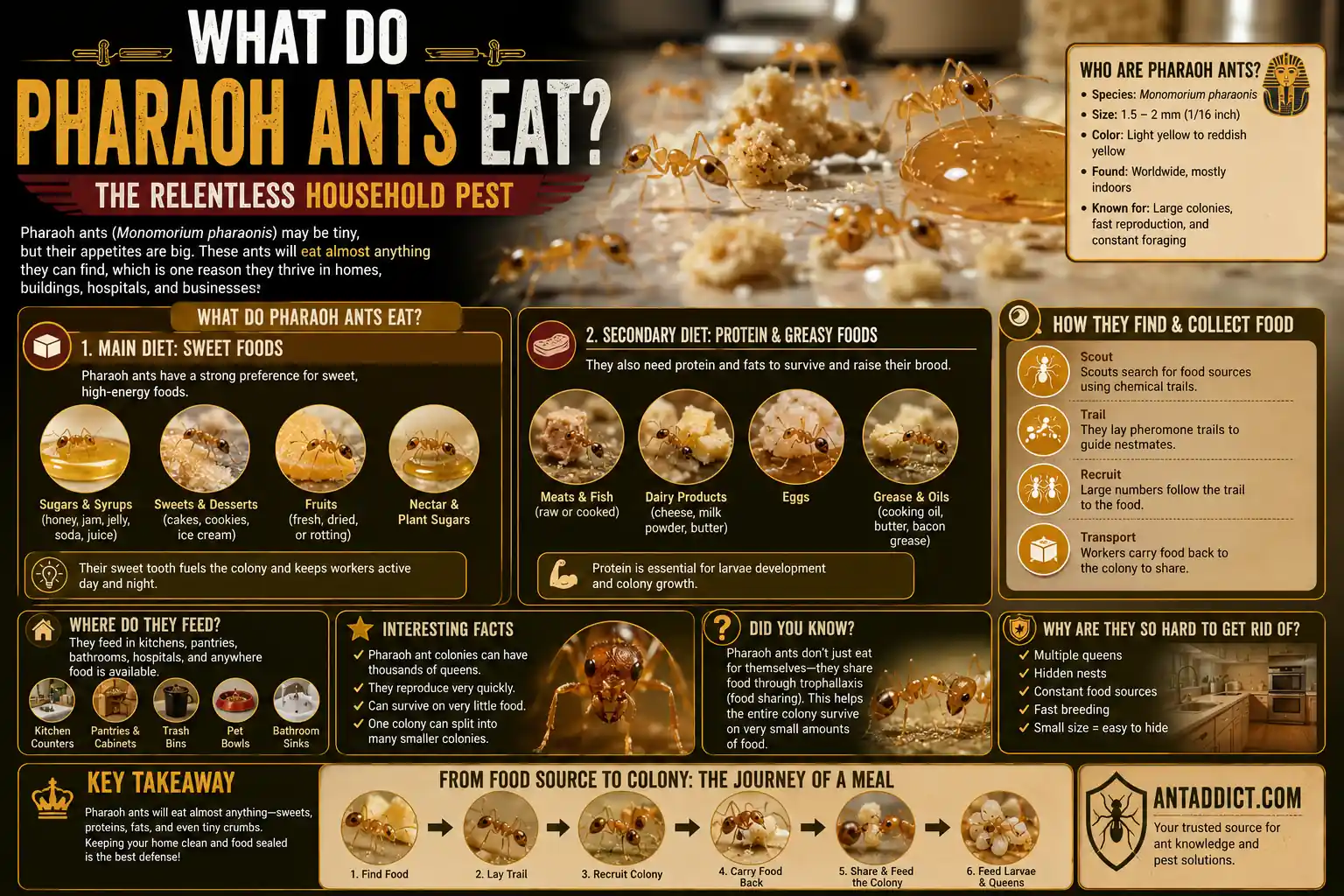
What Do Pharaoh Ants Eat? The Relentless Household Pest
Written from an ant keeper’s perspective, with peer-reviewed sources. Last updated: June 2026.
Pharaoh ants are tiny, pale, and almost impossible to get rid of, and a big part of why comes down to their stomachs. So what do pharaoh ants eat? Almost anything. They are extreme omnivores that will take sweets, grease, meat, dead insects, and famously even the contents of soiled bandages and open wounds in hospitals. But the truly remarkable part is not the length of the menu. It is how cleverly the colony manages it: pharaoh ants balance their own nutrition like a single organism, and they run one of the most sophisticated food-finding systems known in any insect, complete with chemical “no entry” signs.
Quick answer: Pharaoh ants (Monomorium pharaonis) are extreme omnivores. They feed on sugary foods (honey, jelly, sugar, syrups), greasy and fatty foods (butter, bacon, oils), and protein (dead insects, other small invertebrates, carrion, and even blood, wound fluids, and soiled medical dressings). The colony actively balances its intake of protein and carbohydrate, switching between food types as the brood and workers need them, and finds food using scouts and an elaborate trail-pheromone system.
This article focuses on the wild and pest diet of pharaoh ants. If you are thinking of keeping them, read the cautionary note first, because this is a species you almost certainly should not keep.
The short answer: an ant that eats almost anything
Pharaoh ants are among the most extreme generalist feeders in the ant world, and that flexibility is the secret to their success as a global indoor pest. Their menu spans nearly every kind of food a human household or hospital contains:
- Sweets and carbohydrates: sugar, honey, jam and jelly, syrups, cakes, breads, and fruit juices
- Greasy and fatty foods: butter, bacon, oils, and other fats
- Protein: dead and live insects, other small invertebrates, carrion, meats, and pet food
- Disturbing extras: they are notoriously drawn to blood, wound fluids, and soiled medical dressings, and have even been recorded feeding on things like shoe polish
This is not a fussy ant. A pharaoh ant colony will exploit whatever food is available, store some of it, and move on to something else when its needs change. That adaptability is exactly why these ants thrive indoors year-round, from kitchens to hospital wards, in climates where they could never survive outside.
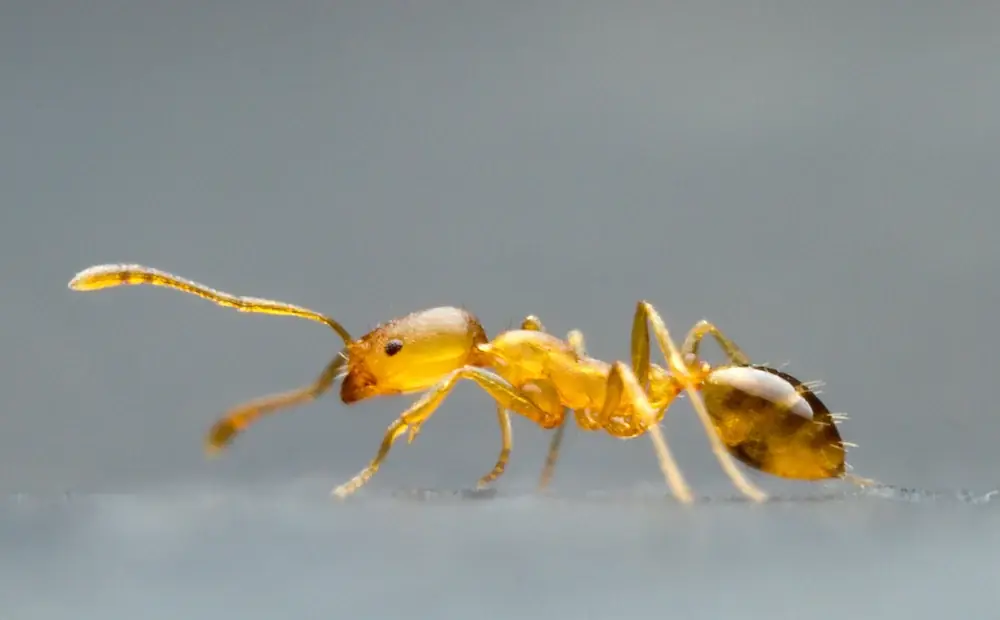
The science of a balanced diet: a colony that eats to a target
Here is where pharaoh ants get genuinely impressive, and where every pest-control page stops at “they eat sweets and proteins.” A pharaoh ant colony does not just grab food at random. It regulates its nutrition with real precision, behaving almost like a single organism managing its own balanced diet.
Like most ants, the colony needs carbohydrate to fuel its adult workers and protein to raise its larvae. What sets pharaoh ants apart is how actively they keep those two in balance. In a classic experiment, Edwards and Abraham (1990) found that pharaoh ant workers show “satiation” and “alternation” responses: a colony fed mostly on protein will then strongly prefer carbohydrate, and a colony fed mostly on sugar will switch to craving protein. By constantly alternating, the colony ensures it gets a varied, balanced diet rather than a glut of one nutrient.
Modern research has measured this balancing act with striking precision. Using a method called nutritional geometry, a Birla A. Krabbe 2019 study found that pharaoh ant colonies aim for a consistent intake mix that tilts slightly toward carbohydrate, and that their food choices juggle two competing pressures: workers live longest when the diet is rich in carbohydrate, while the colony rears the most brood when the diet is higher in protein. In other words, the colony does not just eat. It calculates, steering its collective intake toward the blend that keeps both the workforce alive and the nursery growing.
This is the deeper answer to what pharaoh ants eat: not a fixed menu, but a moving target the colony continuously adjusts.
The science competitors miss: chemical “no entry” signs
The other half of the pharaoh ant’s food story is how it finds and chooses food, and this is where the species made scientific history.
Like many ants, pharaoh ants send out scouts that lay attractive pheromone trails to guide nestmates to food. But pharaoh ants do something more sophisticated, and they were the species in which it was first discovered. In a landmark study, Robinson and colleagues (2005) showed that pharaoh ants also lay a repellent “no entry” pheromone, a chemical signal that marks an unrewarding path and tells nestmates not to bother going down it. This was the first time a negative, repellent trail pheromone had ever been demonstrated in ants, and it was published in Nature.
Think of it as a road network with both “go” and “stop” signs. Later work showed that pharaoh ants use at least three different trail pheromones: a long-lasting attractive trail, a short-lived attractive trail, and the short-lived repellent one, with the repellent signal concentrated at junctions where trails split, exactly where a forager has to make a decision (Robinson and colleagues, 2008). The repellent mark even outlasts the short-term attractive one, so a “no entry” sign stays up longer than a fading “this way” sign.
The result is a self-organizing food-finding system of remarkable efficiency, run entirely by tiny ants following simple chemical rules, with no one in charge. It is a big reason pharaoh ants are so good at locating every crumb in a building, and so hard to starve out.
Feeding the colony: how food gets shared
Once food is found, it has to reach a colony that may contain multiple queens and many thousands of workers spread across several connected nests. Pharaoh ants do this through trophallaxis, the mouth-to-mouth sharing of liquid food from one ant’s crop to another, which distributes a meal throughout the colony. Liquids and processed foods move efficiently through this network to the queens and the developing brood.
That colony-wide sharing has a famous practical consequence. It is the whole basis of ant baiting: a worker that picks up poisoned bait carries it home and shares it, spreading the toxicant through the colony. The catch, as the nutrition research explains, is that pharaoh ants get “bored” of a single food. Because of the satiation response, a bait that worked last week may be ignored this week as the colony’s nutritional cravings shift, which is one reason these ants are so notoriously difficult to bait successfully.
The hospital ant: a disturbing side of the diet
No honest account of what pharaoh ants eat can skip the reason they are dreaded in healthcare settings. Pharaoh ants are strongly attracted to protein and moisture, and in hospitals that can mean blood, wound fluids, used dressings, and even fluids in intravenous lines. They have been recorded entering wounds and feeding on the secretions of patients who cannot brush them away.
This is not just unpleasant. Because the same ants travel between drains, waste, and patients, they can carry and spread harmful bacteria. Pharaoh ants were documented as mechanical vectors of pathogens in hospitals decades ago (Beatson, 1972), with the ants capable of transferring organisms such as Salmonella, Staphylococcus, and Pseudomonas. Their appetite, in other words, turns them from a nuisance into a genuine hygiene hazard in sensitive environments.
Why their diet makes them nearly unkillable
The pharaoh ant’s eating habits are the key to one of its most infamous traits: it is extraordinarily hard to eradicate.
Three diet-related factors stack up. First, the broad, flexible menu means there is almost always something for them to eat, so starving them out rarely works. Second, the satiation and alternation responses mean no single bait stays attractive for long, so simple baiting often fails. Third, and most importantly, pharaoh ants reproduce by “budding,” in which a queen and a group of workers carrying brood split off to start a new nest nearby. When a colony is stressed, sprayed, or disturbed, it responds by budding, scattering into multiple satellite colonies and making the infestation worse rather than better (Buczkowski and Bennett, 2009).
This is why professionals never spray pharaoh ants and instead rely on patient, carefully rotated baiting that works with the colony’s shifting appetite rather than against it. The diet is not a side detail in pharaoh ant control. It is the whole battlefield.
Should you keep pharaoh ants?
This is the rare ant where the honest answer is: please do not.
A serious caution: Pharaoh ants are one of the world’s most invasive indoor pests, and they are a genuinely bad choice as a pet. They are extremely small, they escape easily, and above all they reproduce by budding, so a single escaped fragment with a queen can establish a new colony in your walls. Once established indoors, pharaoh ants are notoriously difficult to eradicate, can spread through an entire building, and may put your neighbors at risk too. They are kept only in tightly controlled research laboratories for studies on foraging and social behavior, with containment most hobbyists cannot replicate. For the overwhelming majority of people, the responsible choice is simply not to keep them.
If you want to keep ants with a comparable appetite for sweets and protein but without the infestation risk, far better beginner options exist. For matching a plan to a species you can responsibly keep, try our interactive ant food finder, and for the wider picture start with our pillar guide, What Do Ants Eat?. You can also compare gentler household feeders in What Do Argentine Ants Eat? and a true seed specialist in What Do Harvester Ants Eat?
What do pharaoh ants eat? The short version
If you take one thing away, make it this: pharaoh ants eat almost anything, but they eat it intelligently. Their menu runs from sweets and grease to dead insects, carrion, and even wound fluids and soiled dressings, which is why they thrive indoors anywhere in the world. Beneath that endless appetite is a colony that balances its own nutrition like a single organism, defending a target blend of protein and carbohydrate, and that finds food using a sophisticated trail system featuring the first chemical “no entry” sign ever discovered in ants. That same flexible, self-regulating diet is exactly why pharaoh ants are nearly impossible to eradicate. Understand how they eat, and you understand why they win.
FAQ
What do pharaoh ants eat in a house?
Pharaoh ants eat almost anything in a home: sweets like sugar, honey, and jelly, greasy and fatty foods like butter and bacon, and protein such as dead insects, meats, and pet food. They are extreme omnivores, which is why they are such a persistent indoor pest.
Do pharaoh ants prefer sweet or greasy food?
Both, and they switch between them. Pharaoh ant colonies actively balance their diet, alternating between carbohydrate-rich (sweet) foods and protein-rich or greasy foods depending on what the colony currently needs. A colony that has had a lot of one type will start preferring the other.
Do pharaoh ants really eat wounds and blood?
Yes. Pharaoh ants are strongly drawn to protein and moisture, and in hospitals they have been recorded feeding on blood, wound fluids, and soiled dressings, and entering IV equipment. This, combined with their ability to carry bacteria, makes them a serious concern in healthcare settings.
How do pharaoh ants find food so well?
They use scouts and chemical trail pheromones, including an unusually sophisticated system with both attractive trails and a repellent “no entry” pheromone that marks unrewarding paths. Pharaoh ants were the first ant species shown to use such a negative trail signal.
Why are pharaoh ants so hard to get rid of?
Largely because of their diet and breeding. Their broad menu means they rarely starve, they lose interest in any single bait over time, and disturbing or spraying them causes the colony to “bud” into multiple new nests. Control relies on patient, rotated baiting, never spraying.
Do pharaoh ants eat other insects?
Yes. They hunt and scavenge other small invertebrates and feed on dead insects and carrion as a protein source, which mostly goes to feed the larvae. They will also exploit other household pests’ food and remains.
Should I keep pharaoh ants as pets?
No. Pharaoh ants are a highly invasive indoor pest that escapes easily and reproduces by budding, so they can infest your home and building and are extremely hard to remove. They are kept only in controlled research settings, not as pets.