What Do Army Ants Eat? Nature’s Unstoppable Swarm
Written from an ant keeper’s perspective, with peer-reviewed sources. Last updated: June 2026.
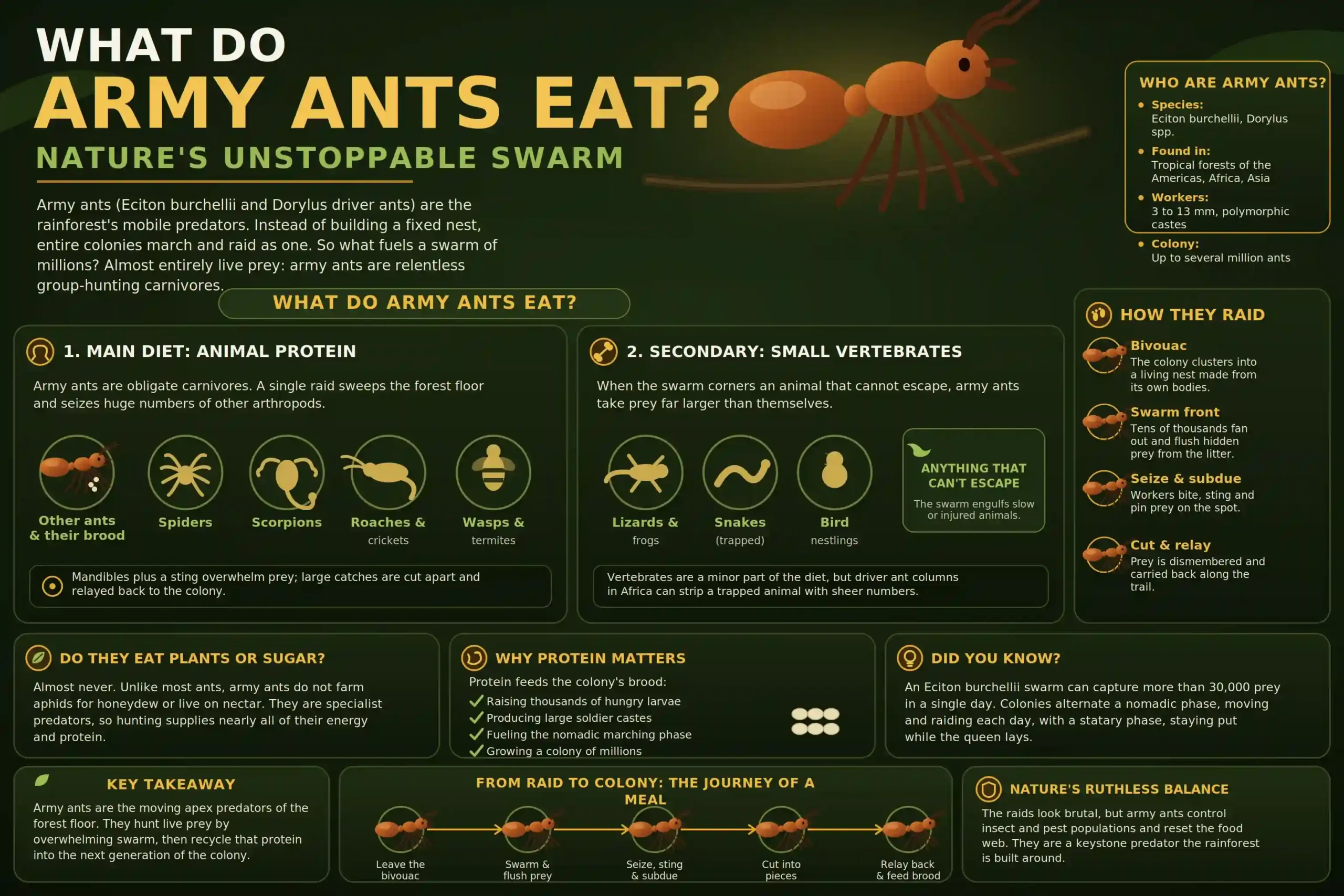
Army ants are the great hunters of the ant world, famous for sweeping across the forest floor in living rivers that overwhelm anything in their path. So what do army ants eat? Unlike almost every other ant, they are pure carnivores: they eat live prey they catch in massive group raids, and they eat almost nothing else. But the real answer is more surprising than the legend. For all their fearsome reputation, army ants are not eating cattle and careless campers. By a wide margin, the favorite food of an army ant is other ants, especially the helpless brood inside rival nests.
Quick answer: Army ants (the legionary ants, mostly in the subfamily Dorylinae, including New World Eciton and African Dorylus driver ants) are predatory carnivores that hunt live prey in huge coordinated raids. Their diet is overwhelmingly other invertebrates, and research shows it is dominated by other ants and their brood, along with wasps, spiders, and assorted insects. A few species occasionally take small vertebrates that cannot escape, but the popular image of army ants devouring large animals is mostly myth. Their entire nomadic lifestyle exists to feed their enormous, hungry brood.
If you are wondering whether you can keep army ants, skip to can you keep army ants? The short answer is no.
The short answer: relentless carnivores
Every other ant in our guides runs on something plant-based or sweet, whether that is sugar, honeydew, seeds, or cultivated fungus. Army ants are the great exception. They are obligate predators that live by hunting other animals, and they do it on a scale unmatched in the insect world.
The name “army ant” applies to more than 200 species that share a hunting lifestyle called legionary behavior: they raid in enormous cooperative groups, and they have no permanent nest, instead wandering almost constantly. The most famous are the New World swarm raiders like Eciton burchellii and the African Dorylus driver ants. Whatever the species, the core of the diet is the same: live prey, caught by the colony acting as one.
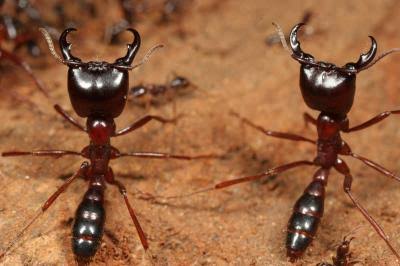
What army ants actually eat
Here is where the science overturns the legend, and where no competitor goes. When researchers actually catalog what army ants carry home, the answer is strikingly specific: mostly other ants.
In a large diet survey of eleven surface-raiding army ant species in Costa Rica, scientists collected thousands of prey items and found that other ants made up the overwhelming majority of the catch (Hoenle and colleagues, 2019). In that survey, around 98 percent of the prey were other ants, and roughly 87 percent of everything the colonies hauled home was larvae and pupae raided from rival ant nests. In other words, an army ant raid is mostly a raid on rival ant nests, carrying off their defenseless young.
That makes most army ants specialist nest robbers rather than indiscriminate everything-eaters. And they divide up the targets with surprising precision. Different army ant species specialize on different prey, which lets many species share the same forest without competing: some focus on the brood of carpenter ants (Camponotus), others on leafcutter ants (Atta and Acromyrmex), others on particular ground-nesting ants. Each species effectively has its own hunting niche.
The famous broad-spectrum exception is Eciton burchellii, the classic swarm-raiding army ant. It takes a wider menu, including a diverse range of litter arthropods, spiders, scorpions, crickets, and other insects, alongside its staple of other ants’ brood. Even so, a large share of its diet is still the brood of Camponotus carpenter ants. A single Eciton burchellii colony can capture tens of thousands of prey items in a single day. Underground army ant species, meanwhile, hunt soil-dwelling arthropods and earthworms, and have occasionally been recorded taking turtle eggs or oily seeds.
The myth: do army ants eat large animals or people?
This is the question everyone really arrives with, so let us be clear and accurate.
The image of army ants stripping a tethered cow or an unlucky person to a skeleton is, overwhelmingly, fiction. Army ants eat invertebrates almost exclusively. Healthy animals simply walk away from a raid, which advances slowly enough to escape with ease. A few species do occasionally kill and eat small vertebrates that cannot flee, such as leaf-litter lizards, nestling birds, or trapped frogs and snakes, but these are a tiny and opportunistic part of the diet, not a target. The New World Eciton army ants are not even physically built to process vertebrate prey; large animals caught in a raid are usually killed and then left behind for scavengers and the flies that follow the swarm.
The African Dorylus driver ants are the most capable of tackling larger prey and can occasionally overwhelm a small, restrained animal, which is the kernel of truth behind the legend. But even they live overwhelmingly on insects and other invertebrates. The terrifying “marabunta that devours everything” is a story, not a diet.
The science competitors miss: the diet that drives the whole colony
Here is the standout, and it explains the single most famous fact about army ants, that they never stop moving. The army ant’s nomadism exists to feed its diet, or more precisely, to feed its brood.
Army ant colonies cycle between two phases tied directly to feeding. During the nomadic phase, the colony has a huge batch of developing larvae, and hungry larvae demand enormous amounts of food. To supply them, the colony raids almost every day and moves to a new campsite almost every night, constantly seeking fresh hunting ground.
Then the larvae spin cocoons and pupate, and pupae do not eat. With the brood’s appetite switched off, the colony enters the stationary phase: raiding drops sharply, the colony stays in one bivouac for two to three weeks, and the captured food now flows to the queen. Fed and stationary, she swells with eggs and lays the next generation, and when those eggs hatch into a fresh wave of hungry larvae, the nomadic phase begins again.
In other words, the army ant’s restless wandering is not aimless aggression. It is a feeding schedule. The colony moves because its growing young must be fed, and it settles when they do not. The diet is the engine of the entire army ant way of life.
How army ants hunt
The way army ants gather food is as remarkable as what they eat, and it is genuinely different from how other ants forage.
Most ants send out lone scouts to find food and then recruit nestmates to it. Army ants do the opposite: they launch a leaderless swarm of thousands of workers all at once, fanning out to detect and overwhelm prey by sheer cooperative force. To keep such a massive column flowing, the ants self-organize into traffic lanes, with outbound ants taking the outer edges and prey-laden returning ants running up the center, a system worked out so the columns never jam (Couzin and Franks, 2003). When the terrain breaks up, workers link their own bodies together to build living bridges and fill potholes, smoothing the path for the ants carrying prey.
Remarkably, the workers of many army ant species are blind or nearly so, navigating entirely by pheromone trails. The colony’s intelligence is collective: no individual ant directs the raid, yet the swarm behaves like a single coordinated predator. Larger soldier ants with oversized jaws help defend the column and haul the heaviest prey back to the nest.
A moving feast for the whole forest
An army ant raid does not just feed the ants. It feeds an entire community, which is why army ants are considered keystone species in tropical forests.
As the swarm advances, it flushes countless insects and other small creatures from their hiding places. Specialized birds called antbirds follow the raids to snatch up this fleeing prey, eating the escapees rather than the ants themselves. They are not alone: the army ant Eciton burchellii supports the largest known association of animals centered on a single species, with an estimated 300 to 500 associated species (Rettenmeyer and colleagues, 2011), from birds to beetles to mites, that live off the raid, the colony, or its refuse. The army ant diet, in effect, sets a table for a whole ecosystem.
How food gets home: the living nest
Army ants do not carry their catch back to a built nest, because they do not have one. Instead, the colony forms a living nest called a bivouac, made entirely of the ants’ own bodies linked together into a great ball, with the queen and brood sheltered inside. Prey is dismembered in the field, carried back along the columns, and brought into the bivouac to feed the larvae and the queen. Leftover remains pile up in refuse deposits, or middens, which themselves become a feeding ground for scavenging beetles and other guests.
Can you keep army ants?
This is the rare ant where keeping it is essentially impossible, and the reasons all come back to the diet.
The honest answer: You cannot realistically keep army ants as pets, and no responsible source will tell you otherwise. They are obligate nomads that must raid more or less constantly to feed their brood, with colonies numbering from the hundreds of thousands into the millions, far beyond any home setup. They have a single specialized queen who cannot be replaced, and they reproduce by splitting the colony rather than by founding queens, so there is no practical way to start or sustain one in captivity. Army ants are a spectacle to witness in the wild or in a good documentary, not an animal to keep.
If you want to keep ants that actually thrive in captivity, almost any other species is a better choice. To match a feeding plan to a species you can responsibly keep, try our interactive ant food finder, and for the full picture start with our pillar guide, What Do Ants Eat?. For other dramatic predators that are easier to understand, compare What Do Fire Ants Eat? and What Do Bullet Ants Eat?
What do army ants eat? The short version
If you take one thing away, make it this: army ants are pure carnivores that hunt live prey in mass raids, and their favorite food is other ants, especially the brood they steal from rival nests. Studies of what they actually carry home show their prey is almost entirely other ants and their young, rounded out with spiders, insects, and other small invertebrates, and only rarely a small trapped vertebrate. The legend of army ants devouring large animals is mostly myth. Best of all, their endless wandering is really a feeding schedule: the colony raids and roams to feed its hungry larvae, and rests when the brood pupates. Understand the hunt, and you understand the army ant.
FAQ
What do army ants eat in the wild?
Army ants are carnivores that hunt live prey in large raids. Their diet is overwhelmingly other invertebrates, and studies show it is dominated by other ants and their brood, along with wasps, spiders, and various insects. A few species occasionally take small vertebrates that cannot escape.
Do army ants eat other ants?
Yes, more than anything else. Research on surface-raiding army ants found that other ants made up around 98 percent of their prey, and most of that was the larvae and pupae of rival ant colonies. Most army ants are essentially specialist raiders of other ants’ nests.
Do army ants eat humans or large animals?
Almost never, and the popular image is mostly myth. Healthy animals and people easily walk away from a slow-moving raid. Army ants eat invertebrates overwhelmingly, and only occasionally take small trapped vertebrates. The New World species cannot even process large prey, leaving it for scavengers.
Do army ants eat plants, seeds, or leaves?
No. Army ants are predators, not plant-eaters. They do not eat leaves or fungus, and only rarely take oily seeds. Their food is almost entirely other animals, caught alive during raids.
How do army ants hunt?
They launch a leaderless swarm of thousands of workers that fan out to overwhelm prey all at once, rather than scouting and recruiting like most ants. They organize into self-sorting traffic lanes and build living bridges from their bodies, and they navigate by scent, since many are blind.
Why do army ants keep moving?
Because of their diet. When the colony has hungry larvae, it raids daily and moves to a new site almost every night to find enough prey. When the larvae pupate and stop eating, the colony stays put for a few weeks while the queen lays eggs. Their nomadism is a feeding schedule.
Can you keep army ants as pets?
No. Army ants are nomadic, must raid constantly to feed huge colonies of hundreds of thousands to millions, and have a single queen that cannot be replaced. They cannot be realistically kept in captivity and are best appreciated in the wild.