Bullet Ant: The World’s Most Painful Sting, the Venom, and the Amazon Ritual
Last reviewed: June 2026. Claims in this guide are drawn from first-hand keeping and the peer-reviewed and reference sources linked inline and listed below. The cultural material is presented with respect for the Sateré-Mawé people, to whom the ritual belongs.
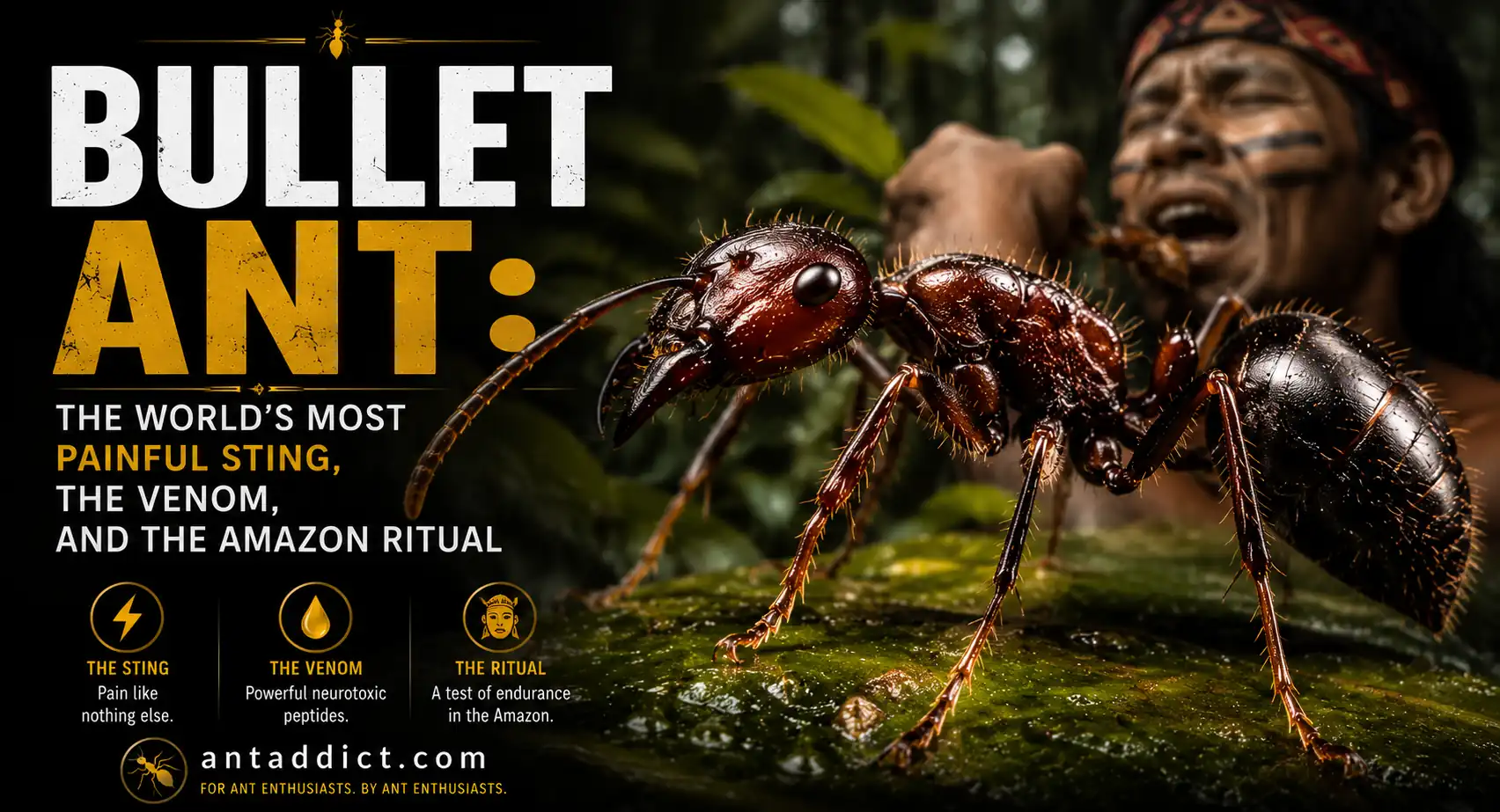
The bullet ant (Paraponera clavata) is a large rainforest ant of Central and South America, famous for having what is widely considered the most painful sting of any insect. It earns its name because victims say the sting feels like being shot. The pain sits at the very top of the Schmidt sting pain index, comes in waves, and can last a full 24 hours, driven by a venom peptide called poneratoxin. In the Brazilian Amazon, the Sateré-Mawé people build an entire coming-of-age ritual around enduring it.
Some ants impress you. The bullet ant commands respect the way a loaded weapon does. It is nearly an inch long, jet-black, and armed with a sting so notorious it has its own place in anthropology, medicine, and folklore.
I keep ants, and this is one I study from a safe distance rather than keep. This guide covers what the bullet ant is, why its sting is the benchmark for pain, how the venom actually works, the extraordinary ritual built around it, and the honest answer to whether anyone should keep one.
What is a bullet ant?
The bullet ant is a single species, Paraponera clavata, and it is unusual enough to sit alone in its own genus and its own subfamily, Paraponerinae. It is not closely related to the ants in your kitchen. It is an ancient, heavyset lineage of its own.
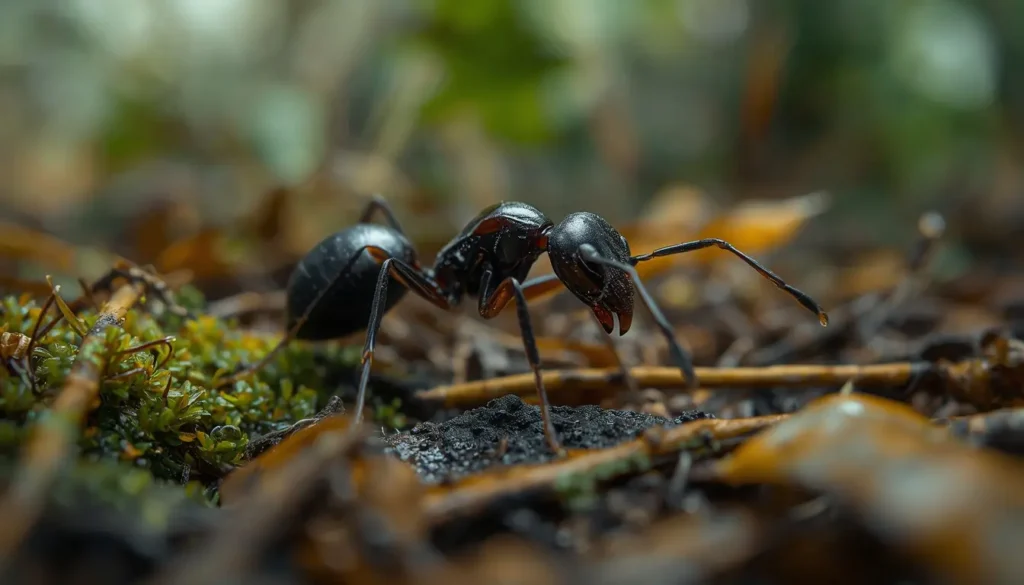
Size is the first thing you notice. Workers are giants by ant standards, reaching up to about 1.2 inches (30 mm), with a glossy reddish-black body, powerful jaws, and a prominent stinger at the tip of the abdomen. A mature colony holds a few hundred to a couple of thousand workers.
The species name clavata means “club-shaped,” and Paraponera means “near-Ponera,” tying it to the primitive stinging ants. Everything about the bullet ant, its size, its venom, its solitary branch of the family tree, marks it as one of the more formidable ants alive.
Why is it called the bullet ant?
For the obvious reason. People who have been stung describe a pain so sudden and severe that it is often compared to being shot, and that comparison gave the ant its English name.
It collects fitting names wherever it lives. Across its range it is called the tocandira or tucandeira, and in parts of the Amazon it is the vinte-e-quatro-horas, the “twenty-four-hour ant,” because the agony from a single sting can last most of a day.
Unlike a bee, the bullet ant does not lose its stinger. It can sting again and again, pumping venom with each strike, which is exactly why it features in a ritual designed to maximize pain.
The most painful sting in the world
The bullet ant is the reference point against which all other stings are measured. The entomologist Justin Schmidt built a now-famous pain scale by getting stung by insects across the world and rating each one from 1 to 4. The bullet ant stood alone at the top, the only sting he originally rated a full 4.
Schmidt described the experience in vivid terms, likening it to walking barefoot over burning coals with a rusty nail driven through the heel. Where a honey bee sting is a brief, sharp jab, the bullet ant delivers waves of deep, throbbing, building pain that do not let up for hours.
| Insect | Schmidt rating | What it feels like |
|---|---|---|
| Sweat bee | 1 | Light, fleeting, almost trivial |
| Honey bee | 2 | Sharp, familiar, burning |
| Paper wasp | 3 | Caustic and bitter, longer lasting |
| Tarantula hawk wasp | 4 | Instant, electric, blindingly intense but brief |
| Bullet ant | 4.0+ | Relentless waves that build and last up to 24 hours |
The crucial difference is time. The tarantula hawk’s sting is arguably as intense in the moment, but it fades in minutes. The bullet ant’s pain settles in and stays, hour after hour, which is what makes it uniquely dreaded.
Poneratoxin: how the sting actually works
Here is the part almost every other page skips, and it is the most interesting of all. The bullet ant’s agony is not caused by tissue damage. It is a hijacking of your nervous system.
The venom’s active ingredient is a peptide called poneratoxin. Researchers who isolated and studied it found that it works on the voltage-gated sodium channels in your nerve cells, the tiny gates that let nerves fire. Poneratoxin jams those gates open.
With the channels stuck open, the affected nerves cannot reset. They fire over and over, flooding the brain with a continuous, unstoppable pain signal. Your body is screaming injury when almost no injury has occurred.
That mechanism explains the bullet ant’s strange signature: extreme pain with relatively little swelling or lasting harm. A wound that should match the agony simply is not there. The sting hurts like a catastrophic injury while doing very little actual damage, because the whole effect is electrical, not physical.
The same property makes poneratoxin genuinely useful to science. Because it manipulates nerve signaling so precisely, it is being studied as a lead for new painkillers and as a natural insecticide. The most painful molecule in the insect world may end up helping treat pain.
It is a strange kind of gift. The peptide that the Sateré-Mawé endure as a test of manhood, and that stops a person in their tracks in the forest, is now read by scientists as a finely tuned key to how nerves signal pain, potentially one that could help switch that pain off.
Is a bullet ant sting dangerous?
For a healthy adult, a bullet ant sting is an ordeal, not usually a catastrophe. It is famous for pain rather than lethality. But it is far from harmless.
A single sting can bring on temporary paralysis of the stung limb, uncontrollable trembling and shaking, cold sweats, nausea, a racing or irregular heartbeat, fever and chills, and swollen lymph nodes. The medical literature on the Sateré-Mawé ritual notes that a person may need up to two weeks to fully recover from a single sting, and may shake for days.
The real danger, as with bees and wasps, is an allergic reaction. Anyone who reacts severely to insect venom could face a medical emergency, and multiple stings raise the stakes. In the rainforest, a bullet ant is an insect to give a wide berth, not to handle.
The Sateré-Mawé bullet ant glove ritual
The most extraordinary chapter in the bullet ant’s story belongs to the Sateré-Mawé people, who live along the Andirá River near the border of Amazonas and Pará states in the Brazilian Amazon. For them, the bullet ant is at the center of a sacred rite of passage.
In the ritual, known as the waumat or tucandeira, elders first smoke a bullet ant nest to drive the workers out, then sedate the ants in an herbal brew. While the ants are limp, the elders weave them into a glove of palm fronds, stingers turned inward, and finish it as an ornate ceremonial piece decorated with palm fiber and feathers.
Then the ants wake up. A boy pushes his hand into the glove and holds it there for about ten minutes while the colony stings him without pause, and he is expected to endure it in silence, without crying out, as the community chants and drums around him.
One session is not enough. A young man repeats the ordeal many times, by some accounts up to twenty, across months and years, before he is recognized as a man and a warrior able to hunt, protect, and lead. To flinch or complain is to fail.
It would be easy to sensationalize this, so it is worth being clear: to the Sateré-Mawé the sting is not punishment but purification and proof, a controlled encounter with the worst pain the forest offers, tied to courage, endurance, and readiness to serve the community.
The Sateré-Mawé are also known as the guardians of guaraná, the Amazonian plant now used the world over, and the tucandeira belongs to that same deep relationship with their forest. Before a boy takes the glove, his forearm is often stained dark with genipapo dye, and the whole village takes part, with drummers, singers, and elders marking the ordeal. It is a shared act, not a solitary trial.
Today the ritual also carries weight as an act of cultural survival, as these communities work to hold their ancestral land and pass their traditions to a new generation. It is their heritage, not a stunt.
Where bullet ants live
Bullet ants are creatures of the wet tropics. They live in humid lowland rainforest across Central and South America, ranging from Honduras and Nicaragua in the north down through the Amazon basin to Bolivia and Paraguay.
They are ground-and-tree ants. Colonies typically nest in the soil at the base of a large tree, often one with buttress roots, and the workers travel up the trunk to forage in the canopy far overhead. A single well-placed nest tree can support the colony for years.
You will not find bullet ants infesting a house or a picnic. They are wild rainforest specialists, which is one reason the pest-control framing you see on some pages misses the point entirely. This is an ant of the deep forest, not the kitchen.
Biology and behavior
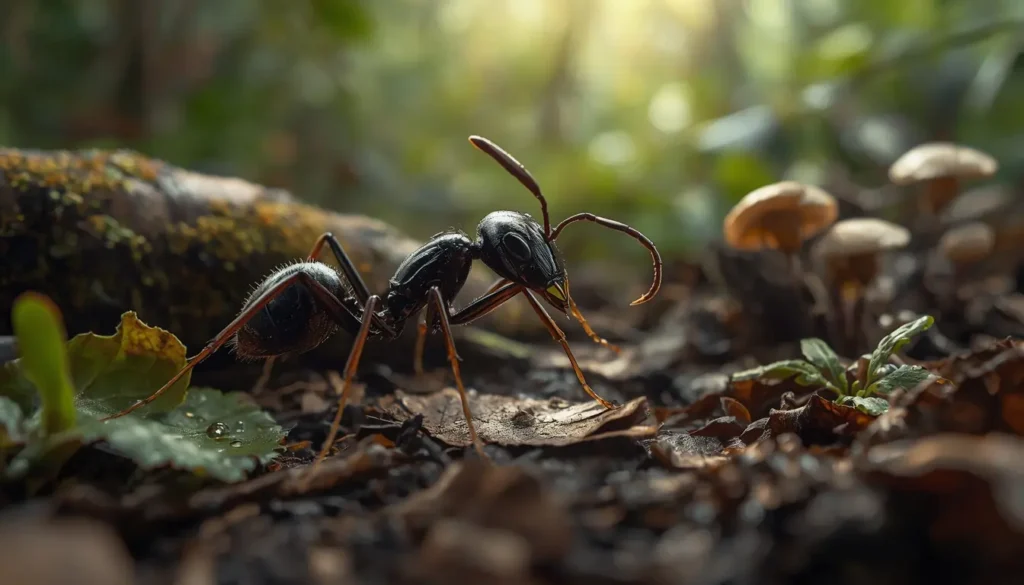
For all its fearsome reputation, a bullet ant colony is a fairly ordinary ant society scaled up and heavily armed. Workers leave the nest to forage, often at night, climbing into the canopy to collect nectar and to hunt small arthropods and other prey, which they carry back to feed the brood.
That diet of sugar and protein is standard ant fare, the same balance covered in what do ants eat, just gathered dozens of feet up in the trees. Researchers studying which trees the ants choose found they are selective about their nest sites, favoring particular large trees rather than settling at random.
Bullet ants are not looking for a fight. Left alone, a forager will go about its business. But a threatened worker gives a clear warning first, releasing a musty odor and producing a shrill stridulation, a squeak you can sometimes hear, before it resorts to that famous sting. It is a courtesy most people are wise to heed.
What preys on a bullet ant?
A sting that stops a human does not make the bullet ant untouchable. Plenty of rainforest animals eat ants, and anteaters, armadillos, and some birds will take bullet ants despite the venom. Colonies are long-lived, often persisting for years at a good nest tree, but individual foragers face constant risk in the canopy.
The strangest enemy is far smaller. A tiny parasitic phorid fly, Apocephalus paraponerae, hunts this ant in particular. It is drawn to the scent of an injured worker, so when a bullet ant is hurt in a fight, the fly homes in and lays its eggs on the ant’s body. The larvae develop inside and eventually kill the host. An ant carrying the world’s most painful sting can still be undone by a fly the size of a speck.
Can you keep bullet ants?
This is where I will be blunt, because the honest answer matters more than the exciting one. For almost everyone, the answer is no.
Bullet ants are occasionally kept by a small number of very experienced keepers, but they are among the most hazardous ants in the hobby. A single sting can incapacitate an adult for hours and hurt for a day, and a keeping accident with an escaped forager is a genuine medical event, not a lesson learned. There is no beginner version of this ant.
There are practical walls too. Bullet ants are tropical rainforest animals with demanding heat and humidity needs, they are not native to most keepers’ countries, and importing them runs into serious legal restrictions, including the rules that govern moving ants across borders and into new regions. A founding queen of a species like this is not something to source casually.
My honest keeper’s take: admire the bullet ant, study it, watch the excellent footage others have filmed, and keep a species that will not send you to the hospital. If you want a large, impressive, genuinely keepable ant with its own wow factor, there are far better first choices, including desert specialists like the honeypot ants. Respect for this animal means knowing when not to keep it.
The bottom line
The bullet ant is a masterclass in how much power a one-inch insect can hold. Its sting is the yardstick for pain, its venom is a precision tool that hijacks the nervous system without wounding the body, and its reputation has woven it into one of the most demanding human rituals on Earth.
Learn to see the bullet ant clearly and it stops being a shock-value curiosity and becomes something richer: a rainforest architect, a subject of real medical research, and a sacred partner in a living culture. That is a remarkable amount of meaning for an ant to carry, and it carries it on the strength of a sting no one who feels it ever forgets.
FAQ
What is a bullet ant?
A large rainforest ant, Paraponera clavata, native to Central and South America. It is famous for having what is widely regarded as the most painful sting of any insect, and it lives in its own genus and subfamily.
Why is it called the bullet ant?
Because the sting is so intensely painful that victims commonly compare it to being shot. In parts of the Amazon it is also called the twenty-four-hour ant, since the pain can last a full day.
How painful is a bullet ant sting?
It ranks at the very top of the Schmidt sting pain index, above every bee and wasp. The pain comes in deep, relentless waves that build rather than fade, and a single sting can hurt for up to 24 hours.
What makes the bullet ant sting hurt so much?
A venom peptide called poneratoxin. It jams the sodium channels in nerve cells open, so the nerves fire continuously and flood the brain with pain signals, even though the sting causes very little physical damage.
Is a bullet ant sting deadly?
Rarely, for a healthy adult. It is known for pain, not lethality. The serious risk is an allergic reaction to the venom, which, as with bee and wasp stings, can be dangerous and needs medical care.
How long does a bullet ant sting hurt?
Up to about 24 hours from a single sting, with waves of pain that build and fade. Full recovery, including trembling and other symptoms, can take longer after repeated stings.
What is the Sateré-Mawé bullet ant ritual?
A coming-of-age rite in the Brazilian Amazon in which a young man wears a glove woven with live bullet ants, stingers inward, for about ten minutes and endures the stings in silence, repeating the ordeal many times over years to be recognized as an adult.
Where do bullet ants live?
In humid lowland rainforest across Central and South America, from Honduras and Nicaragua south to Bolivia and Paraguay, usually nesting at the base of a large tree.
How big is a bullet ant?
Very large for an ant. Workers reach up to about 1.2 inches (30 mm), with a glossy reddish-black body and a prominent stinger.
Can you keep bullet ants as pets?
It is possible but strongly discouraged for all but a few expert keepers. The sting is a genuine medical hazard, the ants have demanding tropical needs, and importing them faces serious legal restrictions.
Are bullet ants aggressive?
Not especially. A lone forager usually ignores people and goes about its work. Bullet ants sting in defense, typically after a warning odor and a squeaking sound, so most stings happen when a nest or ant is disturbed.
Do bullet ants bite or sting?
Both, but the sting is what matters. They can grip with strong jaws, yet it is the venomous sting at the tip of the abdomen, not the bite, that delivers the legendary pain.
What eats bullet ants?
Anteaters, armadillos, and some birds eat them despite the venom, and a specialized parasitic phorid fly targets injured workers, laying eggs that develop inside and kill the ant.