Carpenter Ant Holes: What They Are, How to Identify Them, and What to Do
Last reviewed: June 2026. Identification details are drawn from university extension and public-health sources linked inline and listed below. This article is educational and is not a substitute for professional pest control or a structural inspection.
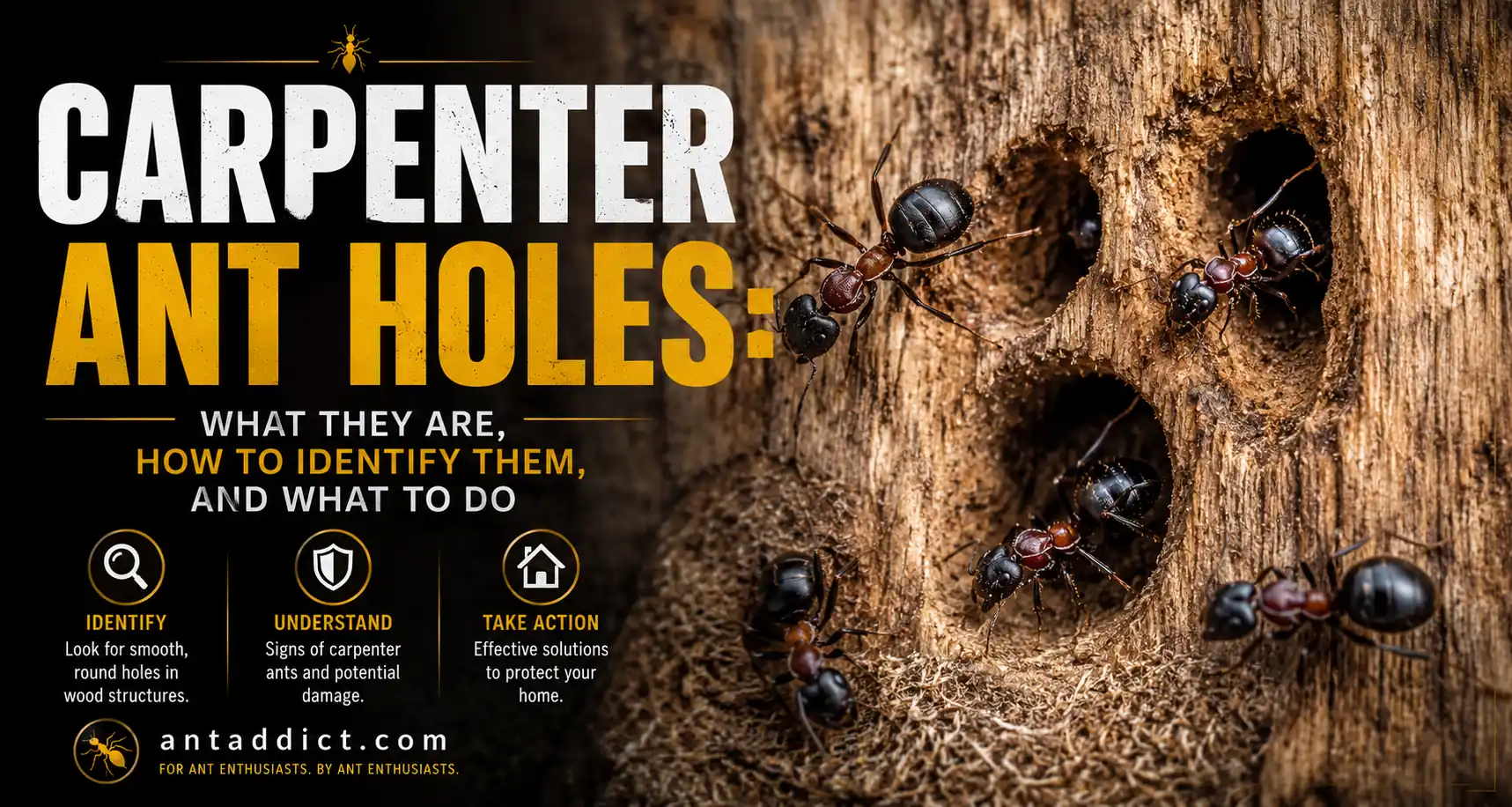
A carpenter ant holes is a small opening, usually round or slit-like and often no wider than a pencil, that carpenter ants cut into wood to push out debris from the tunnels they are excavating. These are called kickout holes. Carpenter ants do not eat wood; they carve smooth galleries inside it to nest, and the tell-tale sign is a small hole with a cone of sawdust-like frass beneath it. The single most useful thing to know is how to tell a carpenter ant hole from termite damage, because the two are handled very differently.
If you have found neat little holes in a windowsill, a door frame, or a deck board with a pile of what looks like sawdust underneath, this guide will help you identify what you are looking at, judge how worried to be, and decide what to do next.
A note on where I sit: I study ants and their biology, not pest control. I can tell you with confidence what the hole and the frass mean and how to read the ant. For the actual treatment of an active infestation in your home, the right move is a licensed pest professional, and I will point you there honestly rather than pretend otherwise.
What is a carpenter ant hole?
A carpenter ant hole is not really a front door. It is a waste chute.
Carpenter ants (genus Camponotus) nest by hollowing out galleries inside wood. As they dig, they have to get rid of the excavated material, so they cut small openings in the surface, often called kickout holes or windows, and shove the debris out through them. The hole you see is where the ants are housekeeping, not the whole nest.
The holes are usually small, round or slit-shaped, and clean-edged. Most of the colony and its tunnel network stays hidden inside the wood, which is exactly why a small hole can sit above a surprisingly large nest.
Crucially, carpenter ants do not consume the wood. Unlike termites, they gain no food from it. They are after shelter, not a meal, which shapes everything about the damage they leave.
What carpenter ant holes and frass look like
The hole rarely travels alone. The real giveaway is what collects beneath it.
That material is called frass, and carpenter ant frass is distinctive. It looks like coarse sawdust or fine wood shavings, but look closely and you will find shreds of the ants themselves worked into it, a broken leg here, a scrap of wing there, along with the dead nestmates the colony has cleared out. Wood mixed with insect remains, rather than clean shavings, is the single most reliable sign that you are dealing with carpenter ants and not something else.
The frass tends to pile up in a small cone or fan directly below a kickout hole, collecting on windowsills, baseboards, door frames, or inside cabinets, anywhere sheltered from wind and rain. Fresh, growing frass piles mean an active nest nearby.
If you can see inside the damaged wood, the galleries themselves are another clue. Carpenter ant tunnels are smooth and clean, their walls looking as though someone had sanded them, with no soil or mud packed inside. The ants keep their nest tidy, which is why the inside looks finished rather than ragged.
Other signs that often accompany the holes: large black or black-and-red ants indoors, a faint rustling or crackling sound inside walls when the nest is active, and small piles of dead ants near windows or baseboards.
Carpenter ant holes vs termite damage
This is the comparison that actually matters, because mistaking one for the other wastes time and money. Here is how they differ.
| Sign | Carpenter ants | Termites |
|---|---|---|
| Do they eat wood? | No, they only excavate galleries to nest | Yes, they consume the wood for food |
| The debris | Coarse frass: sawdust mixed with insect body parts | Drywood termites leave uniform gritty pellets; subterranean termites leave none |
| Galleries inside wood | Smooth and clean, walls that look sanded, no soil | Rough, ragged, packed with mud or soil |
| Mud tubes | Never | Subterranean termites build pencil-thick mud tubes on surfaces |
| Kickout holes with sawdust | Yes, this is the classic sign | No, not for subterranean termites |
| Damage speed | Slower; years to become serious | Often faster and more structurally destructive |
The quickest field test: if the debris is a fibrous sawdust with visible insect parts and the tunnels are clean, think carpenter ants. If you see mud tubes, soil-packed galleries, or tidy piles of identical pellets, think termites. When in any doubt, this is exactly the point to get a professional identification, because the treatments are not interchangeable.
Why are there holes in my wood? Moisture is the real story
Here is the insight the “call us now” pages tend to bury: a carpenter ant hole is usually a symptom of a moisture problem.
Carpenter ants strongly prefer wood that is damp, decaying, or water-damaged, because it is softer and easier to excavate. That is why their holes so often show up around leaky windows, poorly sealed door frames, roof lines, and under sinks, dishwashers, and bathrooms, the damp spots of a house.
So the hole is telling you two things, not one. It says carpenter ants are nesting, and it says there is likely moisture feeding that wood. Address only the ants and ignore the water, and you have fixed a symptom while leaving the cause. Once established, colonies can also extend from soft wood into sound, dry wood and into wall voids and insulation over time, so a damp starting point can spread.
The galleries they carve follow the same logic a wild carpenter ant nest does at the base of a tree, just relocated into your home’s timber. It is the same ant, doing the same thing, in the wrong place.
Parent nests and satellite nests
One reason carpenter ants are frustrating is that the nest you find is often not the whole story.
Carpenter ants frequently run a parent colony, with the queen and brood, in a moist outdoor site such as a tree stump, log, or landscaping timber, and then establish satellite nests, of workers and older larvae, in nearby structures including houses. The holes and frass you see indoors may belong to a satellite, while the parent sits outside.
This matters because it explains why spraying the ants you see so often fails. Killing foragers or even a satellite does not touch the parent colony that keeps sending more. Effective control depends on finding and treating the actual nest or nests, which is skilled work, and one of the main reasons professional help pays off here.
How serious is carpenter ant damage?
Somewhere between “ignore it” and “your house is doomed,” closer to the calm end if you act.
Carpenter ants are real wood-damaging insects, but they work more slowly than termites and they do not eat the wood, so a small or new infestation is rarely an emergency. Over months and years, though, an established colony hollowing out joists, studs, and beams can genuinely weaken a structure, so this is not something to leave indefinitely either.
The honest framing: finding carpenter ant holes early is good news, because it means you can deal with the moisture and the colony before the damage becomes expensive. It is a problem to address, not a catastrophe to panic over.
What to do if you find carpenter ant holes
Here is the calm, correct order of operations.
First, confirm the identification. Check the frass for insect parts and the galleries for that smooth, soil-free look, and rule out termites using the table above. Photograph the holes, the frass, and any insects; clear images make professional diagnosis far faster.
Second, find and fix the moisture. Track down the leak, the poor drainage, or the damp wood that drew the ants in. This is the root cause, and skipping it invites the problem back.
Third, for treatment, bring in a licensed pest control professional. Locating the nest, and especially an outdoor parent colony, is genuinely difficult, and this is a home-structure issue where getting it right matters. A pro can find the nest, treat it properly, and advise whether any damaged wood needs a structural inspection. Do not rely on hardware-store sprays alone, which typically kill visible foragers while the colony carries on out of sight.
That division is the honest one: identify it yourself, fix the water yourself, and hand the treatment to someone licensed to do it well.
The bottom line
A carpenter ant hole is a small window into a hidden nest, cut so the ants can throw out the wood they are tunneling through. Read together with the frass beneath it, the smooth galleries inside, and the absence of mud tubes, it is usually straightforward to tell carpenter ants from termites, and that identification decides everything that follows.
Treat the hole as useful information rather than a threat. It tells you there are ants, and it tells you there is probably moisture. Fix the water, confirm the culprit, and let a professional handle the colony, and a scary-looking hole becomes a manageable, well-understood problem.
FAQ
How do I know if a hole is from carpenter ants or termites?
Check the debris and the tunnels. Carpenter ants leave coarse frass that mixes sawdust with insect body parts and carve smooth, soil-free galleries. Termites leave uniform pellets or mud tubes and pack their galleries with soil. Mud tubes always mean termites, not carpenter ants.
Why do carpenter ants make holes in wood?
They are excavating galleries to nest, not feeding. The holes, called kickout holes, are simply where the ants push out the wood debris they dig from their tunnels.
Are carpenter ant holes a sign of serious damage?
Not necessarily. They confirm an active nest, but carpenter ants work slowly and do not eat wood, so caught early the damage is usually limited. Left for years, a colony can weaken structural wood, so it should be addressed.
What does carpenter ant frass look like?
Like coarse sawdust or fine wood shavings, piled in a small cone below a hole, and mixed with recognizable insect parts such as legs and wings. That insect content is what separates it from clean drill sawdust or termite pellets.
Do I need an exterminator for carpenter ants?
For an active indoor infestation, usually yes. Locating the nest, which may be an outdoor parent colony, is difficult, and treating only the ants you see rarely solves it. A licensed professional can find and treat the actual nest.
Why do carpenter ants keep coming back after I spray?
Because sprays kill visible foragers or a satellite nest, not the parent colony that keeps producing more. Lasting control requires treating the nest itself and fixing the moisture that attracts them.
Can I fix carpenter ant holes myself?
You can and should fix the underlying moisture and later repair damaged wood, but the colony treatment is best left to a professional. Filling the holes without dealing with the nest just hides the problem.
Where are carpenter ant nests usually found?
In damp or damaged wood: around leaky windows and doors, under sinks and dishwashers, in bathrooms, along roof lines, and in wall voids. The parent colony is often outdoors in a stump, log, or timber.