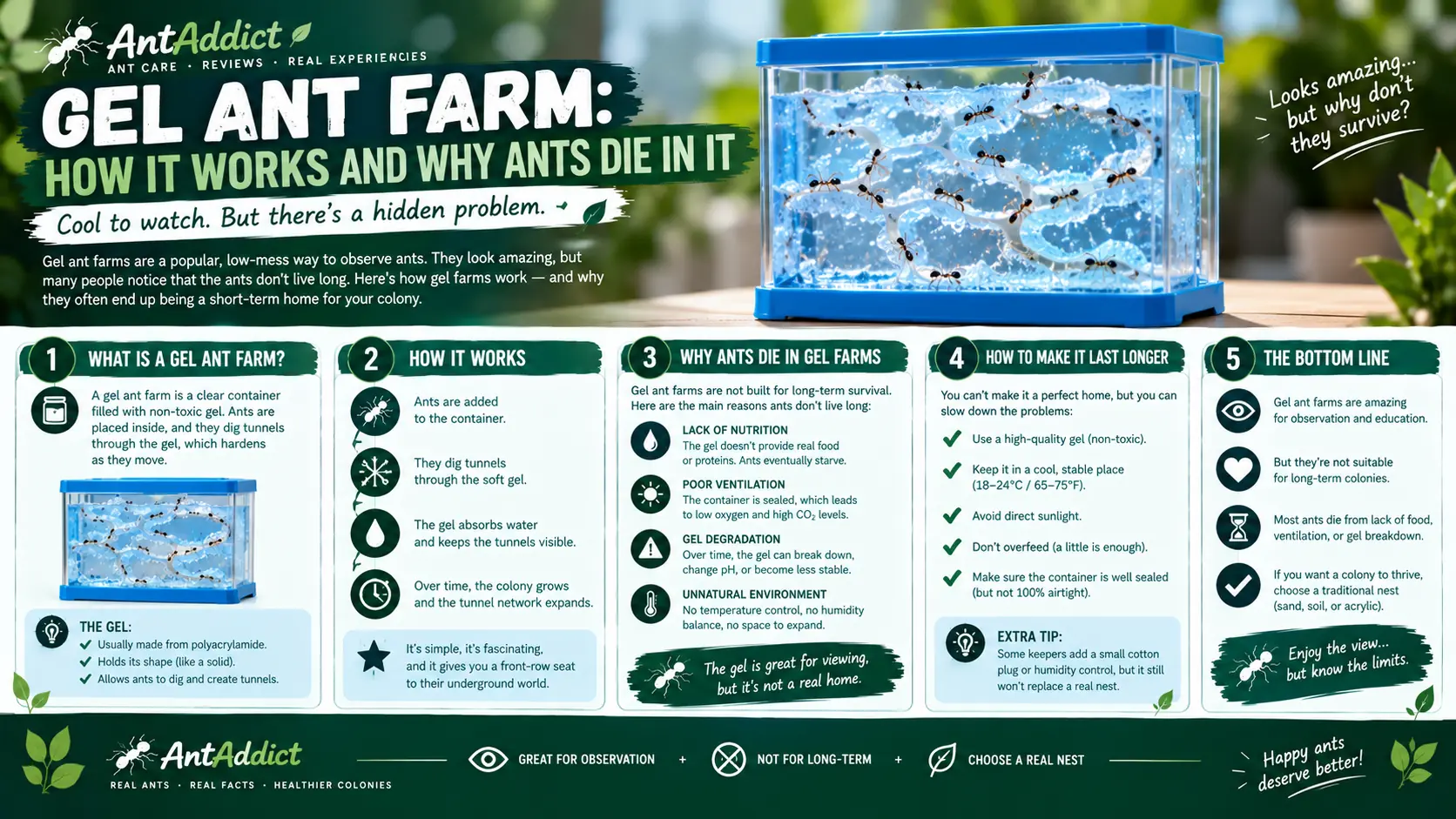
Gel Ant Farm: How It Works and Why Ants Die in It
What the blue gel really is, where it came from, and what a keeper would do with one
Quick Answer: A gel ant farm is a clear habitat filled with a translucent, usually blue gel that ants tunnel through and eat. The gel is typically agar with sugars, amino acids, and fungicides, and it traces back to a student ant experiment flown on the space shuttle Columbia in 2003. It keeps a tube of worker ants alive for weeks to a few months, but it cannot support a growing colony, so it works as a short science demo, not a long-term home.
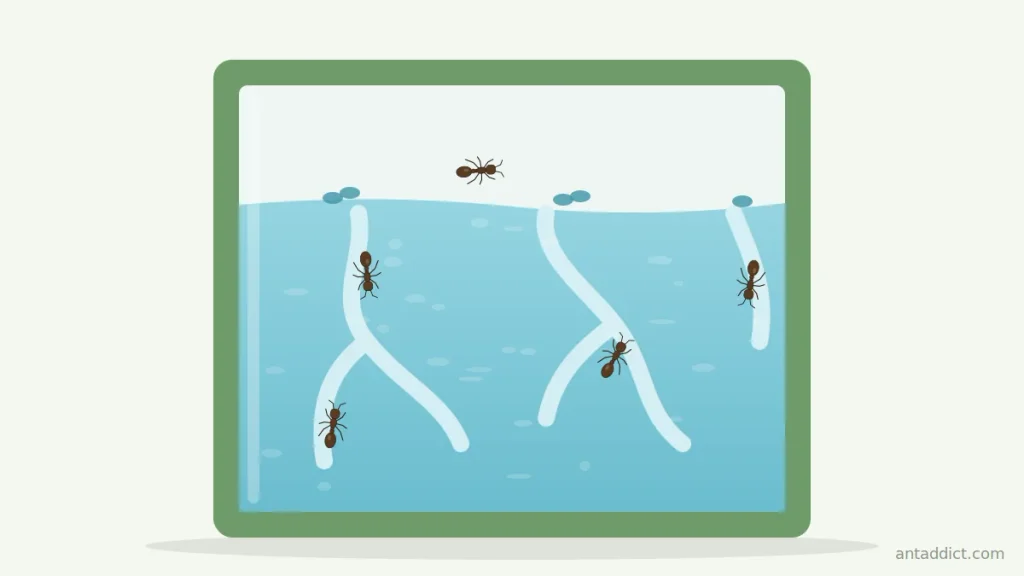
Gel ant farm with blue gel, harvester ants, and tunnels dug through the gel
I have kept ant colonies for six years, and few products divide ant keepers more than gel ant farms. Parents and teachers are often drawn to them because they look like a science kit. Most experienced keepers refuse to recommend them, and the reasons are real.
This guide covers what the gel is made of, the space-shuttle story behind it, how long ants actually live in one, why the gel fails as a long-term diet, how to get the most out of a gel farm you already own, and how to turn it into something better.
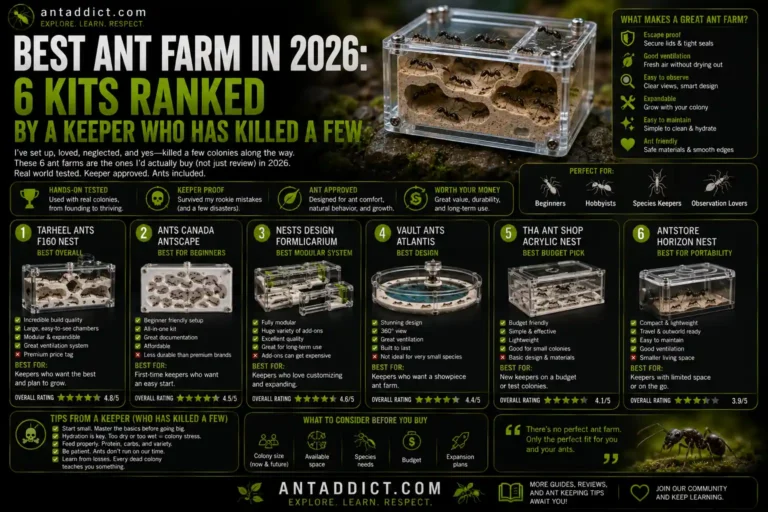
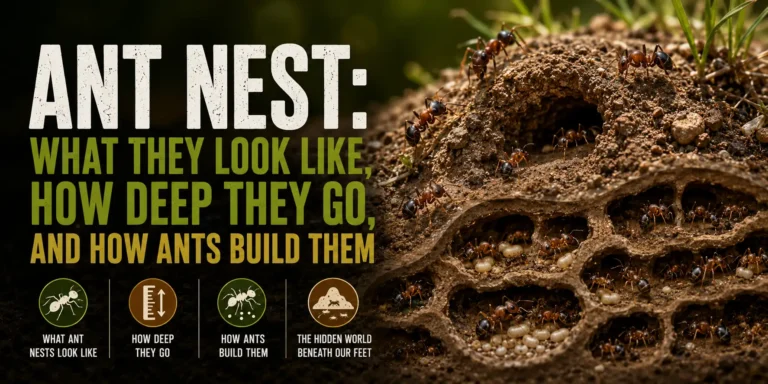
What is a gel ant farm?
A gel ant farm is a clear plastic habitat filled with a nutrient gel instead of sand. Ants dig tunnels through the gel and eat it as they go, and because the gel is see-through, every tunnel stays visible. Most gels are colored blue (Wikipedia: Formicarium).
The marketing promise is simple: the gel is the home, the food, and the water, so you never feed or water the ants. Uncle Milton’s gel booklet claims the gel is formulated to provide all the nutrients and moisture the ants need (Formiculture). As you will see below, that promise only holds for a few months.
What is the blue gel in an ant farm made of?
The gel is mostly agar, a seaweed-derived jelly that labs use to grow microorganisms (Poramor Art). NPR, describing the gel farm on its newsroom AntCam, reported that it contains amino acids, sugars, and fungicides (NPR via WGBH, 2012).
Exact recipes are proprietary and vary by brand. Refill kits come as a powder that you prepare into gel using the included instructions; Nature Gift Store’s refill makes about 1.5 cups (roughly 350 ml) of gel per tube (Nature Gift Store).
Was the gel really developed by NASA?
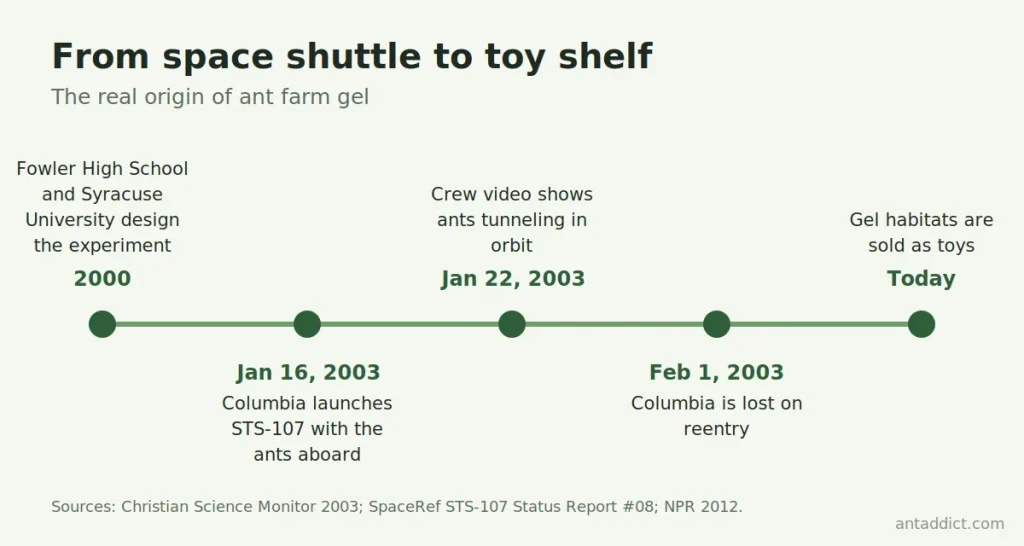
Partly, and the real story is better than the box. In January 2003, the space shuttle Columbia flew STS-107 with more than 80 experiments aboard, including “Ants in Space,” a harvester ant experiment designed by students at Fowler High School in Syracuse, New York, with help from Syracuse University (Christian Science Monitor, 2003). The habitats were built by BioServe Space Technologies for the student program (SAE Technical Paper 2004-01-2394).
According to gel-farm maker Fascinations, sand tunnels would have collapsed under the shaking of launch and reentry, so the experiment needed a medium that would hold its shape (Fascinations). NPR credits the gel to Syracuse students and University of Colorado researchers working on that NASA experiment (NPR via WGBH, 2012). Crew video from orbit showed the ants busily tunneling (SpaceRef, STS-107 Status Report #08). Columbia was lost on reentry on February 1, 2003, and the experiment with it.
Timeline of the ant farm gel origin: student harvester ant experiment on space shuttle Columbia STS-107 in 2003
So “developed for NASA” is fair. “Designed for ants to live in long term” is not. It was built for a 16-day mission.
Do gel ant farms kill ants?
The gel does not poison ants, but a gel farm is a dead end. Gel farm kits are stocked with queenless workers, the gel is not designed to raise larvae, and the habitat fills with waste and mold over time. Canada Ant Colony describes gel farms as designed only to keep ants alive for a few months, and notes that the ant-keeping community broadly considers them unsustainable (Canada Ant Colony).
That is the honest framing: a gel farm does not kill ants quickly. It just gives them nowhere to go.
How long do ants live in a gel ant farm?
Expect weeks to a few months. Mailed ants for gel farms are harvester workers with no queen; Uncle Milton’s gel manual states it cannot supply queens or male ants (Uncle Milton Gel Colony manual). Uncle Milton gives its sand farm ants one to three months with good care, and gel farm ants face the same limit for the same reason. See our Uncle Milton ant farm guide for why mailed workers have such a short clock.
In contrast, worker ants in a well-kept setup can live for one to three years depending on species, and queen-right colonies for many years (Canada Ant Colony).
Here is the part everyone else skips: the gel feeds the workers, not the colony
Most reviews say “the gel has no protein.” That is close, but it misses the real mechanism. Ant colonies split their nutrition by role. Adult workers run mostly on carbohydrates. Growing larvae need protein, and so does an egg-laying queen (Dussutour & Simpson, 2009).
That split is strong enough that protein can actually harm workers. In black garden ants (Lasius niger), workers fed a high-protein, low-carbohydrate diet died young, and colonies collapsed (Dussutour & Simpson, 2012).
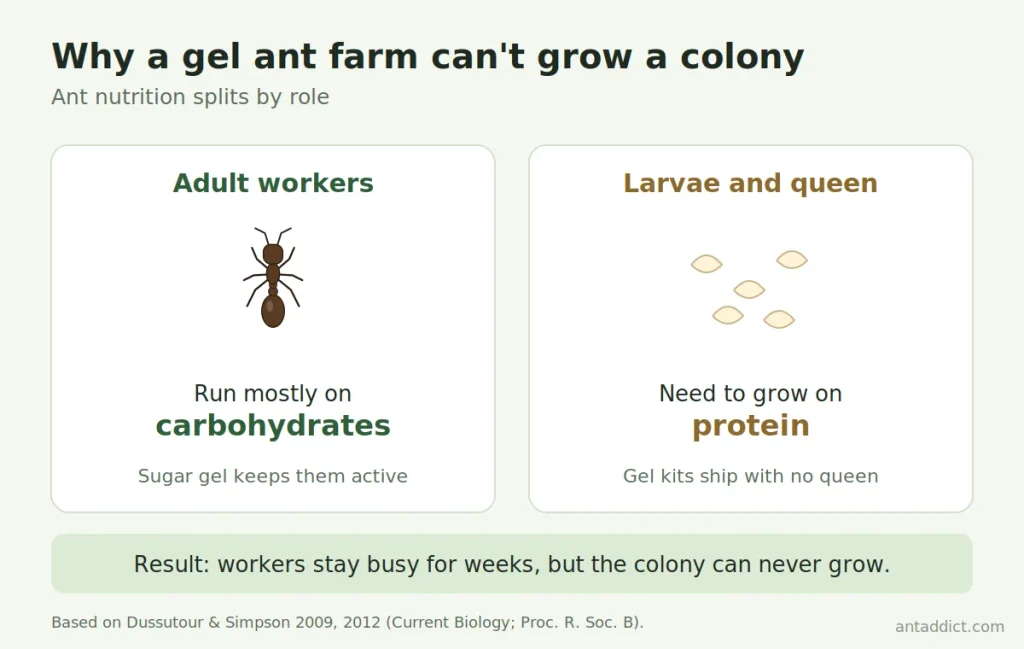
Diagram: adult worker ants need carbohydrates while larvae and queens need protein, so a sugar gel feeds workers but cannot grow a colony
Now look at the gel through that lens. A sugary gel is a reasonable fuel for adult workers, which helps explain why they stay active for weeks. But a colony grows through its larvae, and larvae need a protein-rich diet. Manufacturers do not claim the gel supports brood, and their own kits ship without queens. The system is built to keep workers moving, not to raise the next generation.
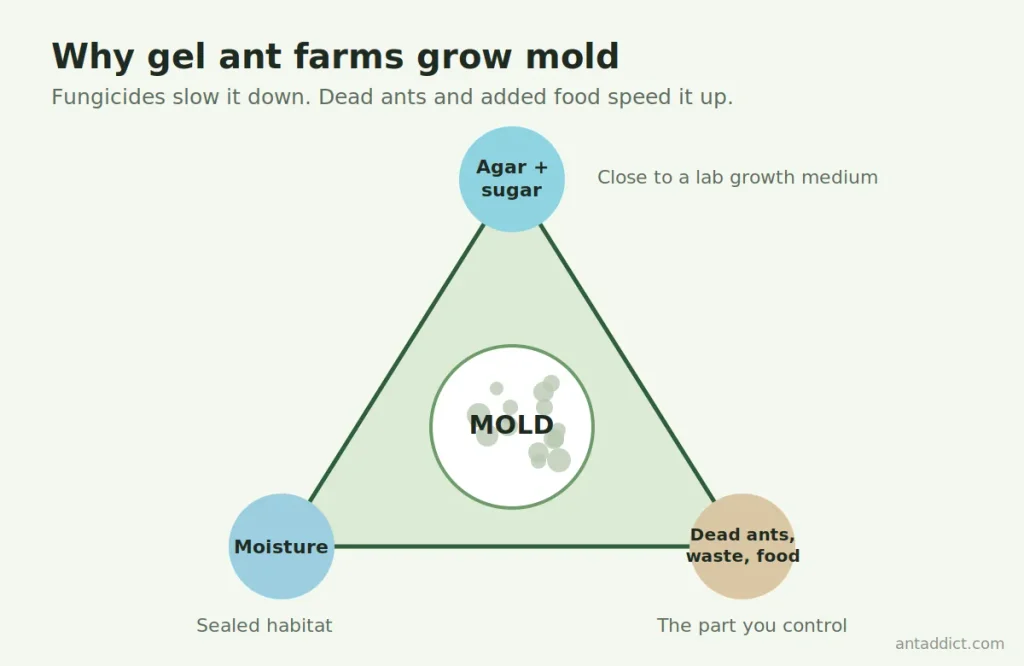
There is a second problem in the recipe. Agar plus sugar plus amino acids is close to how microbiologists make growth media for bacteria and fungi. The fungicides slow that down, but dead ants, waste, and any food you add give mold a foothold. In a sand farm you can feed in an outworld. In a gel farm, the food and the floor are the same material.
Why gel ant farms mold: agar, sugar, and moisture plus dead ants and waste feed fungus
How do you set up a gel ant farm?
If you already own one, set it up to give the ants the best possible run:
- Poke starter holes. Uncle Milton’s manual tells you to make three holes in the gel before adding ants, which gives them a place to start digging (Uncle Milton Gel Colony manual).
- Chill the tube briefly before opening it, as the manual advises, so the ants are calmer during transfer, and do not leave them in the cold for long.
- Tip the ants in carefully, close the lid, and never touch the ants by hand. Harvester ants can sting.
- Place it out of direct sun and away from heaters. A warm, sealed gel farm can fog up quickly.
- Follow your model’s airing instructions. Some gel habitats are sealed with vents; others ask you to open the lid briefly for fresh air.
- Remove dead ants with a cotton swab or thin stick when they appear on the surface.
Local ants work too: Uncle Milton suggests large ants that cannot escape through the air holes (Uncle Milton Gel Colony manual).
What do you feed ants in a gel ant farm?
Nothing. This is the one point where manufacturers and keepers agree, for different reasons. The gel already supplies water and sugar, and extra food in a sealed gel farm is the fastest route to mold.
| Item | Add it? | Why |
|---|---|---|
| Gel | Already there | Supplies water and carbohydrates |
| Water | No | The gel is mostly water; extra water pools and floods tunnels |
| Sugar or honey | No | Sticky residue molds and traps ants |
| Protein (insects, egg) | No | Queenless workers have no larvae to feed, and protein-heavy diets shorten worker life (Dussutour & Simpson, 2012) |
| Bread, cookies, fruit | Never | Rots inside the habitat within days |
| Dead ants | Remove | Feed mold and contaminate the gel |
For colonies in proper setups, where feeding matters, see what ants eat.
Why is there mold in my gel ant farm?
Mold in a gel farm almost always starts on dead ants, waste piles, or food someone added. Remove dead ants promptly and add nothing. If a fuzzy white or green patch appears, scoop it out with a clean swab. If mold spreads through the tunnels, move the surviving ants out and discard the gel.
Can you reuse the gel in an ant farm?
Sometimes, briefly. Nature Gift Store says gel habitats can be reused a number of times before the gel is saturated with tunnels (Nature Gift Store). In practice, only reuse gel that is mold-free and still has unworked space. Remove every old ant, dead or alive, before adding new ones, and replace the gel with a refill when in doubt.
Gel ant farm vs sand ant farm
| Factor | Gel ant farm | Sand ant farm |
|---|---|---|
| Visibility | Excellent | Good, varies |
| Feeding | None (gel is food) | You feed in an outworld |
| Natural digging | Yes, but unnatural substrate | Yes, closest to the wild |
| Mold risk | High | Medium |
| Queen-right colony | Not suitable | Suitable with care |
| Typical lifespan | Weeks to a few months | Months (workers only) to years (with a queen) |
| Best for | Short classroom demos | Watching real nest building |
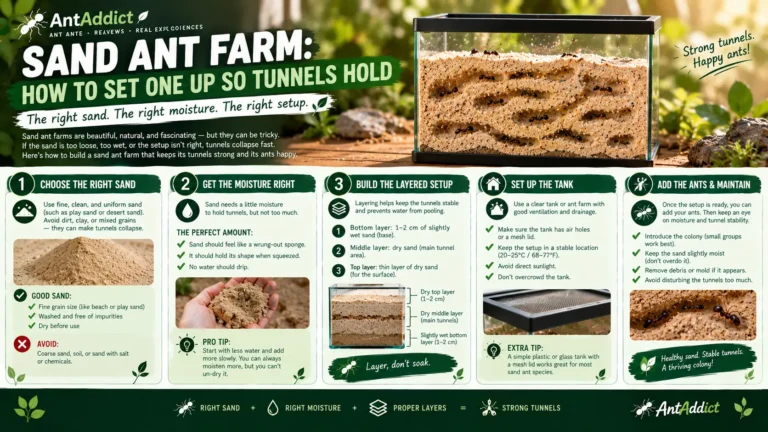
If you want a dig-it-yourself habitat that can last, our sand ant farm guide covers the right sand, moisture, and gap width.
Can you convert a gel ant farm into something better?
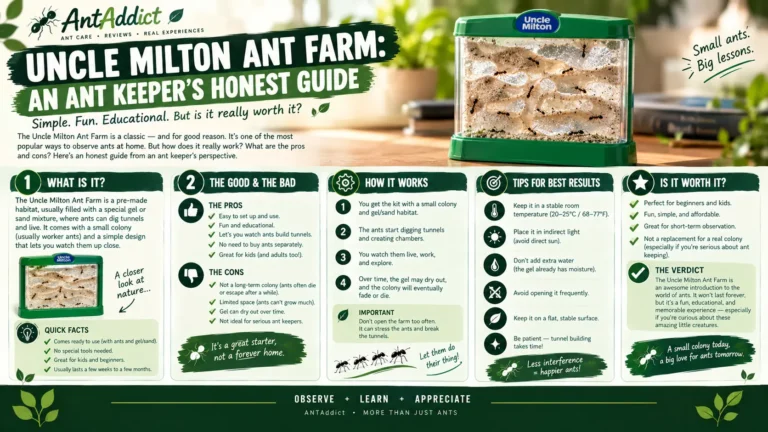
Yes, and it is the best use for an old gel farm. The fix is to remove the gel completely and replace it with a sand and loam mix (Poramor Art). Scrape out the gel, wash and dry the habitat, fill it with damp, sterilized sand-loam, and add a separate feeding spot on top.
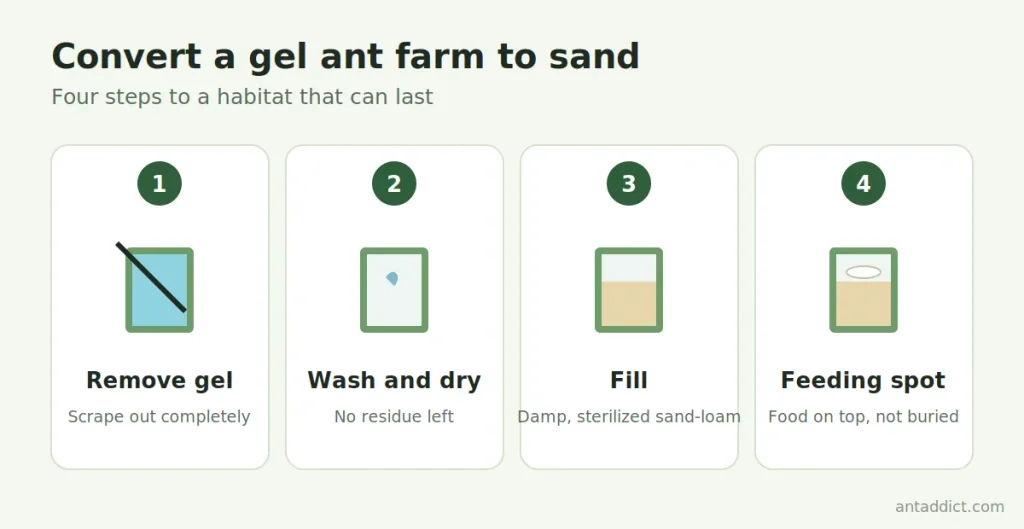
Four steps to convert a gel ant farm: remove gel, wash and dry, fill with damp sand-loam, add a feeding spot
Check the depth first. Many gel habitats are thicker than sand farms, and in a deep box the ants will tunnel out of sight in the middle. A converted gel farm works best for viewing when you place a filler block behind the sand to bring tunnels against the front.
Can you make your own ant farm gel?
You can, but it is rarely worth it. Homemade versions are usually agar cooked with sugar, and without commercial fungicides they are likely to mold even faster. A sand farm costs less, lasts longer, and lets you control feeding properly.
Is a gel ant farm ethical?
Most experienced keepers come down against gel farms. Canada Ant Colony, an ant supplier, calls gel farms cruel and unsustainable because workers are taken from their colony and kept until they die (Canada Ant Colony). Others argue that the farms spark real curiosity in kids, and that a short demo is still a learning experience.
Here is my honest keeper’s take. A gel farm is not torture, but it is a one-way trip, and it teaches a misleading lesson: that ants live in blue jelly and die in a month. If you buy one, treat it as a short demo, explain to the kids why the ants will not last, and use it as a doorway to a real colony.
Which gel ant farm should you buy?
If you want a short, high-visibility classroom demo, a basic gel habitat with an ant voucher does the job. If you want ants that build, grow, and last, skip gel and start with a queen.
Affiliate note: the Amazon links below are affiliate links; Antaddict may earn a small commission at no cost to you.
- Blue gel ant habitat with ant certificate (Amazon): for a short classroom demo.
- Sand ant farm formicarium (Amazon): the better choice for a real colony.
For a full comparison of every habitat type, see our guide to the best ant farm. To start a colony that lasts years, begin with how to catch a queen ant and an ant test tube setup.
The bottom line
A gel ant farm is a clever piece of space-program spin-off design: a transparent, edible substrate built for a 16-day shuttle mission. It keeps queenless workers busy for weeks to a few months, because sugar fuels adult ants. It cannot grow a colony, because it is not designed to raise larvae, and its agar-and-sugar recipe is an open invitation to mold. Use a gel ant farm as a short demo, feed it nothing, remove dead ants fast, and when it is done, convert it to sand or move on to a queen-right colony.
FAQ
What is a gel ant farm?
A clear habitat filled with a translucent, usually blue gel that ants tunnel through and eat. The gel serves as their home, food, and water.
What is ant farm gel made of?
Mostly agar, a seaweed-based jelly, with sugars, amino acids, and fungicides. Exact recipes vary by brand.
Was ant farm gel invented by NASA?
It traces back to a student harvester ant experiment flown on the space shuttle Columbia (STS-107) in 2003. NPR credits the gel to Syracuse students and University of Colorado researchers.
How long do ants live in a gel ant farm?
Usually weeks to a few months. The ants are queenless workers, so they cannot be replaced as they die.
Do gel ant farms kill ants?
The gel is not poisonous, but it cannot sustain a colony. Workers eventually die of age, poor nutrition, or mold, with no new ants to replace them.
Do you need to feed ants in a gel ant farm?
No. The gel supplies water and sugar. Adding food or water can cause mold and flooding.
Can a queen ant live in a gel ant farm?
Not long term. Larvae need a protein-rich diet to grow, and the gel is not designed to raise them, so a colony cannot develop.
Why is my gel ant farm moldy?
Mold grows on dead ants, waste, or added food. Remove dead ants quickly, add nothing, and discard the gel if mold spreads.
Can you reuse ant farm gel?
Sometimes, if it is mold-free and has unworked space. Remove every old ant first, and replace the gel when in doubt.
Is a gel or sand ant farm better?
Sand is better for ants. Gel gives clearer views for a short demo, but sand supports natural digging and, with a queen, a colony that lasts years.
Can you put sand in a gel ant farm?
Yes. Remove all the gel, wash and dry the habitat, and fill it with damp, sterilized sand-loam with a separate feeding spot.
Are gel ant farms cruel?
Many keepers consider them unethical because the workers cannot survive long term. If you use one, treat it as a short demo and explain why.