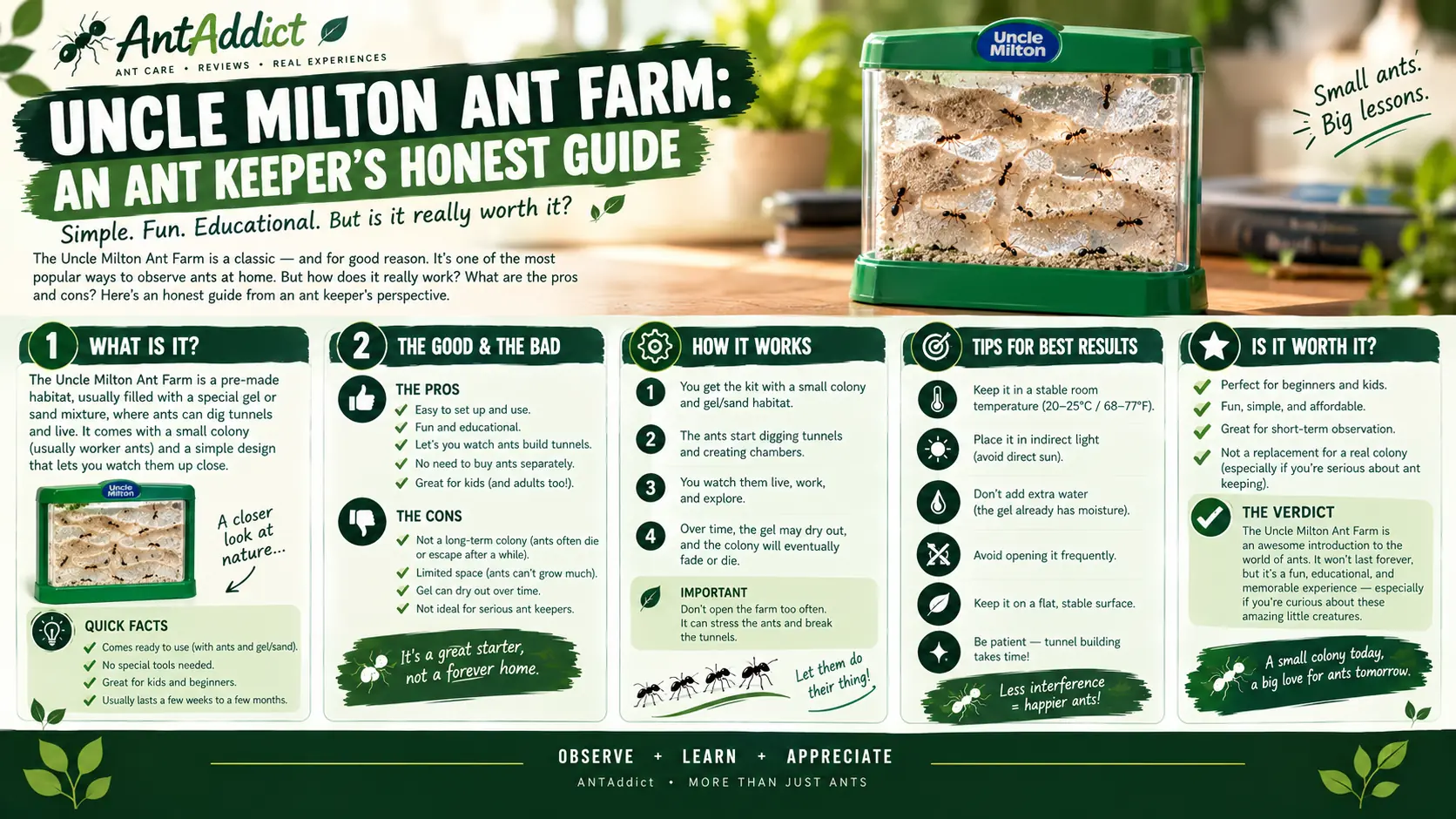
Uncle Milton Ant Farm: An Ant Keeper’s Honest Guide
Which ants you actually get, why they die in weeks, and how to make the classic kit last as long as possible
Quick Answer: The Uncle Milton ant farm is a classic tunneling habitat, created by Milton Levine in 1956, that you stock with about 25 California harvester ants (Pogonomyrmex californicus) ordered by mail with a voucher. Uncle Milton cannot ship a queen, so the ants never reproduce, and the company itself says they live one to three months. It is a brilliant short science project, not a permanent pet colony.
I have kept ant colonies for six years, and the Uncle Milton ant farm is the product most people think of when they hear the words “pet ants.” It has introduced generations of kids to ants. It has also left many of them watching every ant die within weeks, with no explanation of why.
This guide covers what the kit actually is, which species arrives in the tube, why the colony has a built-in expiry date, how to care for the ants so they reach the top of that range, and what to get if you want a colony that lasts years instead of weeks.
What is the Uncle Milton ant farm?
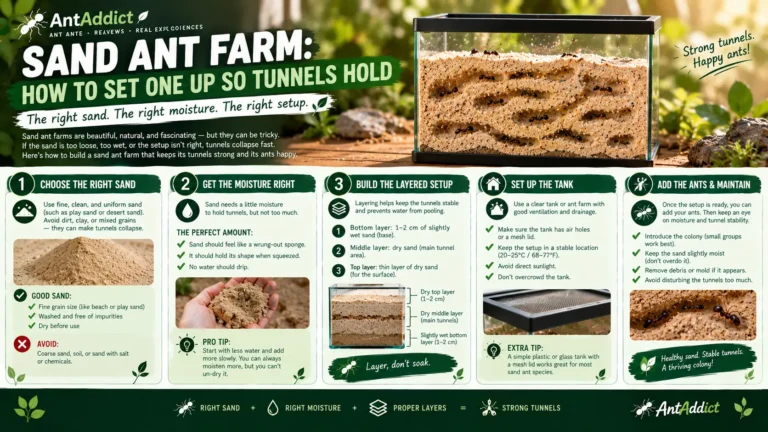
The Uncle Milton ant farm is a thin, two-sided plastic habitat filled with sand. Ants dig tunnels against the clear walls, so you can watch them work in cross-section. The kit ships empty. Inside the box is a voucher you redeem for a tube of live ants, paying only a small shipping and handling fee (Basic Fun!).
Today the brand belongs to Basic Fun!, the Florida toy company whose predecessor acquired Uncle Milton Industries in 2017 (PitchBook; Wikipedia: Jay Foreman). The line still sells several sizes, from the original farm to the Giant Ant Farm aimed at classrooms.
Who was Uncle Milton?
“Uncle Milton” was Milton Levine, a Pittsburgh-born entrepreneur who had collected ants in a jar on his uncle’s farm as a boy. He co-founded the company with his brother-in-law, E. Joseph Cossman. In 1956, at a Fourth of July picnic, Levine spotted an ant mound and decided to sell an ant habitat for kids (Wikipedia: Milton Levine).
The first version cost $1.29 and measured six by nine inches. Children mailed away for 25 ants, which arrived weeks later in a vial. By the time Levine died in 2011, at 97, more than 20 million units had sold (The New York Times). Levine was not the first to sell an ant habitat, though. Frank Eugene Austin, an engineering professor at Dartmouth, patented his “Ant House” on June 16, 1931 (Dartmouth College Library Bulletin). What Levine did own was the name: he registered “Ant Farm” as a trademark (Wikipedia: Formicarium).
What kind of ants come with an Uncle Milton ant farm?
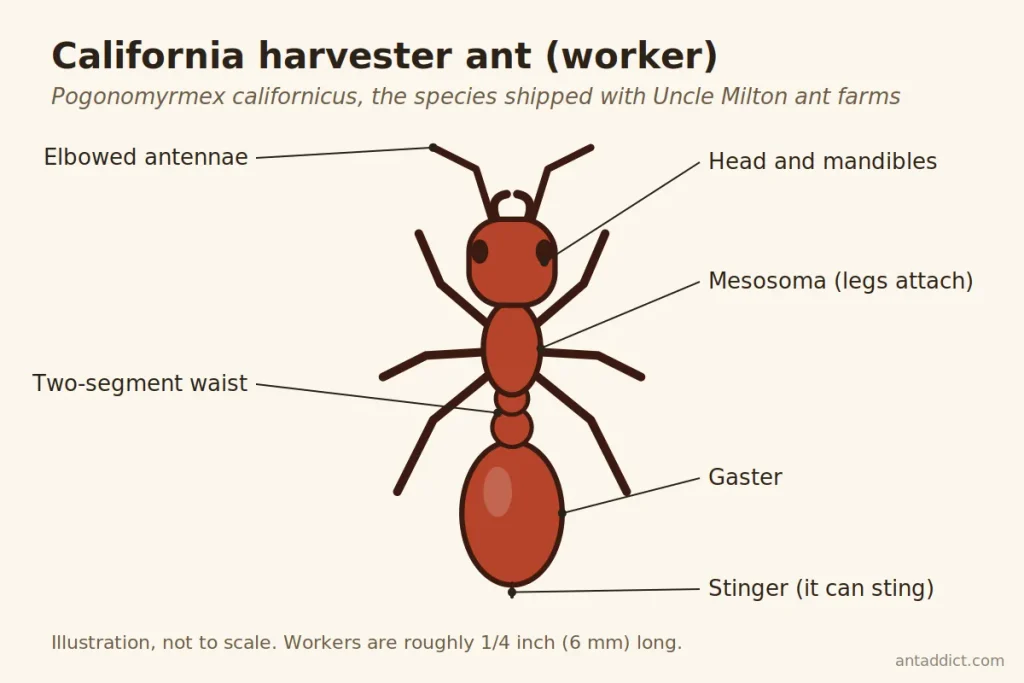
The ants are California harvester ants, Pogonomyrmex californicus, a seed-eating species native to the southwestern United States (Wikipedia: Milton Levine). Uncle Milton’s own product pages simply say “live harvester ants.”
Harvester ants are a sensible choice for a toy habitat. They are relatively large, active diggers, so their tunnels are easy to see. They also come from dry habitats, which suits a sand farm that gets only a few drops of water. The catch is the stinger, which we cover next.
Do Uncle Milton ants sting?
Yes. Harvester ants sting, and it hurts. The genus Pogonomyrmex has the most toxic insect venom measured in lab mice. A related species, the Maricopa harvester ant, tops the list with an LD50 of 0.12 mg/kg (University of Florida Book of Insect Records).
A 2024 study explained why the pain lingers: harvester ant venom is made largely of peptide toxins that act on the sodium channels of vertebrate sensory nerves, and they appear to have evolved specifically to deter vertebrates (Robinson et al., 2024). One of its co-authors was entomologist Justin Schmidt, who created his famous sting pain scale while studying harvester ant venom (Schmidt, 2016).
With sensible handling the risk is manageable, but it does mean three rules:
- An adult handles the ant transfer, never a young child.
- Nobody picks the ants up by hand.
- Anyone with a known insect sting allergy stays hands-off, and any sting followed by swelling beyond the site, hives, or trouble breathing needs medical help right away.
Why doesn’t Uncle Milton send a queen ant?
Uncle Milton says federal agricultural regulations prohibit it from selling or shipping queens. Because only the queen reproduces, the company cites the regional ecological balance as the main concern (Uncle Milton Ants FAQ). The company also notes the farm was never designed to hold a queen and the thousands of offspring she would produce.
That single rule shapes everything about the product. No queen means no eggs, no larvae, and no new workers. The ants you receive are the only ants you will ever have.
How long do Uncle Milton ants live?
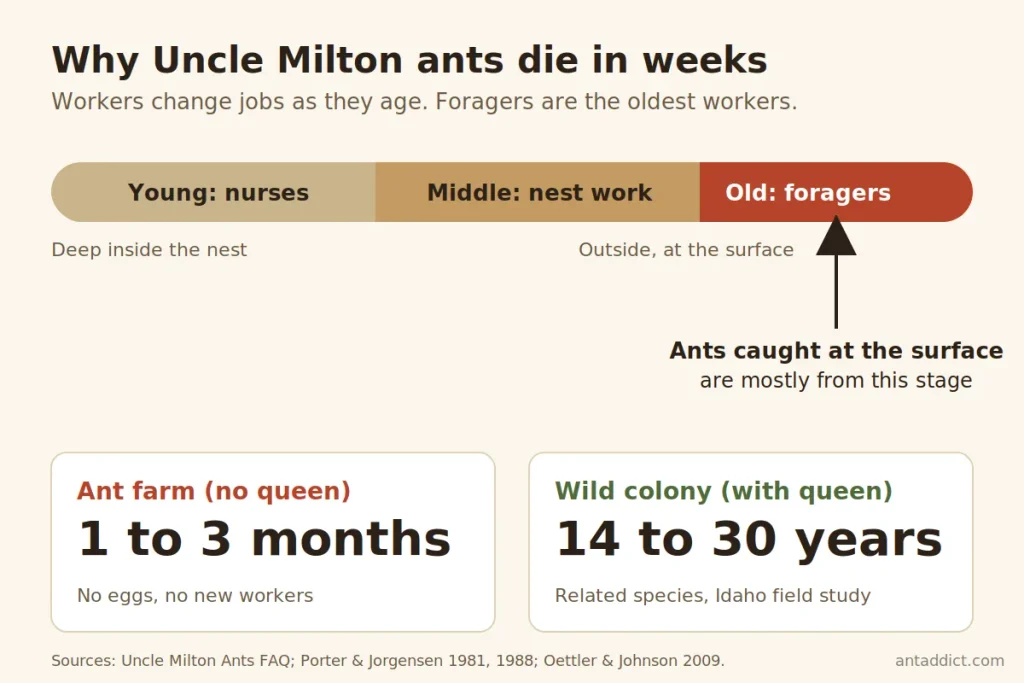
Uncle Milton states that with proper care the ants should live one to three months (Uncle Milton Ants FAQ). Overwatering, heat, and a farm placed in a sunny window are the usual ways to land at the short end of that range.
Compare that with a real harvester ant colony. A nine-year study of a related harvester species in Idaho estimated that established colonies live 14 to 30 years, averaging 17 (Porter & Jorgensen, 1988). The difference is not the habitat. It is who you put in it.
Here is the part everyone else skips: you are mailed the colony’s oldest ants
Every product page and toy blog stops at “no queen.” The deeper reason your ants die fast is a pattern called temporal polyethism: ant workers change jobs as they age. Young workers stay deep inside the nest nursing brood. Older workers move to the surface to forage and defend, so the riskiest jobs fall to ants near the end of their lives (Oettler & Johnson, 2009).
Harvester ants show this clearly. A classic field study of a related species, Pogonomyrmex owyheei, asked whether foragers are a “disposable caste” and concluded the colony tolerates high forager mortality (Porter & Jorgensen, 1981). Foragers also tend to carry less body fat and more worn mandibles than younger nest workers, physical signs of age (Oettler & Johnson, 2009).
Uncle Milton does not publish how its ants are collected. But ants gathered from the surface of a harvester nest are, almost by definition, outside workers. So the likely picture is this: you receive older workers, already partway through their lives, with no queen to replace them. Every death is permanent, and the clock started before the tube reached your mailbox.
That reframes care. You cannot make these ants live for years. You can only stop yourself from shortening the time they have left.
Which Uncle Milton ant farm should you buy?
All current models use the same voucher ants and the same sand-tunnel concept. The real choice is viewing size and whether you want to connect habitats. If you are still deciding between Uncle Milton and other brands, see our full guide to the best ant farm options, including setups that can hold a queen.
| Model | Best for | Key feature | Ants included? |
|---|---|---|---|
| Ant Farm (original) | First-time families | Classic size; links to other Ant Farm habitats | Voucher (US only) |
| Giant Ant Farm | Classrooms, groups of viewers | Largest viewing area in the line, twice that of the 60th edition | Voucher (US only) |
| 60th Ant-iversary Ant Farm | Collectors, gift buyers | Modern redesign marking the brand’s 60th year | Voucher (US only) |
| Vintage Ant Farm | Nostalgia gifts | Retro-look edition | Voucher (US only) |
Sources: Uncle Milton product pages, Basic Fun!.
Affiliate note: the Amazon links below are affiliate links; Antaddict may earn a small commission at no cost to you.
My pick is the Giant Ant Farm. More viewing area means more visible tunnels for the same 25 ants, and its tubes connect to the original size if you want to expand. For a single child on a budget, the original Ant Farm does the job.
How do you set up an Uncle Milton ant farm?
Set the habitat up before the ants arrive. Uncle Milton tells buyers to have the farm ready and move the ants in as soon as possible after delivery (Uncle Milton Ants FAQ).
- Fill the farm with the included sand following the instruction booklet, which you can also download from Uncle Milton’s site.
- Pick a permanent spot away from direct sun, heaters, and air vents. Moving the farm later collapses tunnels.
- Redeem the voucher at the right time. If you will be away, Uncle Milton asks you to call two to three weeks ahead so delivery can be scheduled.
- Chill the tube briefly in the refrigerator, as the kit instructions advise, so the ants slow down and are easier to transfer (Bug Under Glass).
- Tip the ants in with an adult in charge, close the lid, and leave them alone for a day to start digging.
What do Uncle Milton ants eat?
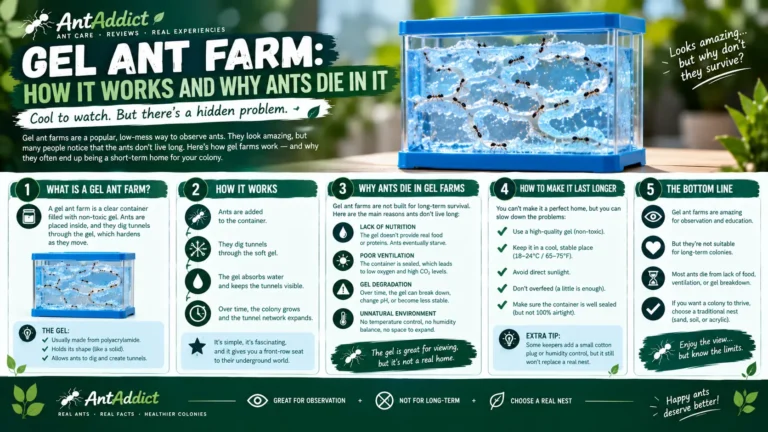
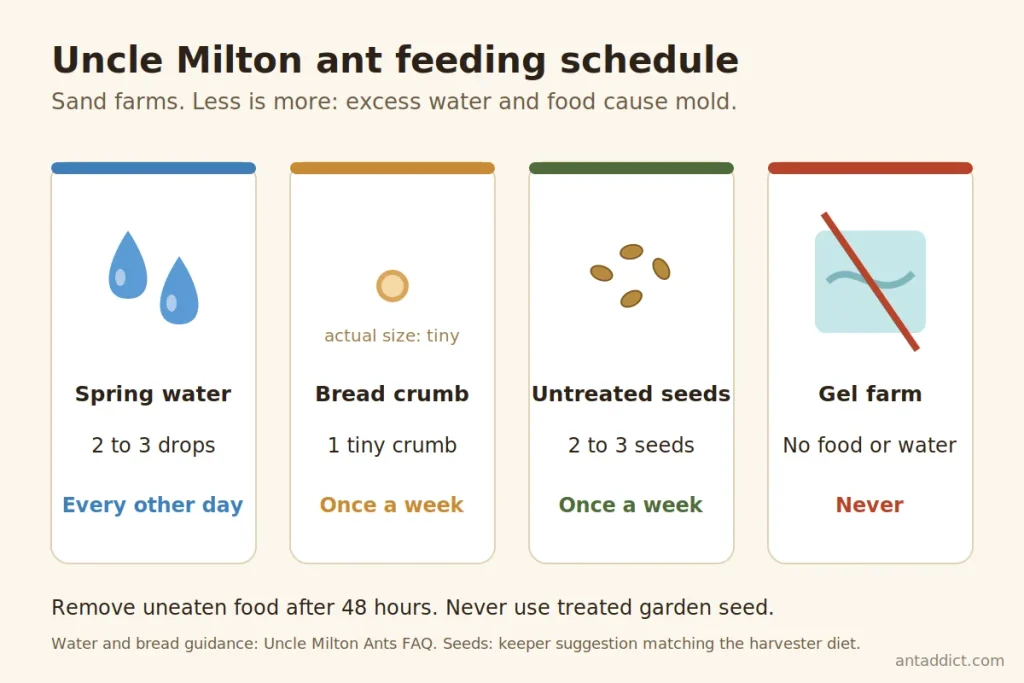
Harvester ants are seed eaters in the wild. Uncle Milton’s own routine for sand farms is two to three drops of bottled spring water every other day and one tiny bread crumb once a week. Gel farms need no feeding at all, because the gel supplies food and water (Uncle Milton Ants FAQ).
Workers with no larvae to raise mostly burn carbohydrates, so you do not need heavy protein feeding. The bigger risk is excess: leftover food molds, and too much water floods tunnels. For the full picture of ant nutrition, see our guide to what ants eat.
| Food | Amount | How often | Why |
|---|---|---|---|
| Bottled spring water | 2 to 3 drops | Every other day | Uncle Milton’s guideline; more risks flooding and mold |
| Bread crumb | 1 tiny crumb | Once a week | Uncle Milton’s guideline |
| Untreated small seeds (grass seed, millet) | 2 to 3 seeds | Once a week | Matches the natural harvester diet |
| Sugar water | A toothpick tip | Once a week, optional | Quick carbohydrates for adult workers |
| Gel farm | Nothing | Never | The gel is their food and water |
Remove anything uneaten after 48 hours. Never use treated garden seed, which can carry pesticides or fungicides.
Can you use your own ants in an Uncle Milton ant farm?
Yes. Uncle Milton allows it, with two conditions: every ant must come from the same nest, and each ant should be at least 1/4 inch (about 6 mm) long, or they could escape (Uncle Milton Ants FAQ).
Mixing ants from two nests usually leads to fighting, since colonies recognize nestmates by scent. Small species escape. And wild-caught workers face the same queenless clock as mailed ones. Return them to their home nest when you are done if you can.
Can you get Uncle Milton ants outside the US?
No. Ants ship only within the continental United States, and Uncle Milton’s own product page also excludes Oregon (Uncle Milton: Giant Ant Farm). Buyers in Canada, the UK, Europe, and elsewhere get the habitat but cannot redeem the voucher.
Outside the US, the honest options are local ants that follow the size and same-nest rules above, or skipping the toy and starting a real founding queen instead. Check local rules before collecting or buying live ants.
Uncle Milton ant farm vs a real queen-right colony
This is the comparison most buyers never see before checkout.
| Factor | Uncle Milton ant farm | Queen-right starter colony |
|---|---|---|
| Queen | None | One founding queen (some species several) |
| Brood and growth | None | Eggs, larvae, new workers |
| Typical lifespan | 1 to 3 months (company figure) | Years; some queens live for decades |
| Setup difficulty | Very easy | Easy with a test tube setup |
| Best age | 6+ with adult help | Teens and adults, or kids with a committed parent |
| What you learn | Tunneling behavior | The full life cycle |
Queen lifespans are where real colonies shine: a black garden ant (Lasius niger) queen holds the record at 28¾ years in captivity (University of Florida Book of Insect Records).
P. californicus itself is a model species for studying cooperation. In some populations, unrelated queens team up to found a colony, and queens in these groups survive longer and produce more than lone queens (Shaffer et al., 2022). The species has a rich social life. The toy just never lets you see it.
If you want the real thing, start with a single newly mated queen in a test tube. Our ant test tube setup guide walks you through it, and how to catch a queen ant covers finding one during the ant mating flight season.
Is the Uncle Milton ant farm worth it?
Here is my honest keeper’s take. As a two-month science project, yes. Kids watch tunnels take shape over the first days, they learn that ants dig with purpose, and the kit is inexpensive. For a classroom unit, the Giant Ant Farm is hard to beat.
As a pet, no. Calling it a “farm” sets up a promise it cannot keep, because nothing in it grows. Still, I see these kits as a genuine gateway into the hobby. Just buy one knowing the ending, and treat that ending as the start of a conversation about queens.
The bottom line
The Uncle Milton ant farm is a 70-year-old classic that does one thing well: it shows ants tunneling. You get about 25 California harvester workers, no queen, and one to three months of viewing. Keep the farm out of the sun, give too little water rather than too much, and let an adult handle the stinging ants. That gives them the best chance of reaching the top of that range. When the last Uncle Milton ant is gone, a founding queen in a test tube is the natural next step, and our ant farm buying guide shows which habitats can grow with her.
FAQ
What ants come in an Uncle Milton ant farm?
California harvester ants, Pogonomyrmex californicus, a seed-eating species native to the southwestern United States. You receive about 25 workers after redeeming the voucher in the kit.
How long do Uncle Milton ants live?
Uncle Milton says one to three months with proper care. The ants are workers with no queen, so they cannot be replaced as they die.
Do Uncle Milton ants bite or sting?
Yes. Harvester ants can sting, and their venom is painful. An adult should handle the transfer, and nobody should pick the ants up by hand.
Can I buy a queen ant from Uncle Milton?
No. Uncle Milton says federal agricultural regulations prohibit it from shipping queens.
Will Uncle Milton ants reproduce?
No. Without a queen there are no eggs or new workers, so the population only shrinks.
How do I get ants for my Uncle Milton ant farm?
Redeem the voucher included in the box. You pay a small shipping fee, and ants ship within the continental US only.
Do Uncle Milton ants ship outside the US?
No. Ants ship only within the continental United States, and Uncle Milton’s product page also excludes Oregon.
What do I feed Uncle Milton ants?
For sand farms, two to three drops of bottled spring water every other day and one tiny bread crumb weekly. A few untreated seeds suit their natural diet. Gel farms need no feeding.
Can I put my own ants in an Uncle Milton ant farm?
Yes, if they all come from the same nest and are at least 1/4 inch (about 6 mm) long so they cannot escape.
Can I reuse the sand in my Uncle Milton ant farm?
Uncle Milton says you can use the sand twice. Pour it out and sift out dead ants and old food before refilling.
Who invented the Uncle Milton ant farm?
Milton Levine, who co-founded the company with E. Joseph Cossman and came up with the idea at a Fourth of July picnic in 1956. More than 20 million units had sold by his death in 2011.