Sand Ant Farm: How to Set One Up So Tunnels Hold
The right sand, the right moisture, the right gap, and the physics behind every tunnel your ants dig
Quick Answer: A sand ant farm is a narrow, two-pane habitat filled with sand (often mixed with a little clay or loam) that ants tunnel through against the clear walls, so you can watch the nest in cross-section. It works when three things are right: sand that is damp like a sandcastle (roughly 10% water by weight), a gap about one to two worker body lengths wide, and a colony with a queen if you want it to last. Dry sand collapses. Wet sand floods and molds.
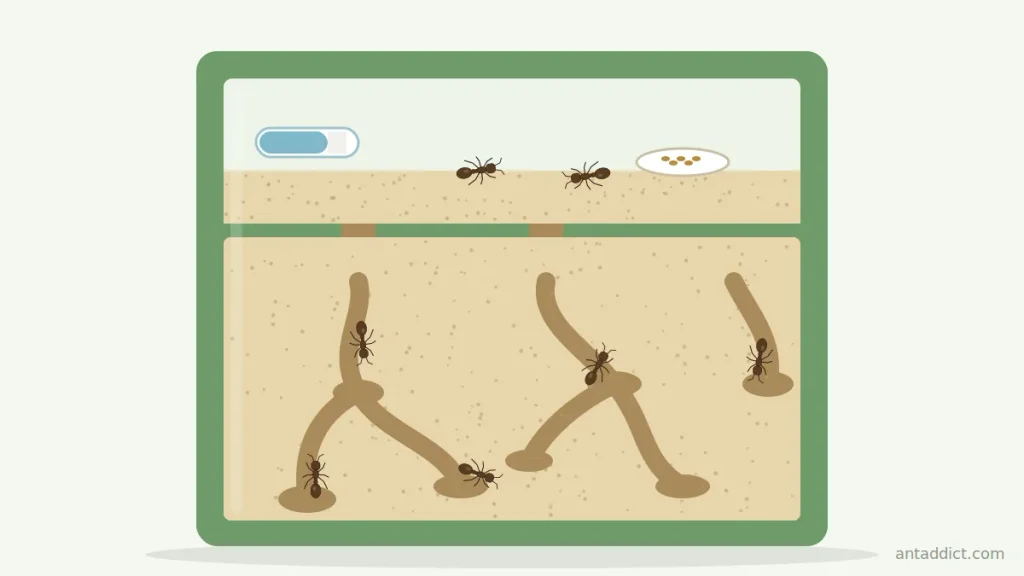
Sand ant farm with a sand nest, tunnels and chambers, and a small outworld on top
I have kept ant colonies for six years, and the sand ant farm is still the setup that makes people stop and stare. It is one of the few nests where you watch ants build their home from nothing. It is also the setup most likely to disappoint, because a sand farm that is too dry, too wet, or too wide gives you collapsed sand and hidden ants.
This guide covers which sand to use, exactly how damp to keep it, how wide the gap should be, why tunnels in sand hold at all, which species dig best, and how to feed a colony without turning your sand into a mold farm.
What is a sand ant farm?
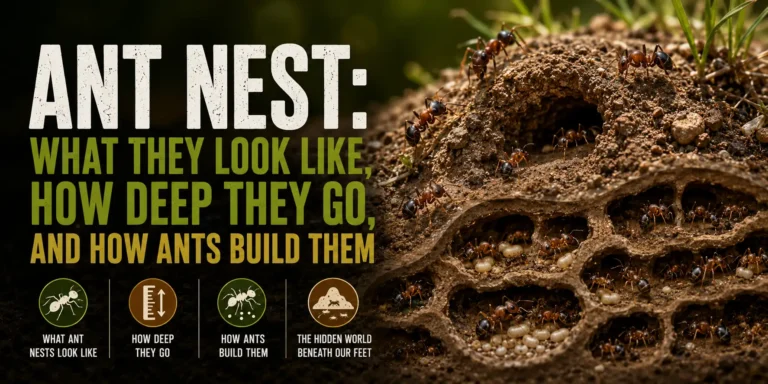
A sand ant farm is a thin, vertical habitat: two clear panes with sand between them. Ants dig tunnels and chambers, and because the space is narrow, much of that work happens right against the glass or acrylic where you can see it.
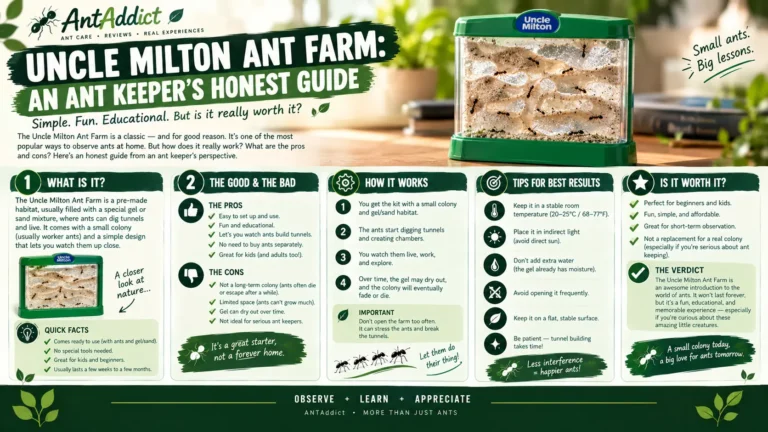
The classic version is the toy farm, like the Uncle Milton ant farm, stocked with a tube of queenless workers. Modern hobby versions, such as Anthouse’s 3D-printed sand farm, pair a sandwich nest with an “outworld,” an open foraging area on top where you place food and water (BRUMA Ants).
Do sand ant farms actually work?
Yes, when the substrate is prepared properly. Digging is what many ants are built to do. In a hobby review of the Anthouse sand farm, a Messor barbarus colony started excavating within minutes of reaching the sand (BRUMA Ants).
Researchers even use sand-like media to study ant engineering. Lab colonies of Pogonomyrmex harvester ants have been X-rayed in real time while tunneling through granular material (Buarque de Macedo et al., 2021). If engineers can get ants to build stable tunnels in a cup of grains, you can get them to do it in a farm.
What is the best sand for an ant farm?
The best sand for an ant farm is fine, washed, untreated sand, ideally mixed with a small amount of clay or loam for cohesion. Fine grains hold water films between them better than coarse grains, and that water is what glues tunnel walls together (more on that below).
| Substrate | Verdict | Why |
|---|---|---|
| Washed play sand | Good base | Clean and cheap; works best slightly damp or blended with clay |
| Play sand + clay or loam (about 3:1) | Best for most colonies | Common keeper blend; extra cohesion means fewer collapses |
| Kit refill sand | Fine for toy farms | Made for the job; Nature Gift Store’s 10 oz refill fills most kits twice |
| Beach sand | Avoid unless cleaned | Salt, debris, and hitchhiking organisms; rinse and sterilize first |
| Dyed or glitter craft sand | Avoid | Unknown dyes and coatings; no benefit to the ants |
| Garden soil | Risky | Mites, fungi, and pesticide residue unless sterilized |
Kit refill detail: Nature Gift Store. The 3:1 blend is a keeper starting point, not a fixed rule; adjust toward more clay if tunnels slump.
Whatever you choose, sterilize it. Many keepers bake sand on a tray at about 300°F (150°C) for around 30 minutes, then let it cool fully before adding water.
How wet should ant farm sand be?
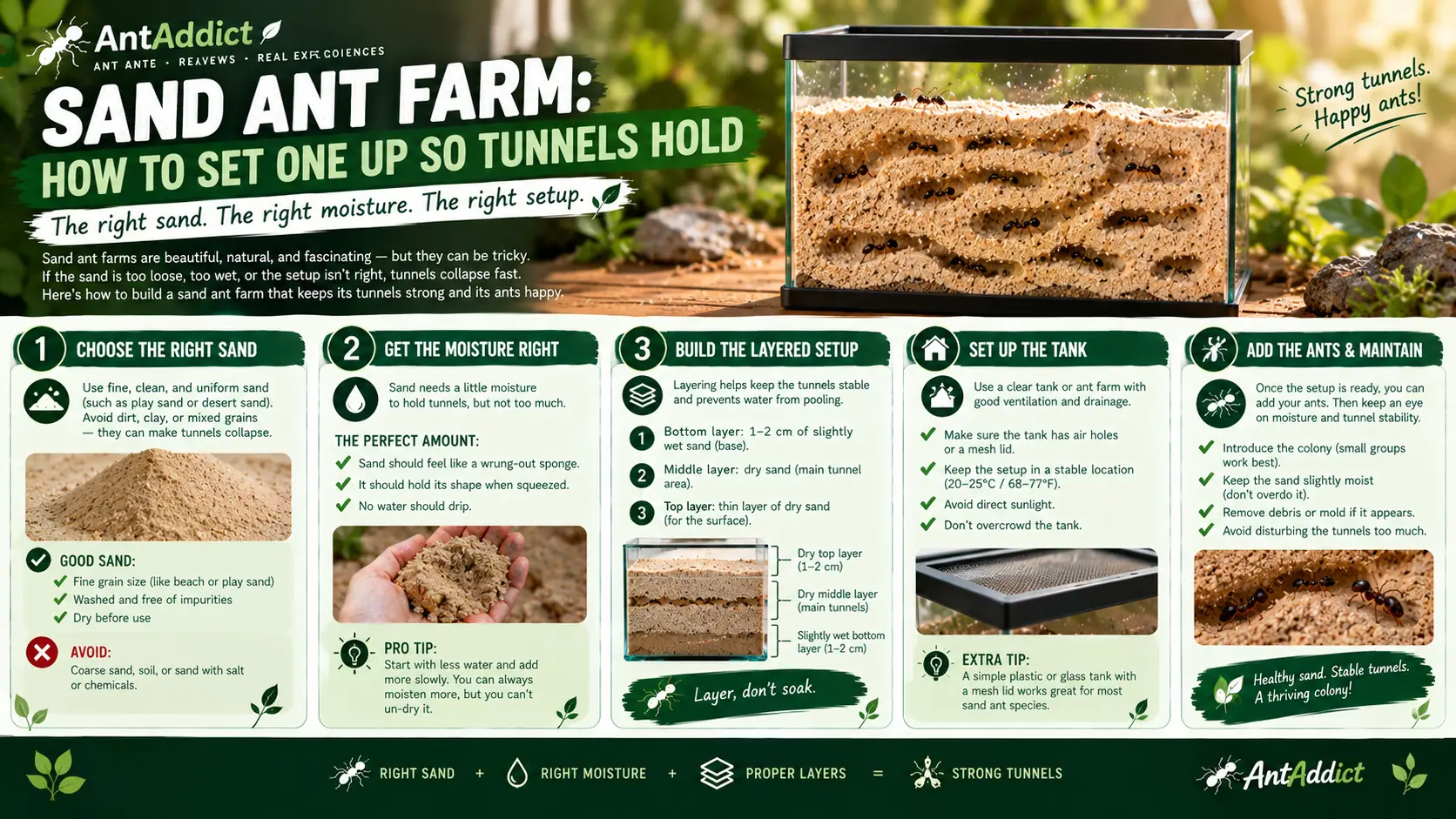
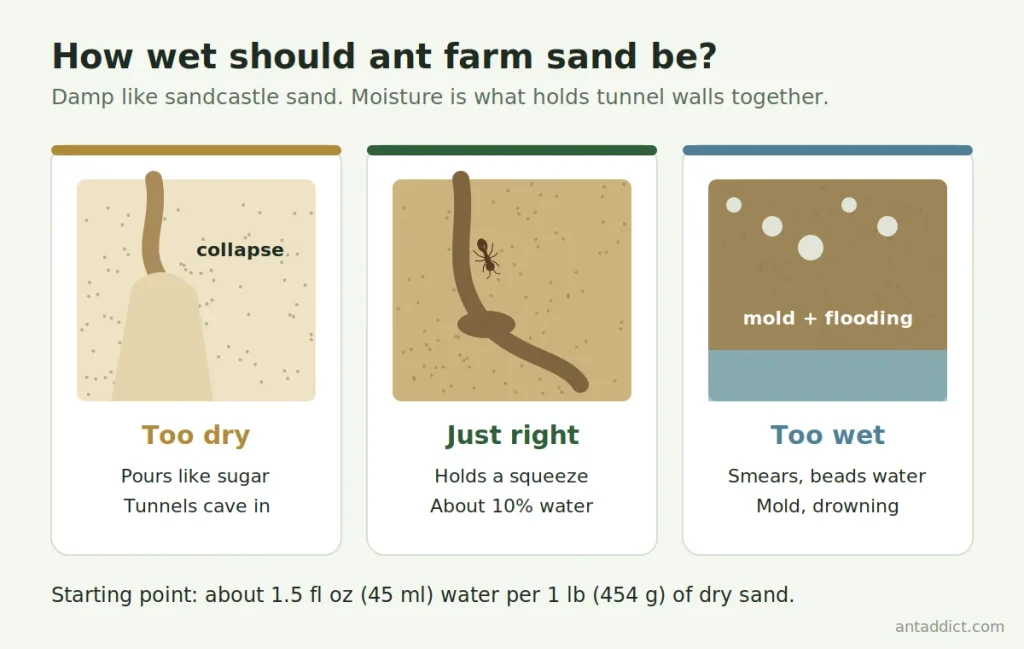
Damp, not wet. A good starting point is about 10% water by weight: roughly 1.5 fl oz (45 ml) of water per 1 lb (454 g) of dry sand. The sand should hold its shape when squeezed and crumble cleanly when poked, with no water pooling at the bottom.
This number comes from research, not guesswork. In X-ray studies of fire ants digging through moistened glass beads, tunnels reached at least twice the depth at 10% moisture compared with 1% moisture, and the researchers tied the difference to soil cohesion (Monaenkova et al., 2013). Their 2015 paper found tunnels were deepest at intermediate moisture levels (Monaenkova et al., 2015).
Sand ant farm moisture guide comparing too dry, just right, and too wet sand
The squeeze test, in practice:
- Too dry: the sand pours like sugar and tunnels cave in.
- Just right: it holds a print of your fingers, like sandcastle sand.
- Too wet: it smears, beads water, or darkens to a uniform paste.
How wide should a sand ant farm be?
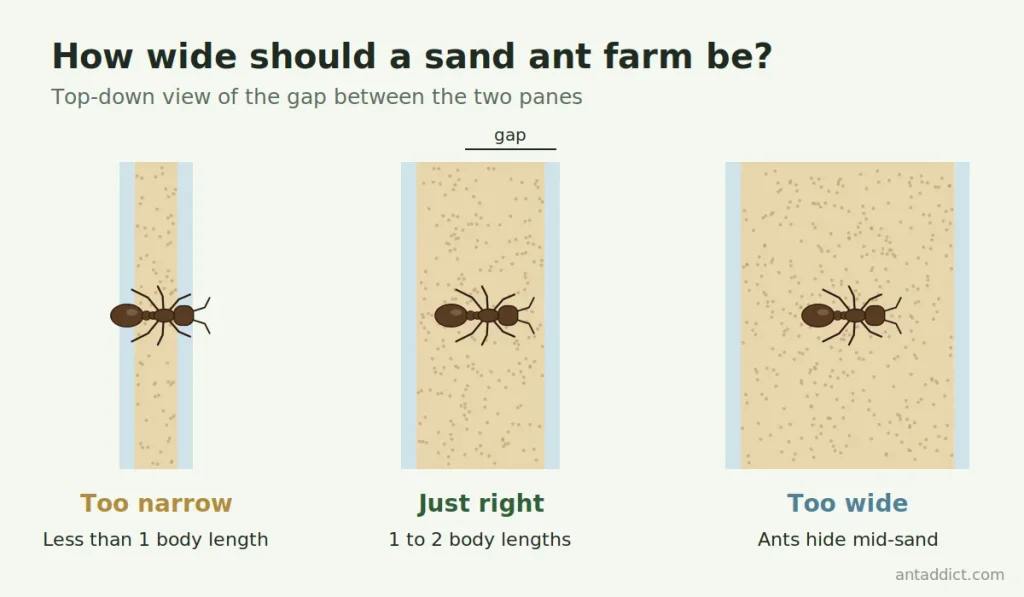
Make the gap between the panes about one to two body lengths of your largest worker. Narrower than one body length, ants cannot build normal tunnels. Much wider, and they tunnel in the middle of the sand where you cannot see them.
Sand ant farm gap width: too narrow, just right at one to two body lengths, and too wide
The science behind that rule: fire ants dig tunnels with a diameter close to one body length, regardless of moisture or grain size, a width that helps them brace and catch themselves when they slip (Gravish et al., 2013). Other species may vary, but one body length is a sensible floor.
For a real-world reference, Anthouse’s 3D sand farm uses a 2 cm (about 0.8 in) deep sandwich, which its reviewer called a good compromise between chamber space and visibility (BRUMA Ants). That suits medium to large species. Small ants do better in a thinner nest.
Here is the part everyone else skips: why tunnels in sand don’t collapse
Dry sand has no strength. Pour it and it slumps. So why can ants carve open tunnels through it? Two mechanisms work together.
First, water bridges. In damp sand, tiny water films form between neighboring grains. Surface tension in those films pulls the grains together, giving sand temporary cohesion. That is why your sandcastle stands and why the fire ant studies above found deeper tunnels in damp media (Monaenkova et al., 2015).
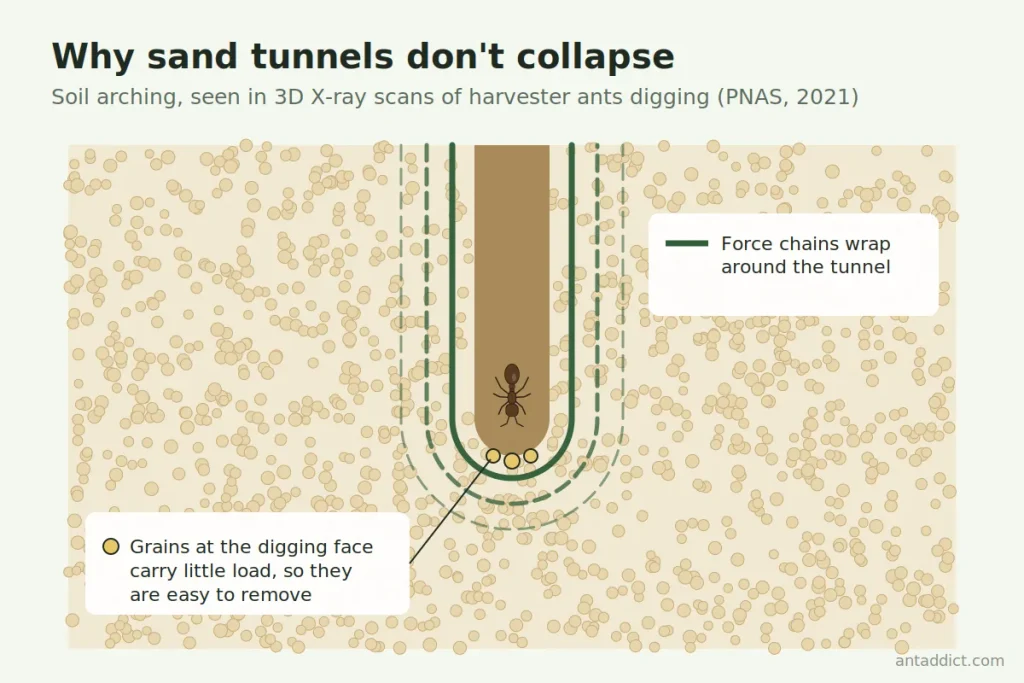
Second, soil arching. A 2021 study used real-time 3D X-ray imaging to watch Pogonomyrmex harvester ants dig, then simulated the forces between individual grains. As ants removed grains, the load in the surrounding sand shifted into “force chains” that wrap around the tunnel like a liner. Those chains reinforce the walls and relieve pressure on the grains at the digging face (Buarque de Macedo et al., 2021).
Diagram of soil arching: force chains wrap around an ant tunnel in sand and leave low-stress grains at the digging face
The elegant part: the ants do not need to sense those forces. Any grain they pick from the tunnel surface is likely to be under low stress, so they naturally avoid pulling load-bearing grains (Buarque de Macedo et al., 2021).
What this means for you: you supply the water bridges, the ants supply the arching. Let the sand dry out and you remove the water bridges. That is why moisture control is one of the most important choices in a sand farm.
How do you set up a sand ant farm?
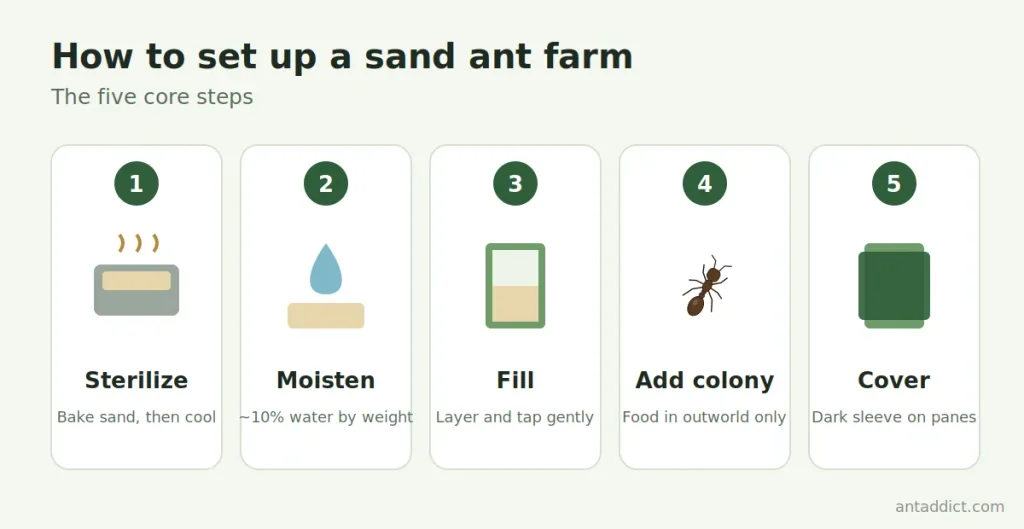
- Sterilize and cool the sand, then mix in clay or loam if you are using a blend.
- Pre-moisten it to about 10% water by weight and mix until evenly damp. You can also water after filling, but the moisture takes longer to spread evenly.
- Fill in layers, tapping the frame gently so the sand settles without hard packing. A folded sheet of paper helps guide the sand into the nest (BRUMA Ants).
- Leave a starter hole or short tunnel against the glass. Many keepers find it gives the colony a head start.
- Seal and escape-proof the outworld with a fitted lid or a barrier coating on the rim.
- Add the colony with water and food in the outworld, not buried in the sand.
- Cover the nest panes with a dark sleeve when you are not viewing. Many keepers find ants build more against the glass when it is kept dark.
Five-step sand ant farm setup: sterilize, moisten, fill, add colony, cover
What ants are best for a sand ant farm?
Strong diggers from open, sandy, or dry habitats suit sand farms best. Wood nesters and tiny species are a poor fit.
| Species | Fit for sand | Notes |
|---|---|---|
| Messor harvester ants (for example M. barbarus) | Excellent | Eager diggers; seed eaters; keep seeds dry in the outworld |
| Pogonomyrmex harvester ants | Excellent | The classic US sand ant; workers sting |
| Lasius niger (black garden ant) | Very good | Hardy beginner species in Europe; digs readily in sand-loam |
| Tetramorium immigrans (pavement ant) | Good | Small and busy; use a narrow nest; introduced (non-native) in North America |
| Camponotus (carpenter ants) | Poor | Prefer wood or premade cavities; dig slowly |
| Solenopsis invicta (fire ant) | Do not keep | Invasive outside South America and regulated in many places |
Only keep species native to your region (North American keepers can choose native Lasius, Pogonomyrmex, or Messor species instead of European ones), and check local rules before collecting or buying live ants. If you need a founding queen, see how to catch a queen ant, and start her in a tube first with our ant test tube setup guide. Many keepers wait until a young colony has around 20 to 50 workers before moving it into a sand farm.
How do you feed ants in a sand ant farm?
Feed in the outworld, never in the sand itself. Buried food is invisible to you, rots out of reach, and seeds mold through the substrate. For a full breakdown of diets, see what ants eat.
| Food | Amount | How often | Notes |
|---|---|---|---|
| Fresh water | Small feeder or test tube | Always available | Outworld water is separate from nest moisture |
| Sugar water or honey water | A few drops | 2 to 3 times a week | Carbohydrates for workers |
| Protein (fruit flies, crickets, mealworm pieces) | Roughly 1 insect per 10 to 20 workers | 2 to 3 times a week | Larvae need protein to grow |
| Seeds (harvester species only) | A small pinch | Keep stocked, dry | Store in a dry dish so seeds don’t sprout or mold |
| Leftovers | Remove | Within 24 to 48 hours | The main mold trigger in sand farms |
How do you stop mold in a sand ant farm?
Mold thrives on three things: moisture, organic matter, and still air. You cannot remove moisture from a sand farm, so control the other two. Remove uneaten food quickly, keep feeding in the outworld, and make sure the farm has ventilation.
If a white fuzz appears on the sand surface, scrape out that patch with a small spoon. If mold spreads into the nest, or the colony starts abandoning its chambers, it is time to rehome the colony into fresh sand.
How often should you water a sand ant farm?
Add water only when the sand visibly lightens from the top down, often every one to two weeks, depending on your room’s humidity. Drip it slowly onto one edge with a pipette and let it wick down. In the Anthouse setup, water added at the surface gradually moistened the lower levels of the nest (BRUMA Ants).
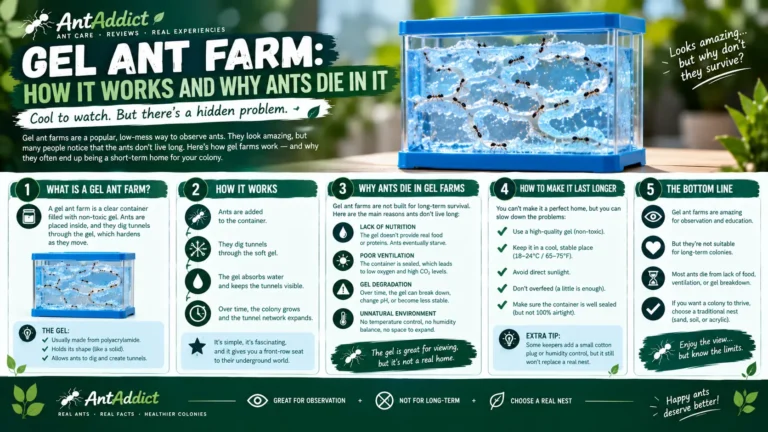
Toy farms stocked with queenless workers follow the kit’s lighter routine. The Uncle Milton ant farm guide covers that schedule.
Can you reuse ant farm sand?
Yes, usually once. Nature Gift Store says used ant farm sand can be sifted and reused once before it needs replacing (Nature Gift Store). Sift out dead ants and debris, then sterilize it again before the next colony. If it has hosted mold, throw it out.
Sand ant farm vs gel, acrylic, and plaster nests
| Factor | Sand | Gel | Acrylic | Plaster or Ytong |
|---|---|---|---|---|
| Ants build their own tunnels | Yes | Yes | No (premade) | No (chambers are pre-carved) |
| Visibility | Good, varies | Excellent | Excellent | Good |
| Mold risk | Medium | High | Low | Low to medium |
| Long-term colonies | Yes, with care | No | Yes | Yes |
| Best for | Watching natural digging | Short classroom demos | Clean viewing, easy care | Humidity control |
A sand farm wins on natural behavior. It loses on easy cleaning, because you cannot clean out a chamber without disturbing the whole nest.
Can you make a DIY sand ant farm?
Yes. The simplest DIY sand ant farm is a jar-in-a-jar: a smaller jar or bottle inside a larger clear jar, with sand filling the ring between them. The inner jar forces tunnels toward the outer glass, and the gap rule above still applies.
A step up is two acrylic panes held apart by spacer strips at the right width. Whichever you build, add a mesh-covered vent, a tight lid, and a separate outworld or feeding area on top.
Which sand ant farm should you buy?
For a real colony with a queen, a hobby sand farm with an attached outworld beats any toy. The Anthouse-style sand farm reviewed above is a solid example of the design. For a short classroom demo with mailed workers, a toy farm like the Uncle Milton Giant Ant Farm is the easiest start.
Affiliate note: the Amazon links below are affiliate links; Antaddict may earn a small commission at no cost to you.
- Sand ant farm formicarium (Amazon): for keepers with a founding colony.
- Uncle Milton Giant Ant Farm (Amazon): for kids and classrooms.
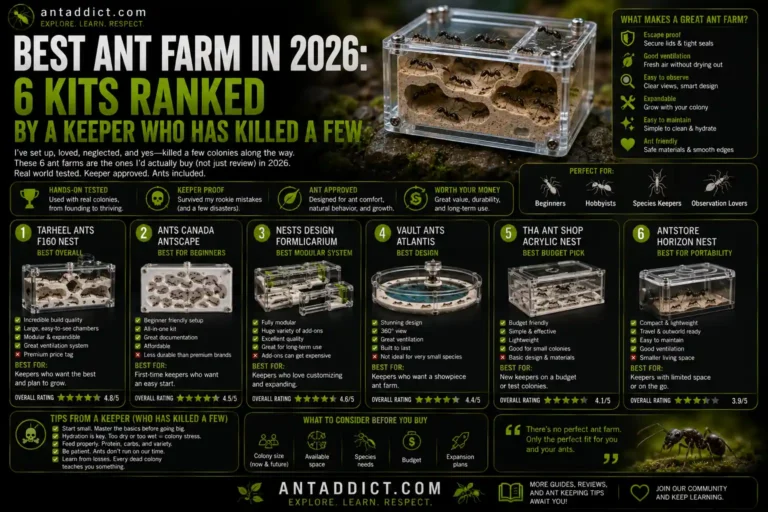
For the full comparison across sand, gel, acrylic, and hybrid nests, see our guide to the best ant farm for every budget.
Is a sand ant farm right for you?
Here is my honest keeper’s take. If you want to watch real nest construction, nothing beats sand. You see ants make decisions: where to dig, where to dump spoil, where to place brood. No acrylic nest gives you that.
But a sand farm asks more of you. You manage moisture regularly, you fight mold with good feeding habits, and you accept that some tunnels will be hidden. If you want a low-maintenance first nest, start with a test tube or acrylic nest, then upgrade to sand once your colony is established.
The bottom line
A sand ant farm succeeds or fails on physics. Damp sand at roughly 10% water by weight gives tunnels the cohesion they need, the ants’ own digging redistributes the load around each tunnel, and a gap of one to two body lengths keeps that work visible. Use clean, sterilized sand, feed only in the outworld, and stock it with a queen-right colony of a digging species. Get those right and your sand ant farm becomes a living cross-section of an ant nest.
FAQ
What is a sand ant farm?
A narrow habitat with two clear panes and sand between them. Ants dig tunnels against the glass, so you can watch their nest being built.
What kind of sand is best for an ant farm?
Fine, washed, untreated sand, ideally mixed with a little clay or loam. Avoid dyed craft sand and unwashed beach sand.
How wet should sand be in an ant farm?
Damp like sandcastle sand, roughly 10% water by weight: about 1.5 fl oz (45 ml) of water per 1 lb (454 g) of dry sand.
Why do tunnels collapse in my sand ant farm?
Usually the sand is too dry. Water films between grains hold tunnel walls together, so dry sand loses its strength. A clay blend also helps.
How wide should a sand ant farm be?
About one to two body lengths of your largest worker. Too narrow blocks tunneling; too wide hides the ants in the middle of the sand.
Can I use play sand in an ant farm?
Yes. Washed play sand is a good base. Sterilize it, moisten it evenly, and consider mixing in clay or loam for stronger tunnels.
Can I use beach sand for an ant farm?
Only after rinsing out salt and debris and sterilizing it. Clean play sand is easier and safer.
How often do you water a sand ant farm?
When the sand visibly lightens, usually every one to two weeks. Add water slowly at one edge and let it wick down.
Where do you put food in a sand ant farm?
In the outworld or on the surface, never buried. Remove leftovers within 24 to 48 hours to prevent mold.
Can you reuse ant farm sand?
Yes, usually once. Sift out debris and dead ants, then sterilize it. Throw out sand that has had mold.
What ants are best for a sand ant farm?
Strong diggers such as Messor and Pogonomyrmex harvester ants, Lasius niger, and pavement ants. Carpenter ants are a poor fit.
Do sand ant farms need a queen?
Not to work, but to last. Without a queen, workers cannot be replaced and the colony dies out within weeks or months.
Can I make my own sand ant farm?
Yes. A jar-in-a-jar or two acrylic panes with spacers works, as long as the gap is right and the lid is escape-proof.