Water Ants in House: What They Are and How to Get Rid of Them
You turned on the kitchen tap and there they were: a thin line of tiny ants crossing the sink. Or worse, a few floating in a glass of water you left out overnight. You typed “water ants in house” because you want two answers fast. What are these things, and how do you get them out without fogging your house with poison?
I keep ant colonies, and have for six years. The first thing that job teaches you is how much a colony cares about water. Not sugar. Not grease. Water. I watch my own colonies run workers to their water source all day long, because if that source dries up, the brood starts to dry out too and things go bad quickly. Wild ants are no different. That same thirst is what marches them across your counter and into your bathroom. Once you get why they want your water, everything about getting rid of them makes more sense.
So let’s start there.
“Water ants” isn’t a real species — here’s what you actually saw
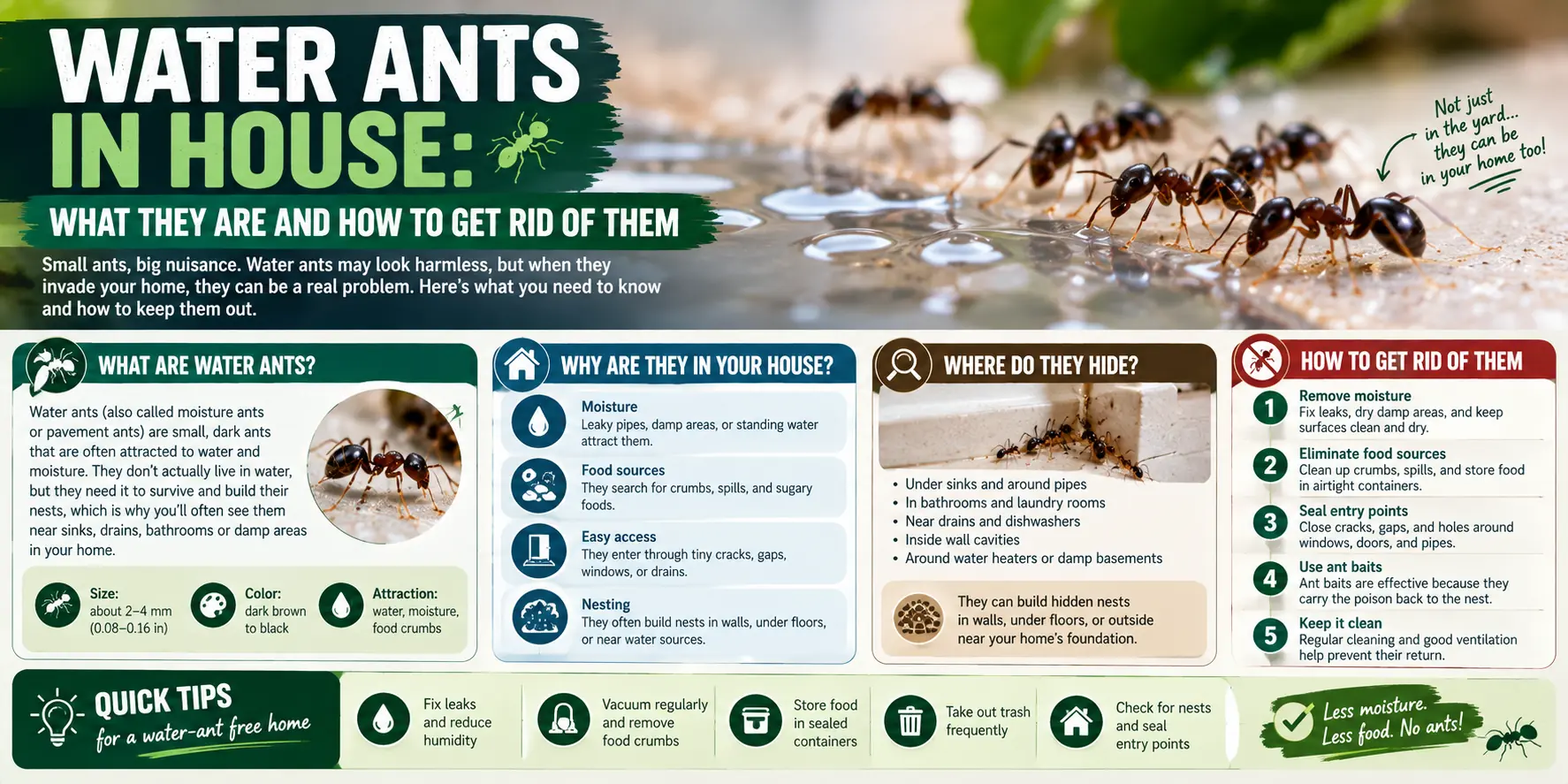
There is no ant officially called the “water ant.” It’s a nickname people reach for when they see ants gathering around water indoors. Depending on what you actually saw, “water ants in house” almost always comes down to one of four very different ants:
- Moisture ants (Lasius species). The closest thing to a real “water ant,” because they genuinely nest in damp, rotting wood.
- Odorous house ants (Tapinoma sessile). The usual suspect on a trail to the sink in North America.
- Pavement ants (Tetramorium species). Dark little ants that nest outside but come indoors for water and food.
- Pharaoh ants (Monomorium pharaonis). Tiny yellow ants that love warm, humid rooms like bathrooms and kitchens.
The name matters because the right fix is different for each one. Spray a pharaoh ant colony, for instance, and you’ll actually make it worse (more on that below). Most guides skip this step and treat “water ants” as one bug with one solution. That’s exactly why generic advice keeps failing people.
If you want the full picture, including the water ants that live outdoors and near ponds, I cover all of it in my main guide to what water ants really are. Here I’m focused on the ones already inside your home.
Why ants suddenly invade your house for water
A colony doesn’t just drink water. It uses water to:
- Keep the brood alive. Eggs, larvae and pupae dry out and die without steady humidity.
- Process food. Adult ants can only swallow liquids, so water helps them break down and share what they bring back.
- Regulate the nest. Moisture helps hold temperature and humidity steady inside the colony.
Water isn’t optional for them. It’s survival. When I let a colony’s water run dry for even a day in summer, I can see the workers get frantic. That’s the same behavior you’re watching on your counter right now.
Then there’s the trigger. Most indoor water ant problems flare up in hot, dry weather. When the puddles, dew and damp soil outside all dry up in a heatwave or drought, scouts have to travel farther to find water, and your home is basically an oasis: leaky pipes, condensation, sink basins, pet bowls, houseplant trays. One scout finds the water, lays a scent trail on the way home, and a few hours later you’ve got a line of ants following that invisible trail straight to the wet spot.
That’s why they seem to come out of nowhere and always hit the same place. It isn’t random. They’re tracking a chemical trail to a water source you probably haven’t even noticed. If the biology interests you, I go into how ants find, carry and share water in how ants actually drink and store water.
The 4 ants people call “water ants” — how to tell them apart
Snap a zoomed-in photo on your phone, or trap one under a clear glass. Here’s how to work out which “water ant” you’ve got, because it decides the whole treatment plan.
| Ant | Size | Color | Tell-tale sign | Where you’ll see it |
|---|---|---|---|---|
| Odorous house ant | 2.4–3.25 mm | Brown to black | Smells like rotten coconut when crushed | Trailing to sinks, dishwashers, pet bowls |
| Pavement ant | 2.5–3 mm | Dark brown/black | Two tiny spines on the back; grooved head | Along baseboards, from cracks in slab/patio |
| Pharaoh ant | 1.5–2 mm | Pale yellow/amber | Very tiny, translucent, moves in loose trails | Warm, humid bathrooms, kitchens, wall outlets |
| Moisture ant | 4–4.5 mm | Yellowish | Faint lemon/citronella smell; near damp wood | Around leaks, rotting window frames, damp subfloor |
Odorous house ants — the classic sink trailer
A neat line of small dark ants heading for your kitchen sink or a dripping faucet is usually this one. The smell gives it away. Crush one and you get a surprisingly strong rotten-coconut or blue-cheese odor. Washington State University’s extension uses that exact scent as a field ID. They nest in wall voids, under floors, and near warm damp spots, and they are relentless about water.
Pavement ants — outdoor nesters, indoor visitors
These nest under sidewalks, driveways, patios and slab foundations, then run trails inside. You’ll usually spot them coming out of a crack where the floor meets the wall. They want water and food both, so it’s common to find them working a wet sink and a dropped crumb at the same time.
Pharaoh ants — the ones you must NOT spray
Tiny, pale yellow, and pulled toward warmth and humidity, pharaoh ants love bathrooms, kitchens, and anywhere the pipes run warm. Here’s the catch. Pharaoh colonies reproduce by “budding.” Hit them with a repellent spray and the colony panics and splits into several new colonies that scatter through your walls. Baiting is the only approach that works on these. And if you’re in an apartment or a shared building, tell your property manager, because the colony often runs across several units.
Moisture ants — a warning sign, not just a pest
Bigger and yellowish, with a faint lemony smell when crushed (which is why the yellow types also get called citronella ants, as Penn State Extension notes), moisture ants are the only group that really earns the “water ant” name. They nest in wood that’s already wet and rotting: around a slow roof leak, a rotting window sill, a damp crawlspace, subfloor near a plumbing leak. They don’t chew through healthy wood the way termites do, but finding them is a red flag. It means you’ve got moisture and rot somewhere. Kill the ants but ignore the leak and they’ll be back.
The “ants in a clean glass of water” mystery
Here’s a version of the question I get a lot: “There are ants in my glass of water even though the glass was clean. Why?”
It has nothing to do with how clean it is. The ants are after the water and the humidity, plus faint mineral or residue traces you and I can’t even detect. A scout finds the moisture, marks the route, and brings the others in. Leave that glass on the nightstand overnight and it turns into a beacon. The ones that drowned just got too close to the surface.
Scrubbing harder won’t help. Getting rid of standing water at night and breaking the trail will, and I’ll cover both below.
How to get rid of water ants in the house — step by step
This is the plan I’d run myself. It works with ant biology instead of fighting it, which is why it holds. Spraying gives you a satisfying line of dead ants and a fresh trail by morning.
Step 1 — Identify the ant (don’t skip this)
Use the table above. The identification that changes everything is pharaoh ant (never spray) versus the rest. And if there’s damp or rotting wood in the picture, you’re probably looking at moisture ants, which makes Step 5 non-negotiable.
Step 2 — Cut off the water (the real root cause)
This is the step the pest-control pages breeze past, because there’s nothing here for them to sell you. The ants came for water, so take the water away:
- Fix dripping faucets and the leaking traps under sinks.
- Wipe sinks, tubs and shower floors dry before bed.
- Empty and dry pet water bowls overnight, or stand them in a shallow tray of soapy water.
- Run a dehumidifier or an exhaust fan in humid bathrooms.
- Wipe up condensation around windows and cold pipes.
- Empty houseplant drip trays.
In a dry spell this step alone can end a small invasion in a few days, because you’ve taken away the only reason they came.
Step 3 — Bait the colony, don’t spray the trail
This is the one that people get wrong most often. Spraying kills the workers you can see and never touches the queen and brood you can’t. With most of these ants the colony just reroutes. With pharaoh ants it multiplies. Baiting does the opposite: the foragers carry slow-acting bait home and feed it to the whole colony, queen included.
- Match the bait to what they want. Since these are water and sugar foragers, start with a sugar-based gel or liquid bait (look for borax, fipronil or hydramethylnon on the label).
- Put small dabs right on the active trail and near where they’re getting in. Not where you’d prefer them to be.
- Don’t clean the trail or squash the foragers while the bait is out. You want them alive and carrying it home. Wiping the trail too soon is the number one reason baiting “doesn’t work.”
- Give it time. A real colony collapse takes several days to a couple of weeks. Don’t crack and reach for the spray, because that undoes the whole thing.
If they ignore the sugar bait and seem more interested in protein, switch to a protein or grease-based bait. Odorous house ants in particular change what they want with the seasons.
Step 4 — Seal them out
Once the colony’s knocked down, close the doors behind them:
- Caulk the gaps around pipes, along baseboards, and where the counter meets the wall.
- Weatherstrip doors and windows.
- Seal the crack the trail was coming from, but only after the bait has done its job, not before.
Step 5 — For moisture ants: fix the wood and the leak
If you’ve pegged them as moisture ants, treating the ants is only half the job. Track down and fix the moisture source, whether that’s the roof leak, the plumbing drip or bad ventilation, and replace the rotted wood they nested in. If the nest is inside a wall or in structural timber, this is where a professional inspection earns its money, because they’ll also rule out termites and carpenter ants. (Carpenter ants are a bigger, more serious wood problem. I get into what they eat and how they behave in my carpenter ant guide.)
What NOT to do
- Don’t grab the spray can first. It’s the reflex those pest-company pages are quietly counting on, and it’s the weakest move against a colony that’s after water.
- Don’t wipe the trail before baiting. You need that trail working for you.
- Don’t lean on scent deterrents alone. Vinegar, peppermint and cinnamon can knock a trail out for a night, but they won’t kill a colony. They buy you some peace while the bait does the real work.
- Don’t shrug off the same wet spot getting hit again. If they keep coming back, there’s still a moisture source or an open entry point you haven’t found.
When to call a professional
A plain trail of odorous house or pavement ants coming for water is a weekend job you can handle yourself. Call someone in when:
- You’ve confirmed moisture ants nesting in structural wood, or you can’t tell whether it’s ants or termites.
- Pharaoh ants keep going in a shared building even after you’ve baited them properly.
- The trail keeps coming back after you’ve fixed the moisture, baited, and sealed.
- You find large winged ants indoors, which can mean a carpenter ant or termite swarm, and that’s a structural issue, not just a nuisance.
How to keep water ants from coming back
Prevention is really just Step 2 made permanent. Make your home a bad place to find water.
- Keep sinks, tubs and counters dry overnight, especially in summer.
- Fix leaks fast. A slow drip under a sink is a colony’s dream.
- Ventilate bathrooms, kitchens and crawlspaces, and run a dehumidifier if the humidity stays high.
- Keep sweet and greasy foods sealed.
- Keep a caulk gun around and close new gaps as you notice them.
- Expect more pressure in drought season and stay ahead of it. That’s when the scouts come looking.
Do that and you’re not really fighting ants anymore. You’ve taken away the reason they came inside in the first place.kind of water ant and what it means, then come back and run the plan above.
The bottom line
“Water ants in house” is really a water problem with ants attached. Work out which of the four ants you’ve got, take away the moisture that pulled them in, bait the colony instead of spraying the trail, and then seal the way back in. Do that and the invasion is over for good, with no monthly service contract required.
Still not sure what you saw? Start with my full breakdown of every kind of water ant and what it means, then come back and run the plan above.
Are water ants in the house dangerous?
For the most part, no. Odorous house, pavement and pharaoh ants are nuisance pests — they contaminate food and are unpleasant in numbers, and pharaoh ants can spread bacteria in sensitive settings like hospitals, but they don’t damage your home. Moisture ants are the exception worth taking seriously: they don’t cause the damage themselves, but they signal wet, rotting wood that does need fixing.
Why do ants keep coming to my sink even when it’s clean?
Because they’re after the water and humidity, not crumbs. A scout found moisture, laid a pheromone trail, and now the colony follows it. Drying the sink at night and breaking the trail matters far more than how clean the basin is.
Will vinegar or peppermint get rid of water ants?
Only temporarily. These scents can disrupt a trail for a night, but they don’t reach or kill the colony. Use them as a short-term interruption while a proper bait does the actual work of collapsing the nest.
Why are the ants worse in summer?
Heat and drought dry up the outdoor water ants normally rely on, so foragers push indoors to your leaks, condensation and sinks. Indoor “water ant” invasions almost always spike in hot, dry stretches.
Should I spray the ants I see?
No — spraying the visible trail kills foragers but not the queen, and with pharaoh ants it makes the infestation split and spread. Bait instead, and leave the trail alone until the bait has done its job.
How long does it take to get rid of them?
If it’s a simple water-seeking trail and you cut off moisture plus bait correctly, expect a few days to about two weeks for the colony to collapse. Moisture-ant problems tied to structural rot take longer because you also have to fix the underlying leak.