
Water Ants: The Simple Truth About What You Actually Saw
Last reviewed: June 2026. Claims in this guide are drawn from first-hand keeping and the peer-reviewed and reference sources linked inline and listed below. For an active infestation in your home, consult a licensed pest control professional.
Water ants are not one kind of ant. “Water ants” is a catch-all people reach for to describe several different things: moisture ants, a group of ants that nest in damp, decaying wood indoors; ordinary ants showing up around water in kitchens, bathrooms, and sinks; ants seen swimming, floating, or surviving a flood; and the water a keeper adds to an ant farm. This guide sorts out which “water ant” you actually mean, and answers the real question behind each one, including the remarkable science of how ants survive water they cannot breathe in.
If you searched “water ants,” you had one of a few very different situations in mind, and the internet’s answers are a mess because they blur them together. Let me untangle it.
After six years of keeping ants, I can tell you the phrase almost always maps to one of four things. This guide walks through each, tells you how to know which is yours, and links out to the fuller guide where one exists, so you can jump straight to the answer you need.
What people mean by “water ants”
Before anything else, here is the quick sort. Match your situation to one of these, then read that section.
| If you saw… | You probably mean | Jump to |
|---|---|---|
| Ants coming from damp wood, a leak, or a bathroom wall | Moisture ants | Below |
| Ants swarming the sink, pet bowl, or a puddle | Ants attracted to water | Below |
| Ants floating, rafting, or surviving a flood | Can ants swim and survive water | Below |
| Wondering how much water to give a captive colony | Watering an ant farm | Below |
None of these is a distinct species named the “water ant.” They are four different questions wearing the same nickname. Sorting them is most of the battle.
Moisture ants: the closest thing to a real “water ant”
If you found ants living in wet, rotting wood, or streaming out of a damp spot in your home, you are almost certainly dealing with moisture ants, and this is the meaning closest to a genuine “water ant.”
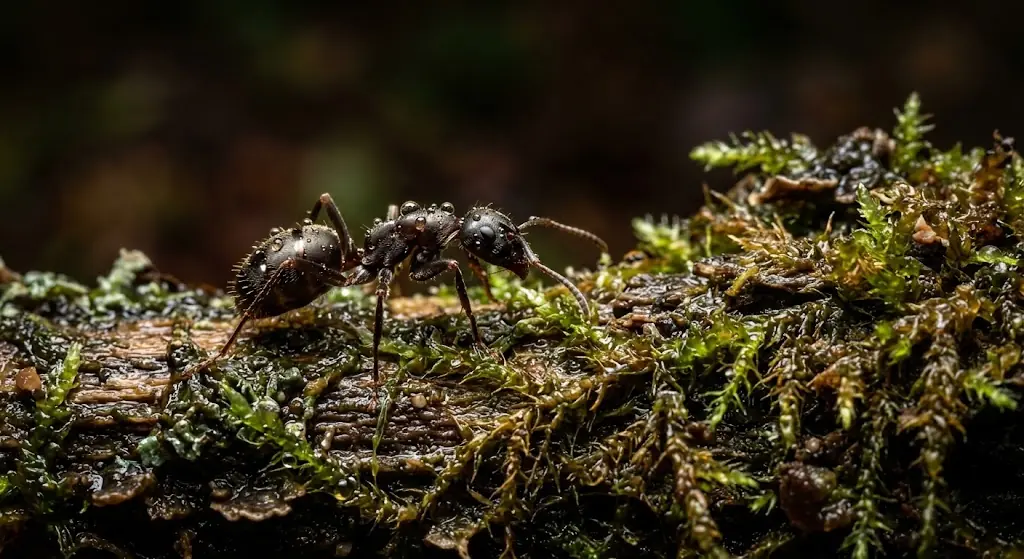
Moisture ants are a loose group of ant species, many in the genus Lasius, that are strongly drawn to damp, decaying wood. Some are yellowish and give off a faint lemon or citronella smell when crushed, which is why a few are also called citronella ants. They nest in wood that is already wet and rotting, in soil, and under stones.
Here is the key point for a homeowner: moisture ants do not create a moisture problem, they reveal one. Like carpenter ants, they are drawn to wood that is already water-damaged. Finding them indoors is a strong sign of a hidden leak, poor drainage, or condensation somewhere feeding damp wood.
Because they colonize wood that is already rotting, moisture ants cause far less structural damage than termites, and typically less than carpenter ants, since they move into failing wood rather than excavating sound timber.
The real fix is almost never the ants. It is the water. Find and repair the moisture source, dry out or replace the damaged wood, and the ants lose the conditions they need.
For an active indoor infestation, and especially to trace the moisture, a licensed pest professional is the right call. Identifying moisture ants also overlaps with telling ants from termites in damp wood, which I cover in the guide to carpenter ant holes.
Ants attracted to water: why they are at your sink
The second meaning is simpler. Sometimes “water ants” just means ordinary ants that keep showing up wherever there is water: the kitchen sink, the bathroom, the pet’s water bowl, a leaky pipe, or a puddle on the patio.
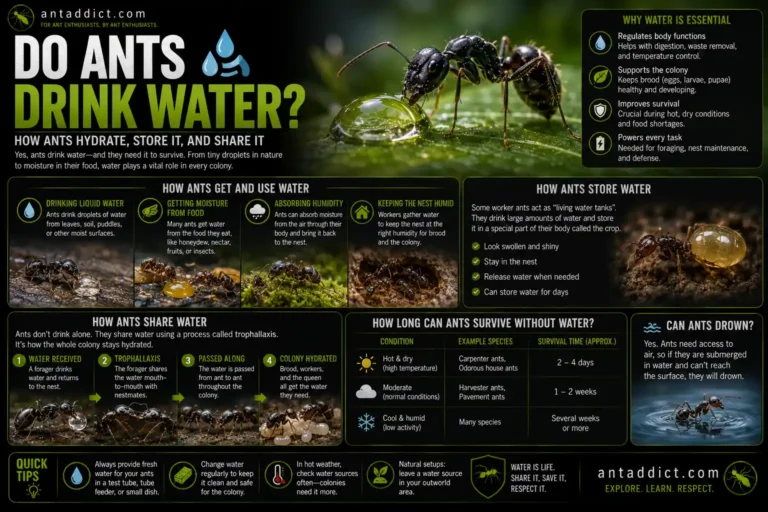
Ants need water like any animal, and in dry conditions they will forage for it just as they forage for food — here’s how ants drink water and why the whole colony depends on it. A dripping tap or a damp bathroom is, to a thirsty colony, an oasis. This is why ant activity around water often spikes in hot, dry weather, when outdoor moisture disappears and your plumbing becomes the most reliable water source around.
Common household culprits include odorous house ants, pavement ants, and pharaoh ants, all of which will trail indoors toward moisture. Activity tends to peak in mid to late summer and during dry spells, and then again, oddly, right after heavy rain, when a soaked nest pushes a ground-dwelling colony to seek higher, drier ground inside your walls.
These are not a special species. They are whatever ants live nearby, following a water source. The same trails that lead ants to a spilled soda lead them to standing water, guided by the scent trails that organize all ant foraging, a system explained in the guide to what ants eat.
The fix is the same as for any ant intrusion: remove the attractant. Fix drips, wipe up standing water, empty and dry sinks at night, and seal the entry points they are using. Take away the reliable water and the trail dries up with it.

Can ants swim? The science of ants and water
The third meaning is the most interesting, and where “water ants” turns from a pest question into a genuine wonder of biology. People see ants floating, crawling out of a flooded nest, or surviving a soaking, and ask: can ants actually swim?
The honest answer is that most ants do not swim in the way a fish or a person does. Their legs are too small to generate real propulsion, and a lone ant dropped in water mostly just struggles at the surface. But ants have three tricks that make them far harder to drown than their size suggests.
They can hold their breath. Ants do not breathe through their mouths. They take in air through tiny holes along their bodies called spiracles, and when submerged, many ants can close those spiracles and shut down, surviving underwater for hours, and in some cases much longer, until conditions improve.
Their bodies trap air. An ant’s exoskeleton is water-repellent, and its rough surface holds a thin film of air against the body when submerged, called a plastron. That trapped air both keeps the ant from getting waterlogged and can supply a little oxygen, buying survival time underwater.
A few species genuinely swim and dive. The most extreme is the diving ant Colobopsis schmitzi, long known as Camponotus schmitzi, which lives with carnivorous pitcher plants and deliberately swims and dives into the plant’s digestive fluid to retrieve food. It is one of the only ants that truly moves through liquid on purpose.
There is a flip side, and it explains a common kitchen trick. Plain water lets an ant keep its protective film of air, but soapy water does not: detergent breaks the water’s surface tension and strips away the trapped air the ant depends on, so an insect that would ride safely on plain water sinks and drowns in soapy water. It is the surfactant, not any poison, that does the work.
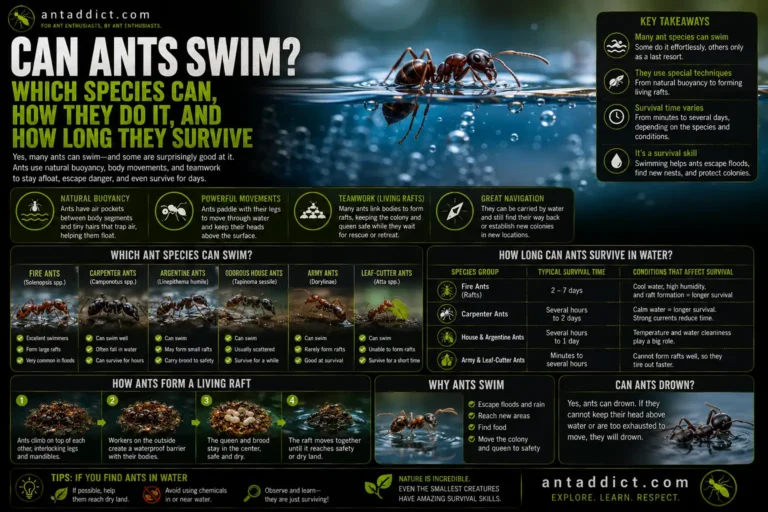
Some ants genuinely swim while most just float, and a few drown in seconds — see our full guide on whether ants can swim for which species can, how they do it, and how long they survive underwater.
How ants survive floods: the living raft
Here is the part that turns disbelief into awe, and the single best reason “water ants” is worth writing about at all.
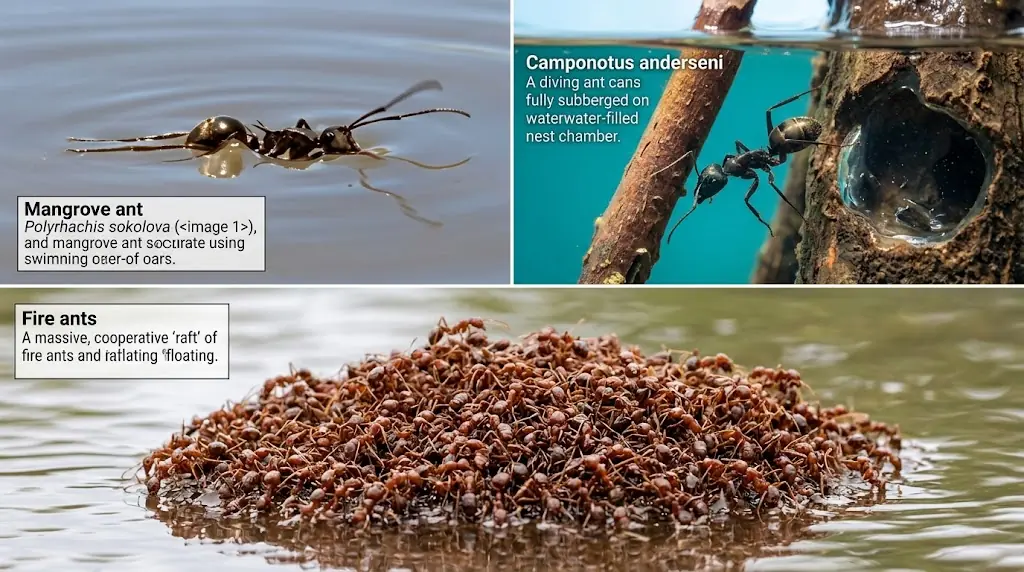
When a nest floods, fire ants (Solenopsis invicta) do not scatter and drown. The entire colony links together into a living, floating raft, and this is genuinely one of the most remarkable behaviors in the insect world.
Researchers at Georgia Tech studied exactly how they do it. In a 2011 study in PNAS, Mlot and colleagues showed that fire ants grip one another with their jaws, claws, and sticky footpads, lacing their bodies together into a tight, water-repellent mesh. A ball of ants dropped in water spreads into a flat, disc-shaped raft in as little as 100 seconds.
The physics is elegant. A single ant is only mildly water-repellent, but a raft of interlinked ants dramatically boosts that repellency, trapping a layer of air underneath so water cannot penetrate. The raft becomes buoyant, elastic, and nearly unsinkable, springing back even when pushed underwater with a twig.
The whole colony rides along. Workers carry the brood, and the queen sits protected in the center, while the ants on the bottom, the ones with their heads in the water, are not sacrificed: the raft slowly churns, rotating individuals between the wet underside and the dry top so everyone gets a turn to breathe. In the lab, these rafts stay afloat for anywhere from a day to nearly two weeks.
It is not just survival, either. Rafting lets a flooded colony drift to new ground, so a disaster doubles as a way to colonize new territory. A fire ant colony treats a flood the way a sailor treats a storm: batten down, float, and make landfall somewhere new.
One practical warning comes with all this. A floating fire ant raft is still a colony of stinging ants, and in a real flood these rafts drift into people, pets, and anything else in the water. Brushing against one while wading can trigger a mass of stings at once, so in fire ant country, floodwater is worth treating with real caution.
Which ants handle water best?
Not all ants are equal in water. A few are genuine specialists.
Fire ants are the champions, thanks to the rafting described above. Army ants are close behind: on their nomadic marches they link their bodies into living bridges and rafts to carry a column across streams, using the same self-assembly trick. Carpenter ants, despite their bulk, are reported to be decent paddlers at the surface.
The strangest is the diving ant, Colobopsis schmitzi, which lives inside carnivorous pitcher plants and deliberately swims and dives beneath the surface of the plant’s digestive fluid to retrieve drowned prey. It is one of the only ants on Earth that moves through liquid on purpose rather than in an emergency.
Most other ants, though, simply avoid water when they can, and rely on the survival tricks, breath-holding, trapped air, and rafting, only when caught out. Swimming is the exception in the ant world, not the rule.
How ants keep the nest dry
Long before a flood forces a raft, most ants work to keep water out of the nest in the first place. It is the quieter half of the ant-and-water story.
Many soil-nesting ants build so the nest architecture itself sheds water, with mounded surfaces and angled entrances that shrug off rain, and some species plug the entrances ahead of a storm. Inside, the chambers sit at different depths, so when the lower levels start to flood, workers carry the brood and the queen upward to drier rooms and wait it out.
That is why a rainstorm rarely destroys a healthy colony. The nest is built to drain and buffer, the ants relocate the vulnerable brood upward, and only a true inundation forces the dramatic last resort of abandoning the nest and rafting away.
Watering an ant farm: the keeper’s version
The fourth and final meaning has nothing to do with pests or floods. If you keep ants, “water ants” might simply mean the everyday task of giving your colony water, and getting it wrong is one of the most common ways new keepers lose a colony.
Ants need constant access to water, but they drown easily, so the goal is humidity and safe drinking., never an open pool. Most keepers provide water through a test tube setup, a tube with water trapped behind a cotton plug, which wicks moisture slowly and safely, or through a hydration port or a dampened area of the nest. The ants drink from the damp cotton or surface without ever risking open water.
The two failure modes are opposite and equally deadly. Too little water and the colony desiccates, since ants and especially their brood are very sensitive to drying out. Too much, or standing open water, and workers drown or the nest grows mold. The art is a stable, moderate humidity gradient, damp at one end, dry at the other, so the colony can choose.
If this is the “water ants” you meant, the broader husbandry context, hydration, heat, and feeding, ties into how a whole colony works, covered in the guide to ant colonies.
Here is the part most pages miss: why water both threatens and saves ants
Step back and something striking emerges. Water is at once one of the deadliest threats an ant faces and one of the resources it cannot live without, and the same colony that drowns in an open dish can survive two weeks adrift on a flood.
The resolution is the theme that runs through all of ant biology: the colony, not the ant, is the unit that matters. A single ant is genuinely bad at dealing with water. It struggles to swim, it can be drowned in a soapy dish, and it dies alone in a puddle.
But the colony as a superorganism handles water brilliantly, weaving thousands of mediocre swimmers into an unsinkable raft, rotating members so none stays under too long, and keeping the queen dry at the center.
That is the deeper answer to “what is a water ant.” There is no such species, but there is a profound relationship between ants and water, and it only makes sense once you stop looking at the individual ant and start looking at the colony. Alone, an ant loses to water. Together, ants beat it.
What to do, depending on which “water ant” you have
To close the loop, here is the practical takeaway for each meaning.
If you have moisture ants in the home, treat it as a moisture problem first. Find the leak or damp wood, fix it, and get a professional to handle an active nest.
If you have ants around water at the sink or bowl, remove the water source and standing moisture, seal entry points, and the trails will fade.
If you are curious whether ants can swim or survive water, the answer is that individuals mostly cannot, but colonies survive remarkably well by holding their breath, trapping air, and rafting.
If you are asking about watering a captive colony, give water safely through a test tube or hydration port, never an open pool, and aim for a stable humidity gradient.
The bottom line
“Water ants” is not a species, it is a question with four different answers hiding inside it. Most often it means moisture ants nesting in damp wood, which are really a sign of a water leak. Sometimes it means ordinary ants trailing to your sink for a drink. Sometimes it means the genuine marvel of ants surviving floods. And sometimes it just means keeping your colony hydrated without drowning it.
Figure out which one is yours and the confusion clears instantly. And whichever it is, the most interesting truth stays the same: no single ant is a water ant, but a colony of ants is one of nature’s most surprising survivors of water.
FAQ
Are water ants a real species?
No. “Water ants” is an informal catch-all, not a scientific species. It usually refers to moisture ants that nest in damp wood, to ordinary ants attracted to water, or to ants seen surviving floods.
What are moisture ants?
A loose group of ants, many in the genus Lasius, that nest in wet, decaying wood. Finding them indoors usually signals a hidden leak or water-damaged wood rather than a problem with the ants themselves.
Are moisture ants dangerous to my house?
They cause far less damage than termites and usually less than carpenter ants, because they colonize wood that is already rotting rather than sound timber. The real issue they flag is the underlying moisture.
Why are ants attracted to water?
Ants need water to survive and will forage for it, especially in hot, dry weather when outdoor moisture is scarce. A dripping tap, damp bathroom, or pet bowl becomes a reliable water source for a nearby colony.
Can ants swim?
Most ants cannot truly swim, since their legs are too small for propulsion, but they resist drowning well. They can close their breathing holes to hold their breath and trap a layer of air against their bodies underwater.
How do ants survive floods?
Species like fire ants link their bodies into a floating raft that traps air and repels water, keeping the colony, brood, and queen afloat. These rafts can survive from a day to nearly two weeks and help the colony drift to new ground.
Do all ants build rafts to survive water?
No. Rafting is best known in fire ants, and army ants build similar living bridges and rafts. Most ant species do not raft; they rely on avoiding water, sheltering in the nest, and holding their breath if submerged.
Are floating fire ant rafts dangerous to people?
Yes. A raft is a whole colony of stinging fire ants, and in a flood these rafts drift into people and pets. Brushing against one in floodwater can cause many stings at once, so floodwater in fire ant regions should be treated with caution.
Is there an ant that swims on purpose?
Yes. The diving ant, Colobopsis schmitzi (formerly Camponotus schmitzi), lives with carnivorous pitcher plants and deliberately swims and dives into the plant’s digestive fluid to retrieve food. It is one of very few ants that move through liquid by choice.
How long can ants survive underwater?
It varies by species and conditions. By closing their spiracles and lowering their activity, some ants endure submersion for hours, and certain species have been reported surviving far longer under the right conditions.
Do ants drown in water?
A single ant can drown, especially in soapy water, which breaks the surface tension it would otherwise rest on. But many ants survive ordinary water far longer than expected, and colonies of some species barely drown at all.
How do I give my pet ants water safely?
Provide water through a test tube with a cotton plug or a dedicated hydration port, never an open dish. Aim for a stable humidity gradient in the nest so the colony can choose damp or dry areas and never risk drowning.
How do I get rid of water ants in my house?
It depends which kind. For moisture ants, find and fix the water source and damaged wood. For ants trailing to water, remove standing moisture and seal their entry points. For an established indoor nest, consult a licensed pest professional.