Ant Colonies: Structure, Life Cycle, and How They Really Work
Last reviewed: June 2026. Claims in this guide are drawn from first-hand keeping and standard entomological references on ant biology and the superorganism concept, listed below.
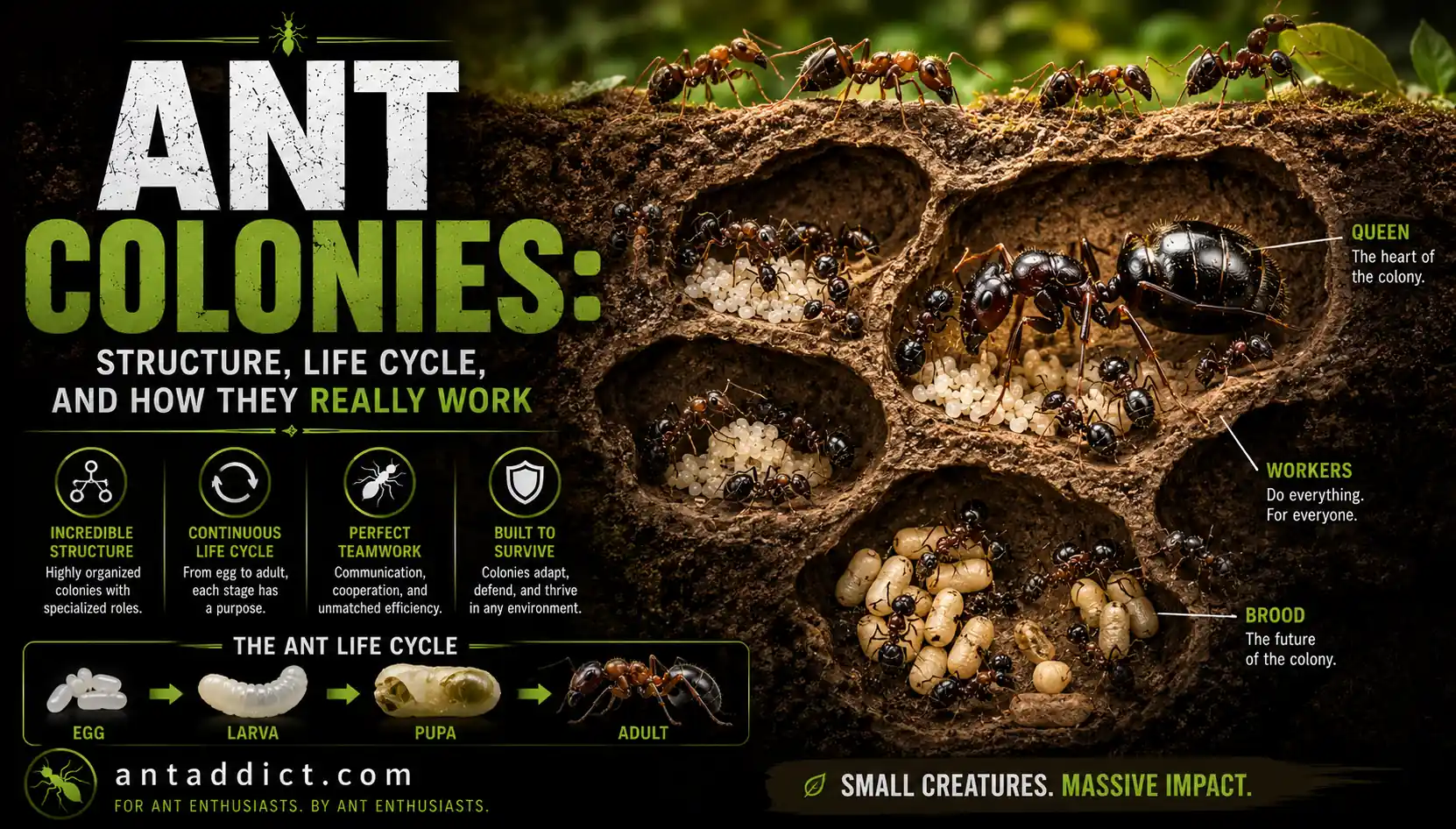
Ant colonies are not just groups of ants living together. An ant colony is a single living system, a superorganism, in which one or a few egg-laying queens, thousands of sterile female workers, and a handful of short-lived males function together like the organs of one body. Only the queens reproduce; the workers do everything else, and no individual ant runs the show. A colony is founded by a single mated queen, grows through distinct life stages, and, as a rule, can live on for years or decades, far longer than any ant inside it.
Once you stop seeing a colony as a crowd and start seeing it as one organism, ants make sense. The scattered foragers, the hidden nurseries, the queen you rarely glimpse, they are all parts of the same creature, spread across thousands of bodies.
After six years of keeping colonies, that shift in perspective is the single most useful thing I can hand a new keeper. This guide is the map: what an ant colony is made of, how one begins from a single queen, how it grows and eventually reproduces, and why the colony can outlive every ant that builds it. It also links out to deeper guides on each part, so treat it as your starting point.
What is an ant colony?
An ant colony is the complete social unit of ants: the queen or queens, the workers, the developing brood, the males when they are present, and the nest they all live in. Biologists call it a superorganism, because the colony as a whole behaves like a single animal.
The comparison is exact, not poetic. In your body, no single cell decides anything; behavior emerges from many cells following simple rules. A colony works the same way. No ant, not even the queen, is in charge. Order emerges from thousands of workers each following simple local rules, a process called self-organization.
That is why a colony can solve problems no individual ant could: finding the shortest path to food, regulating nest temperature, allocating labor, and defending against threats. The intelligence is in the system, not the ant.
The castes: who does what in an ant colony
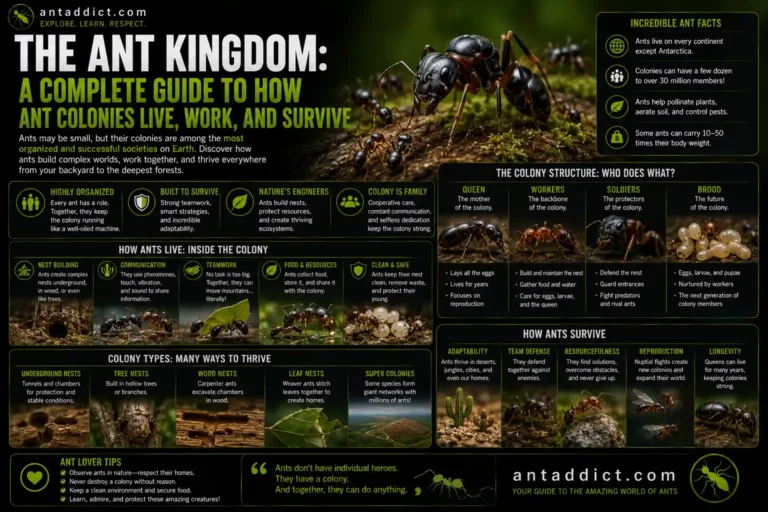
Every ant colony runs on a division of labor between a small number of castes. Each caste is a different kind of body built for a different job, and together they cover everything the colony needs.
| Caste | What they are | Role in the colony |
|---|---|---|
| Queen | Fertile female, usually the largest ant | Lays all or most of the eggs; the reproductive heart of the colony |
| Worker | Sterile female | Forages, builds and cleans the nest, tends brood, defends the colony |
| Male | Fertile male, produced seasonally | Exists only to mate during a nuptial flight, then dies |
| Brood | Eggs, larvae, and pupae | The next generation; not a caste exactly, but the colony’s future |
Everything running the colony day to day is female. The queen and the workers are all female, and the workers are the queen’s own daughters. Males appear only at breeding time and do no work at all.
Workers are not all the same
Within the worker force, many species split the labor further. Larger workers, sometimes called majors or soldiers, handle defense and heavy jobs like cracking seeds, while smaller minors do the delicate work of brood care and foraging.
In some species this is physical, with distinct body sizes built for distinct jobs. In others it is about age: young workers start as nurses deep in the nest tending the brood, then graduate to nest maintenance, and finally become foragers who leave the nest, the most dangerous job, saved for the oldest and most expendable workers. The colony spends its safest lives last.
How an ant colony begins: the founding stage
Almost every ant colony starts with one ant and a gamble. On a warm, humid day, winged queens and males pour out of established colonies in a synchronized nuptial flight, mating in the air or on the ground. The males die within days. Each mated queen then lands, breaks off her own wings, and goes looking for a place to start over.
What she does next defines her odds. In the most common strategy, called claustral founding, the queen seals herself into a small chamber and raises her first workers entirely on her own body reserves, metabolizing her now-useless flight muscles and fat to feed the brood. She does not eat or leave for weeks. It is a closed bet: everything she has, spent on a first batch of workers.
This is the deadliest moment in a colony’s whole life. A lone founding queen, with no workers, no stored food beyond her own body, and no defense, faces enormous odds. Most founding queens die. The rare ones that succeed produce a first generation of tiny workers called nanitics, and the moment those workers open the chamber and begin foraging, the colony survives its most dangerous chapter.
Some species hedge differently. In semi-claustral founding the queen does leave to forage while raising her first brood, and in pleometrosis several unrelated queens team up to found a single colony together, pooling their efforts to get workers on the ground faster, though usually only one queen survives once the workforce is established.
The growth stage: an ergonomic explosion
Once the first workers are foraging, the colony enters its growth stage, and the queen’s job narrows to one thing: laying eggs. She never forages or fights again. Workers feed her, groom her, and carry away her eggs, and she becomes a dedicated egg factory at the center of the nest.
This phase is sometimes called the ergonomic stage, because the colony pours all its energy into work and expansion rather than reproduction. Every new worker means more foragers, which means more food, which means the queen can lay faster, which means still more workers. The colony grows exponentially, from a handful of ants to hundreds, then thousands.
Through this whole stage the colony produces only workers, no new queens and no males. It is building infrastructure, not heirs. A young colony that tried to breed too early would spend resources it cannot spare, so it waits.
The reproductive stage: making the next generation
When a colony is large and well-established enough, often after a period that ranges from a single season to five years or more depending on species, it shifts into its reproductive stage. For the first time, it raises new winged queens and males.
These reproductives, called alates, are the colony’s seeds. At the right moment, they leave on their own nuptial flights to try to found colonies of their own, and the entire cycle begins again. A mature colony may release reproductives year after year, each flight a fresh scattering of gambles.
This is the closest thing a colony has to reproduction of its own. The parent colony does not split or die to make offspring; it simply exports winged queens, most of which will fail, a few of which will become the next generation of colonies.
One queen or many? Monogyny and polygyny
Colonies differ in a way that changes almost everything about them: how many queens they keep.
A monogyne colony has a single queen. It is a tight, closed family, all workers are her daughters, and the colony’s fate is bound to her one life. When she dies, no new eggs are laid and the colony fades out.
A polygyne colony has multiple queens, sometimes dozens or thousands. These colonies are more open and resilient, they can lose a queen without collapsing, and they often spread not by risky nuptial flights but by budding, where a queen and a group of workers simply walk off to start a satellite nest nearby.
That single difference drives the extremes of the ant world. The most invasive ants, like the Argentine ant, are polygyne budders whose colonies fuse into vast supercolonies spanning thousands of miles, effectively one colony that never has to gamble on a founding queen at all.
How ant colonies communicate and make decisions
A superorganism needs a nervous system, and a colony’s runs mostly on chemistry. Ants communicate primarily through pheromones, chemical signals they lay down and detect with their antennae.
A forager who finds food lays a scent trail home, and nestmates follow it and reinforce it, so the busiest, richest trails grow strongest while poor ones fade, and the colony converges on the best food source without any ant deciding to. Alarm pheromones summon defenders to a breach. Each ant also wears a chemical signature that marks it as a nestmate, which is how a colony tells family from intruder.
There is no manager issuing orders. Every colony-level decision, where to forage, when to defend, how to split the workforce, emerges from many ants trading simple chemical signals. That is what self-organization means in practice, and it is why a colony can act intelligently while every individual follows crude rules.
Where ant colonies live
The nest is the colony’s body made physical. Most ant colonies live in nests excavated in soil, a network of chambers and tunnels that can run more than 13 feet (4 m) deep, with the queen and brood kept in the most sheltered rooms and the whole structure tuned for stable temperature and humidity.
But the nest follows the species. Carpenter ants carve galleries in wood, weaver ants stitch living leaves together with silk, and some ants simply move into hollow twigs, acorns, or the gaps under stones.
Colonies range from desert specialists like the honeypot ant, which stores food inside living workers, to the rainforest bullet ant with the most painful sting on Earth, yet the colony logic is the same in every one. Wherever it sits, the nest does the same job: it shelters the queen and brood, buffers them from the weather, and gives the colony a defensible core. The full story of nest architecture is its own subject, covered in the guide to the ant nest.
How long does an ant colony live?
Here is a fact that surprises almost everyone: as a rule, ant colonies are perennial. They are built to persist across years, not seasons, and a colony routinely outlives nearly every individual ant inside it, replacing its workers generation after generation while the whole carries on. In temperate climates the colony even pauses through winter, going dormant rather than dying, which is part of how it spans so many years and is covered in the guide to whether ants hibernate.
How long depends on the queen. In a monogyne colony, the colony can only live as long as its single queen, which for many species means a decade or more, and in the extreme case of a black garden ant queen, nearly three decades. When she dies, the colony dies with her over a slow year or two of decline. Polygyne and supercolonial species escape this entirely and can, in principle, persist almost indefinitely.
The individual ants, meanwhile, are far shorter-lived: males last days, workers weeks to a couple of years. The gap between how long an ant lives and how long its colony lives is one of the strangest things about them, explored in depth in the guide to ant lifespan.
Here is the part most guides skip: the colony is the individual
Almost every article treats an ant colony as a society, a collection of cooperating individuals. The deeper truth, and the one that makes ants click, is that natural selection largely treats the whole colony as the individual.
Think of it this way. A single worker cannot reproduce, so on her own she is an evolutionary dead end. She only passes on her genes by helping her mother, the queen, produce more sisters and, eventually, new queens. So the unit that actually competes, survives, and reproduces is not the ant. It is the colony.
That reframing explains the behavior that otherwise looks baffling. Workers throw themselves at predators and die because the colony, not the worker, is what must survive. The colony spends its foragers freely, rations its workers’ sleep to the edge of exhaustion, and rebuilds them by the thousand, the same way your body sheds and replaces cells.
The queen is less a ruler than a reproductive organ; the workers are less citizens than cells. Once you see the colony as one animal wearing thousands of bodies, everything from suicidal defense to caste specialization stops being a puzzle and starts being anatomy.
What this means if you keep ants
For keepers, the superorganism idea is not abstract, it is the whole job. You are not keeping a tank of insects. You are keeping one long-lived animal whose body happens to be made of thousands of replaceable parts.
That changes what you worry about. Losing workers is normal and constant, a colony that never lost workers would be a colony doing nothing. Losing the queen, in a monogyne species, is terminal, because you have lost the one irreplaceable organ. Almost everything in good husbandry, stable heat, steady food, hydration, and being left undisturbed, comes down to protecting the queen and letting the superorganism run itself.
My honest keeper’s take: the biggest beginner mistake is managing the ants instead of the colony. New keepers panic over dead workers and disturb the nest constantly checking on them, which stresses the very system they are trying to help. Feed it, keep it stable, leave it alone, and let the colony be the organism it is. Your job is to be a good habitat, not a manager.
The bottom line
An ant colony is one of nature’s most convincing illusions of a crowd that is really a single creature. One queen supplies the eggs, thousands of sterile daughters do everything else, a few males exist only to breed, and the whole runs without a leader on nothing but simple rules and chemical signals.
It begins as a lone queen’s desperate gamble, grows into a self-organizing society of thousands, reproduces by scattering winged queens to gamble in their turn, and can outlive every ant that ever belonged to it. Understand the colony as the organism, and the queen, the workers, the nest, and the lifespan all fall into place as parts of one remarkable animal.and the colony as the organism, and the queen, the workers, the nest, and the lifespan all fall into place as parts of one remarkable animal.ifespan all fall into place as parts of one remarkable animal.
FAQ
What is an ant colony?
An ant colony is the complete social unit of ants, made up of one or more queens, sterile female workers, developing brood, seasonal males, and their nest. It functions as a single superorganism rather than a loose group of individuals.
How do ant colonies start?
Almost always with a single mated queen. After a nuptial flight, a queen sheds her wings and founds a colony alone, usually sealing herself in a chamber and raising her first workers on her own body reserves. This founding stage is the deadliest part of a colony’s life.
How many ants are in a colony?
It varies enormously by species and colony age, from a few dozen in a young or small-species colony to hundreds of thousands, or even millions in the largest species and supercolonies.
Does an ant colony have only one queen?
Not always. Monogyne colonies have a single queen, while polygyne colonies have many, sometimes thousands. Polygyne colonies are more resilient and often spread by budding rather than nuptial flights.
Who is in charge of an ant colony?
No one. Despite the name, the queen does not give orders; she only lays eggs. Colony-wide decisions emerge from thousands of workers following simple rules and exchanging chemical signals, a process called self-organization.
How do ants in a colony communicate?
Mainly through pheromones, chemical signals detected with their antennae. Ants lay scent trails to food, release alarm signals when threatened, and carry a chemical signature that identifies nestmates from intruders.
How long does an ant colony live?
Ant colonies are perennial as a rule, living across years rather than seasons. A single-queen colony lives as long as its queen, often a decade or more, while multi-queen and supercolony species can persist almost indefinitely.
What is the difference between a colony and a nest?
The colony is the living social unit, the queen, workers, brood, and males. The nest is the physical structure they live in. A colony can even move nests or occupy several at once without ceasing to be one colony.
Why do worker ants sacrifice themselves for the colony?
Because a sterile worker cannot reproduce on her own; she passes on her genes only by helping the colony survive and produce new queens. Natural selection acts on the whole colony, so defending it, even fatally, is how a worker succeeds.
What is a superorganism?
A group of organisms that functions as a single living system, with specialized members playing the roles that organs play in a body. An ant colony is the classic example, with the queen as the reproductive organ and workers as the working tissue.