Ant Diapause: What Every Keeper Gets Wrong About Winter
Last reviewed: July 2026. Sourcing method: literature search with primary-source verification where accessible. Several Kipyatkov papers were published in Russian-language journals and reached English readers through translation; the manual marks which reference entries could not be independently verified rather than fabricating volume numbers.
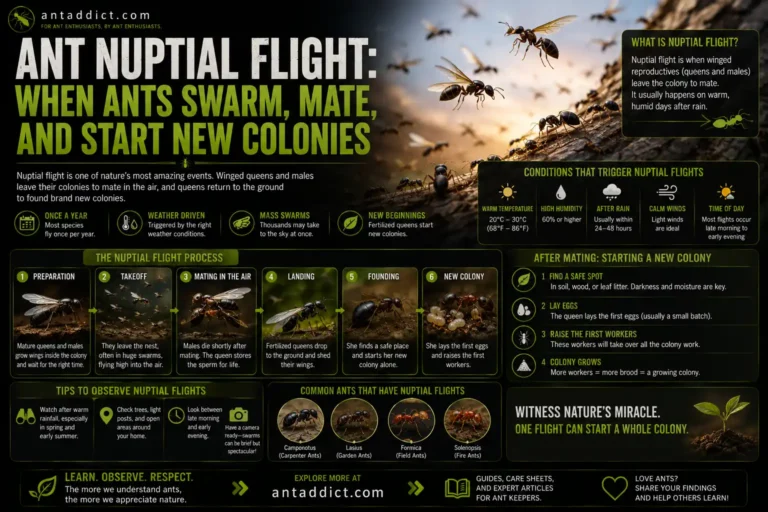
The hobby says cold causes it. Thirty years of research says the opposite. Here is the free 120-page manual that explains why.
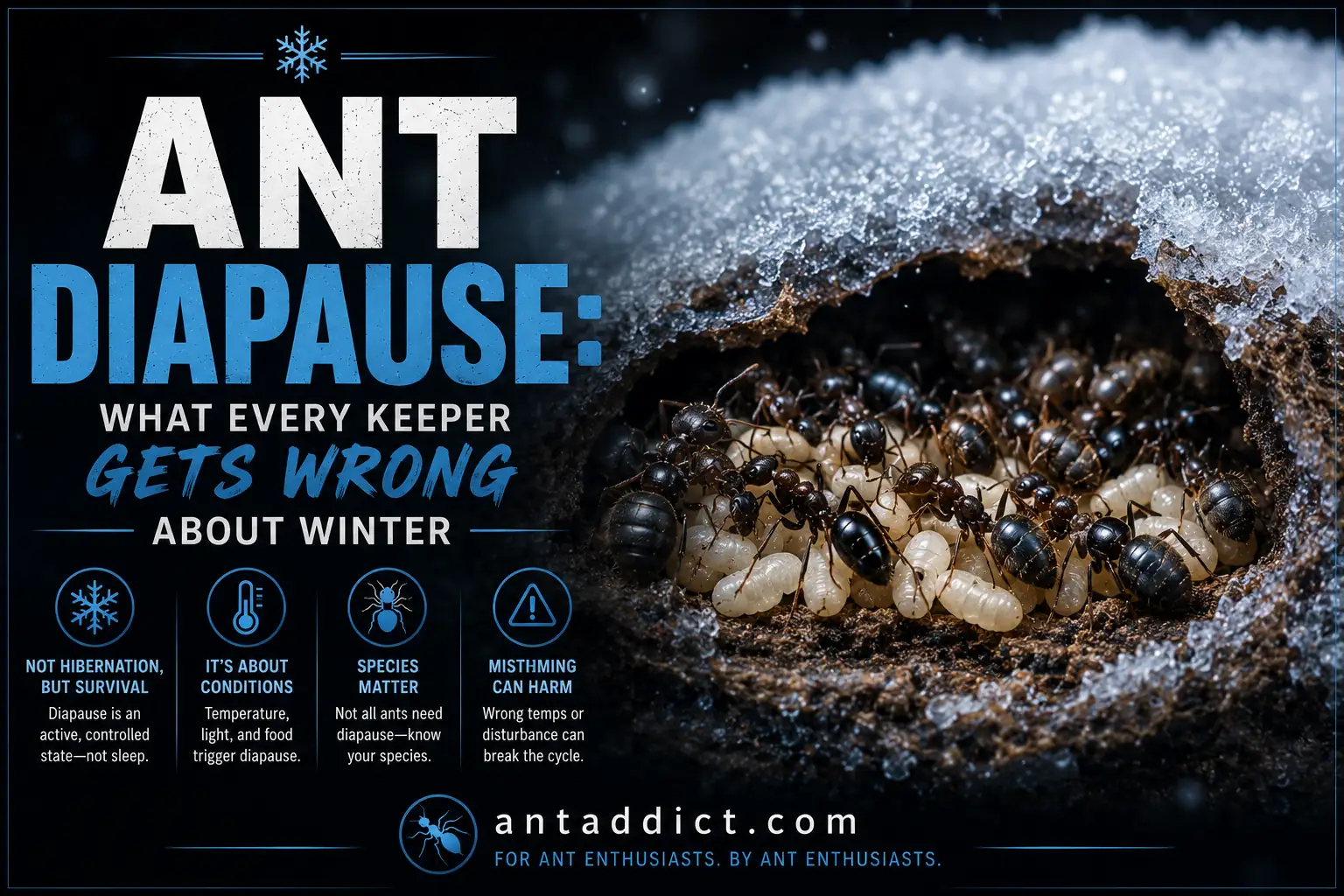
Quick answer: Ant diapause is not caused by cold. It is a programmed developmental arrest driven by an internal timer, and in many temperate species it starts on schedule whether you cool the colony or not. Cold does not trigger ant diapause. Cold is what lets the colony survive it cheaply and finish it properly. Get that backwards and you will be late every autumn, and you will never know why your colonies come out of winter weaker than they went in.
I have kept ants for six years and got diapause wrong for four of them. Not dramatically. My colonies did not die in January. They came out in March looking thin, the queen laid a small batch, and by July I had a queen sitting in a nest that used to hold two hundred workers. I wrote that off as a bad year, four years running.
Then I read the literature and found that a Russian myrmecologist had answered the question in the 1990s. This guide covers what ant diapause actually is, why the two most popular hobby guides contradict each other, what cold is really doing, and how to get the free 120-page manual that goes through all of it with citations.
What is ant diapause?
Ant diapause is a programmed halt in development. The colony stops rearing brood, the queen stops laying, and the whole system parks itself until the season turns.
The key word is programmed. This is not the colony reacting to bad weather. It is the colony executing a plan it carries internally, with its own start, its own duration, and its own end.
Is ant diapause the same as hibernation?
No, and the difference is the whole problem. A hibernating mammal responds to conditions and can be roused by warmth. Ant diapause has phases that must complete, and warming a colony at the wrong phase does not restart it.
There is a third state most keepers have never heard of: quiescence. That is a simple slowdown caused by cold, which reverses the moment things warm up. It is what people think diapause is. For the full breakdown of hibernation versus diapause, see our guide on whether ants hibernate.
Why do the two most popular hobby guides disagree?
Go to Formiculture, the largest English-language ant forum. Two diapause guides sit pinned to the top of the same section. One was posted in 2016, the other in 2021. They have roughly 33,700 and 33,200 views.
They give different accounts of the mechanism. Nobody reconciled them, because in a hobby the pinned post is the truth, and if there are two pinned posts there are two truths.
What actually causes ant diapause?
An internal clock.
Vladilen Kipyatkov spent roughly thirty years at St. Petersburg State University on this question. His group classified ant seasonal cycles and found a category they called endogenous-heterodynamic: a built-in dormant phase running on an internal schedule.
The test is simple. If cold or short days cause diapause, then permanent summer should prevent it. So they tried that. Colonies held under long days, at optimal temperature, well fed, indefinitely.
They stopped anyway. Even under long days at optimal temperature, development ceases and dormancy begins. A 2025 study put it plainly: in these ants, dormancy starts after a fixed period even when the colony is kept warm on long days. Cold does not flip the switch. The colony carries its own clock.
So why does my colony need cold at all?
Three reasons, and none of them is starting the diapause.
It cuts the burn rate. Ants are ectotherms. A colony in diapause has stopped feeding and runs on a fixed reserve. Cold stretches that reserve across the whole arrest.
It builds the antifreeze. Cold cues cryoprotectant synthesis. Camponotus pennsylvanicus seals its nest, loses roughly half its fat reserves over winter, and fills its body with glycerol, reaching freezing points near -8°F (-22°C).
It completes the program. Many insects need a chilling period before diapause can terminate at all. Skip it and the colony never wakes up.
Does day length trigger ant diapause?
Barely. In Lepisiota semenovi, photoperiod and temperature produced only modifying effects on an internally controlled diapause. Work on Lasius japonicus found day length less important than temperature.
This makes sense once you notice the ants are underground. The brood never sees daylight. You do not need to build a light cycle for your fridge.
Is ant diapause controlled by the colony or the individual ant?
The colony. This is the finding that surprised me most.
Workers regulate larval diapause in Myrmica. Queens and workers together control onset and termination in Lasius niger. And in Myrmica rubra, a chemical signal that travels through the air, with no touching or food-sharing needed, ends diapause in the larvae and queens. It was the first pheromone of its kind ever found in social insects.
A message, moving through the colony, ends the arrest. Your colony is not a box of ants that each got cold. It is one system passing messages about what season it is.
Does it matter where my queen came from?
Enormously, and almost nobody asks.
Kipyatkov and colleagues found latitude-dependent variability in the response norm of Lasius niger founding females. Same species, different populations, different programs, sorted by latitude.
So there is no such thing as “the diapause requirement of Lasius niger.” There is only the requirement of the population your queen came from. If you bought her and the seller cannot tell you the collection locality, you have an animal with an unknown schedule.
What happens if you skip ant diapause?
The colony does not skip diapause. It does diapause badly.
In an obligate species the arrest happens anyway. It just happens at 75°F (24°C), where the metabolic rate is roughly what it would be in summer, and the colony burns four months of fuel in a few weeks.
The colony that “grew all winter” is usually a colony that stalled all winter while you fed it and it did not eat.
Hobby advice versus the literature
| Question | Common hobby advice | What the research shows |
|---|---|---|
| What starts diapause? | Cold | An internal timer, in many species |
| When do I cool? | When the colony slows down | On the calendar. The slowdown is the diapause |
| Who decides? | Each ant | The colony, via pheromone |
| Species number? | One number per species | Varies by population and latitude |
| Colony won’t wake up? | Add heat | It may need more cold, not less |
| Autumn prep? | Not mentioned | Sets the ceiling on winter survival |
When should I start cooling my colony?
Earlier than you think, and on the calendar rather than on the colony’s cue.
Here is why. If the timer is internal, your colony’s behavior is a lagging indicator. By the time you see reduced foraging and stalled brood, the program has been running for weeks at room temperature, burning reserves it cannot replace.
Waiting for the colony to tell you feels responsible. It is only observation if the signal leads the event. Here it trails it.
Here is the part everyone else skips
Ant diapause is not survived on what you do in winter. It is survived on what the colony banked in autumn.
The reserve is fixed before the arrest starts. During diapause the colony stops feeding, which is part of the program itself. No deposits. Survival is reserve, divided by burn rate, must exceed duration.
You control all three. Duration is your schedule. Burn rate is your temperature. And the reserve is the eight weeks nobody writes about.
Neither pinned forum guide has a pre-diapause section. That omission follows directly from the causation error. If you think cold causes diapause, then diapause begins when you apply cold, and autumn is just normal keeping.
It is not. Autumn is the funding round.
What is in the manual?
One hundred and twenty pages, twenty chapters, 147 inline citations, free.
- Part I: the science, including the endogenous timer and social regulation
- Part II: diagnosis, including whether your species needs diapause at all
- Part III: the protocol, month by month, from August through spring
- Part IV: species, including an honest table with a confidence column
- Part V: a fourteen-entry failure autopsy index
It also tells you where the evidence runs out. Ant diapause has been studied in perhaps two dozen species out of more than 14,000, mostly European, mostly four genera. For most species you keep, no published protocol exists. The manual says so rather than inventing numbers.
[Download the free PDF] No email required. Creative Commons, attribution required.
The bottom line
Your colony is not waiting for you to put it into ant diapause. It is already going. Your only decisions are how much the trip costs and whether it can complete.
The mechanism has been in the literature for thirty years. In a decade of pinned forum guides, not one has cited it. That is not a failure of science. It is a failure of carrying.
FAQ
Do ants hibernate?
Not in the technical sense. They enter diapause, a programmed developmental arrest, not a passive response to cold.
How long should ant diapause last?
Common hobby practice for temperate species is three to four months. That number is a starting point, not a fact, and it varies by the population your queen came from.
What temperature?
Most keepers use roughly 39 to 43°F (4 to 6°C). Buy a min/max thermometer before you trust any number, because most people have no idea what their fridge actually does.
Can I put my colony straight in the fridge?
You can. I would ramp it down over three to four weeks instead. Cryoprotectant synthesis takes weeks, not seconds. This is mechanistically motivated and untested in ants, and the manual says so.
Do tropical ants need diapause?
No. Refrigerating a tropical species is not being careful. It is a cold challenge to an animal with no cold-hardiness program.
What about leafcutters?
No. They are tropical and they farm a fungus that will die if you chill it.
My colony came out and did nothing. What now?
Give it four to six weeks at growing temperature. If still nothing, the likely cause is an incomplete chilling requirement, and adding heat makes it worse.
Should I feed during diapause?
Water yes, food mostly no. The colony has largely stopped feeding as part of the program.
Can I check on them?
Every check costs a warm excursion and buys you nothing, because diapause looks identical every month. Read a thermometer instead.
What kills colonies most often?
Dehydration in February and underfeeding in September. Both are boring and both are preventable.
Does colony size matter?
Probably, given that regulation is social. Nobody has tested it. That is an open question in the manual.
Is Prenolepis imparis different?
Yes. The winter ant is active in cold and dormant in summer. Standard advice applied to it is the calendar inverted.
What is the single most useful thing I can do?
Buy a twenty dollar min/max thermometer and keep a log. Three dates a year for three years and you will know your population better than any care sheet does.