Ant Lifespan: How Long Workers, Queens, and Males Really Live
Last reviewed: June 2026. Claims in this guide are drawn from first-hand keeping and the peer-reviewed and reference sources linked inline and listed below. Lifespan figures are ranges shaped by species and conditions, and many published maxima come from laboratory colonies.
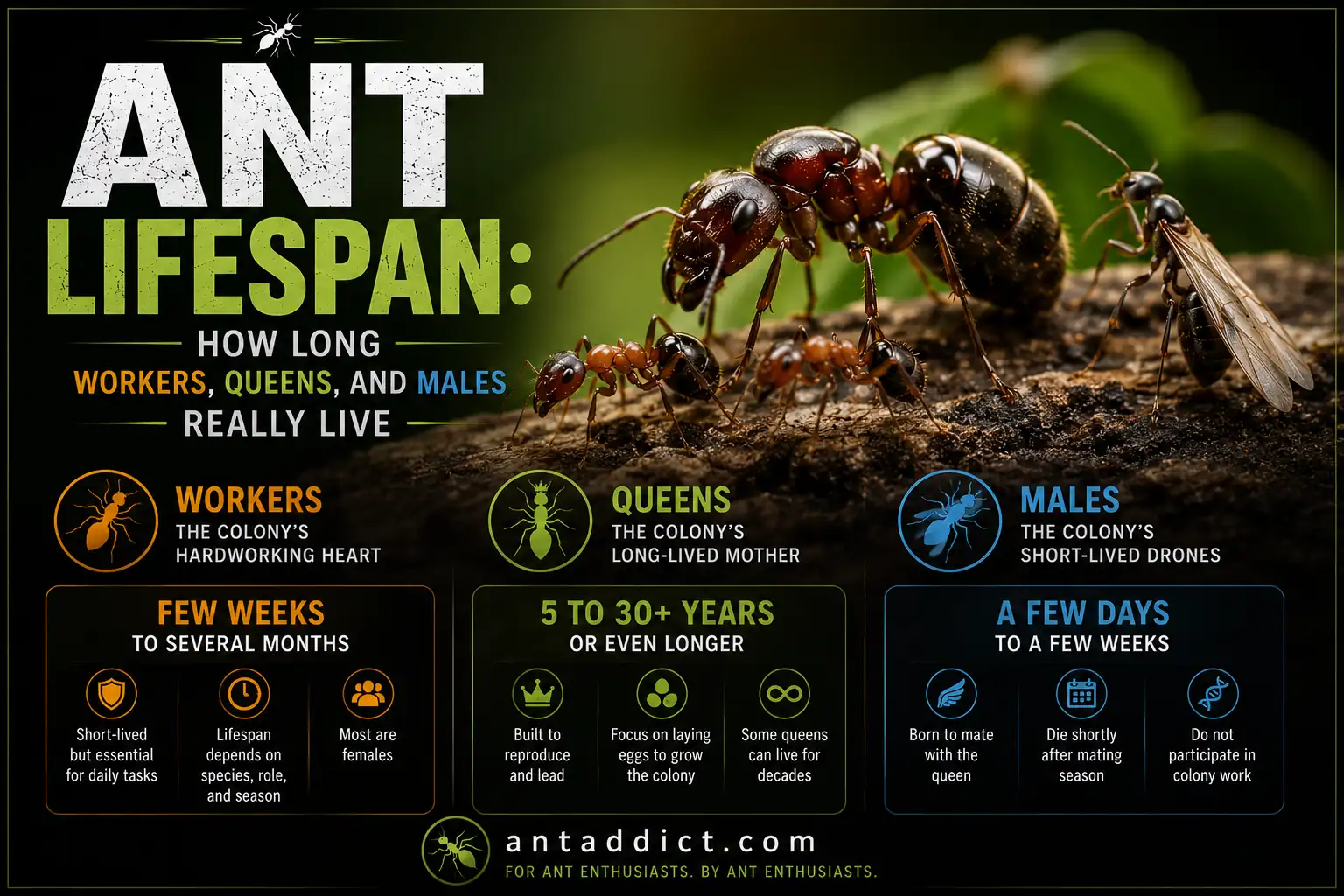
Ant lifespan depends almost entirely on caste. Male ants live days to a few weeks. Worker ants live weeks to a couple of years, depending on species and season. Queens live years to decades, and the record holder, a black garden ant queen, reached 28¾ years in captivity, the longest adult life ever documented for any insect. The strangest part is that a queen and her workers share the same genome. Their bodies are built from the same instructions, yet one may outlive the other twenty times over.
Most guides answer this question with a list of numbers and stop there. That list is the least interesting part. The interesting part is that the numbers should be impossible.
After six years of keeping colonies, the lifespan gap is still the thing I find hardest to explain to visitors. This guide covers how long each caste actually lives, which species live longest, the verified record, why colonies outlive the ants inside them, and the science of how a queen cheats aging while her sisters burn out in a summer.
How long do ants live?
The short answer is that there is no single ant lifespan. There are three, and they belong to the three castes in a colony.
| Caste | Typical lifespan | Role |
|---|---|---|
| Male (drone) | Days to a few weeks | Mates once during a nuptial flight, then dies |
| Worker (sterile female) | A few weeks to 1 to 2 years | Forages, builds, tends brood, defends the nest |
| Queen (reproductive female) | Several years to decades | Lays every egg in the colony |
Workers and queens are all female, and every worker is the queen’s own daughter. The gap in how long they live has nothing to do with them being different animals. It comes down to the job the colony assigned them.
Why do worker ants live such short lives?
Workers are the colony’s spendable resource, and their lifespan reflects it.
A forager’s job is dangerous by design. She leaves the nest, crosses open ground, faces predators and weather and rival colonies, and hauls loads far heavier than herself. Many workers never die of anything resembling old age. They simply do not come home.
Even the ones that stay inside are run hard. Workers get very little rest: fire ant workers snatch roughly 250 one-minute naps a day, under five hours in total, while their queen sleeps around nine. The researchers who measured that gap suspected the workers’ chronic sleep loss contributes to how short their lives are, a link I covered in do ants sleep.
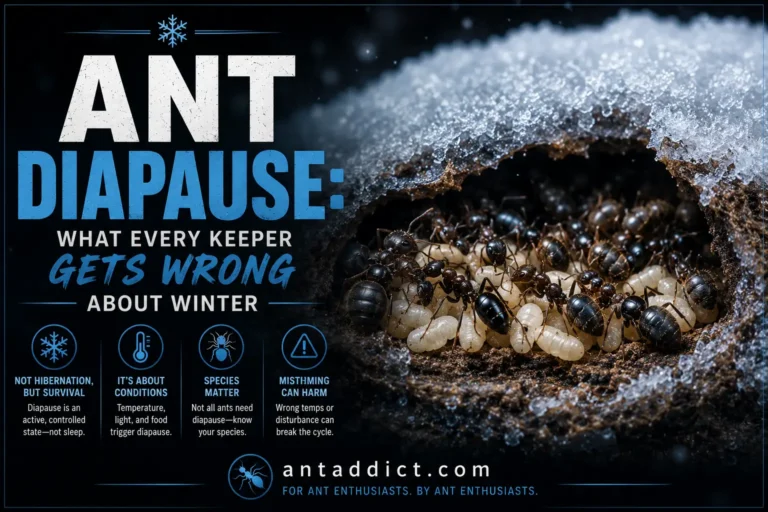
Season matters too. In temperate species, workers born in summer may live only a month or two, while workers born in fall can survive six to eight months by spending winter dormant. Slowing down buys time, which is part of the story of ant hibernation.
How long do queen ants live?
Queens live on a completely different timescale. Depending on species, a queen may live five, ten, fifteen years or more, laying eggs the entire time.
She earns it by never leaving. After her single mating flight, a queen seals herself into a chamber and effectively never sees daylight again. She does not forage, does not fight, and does not take risks. Workers feed her, groom her, and shield her deep inside the ant nest, where the temperature is stable and predators cannot reach.
But protection alone does not explain decades. A pampered housefly is still a short-lived housefly. Something inside the queen is different, and that is where this story gets genuinely strange. I will come back to it.
What is the longest-lived ant ever recorded?
The record is specific, verified, and remarkable.
A queen of the black garden ant (Lasius niger), kept in captivity by the entomologist Hermann Appel, lived 28¾ years. The observation was reported by Kutter and Stumper in 1969, and the University of Florida Book of Insect Records lists it as the longest adult life documented for any insect. Her workers, the same species, typically live one to two years.
A close contender lives in the field rather than the lab. Queens of the harvester ant Pogonomyrmex owyheei have been estimated to live from 14 to 30 years in the wild, with the colony persisting as long as the queen does.
For perspective, that black garden ant queen outlived most dogs, most cats, and every mouse ever born. She spent those decades underground, producing eggs the whole way.
Ant lifespan by species
Numbers vary by species, and they vary a lot. Here are figures for ants people ask about most, with the queen and worker columns side by side so the gap is visible.
| Species | Worker lifespan | Queen lifespan |
|---|---|---|
| Black garden ant (Lasius niger) | 1 to 2 years | Up to 28¾ years (record) |
| Harvester ant (Pogonomyrmex owyheei) | 1 to 2 years | Estimated 14 to 30 years |
| Carpenter ant (Camponotus) | Several months to a year or more | Often 10 years or more |
| Indian jumping ant (Harpegnathos saltator) | About 7 months | About 5 years |
| Fire ant (Solenopsis invicta) | Weeks to a few months | Roughly 2 to 7 years |
| Pharaoh ant (Monomorium pharaonis) | Weeks to a few months | Under a year to about a year |
Notice the pattern. Species with big, slow, long-lived colonies invest in long-lived queens. Species that reproduce fast and spread aggressively, like pharaoh ants, run short-lived queens but keep many of them at once, so the colony survives regardless.
Treat every figure in that table as a range rather than a fixed value. The record and the Pogonomyrmex and Harpegnathos numbers come from the sources listed at the end; the rest are the commonly reported ranges from entomological references, and they shift with conditions.
Why do male ants die so fast?
Males have the shortest life in the colony by a wide margin, often just days to a couple of weeks.
The reason is brutal and simple: a male ant is a flying gamete delivery system. He is produced from an unfertilized egg, he does no work, he does not forage, he does not defend the nest, and workers give him minimal care. His entire existence is aimed at one nuptial flight.
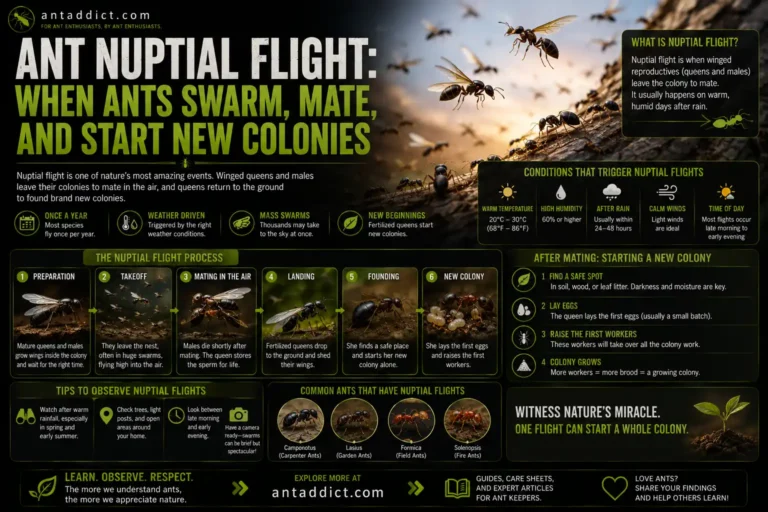
If he mates, he dies shortly after, having handed over the sperm a queen will store and use for decades. If he does not mate, he dies anyway. Either way, the colony spends him. A queen may still be laying eggs fertilized by sperm from a male who died twenty years earlier, which is a genuinely eerie thought.
The paradox: same genes, twenty times the lifespan
Here is the question the fact lists never ask. A Lasius niger queen can live nearly 29 years. Her workers, hatched from eggs she laid, carrying essentially the same DNA, live one or two.
You cannot explain that with genetics, because the gene set is the same. Any fertilized ant egg can become a worker or a queen, and which one it becomes is settled back in the larval stage by how richly it is fed. You cannot fully explain it with safety either, because protection does not stretch an insect’s life twentyfold. And it gets worse for our intuition.
In nearly every animal studied, reproduction and longevity trade off against each other. Producing offspring is metabolically expensive, and animals that reproduce heavily tend to die sooner. It is one of the most consistent patterns in biology.
Ant queens break it. A queen lays hundreds of thousands or even millions of eggs across her life, the most reproductively expensive job in the colony, and she outlives every sterile ant around her by decades. She should be the first to die. She is the last.
Here is the part everyone else skips: how queens cheat aging
For a long time nobody knew how. In 2022, a team studying Indian jumping ants (Harpegnathos saltator) published the best answer we have in Science, and it is the most interesting thing on this page.
The key is insulin. Insulin is not just a sugar hormone; across the animal kingdom, insulin signaling is one of the main dials controlling both reproduction and aging. Crank it up to make eggs and you accelerate aging. That is the trade-off, and it is why the rule holds so widely.
Ants found a loophole. The insulin pathway is not a single wire. It splits into two branches downstream, and researchers found reproductive ants running them in opposite directions.
Insulin production rises in the reproductive ant’s brain. That extra signal activates the MAPK branch, which drives lipid synthesis and yolk production and builds the ovaries. Reproduction switched to maximum.
Then comes the twist. The developing ovary starts producing an anti-insulin protein called Imp-L2. The researchers propose that Imp-L2 suppresses the AKT branch, the other half of the pathway, the half that drives aging. The reproductive machinery, in other words, appears to manufacture the very thing that shields the ant from the cost of running it.
Floor the reproduction accelerator. Cut the aging wire.
One honest caveat, since you will not find it on the pages that copy this finding. The work was done on one species, and mainly on pseudo-queens rather than true queens, though the authors note their findings likely extend to queens. Whether the same mechanism explains a black garden ant queen’s three decades is a reasonable expectation, not a settled fact. It is the strongest lead anyone has, not the final word.
The ants that can reverse their own aging
Harpegnathos does something that makes the mechanism visible, and it is the reason researchers chose it.
When the queen of a colony dies, the workers do not simply carry on. They duel each other with their antennae, and the winners transform into reproductive pseudo-queens called gamergates. They stay in a worker’s small body, but they start laying eggs, and their lifespan jumps roughly fivefold, from about seven months to around three years.
Now the remarkable part. Put a gamergate back into a colony that already has an established reproductive, and she reverts to an ordinary worker. Her ovaries shut down, and her extended lifespan collapses back to a worker’s.
These ants run their aging clock in both directions, on demand, with no change to their DNA. An animal that can decide to age slower, then decide to age faster again, is not something biology offers up often.
Why ant lifespan matters to human aging research
This is not just an ant curiosity, which is why the study drew attention well outside entomology.
Humans have insulin signaling pathways closely related to the ones in that ant, and we have anti-insulin proteins of our own. The US National Institute on Aging noted that because those pathways are shared, work on reproductive ants may offer real insight into human longevity.
The honest caveat matters here: nobody is turning Imp-L2 into a human anti-aging drug, and an ant is not a person. But an animal that decouples reproduction from aging, using machinery we also carry, is a genuinely valuable natural experiment. The queen in a garden nest is now a model organism for the biology of aging.
Colony lifespan is not the same as ant lifespan
One distinction clears up most of the confusion around this topic. The colony and the ant are different units, and they live on different clocks.
A colony can persist for decades, far outliving nearly every individual in it. Workers are replaced continuously, generation after generation, while the superorganism carries on as though nothing happened. Some Pogonomyrmex colonies have been tracked for decades in the field.
In species with a single queen, though, the colony’s life is chained to hers. When she dies, no new eggs are laid, the last workers age out, and the colony dies with them, sometimes over a year or two of slow decline. There is no succession.
Species that keep many queens escape this entirely. Argentine ant supercolonies contain thousands of queens spread across networked nests, so no single death matters and the colony can, in practice, roll on indefinitely.
Do ants die of old age?
Some do, most do not.
In the wild, the majority of workers are killed by predators, rival colonies, weather, or accidents long before their bodies wear out. The lifespans quoted for workers are usually potential, not typical.
Queens are different. Protected inside the nest, many do run out their biological clock, and old queens can show real senescence, with egg production tapering off before they die. That is the closest thing in a colony to dying of old age.
And a queen’s death is often the loudest event in a colony’s life, because in a single-queen species it starts a countdown nothing can stop.
Why the numbers you read never seem to agree
If you have compared a few pages on this topic and found different figures, you are not imagining it. There are three good reasons.
Most impressive numbers are laboratory maxima. That 28¾-year queen lived in captivity with no predators, no drought, and no competition. A wild queen of the same species rarely gets close, so quoting the record as typical is misleading.
Species vary enormously, and “ant” covers more than 14,000 of them. A pharaoh ant queen and a harvester ant queen are not comparable animals.
Conditions change everything. Temperature, food supply, colony size, and season all shift how long an individual ant lives, sometimes by several times over within the same species.
Treat every lifespan figure, including the ones on this page, as a range shaped by conditions rather than a fixed number.
What ant lifespan means if you keep ants
For keepers, this is the most practical thing on the page: when you take a queen, you are signing up for a decade or more.
A Lasius niger queen from a summer nuptial flight can plausibly still be laying when your circumstances have completely changed. That is not a novelty pet timeline; it is closer to adopting a parrot. Think hard before collecting one.
It also reframes what you are watching. Losing workers is normal and constant; a colony that never lost workers would be a colony that never worked. Losing the queen, in a single-queen species, is terminal. Everything in good husbandry, stable temperature, steady food, minimal disturbance, is ultimately about protecting one ant.
My honest keeper’s take: the queen is the colony, and the workers are what she spends to keep it going. Once that clicks, ant keeping stops looking like managing an insect tank and starts looking like tending one very long-lived animal that happens to wear thousands of bodies. It also makes me careful about which queens I take from the wild, because 20 years is a long promise to make to an ant.
The bottom line
Ant lifespan is not one number, it is a strategy. Males are spent in days, workers in weeks to a couple of years, and queens are protected for decades because they carry everything the colony is.
What makes it worth understanding is the mechanism underneath. The same genome that produces an ant dead by autumn also produces one still laying eggs three decades later, and the best evidence we have says reproductive ants pull it off by splitting the insulin pathway in half, feeding the branch that makes eggs while muting the branch that drives aging. Ants took biology’s most reliable trade-off and quietly opted out.
FAQ
How long do ants live?
It depends on caste. Males live days to a few weeks, workers live from a few weeks to about two years depending on species and season, and queens live from several years to nearly three decades.
How long do queen ants live?
Usually several years to well over a decade, depending on species. Carpenter ant queens often exceed 10 years, and black garden ant queens can reach the high twenties in captivity.
What is the longest-living ant?
A black garden ant (Lasius niger) queen that lived 28¾ years in captivity, recorded by Kutter and Stumper in 1969. It is the longest adult lifespan documented for any insect.
How long do worker ants live?
Typically a few weeks to one or two years, depending on species. Season matters too: summer-born workers may live a couple of months, while fall-born workers can survive six to eight months by overwintering.
How long do male ants live?
Only days to a couple of weeks. Males exist to mate during a nuptial flight and die shortly afterward, having done no work for the colony.
Why do queen ants live so much longer than workers?
Partly protection, since queens never forage or face predators, but mainly biology. Research on reproductive ants indicates they suppress the aging branch of their insulin pathway using an anti-insulin protein called Imp-L2 while keeping the reproductive branch running.
Do queen ants and worker ants have the same DNA?
Yes. Workers are the queen’s daughters and share essentially the same genome. The huge lifespan difference comes from which genes are active, not from different genes.
Do ants die of old age?
Queens often do, and old queens can slow their egg laying before dying. Most workers do not; they are killed by predators, weather, or accidents long before their bodies give out.
How long does an ant colony live?
Often for decades, far longer than the individual ants inside it. In single-queen species the colony dies once the queen does, while multi-queen supercolonies can persist almost indefinitely.
Can ants reverse their own aging?
Some can. In Indian jumping ants, workers that become reproductive pseudo-queens live about five times longer, and if they revert to workers their lifespan shortens again.
Why do ant lifespan figures vary so much between sources?
Because most headline numbers are laboratory maxima rather than typical wild lifespans, because ant species differ enormously, and because temperature, food, and season strongly affect how long any individual lives.
How long do pet ants live?
The colony can last as long as its queen, which for common keeper species such as Lasius niger means potentially well over a decade. Workers you see today will be replaced many times over.