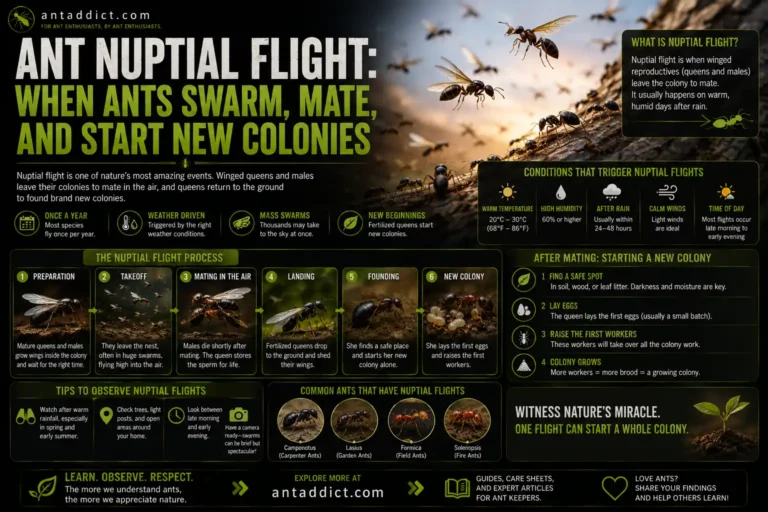
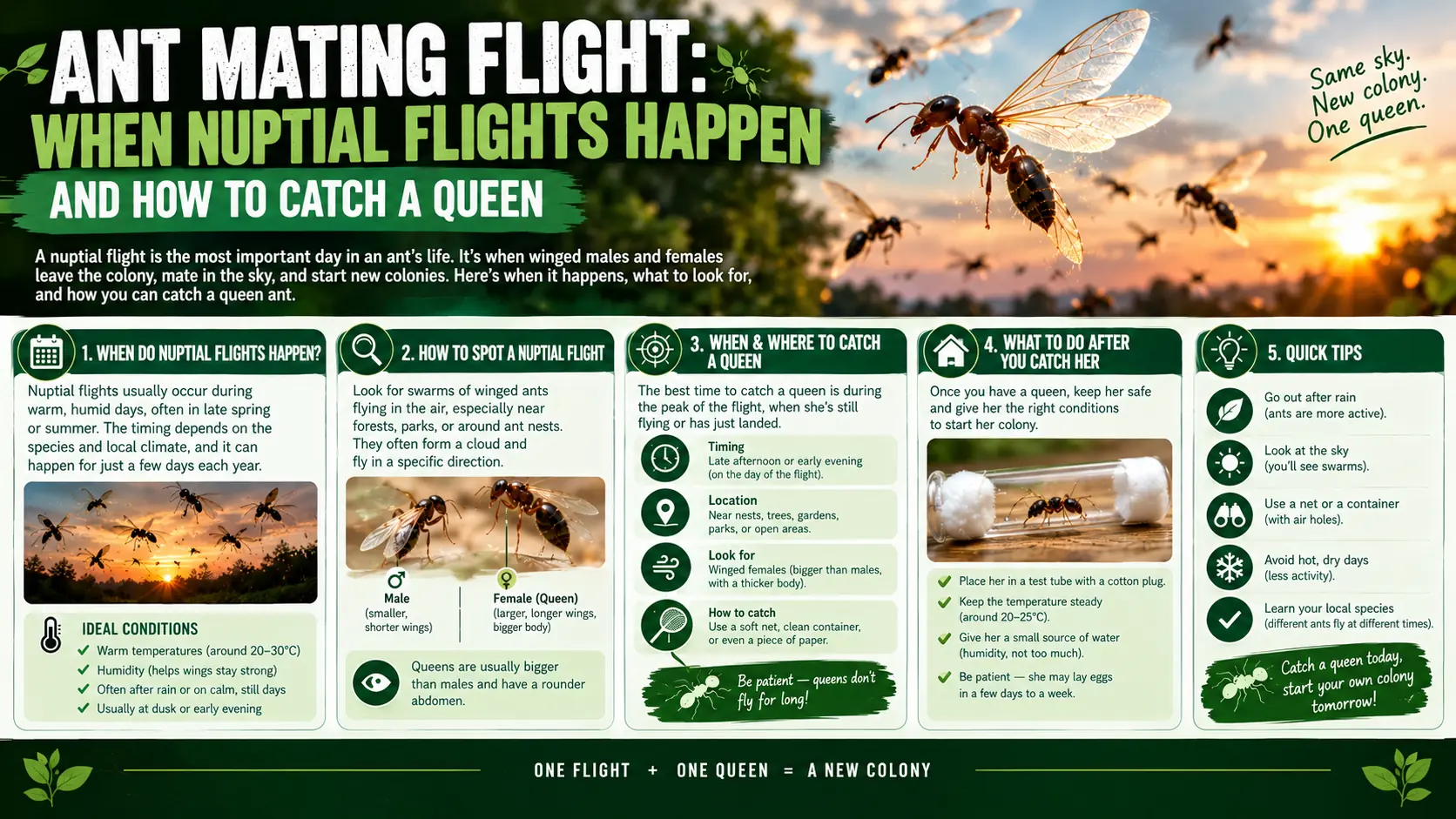
Ant Mating Flight: When Nuptial Flights Happen and How to Catch a Queen
The one afternoon a year an entire ant species bets its future on the weather, and the short window you get to walk home with a founding queen.
I have spent six seasons reading these flights in my own backyard, and I can tell you the online advice mostly fails at the two things that actually matter: knowing when to be outside, and knowing what to do in the fragile weeks after you catch a queen. That is where colonies live or die.
This guide covers what an ant mating flight is, the biology that decides when it happens, a timing table by species, how to read the weather to predict a flight, how to tell a mated queen from a male or a worker, how to catch one responsibly, and the founding protocol that keeps her alive. If you want to check tonight’s odds for your species, run our Nuptial Flight Predictor first, then come back here.

What is an ant mating flight?
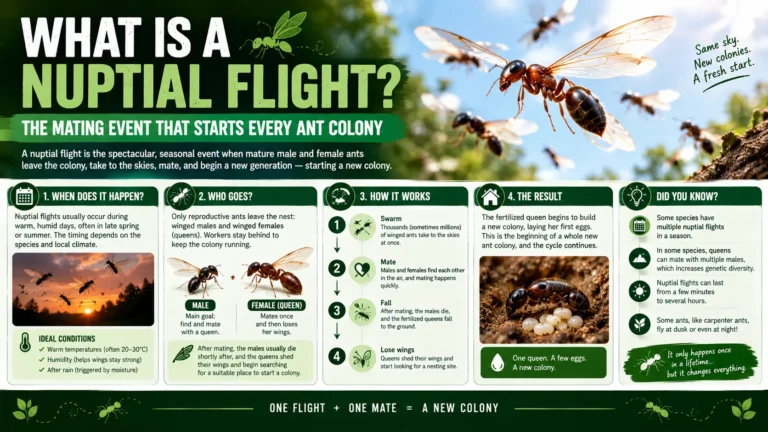
For most of the year an ant colony makes only sterile female workers. Then, once it is mature and the season is right, it raises a batch of alates: winged, sexually mature ants. The large ones are virgin queens, properly called gynes. The small ones, with tiny heads and big eyes, are males.
The nuptial flight is the single event these alates exist for. On the right day they climb the tallest points near the nest, open their wings, and fly. Queens release a mating pheromone, males track it, and mating happens in the air or at a fixed swarm site. A queen mates once, with one or several males depending on the species, and stores every sperm cell she will ever use in an organ called the spermatheca. She never mates again. From that one flight she can fertilize eggs for the rest of her life, which in long-lived genera such as Lasius can run past 20 years.[1]
Why do ants all swarm and fly at once?
This is the part most articles skip, and it is the key that unlocks the timing. Two problems shape the whole event.
The first is inbreeding. If queens mated with males from their own nest, colonies would collapse. Flying scatters queens and males across the landscape and mixes them with strangers, so flights are synchronized across many colonies at once. A queen needs rivals in the air, not her own brothers.[1]
The second is predators. A slow, heavy, low-flying queen is a free meal for birds, dragonflies, and spiders. The colony’s answer is to send everyone up together. Predators can only eat so much in one afternoon, so flooding the sky means most alates survive simply because the predators are full. Biologists call this predator satiation.[1] For you, it means flights are brief and explosive, and the good window can last under an hour.
Keeper’s note: both problems are solved by one tool, shared weather. Colonies cannot signal each other, so they all read the same cue, heat and humidity and the pressure shift around rain, and launch together. That shared cue is the thing you are about to learn to read.
What happens during a nuptial flight, step by step?
- Emergence. Workers open exit holes and the alates pour out, often massing on walls and grass stems before takeoff.
- Takeoff and mating. Alates fly. Queens signal, males pursue, and mating happens in the air or at the swarm site.
- The males die. A male has no role after mating and dies within hours. Nearly every winged ant on the pavement the next morning is a spent male.
- The queen lands and removes her wings. A mated queen drops to the ground and pulls off her own wings, a step called dealation. Her body then digests the wing muscles for fuel. This is the single most useful sign for a keeper.
- Founding. She finds a crack or digs a burrow, seals herself in, and lays her first eggs, running entirely on her own reserves.
When do ant mating flights happen?
Here is where almost every article quits. “Warm, humid days after rain” is true but useless when you are standing outside at 6 p.m. wondering if tonight is the night. Timing depends on the species and your local climate, so the honest answer is a table, not a date.
The ranges below are for the temperate Northern Hemisphere. Southern Hemisphere readers: shift everything by six months. In dry regions, harvester-ant flights often track the first heavy rains rather than the calendar. Treat this as a starting map for your own logbook.
| Genus / common name | Typical flight window | Time of day | Trigger notes |
|---|---|---|---|
| Lasius niger (black garden ant) | Mid-July to early August | Hot afternoon, early evening | The classic “flying ant day” species: muggy, still, often 1 to 2 days after rain |
| Lasius flavus (yellow meadow ant) | Late summer into autumn | Afternoon | Overlaps L. niger but tends to trail it |
| Camponotus (carpenter ants) | Late spring to early summer | Dusk and after dark | Warm, humid nights: queens are large and unmistakable |
| Tetramorium (pavement ants) | Early to mid summer | Daytime | Warm days: often swarm over driveways and sidewalks |
| Solenopsis (fire ants) | Spring through autumn | Late morning after rain | Several flights per season in warm climates, 1 to 2 days after rainfall |
| Messor (harvester ants) | Late summer, early autumn | Morning or evening | Often tied to rain events in dry regions |
| Pogonomyrmex (US desert harvesters) | Summer monsoon season | Late morning | Fly after heavy desert rains: semi-claustral, see feeding section |
| Formica (wood, field ants) | Summer | Daytime | Many queens need a host colony to found: not beginner ants |
Build your own calendar: the best thing you can do is keep a flight log for your own zip code: date, species, temperature, humidity, whether it rained the day before, and takeoff time. After one season you will beat any national “flying ant day” headline, because those headlines average out a phenomenon that is intensely local.[2]
What weather triggers an ant mating flight?
“Flying ant day” is a myth in one exact sense: there is no single day. What exists is a flying ant season with several peaks, because different species and colonies pull the trigger at different times.[2] What they share is the recipe. When these line up inside your species’ window, go outside.
- Warmth. A genuinely warm day for your region. For Lasius niger in temperate zones that is roughly 77°F (25°C) or higher.
- High humidity. Muggy, close air. Dry heat rarely triggers flights, damp heat does, which is why the day after rain is prime.[3]
- Low wind. Still or near-still air. Queens are weak fliers and will not launch into a stiff breeze.
- A pressure change. The muggy calm just before or after a rain front is the textbook trigger. Watch the forecast for a warm spell broken by a thunderstorm, then hunt the day after.
Two shortcuts. First, a flight-prediction tool like our Nuptial Flight Predictor scores today’s real conditions against each species’ triggers, so you know before you step outside. Second, watch the birds: gulls and swifts wheeling low over rooftops on a muggy afternoon are often eating a flight you have not spotted yet.[4]
How do you tell a mated queen from a worker or a male?
This is the skill that separates keepers who go home with a colony from keepers who go home with a dead male. Run these checks in order.
Is it even a queen?
Queens are clearly larger than their workers, with a bulky thorax (the middle section that held the flight muscles) and a large gaster (the rear). Males are small, with tiny heads, big eyes, and long antennae, and they stay winged until they die. Small with big eyes means male: leave it.
Is she mated?
Her wings are the tell.
- Best case: found walking on the ground with no wings, or with two small scars on her thorax. She flew, mated, landed, and de-alated. This is your queen.
- Caution: still winged and running on the ground. She may have mated and not shed yet, or she may never have mated. Lower odds.
- Skip: still in the air, or clearly agitated and just landed with wings. No way to know she mated.
The honest caveat: you cannot be 100% sure a queen is fertile until she produces worker eggs. An unmated queen can still lay, but her eggs become only males. If, weeks in, you get only males and no workers, she flew but never mated. This is why experienced keepers catch several queens in a good flight instead of betting on one.
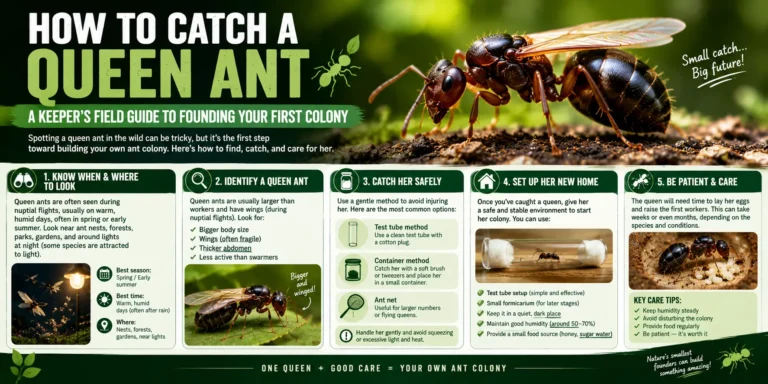
How do you catch a queen ant, and is it legal?
The catch is simple. The ethics matter more than the technique.
- Coax, do not grab. Guide her into a small container or let her walk onto your hand and tip her in. Pinching a queen’s gaster can kill her weeks later.
- One queen per container for species that found alone, so they do not fight.
- Keep her cool and dark until you get home: a jar in a bag, out of direct sun.
On legality and ethics: collect only native species from your own region, and take only a few. A flight releases thousands of queens that would almost all die anyway, so taking a handful of native queens has negligible impact. Moving a non-native species, or releasing an exotic queen you cannot keep, can do real ecological harm, so never release captive queens into the wild. Check your local rules: a few regions restrict keeping certain ants, and shipping live queens across borders is often illegal.
What do you do with a queen after catching her?
This is the part no competitor explains properly, and it is where most first colonies die: not from being caught wrong, but from being cared for wrong in the first weeks. The golden rule of founding is counter-intuitive: do less.
The test tube setup
- Fill about one third of a clean test tube with water.
- Push a tight plug of cotton wool down against the water until there is no gap and no leak. She drinks through this, and it keeps the air humid.
- Drop the queen into the dry chamber on the open side.
- Plug the open end loosely with a second piece of cotton to seal her in with airflow.
- Wrap the tube in foil, or keep it in a dark, warm drawer.

Claustral or semi-claustral: should you feed your queen?
This one distinction decides whether you feed her, and getting it wrong kills queens.
- Fully claustral queens (most common hobby ants: Lasius, Camponotus, Solenopsis, and in practice Messor) seal in and raise the first brood entirely on their own fat and digested wing muscles. Do not feed them. They do not need it, and opening the tube only stresses her.[1]
- Semi-claustral queens (Pogonomyrmex, Myrmecia, and some others) keep a foraging instinct and do need small feedings during founding, a tiny piece of insect every few days.
If you do not know which you have, identify the species first. Feeding a fully claustral queen is not just pointless: the disturbance is the risk.
How long until the first workers appear?
Keep her warm (room temperature up to about 75°F / 24°C for most temperate species), dark, and undisturbed. Check on her for a few seconds once a week at most. Constant light and vibration read as “this nest is not safe,” and a spooked queen will eat her own eggs to reclaim the energy. Patience is the whole skill.
| Stage | Rough timing (fully claustral, room temp) | What you see |
|---|---|---|
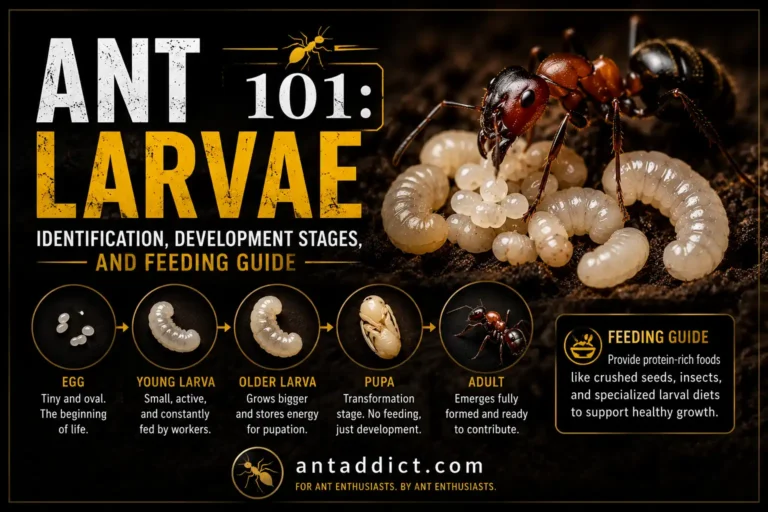
| First eggs | Days to about 2 weeks | A small white clump she tends constantly |
| Larvae | About 1 to 3 weeks after eggs | Grub-like, growing, still piled together |
| Pupae | A few weeks later | Larger, sometimes cocooned depending on species |
| First workers (nanitics) | About 6 to 12 weeks total | Small, sometimes pale at first: the colony has begun |
Those first workers, called nanitics, are undersized on purpose because the queen had limited reserves. That is normal. Once they are walking around, now you feed: a drop of sugar water or diluted honey, plus small pieces of insect protein. For the full founding-stage diet, see our guide to what queen ants eat. The workers take over foraging and brood care, the queen becomes a pure egg-layer, and your job shifts from patience to feeding and, eventually, upgrading her home.
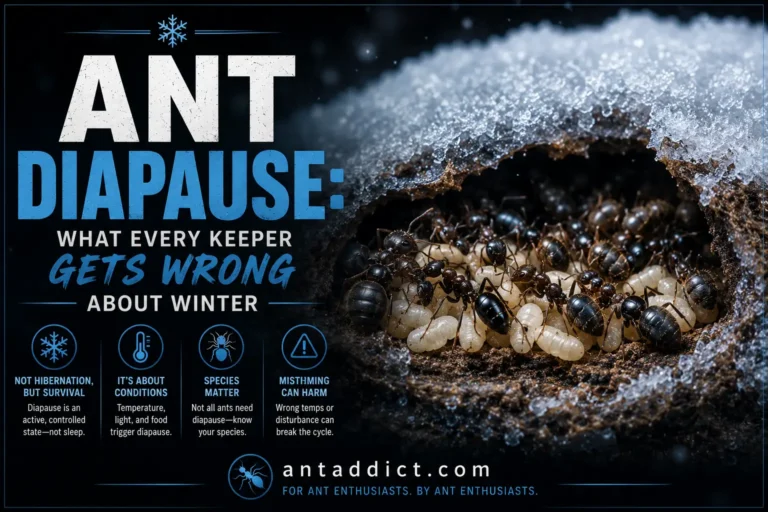
Do new queens need to hibernate?
Queens of temperate species caught late in the season often need a cool dormant period, called diapause, over winter to stay healthy and lay properly the next year. A Lasius queen caught in high summer usually founds a small colony first, then hibernates with it. If your queen slows or stops laying as autumn comes on, that may be normal seasonal slowdown rather than a problem, so research your exact species before you intervene.
What mistakes kill founding queens?
- Feeding a fully claustral queen during founding. The most common beginner error. She does not need it, and opening the tube can make her abandon or eat her brood. Wait for nanitics.
- Checking on her every day. Founding queens want dark and quiet. Once a week, briefly, is plenty.
- Catching a male or an unmated queen. Small, big-eyed, still winged and weak usually means male. Prioritize queens found walking with wings already shed.
- Pinching or overheating her in transit. A crushed gaster or a hot car kills a queen days later with no obvious cause.
- Letting the tube dry out or mold. Pack the cotton tight against the water and use clean tubes. If a tube molds badly, do a careful tube-to-tube transfer.
The bottom line
An ant mating flight is a numbers game the ants play against the weather and their predators, and you get to play the other side of it. Learn your local species’ window, wait for the warm, muggy, still day after rain, and look for the wingless queen walking the ground. Catch her gently, seal her in a test tube, and then, hardest of all, leave her alone. Do that and in a couple of months you are watching the first nanitics of a colony that could outlive your car. The biology is fascinating on its own, but the payoff is in the patience.
Frequently asked questions
What is an ant mating flight?
It is the event, also called a nuptial flight, where winged virgin queens and males from many colonies of one species leave at once to mate in the air or at a swarm site. Afterward the males die and the mated queens shed their wings and try to found new colonies.
When do ants have their mating flight?
Most temperate species fly on warm, humid, still days from late spring through early autumn, usually within a day or two of rain. The exact window depends on the species and your local climate, so there is no single universal “flying ant day.”
How do I know if a queen is mated?
The strongest sign is a large queen walking on the ground after a flight with her wings already shed, or with wing scars on her thorax. Queens still in the air or still carrying wings may not have mated yet.
Should I feed a queen while she founds her colony?
If she is fully claustral (most common hobby species), no: she raises the first workers on her own reserves, and feeding just risks disturbing her. Feed only once the first workers appear. Semi-claustral queens are the exception and do need small feedings.
Why do all the ants fly on the same day?
Colonies of one species synchronize using shared weather cues so they launch together. Flying en masse mixes genes between colonies and satiates predators, so any single queen is far more likely to survive.
How long do the male ants live after the flight?
Only hours. Males exist solely to mate and die shortly afterward, which is why you find so many dead winged ants on the ground the morning after a flight.
How many queens survive a nuptial flight?
Very few. Estimates commonly put successful colony founding at well under 1 in 1,000 queens, between predators, failed mating, and failed founding. That low rate is exactly why taking a few native queens has little impact.
Can I catch a queen ant that still has wings?
You can, but the odds she has mated are lower than a wingless queen walking the ground. Some winged queens have mated and simply not shed yet, so it is worth catching a few if that is all you find.
What is the difference between a flying ant and a queen ant?
“Flying ant” describes any winged reproductive, both queens and males. A queen is the larger winged female that can found a colony. Males are the smaller winged ants that die after mating.
How long until my queen has a full colony?
First workers appear in roughly 6 to 12 weeks. A visibly established small colony takes several months, and a large mature colony takes years, depending on species and temperature.
Do red or flying ants in the house mean an infestation?
A brief indoor swarm during flight season is usually alates that found a gap, not a nest inside your walls. Persistent winged ants indoors, especially carpenter ants, can indicate a nest and are worth investigating.
Last reviewed September 2026. Biological claims are cross-checked against the peer-reviewed and reference sources listed below. Flight timings are general guidance: always verify against your own local observations before planning a hunt.
Keep reading on Antaddict: Nuptial Flight Predictor tool · How to catch your first queen ant · The test-tube setup, step by step
References
- Hölldobler, B. & Wilson, E. O. (1990). The Ants. Harvard University Press. (Nuptial flight synchronization, predator satiation, sperm storage, claustral founding.)
- Hart, A. G. et al. Spatial distribution and environmental triggers of ant mating flights (Royal Society of Biology Flying Ant Survey). University of Gloucestershire. eprints.glos.ac.uk
- Nuptial flight behaviour of the African weaver ant, Oecophylla longinoda, and the weather factors triggering flights. Insectes Sociaux (2015). doi:10.1007/s00040-015-0456-9
- Opportunistic airport-collision samples from swifts reveal ant nuptial flight phenology. Scientific Reports (2026). nature.com
- Nuptial Flights and Mating. AntWiki. antwiki.org