What Is a Nuptial Flight? The Mating Event That Starts Every Ant Colony
The one-day airborne mating swarm that turns a winged princess into a queen, explained from the definition down to the sperm economics that no other guide talks about.
Last reviewed: September 2026. This guide draws on both firsthand ant-keeping experience and published research. Where a claim depends on species-specific biology, it has been checked against the primary literature cited below, and simplified rules of thumb are flagged as such. Reported sperm counts and storage durations are species-specific figures and vary across ants.
Quick Answer: What is a nuptial flight? It is the mating flight of social insects, most famously ants, but also termites, honey bees, and some wasps. On a warm, humid day, usually after rain, colonies release their winged reproductives (called alates): virgin queens and males that take to the air, mate on the wing or at a gathering site, and then part ways. The males die within hours or days. Each mated queen falls to the ground, sheds her wings, and tries to found a brand new colony alone. So a nuptial flight is not a random swarm of “flying ants.” It is a single, synchronized reproductive event, and it is the moment every ant colony on Earth began.
I have watched dozens of these flights over six years of keeping ants, and the first thing I tell new keepers is that the swarm they are staring at is not chaos. It is one of the most tightly choreographed events in the insect world, timed to the hour and shaped by millions of years of evolutionary pressure. Most articles define a nuptial flight in a sentence and move on. This guide goes deeper: what a nuptial flight actually is, which insects do it, exactly what happens in the air, why they all fly at once, and the reproductive biology, from lek swarms to sperm storage, that explains the whole spectacle. If you want the ant-specific timing and species schedules, our full ant nuptial flight guide covers that; this article explains the phenomenon itself.
What Is a Nuptial Flight, Exactly?
A nuptial flight is a synchronized mating flight in which the winged reproductive members of a social insect colony leave the nest, mate, and disperse to start new colonies. The word “nuptial” means wedding, and that is a fair description: it is the colony’s one shot at reproduction sent airborne.
Two kinds of insects take part. Virgin queens (also called gynes) are the large winged females destined to found colonies. Males are the smaller winged individuals whose only job is to mate. Both are produced by an established colony specifically for this event, raised, fed, and held until the conditions are right, then released together into the air.
Crucially, a nuptial flight is a one-time event for each individual. A queen mates only during this window, stores the sperm for the rest of her life, and never mates again. That single detail drives almost everything else about how these flights are built.
Which Insects Have Nuptial Flights?
Nuptial flights are the signature of many eusocial (truly social) insects, not just ants:
- Ants are the classic example, with over 14,000 described species, nearly all of which disperse through nuptial flights.
- Termites hold their own flights, releasing winged “swarmers” (alates) that pair off, drop their wings, and found colonies as a king-and-queen couple. Unlike ants, termite kings live on.
- Honey bees have a version called the mating flight, where a virgin queen flies to a drone congregation area, mates with many males in the air, and returns to head a colony.
- Some wasps and a few other social insects use similar airborne mating strategies.
The core logic is the same everywhere: get the reproductives out of the nest, mix genes with other colonies, and scatter new founders across the landscape. The details differ by group, which is why a “flying ant” and a “flying termite” are doing the same thing with very different outcomes.
What Actually Happens During a Nuptial Flight?
The event runs as a fast, high-stakes sequence:
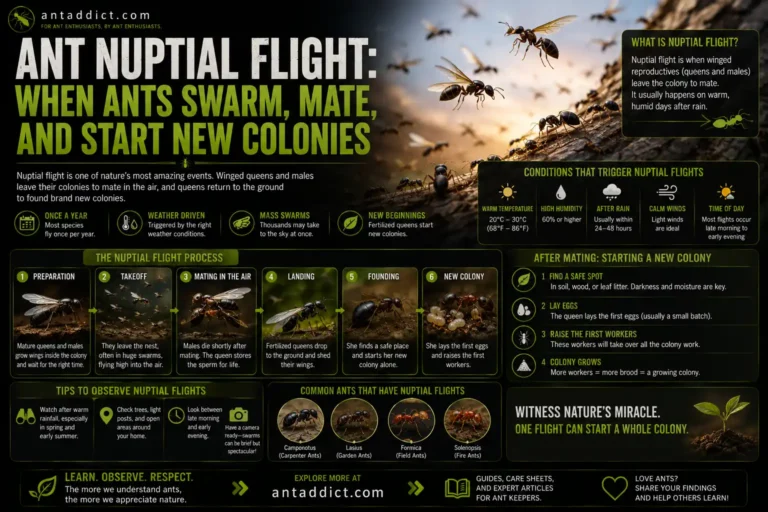
- Emergence. Workers open the nest and the alates pour out, often climbing to a high point before launching.
- Flight. Queens and males take off, sometimes rising hundreds of feet. Fire ant (Solenopsis) reproductives have been recorded flying up to around 800 feet (250 m) into the air.
- Mating. Males locate and mate with queens, either in mid-air or at a gathering site on the ground or in vegetation. A queen may mate with one male or with many, depending on the species.
- Dispersal. Once mated, the queen breaks off, flies or walks to a likely nest site, and lands.
- Dealation. She sheds or chews off her wings (a process called dealation), a near-irreversible signal that her flying life is over and her founding life has begun.
- Founding. She seals herself into a chamber and begins laying eggs, raising her first workers largely on her own body reserves.
The whole airborne part can be over in hours. Everything the queen does for the next several years runs on what she gained in those few minutes of flight.
What Are Alates?
Alates are simply the winged reproductive ants (or termites) produced for the nuptial flight. The term comes from the Latin for “winged.” Both the virgin queens and the males are alates while they still have their wings.
After a queen mates and lands, she becomes a dealate, meaning “de-winged.” That shift from alate to dealate is one of the most useful signals in the whole life cycle: a winged individual has probably not yet completed its flight, while a wingless queen walking on the ground has almost certainly mated. If you keep ants, spotting dealates is how you find founding queens worth collecting.
Why Do Ants All Fly at Once?
Synchronization is the whole point. When many colonies across a region release their reproductives on the same day, two powerful advantages kick in.
First, outbreeding. If a colony’s queens and males only met their own siblings, inbreeding would quickly weaken the population. By flooding the air with reproductives from many colonies at once, a nuptial flight makes cross-colony mating the norm and keeps the gene pool healthy.
Second, predator swamping. Flying reproductives are slow, soft, and packed with fat and protein, which makes them a feast for birds, spiders, dragonflies, and other ants. If they emerged a few at a time, predators would eat nearly all of them. By emerging all at once, in overwhelming numbers, the colony ensures that predators simply cannot eat them all, and enough survivors slip through to found new colonies. The strategy is survival by flooding the market.
What Triggers a Nuptial Flight?
Weather is the trigger. Most species wait for a specific combination of conditions, typically:
- Warmth, often a spell of heat building over several days
- High humidity, which keeps the soft-bodied fliers from drying out
- Rain a day or two before, softening the ground for digging and cueing the release
- Still, low-wind air, so the fliers are not scattered
Because different species tune themselves to slightly different triggers and times of day, they naturally stagger their flights across the season. This is not an accident; it is a form of reproductive isolation that stops closely related species from interbreeding. Many species even hold to a strict internal clock: research shows some ants keep their species-specific flight rhythm for up to a week even in constant darkness, meaning the timing is partly hardwired, not purely a reaction to the weather. To gauge whether conditions are lining up near you, our Nuptial Flight Predictor tool scores live weather against each species’ triggers.
How Do Queens and Males Actually Find Each Other?
Here is where most explanations stop and the biology gets genuinely interesting. Ants use two broad mating strategies, and which one a species uses tells you a lot about its whole life history.
Female-calling. In this system the virgin queen stays put, near or on the ground, and releases sex pheromones to draw males to her. Males do the searching. This tends to occur in species with smaller colonies, often those that mate with a single male. Many of the more ancestral ant lineages work this way.
Male-aggregation (lekking). In this system the males gather in huge numbers at landmarks in the landscape, a treetop, a chimney, a hilltop, forming a swarm, and the queens fly into that swarm to mate. This is the classic “cloud of ants” people see. It is associated with large colonies that pump out hundreds or thousands of reproductives, and it often goes hand in hand with queens mating multiple times. The males compete intensely in these leks, and only a fraction succeed.
Recognizing which strategy you are watching changes what you are looking at. A quiet trickle of queens calling from the grass and a towering column of males over a rooftop are two completely different reproductive systems, both called a nuptial flight.
What Happens to the Queen After the Nuptial Flight?
She becomes the sole founder of a potential colony. After landing and dealating, a mated queen looks for a nest site, digs or finds a chamber, seals herself in, and starts laying eggs. In most common species she raises that first batch of workers entirely on her stored body reserves, without leaving to feed. Once those first workers emerge, they take over foraging and brood care, and the colony is up and running. From there a successful queen can live and lay for years, in some species even a decade or two, all on the sperm from that one flight. If you want the detail on how she fuels and feeds that founding stage, see our guide on what queen ants eat.
The catch is brutal odds. The vast majority of queens never make it. Between predators, dehydration, failed founding, and competition, only a tiny fraction of the queens that take flight will ever produce a mature colony. A single successful queen out of thousands is a normal return.
What Happens to the Male Ants?
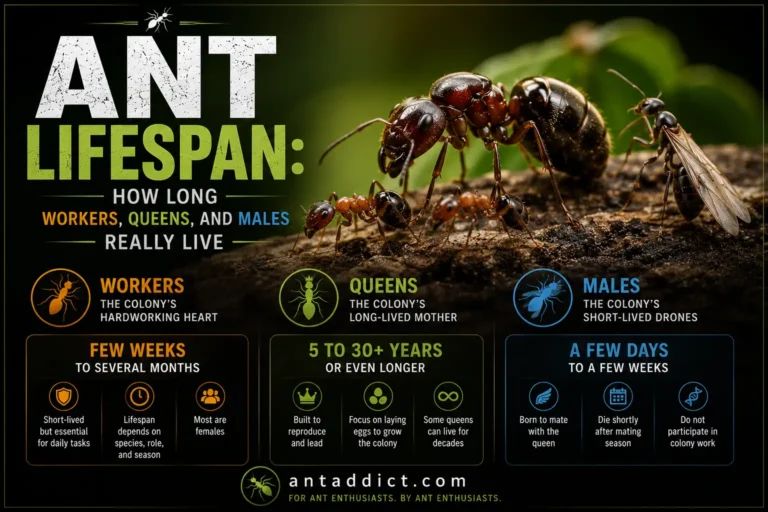
They die, and quickly. Males exist for one purpose, mating, and their bodies are built around it: big eyes, big flight muscles, small heads, short lives. Once a male has mated (or failed to), he has no role in the colony and no way back into one. Males typically die within hours to a couple of days of the flight, whether they succeed or not. Every male in the swarm is, in effect, a one-use delivery system for genes.
Is “Flying Ant Day” Actually Real?
Sort of, but the name is misleading. “Flying ant day” is the popular term for the mass appearance of winged ants in mid to late summer. In reality there is no single day. Flights happen across many days and weeks, with different colonies and species going whenever their local conditions align. What looks like one big “day” is usually several nearby colonies of the same species triggering on the same favorable afternoon, because they are all reading the same weather. So the swarm is real and the synchronization within a species is real, but the idea of one calendar day when all ants fly is a myth.
Nuptial Flight Across Ants, Termites, and Honey Bees
The same event plays out differently across the major groups:
| Feature | Ants | Termites | Honey bees |
|---|---|---|---|
| Who flies | Virgin queens and males | Winged “swarmers” (future kings and queens) | Virgin queen and drones |
| Where mating happens | In air or at a gathering site | Pair on ground after flight | Drone congregation area, in air |
| Number of mates | One to many (species-dependent) | One lifelong partner | Many (typically 10 to 20 drones) |
| Male fate | Dies within hours to days | King survives and lives with queen | Drone dies during or after mating |
| Wings after | Queen sheds wings (dealation) | Both king and queen shed wings | Queen keeps wings |
| Founding unit | Lone queen | King and queen couple | Queen with a worker swarm (existing bees) |
The takeaway: “nuptial flight” is one label for a family of related strategies. Ants and termites both send out lone or paired founders, while a honey bee queen returns to an existing colony. Knowing the group tells you what the flight is really doing.
Here Is the Part Everyone Else Skips: The Sperm Economics Behind the Whole Event
Every competing article describes the swarm. Almost none explain the reproductive math that shapes it, and once you see it, the entire nuptial flight makes more sense.
Start with a constraint: a male ant is born with a fixed, lifetime supply of sperm and cannot make more. In leafcutter ants (Atta), a single male carries only on the order of tens of millions of sperm (reported at roughly 40 to 80 million), while a founding queen of a large-colony species ends up storing hundreds of millions (around 200 to 310 million) to fuel decades of egg-laying. Do the arithmetic and one male simply cannot fill a big queen. That single fact helps explain polyandry, why queens of large-colony species mate with many males: they physically need the sperm of several males to stock a lifetime of reproduction. Roughly three-quarters of studied ant species show some multiple mating, and the tendency tracks colony size closely.
Then consider what she does with it. A queen stores that sperm alive in an organ called the spermatheca and doles it out for years, in fire ants for close to seven years, in some long-lived queens for one to two decades, keeping the cells viable the entire time. That is a genuine biological feat, and it is not free: research has shown that storing sperm imposes a measurable immune cost on newly mated queens, a trade-off between preserving sperm and defending against infection (Baer, Armitage and Boomsma, Nature, 2006). More recent work has traced how queens keep stored sperm viable by holding it in a near-oxygen-free, immobilized state (Scientific Reports, 2023).
So the nuptial flight is not just a mating swarm. It is the one narrow window in which a queen must acquire, in minutes, the entire genetic and reproductive payload she will spend the next ten or twenty years carefully rationing. That is why evolution has tuned the event so tightly: the timing, the synchronization, the lek swarms, and the multiple mating all exist to make sure that a queen who gets exactly one chance gets it right.
Why Nuptial Flights Matter (and Why Keepers Should Care)
Ecologically, nuptial flights are a massive seasonal pulse of life. They redistribute ant genes across the landscape, feed a huge range of predators for a few crucial days, and turn over soil as new queens dig in. A single flight can put protein into birds, spiders, and even fish that snap up fliers over water.
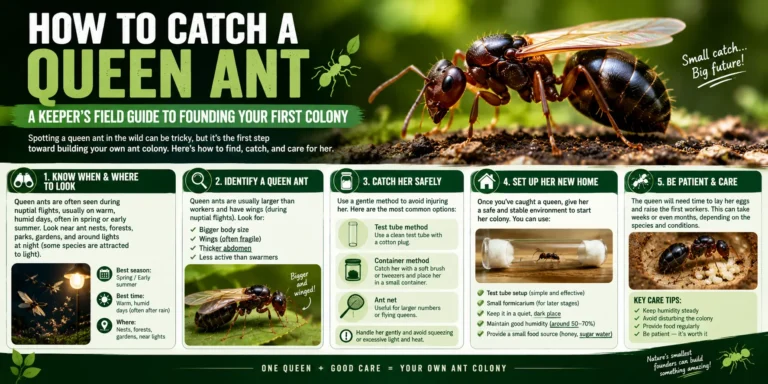
For ant keepers, the nuptial flight is everything, because it is the only moment you can catch a mated, ready-to-found queen from the wild. Understanding what a nuptial flight is, when it happens, and how to read the conditions is the difference between coming home with a founding queen and coming home empty-handed. Learn the event, and you can predict it; predict it, and you can be standing in the right place on the right afternoon.
A Keeper’s Honest Take
The single biggest mindset shift I can offer is this: stop seeing “flying ants” as a nuisance swarm and start seeing a nuptial flight as a countdown. Every one of those fliers is a colony’s entire genetic future gambled on one afternoon, and the overwhelming majority will lose. When you understand the odds each queen faces, and the sperm-storage marathon ahead of any queen who wins, you catch queens more thoughtfully, you found them more patiently, and you stop treating a founding queen like a bug in a tube. She is the survivor of a lottery with thousands of losing tickets. Respect that, and you keep ants better.
The Bottom Line
So, what is a nuptial flight? It is the synchronized mating flight of social insects, the airborne event in which winged queens and males leave their colonies, mate, and disperse to found new ones. In ants it ends with the males dead and a handful of mated queens shedding their wings to start colonies alone, on sperm they will store for years. It is triggered by warm, humid, post-rain weather, synchronized to outbreed and to swamp predators, and organized around one unforgiving truth: a queen gets a single chance to gather a lifetime of sperm. Understand that, and everything from “flying ant day” to how you catch your first queen finally makes sense..
FAQ
What is a nuptial flight in simple terms?
It is the mating flight of social insects like ants, termites, and bees. Winged queens and males leave their colonies on a warm, humid day, mate in the air or at a gathering spot, and then the mated queens land, shed their wings, and try to start new colonies. The males die soon after.
What is the purpose of a nuptial flight?
Reproduction and dispersal. It mixes genes between colonies to prevent inbreeding, scatters new queens across the landscape, and, by releasing huge numbers at once, ensures enough queens survive predators to found the next generation of colonies.
When do nuptial flights happen?
Mostly in late spring through summer, on warm, humid days a day or two after rain, though each species flies on its own schedule and time of day. In cooler climates flights cluster in the warmest months.
What are alates?
Alates are the winged reproductive members of a colony, the virgin queens and the males, produced specifically for the nuptial flight. After a queen mates and sheds her wings she is called a dealate.
Do all ants have nuptial flights?
Almost all do, but not quite all. A few species reproduce by “budding,” where a queen simply walks off with some workers to start a nearby nest, and some others use different strategies. The winged nuptial flight is by far the most common method.
Why do the ants all fly on the same day?
So they can mate with ants from other colonies and overwhelm predators with sheer numbers. Colonies of the same species read the same weather cues, so many of them release their fliers on the same favorable afternoon, creating what looks like a coordinated “flying ant day.”
What happens to the queen after the nuptial flight?
She lands, sheds her wings, finds or digs a nest chamber, and begins laying eggs. She raises her first workers on stored body reserves, then those workers take over and the colony grows. A successful queen can live and lay for years on that one flight’s sperm.
Do male ants die after the nuptial flight?
Yes. Males exist only to mate and die within hours to a couple of days of the flight, whether or not they succeed.
Is a nuptial flight the same as swarming?
They overlap. “Swarming” is the general word for the mass emergence of flying reproductives; the nuptial flight is that emergence plus the mating and dispersal that follow. In termites and bees, “swarming” can also mean other things, so nuptial flight is the more precise term for the mating event.
Can you predict a nuptial flight?
To a degree, yes. By tracking temperature, humidity, and recent rain against a given species’ known triggers, you can estimate when conditions favor a flight. It is not exact, but experienced keepers and tools that score live weather get close.
How is a termite nuptial flight different from an ant’s?
Both send out winged alates that mate and shed their wings, but a termite pair, a king and queen, stays together for life and founds the colony as a couple, whereas an ant queen founds alone and the males die.
Why should ant keepers understand nuptial flights?
Because it is the only time you can catch a mated, founding queen from the wild. Knowing what triggers a flight and how to spot a freshly mated dealate is the core skill behind starting a colony.