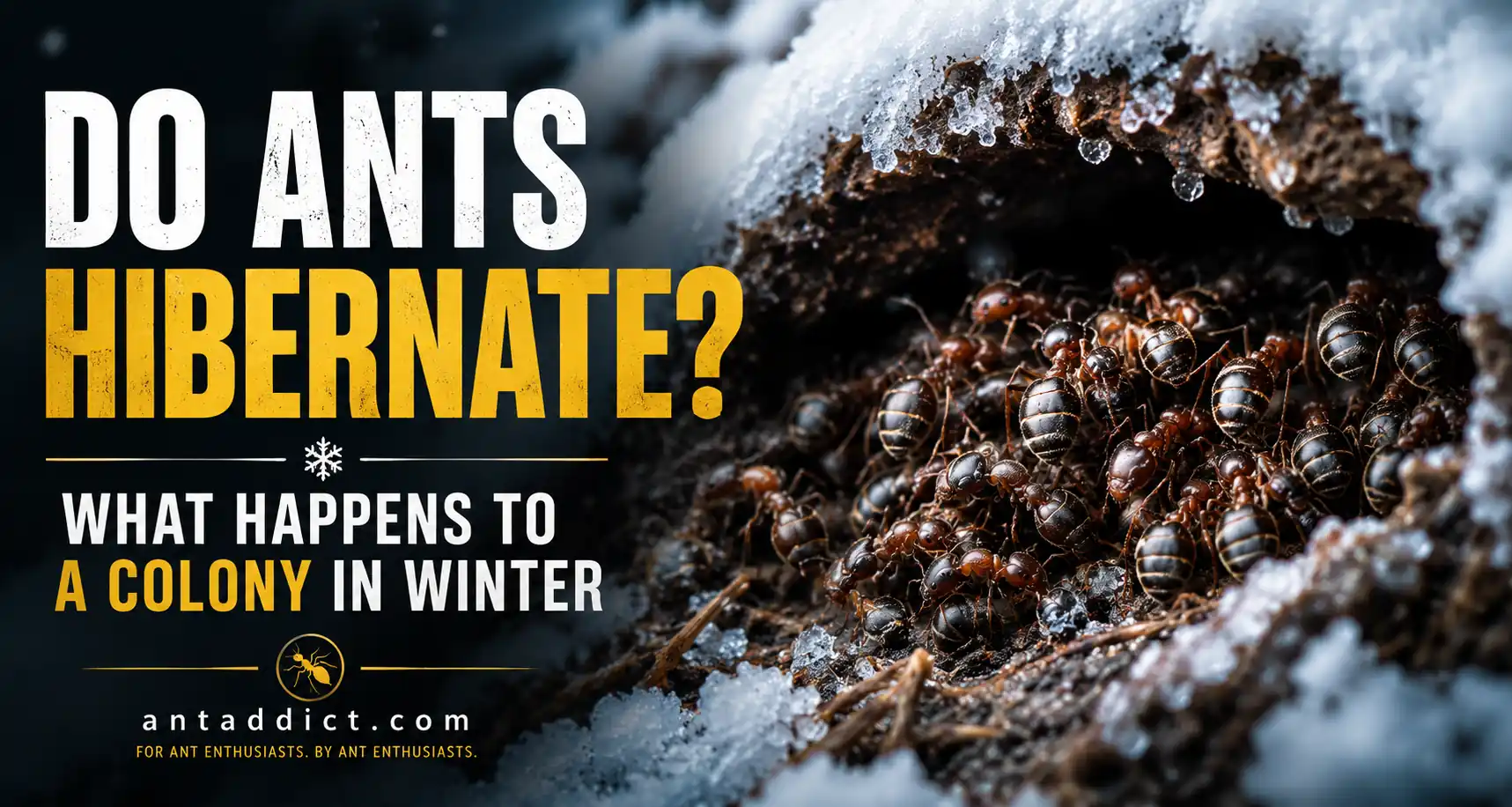
Do Ants Hibernate? What Happens to a Colony in Winter
Last reviewed: June 2026. Claims in this guide are drawn from first-hand keeping and the peer-reviewed and university sources linked inline and listed below.
No, ants do not truly hibernate. Hibernation is a term for mammals. Instead, temperate ant colonies enter a winter dormancy: the larvae fall into true diapause (a programmed developmental pause) while the adults overwinter in a slowed, quiescent state. They cluster deep in the nest, cut their metabolism, build antifreeze compounds, and wait for spring.
So, do ants hibernate? Not the way a bear does. If you have ever wondered what ants do in winter, or why the trail on your patio vanishes in November and reappears in March, this is the answer. The colony did not die and it did not pack up and leave. It downshifted into one of the most efficient survival modes in the insect world. For keepers, understanding that mode is the difference between a queen who lays strongly every spring and a colony that quietly fails over winter.
I keep and overwinter ant colonies myself, so most of what follows pairs the published research with what six years at the bench actually looks like: what the science says, and what decides whether a colony walks into spring strong or never wakes up properly.

Hibernation vs diapause vs overwintering: the words actually matter
Most articles use “hibernate” as a catch-all. It is the wrong word, and the right words explain everything ants do in winter.
Hibernation is a mammalian strategy: a deep, regulated drop in body temperature and heart rate in animals like bears and groundhogs. Ants are cold-blooded, so they cannot hibernate in that sense.
Diapause is a pre-programmed developmental arrest. It is switched on by environmental cues before the cold even arrives, not triggered moment to moment by temperature. In ants, the larvae are the stage that enters true diapause: they stop developing, stop feeding, and hold position until spring.
Quiescence (overwintering) is a direct, reversible response to cold. The adult workers and queen enter this state. They are not developmentally frozen like the larvae; they are simply slowed down. Open a wild nest in midwinter and the workers still stir and shift position, only very slowly.
| Term | Who it applies to | What it is | Reversible on warming? |
|---|---|---|---|
| Hibernation | Mammals only | Regulated metabolic shutdown | Yes |
| Diapause | Ant larvae (and some queens) | Programmed developmental pause set by cues | Only after a chilling period |
| Quiescence | Adult workers and queen | Cold-driven sluggishness | Yes, almost immediately |
This is the distinction the WSU entomologist Laurel Hansen draws in Washington State University’s explainer: for adult ants it is, in her words, “not a true diapause, and it’s not a true hibernation.” Their respiration drops to roughly half of summer levels, but they never fully switch off.
What actually triggers ant winter dormancy (it is not just cold)
Here is the detail nearly every competitor misses. Keepers assume “cold equals dormancy,” so they drop the temperature and expect the colony to shut down. The real trigger is usually a combination of signals, and temperature is only one of them.
In many temperate species the dominant cue is photoperiod, the shortening day length of late summer and fall. Falling temperature reinforces it, and in some ants an internal colony rhythm sets the schedule almost regardless of the weather. Research by Kipyatkov and Lopatina on ant seasonal cycles shows that short days and lower temperatures mainly act to bring diapause forward, while the underlying program can be built into the colony itself. You can read the primary work in the Journal of Evolutionary Biochemistry and Physiology.
The practical takeaway: a captive colony that only ever sees a temperature drop, with no seasonal light change, can get confused signals. That is one reason keepers who skip a proper seasonal transition see weak or erratic spring laying. It is telling that black carpenter ant colonies held at a constant laboratory temperature fail to overwinter normally: the seasonal signal, not the cold alone, is part of what the colony needs.
The antifreeze trick: how ants survive below freezing
Ants are small and water-rich, which should make them easy to freeze solid. They get around this with chemistry, and this is the part worth showing your kids or your audience.
Ants rely on two cold-survival strategies, and which one dominates depends on the species and how harsh its winters are. Many are freeze-avoidant (also called freeze-susceptible): they keep their body fluids liquid below 32°F (0°C) rather than survive being frozen. They lower their supercooling point, the temperature at which body water spontaneously turns to ice, using two tools described in Iowa State University’s cold-hardiness overview.
First, they flood their tissues with cryoprotectants, mainly glycerol and other polyols that behave like the antifreeze in a car radiator. Second, they purge their gut of food particles and microbes, because those act as “ice nucleators,” tiny seeds that ice crystals grow from. Clear out the seeds, add the antifreeze, and the colony can sit well below freezing without a single lethal ice crystal forming.
Other ant species take the opposite route and are freeze-tolerant, allowing controlled ice to form in safe spaces outside their cells while protecting the cells themselves. Either way, the cold hardiness is built up in advance during the fall, not improvised when the first frost hits.
What a colony looks like in the dead of winter
So where do ants go in winter? Mostly straight down. Pull back the soil on a wild temperate nest in midwinter and you will find a colony that looks paused, not dead:
- The cluster moves down. Ants retreat to the lowest, most insulated chambers, often below the frost line, where temperatures stay more stable.
- The queen stops laying. Egg production halts or nearly halts, so the colony is not trying to raise brood it cannot feed.
- The brood is mostly diapausing larvae. Many temperate colonies clear out eggs and pupae before winter and overwinter as a batch of paused larvae plus adults.
- Everyone slows down. Foraging stops, movement becomes sluggish, and the colony runs on the fat reserves it stockpiled in fall.
This is also why you sometimes see ants indoors in winter. A colony nesting in a heated wall void or under a warm slab never gets the full cold signal, so it stays partly active and the occasional worker still wanders into the kitchen.
Do ants die in winter?
For an established colony, no. A mature nest with a laying queen, a worker force, and stored resources is built to survive winter and routinely does so for many years.
The vulnerable ones are different: a newly mated queen founding a colony alone, with no workers and no reserves, faces a much harder first winter, and exposed or shallow nests can be killed by a hard freeze that reaches the cluster. Survival is about depth, reserves, and timing, not luck.
Do all ants hibernate? Carpenter ants, fire ants, and the exceptions
Not every species reads winter the same way. The two most-asked-about ants in the United States, carpenter ants and fire ants, handle the cold very differently.
Carpenter ants (Camponotus). In the wild, carpenter ants go dormant inside their nest, sealing themselves into wood galleries and waiting out the cold. Ohio State University Extension notes they stay inactive until spring, with one exception: a colony nesting inside a heated building can stay active all winter. So if you spot large black ants indoors in January, the nest is almost certainly inside your warm structure, not marching in from the yard. Black carpenter ants go still once the temperature drops below about 41°F (5°C), according to Animal Diversity Web.
Fire ants (Solenopsis invicta). Fire ants barely slow down at all. Instead of hibernating, they thermoregulate: workers shuttle the brood deep into the mound on cold days and shift the mound toward heat sinks in fall. They are freeze-susceptible, and extension entomologists report that fire ants cannot survive where the soil freezes as deep as they nest, which is what caps their spread across the northern United States. A quiet winter mound is not a dead one; on warm days the colony resurfaces.
The exception that proves the rule: winter ants. A few species flip the script entirely. The aptly named winter ant (Prenolepis imparis) is most active in cool weather, foraging on mild winter days when its rivals are shut down, then resting through the summer heat instead.
Which ants actually need to overwinter? (keeper guide)
This is where blanket advice gets colonies killed. Whether you should cool your colony depends entirely on where the species evolved. Forcing a tropical species into a cold rest can be fatal; denying a temperate species its rest disrupts the queen’s natural cycle.
| Species group | Examples | Overwintering need | Keeper approach |
|---|---|---|---|
| Temperate | Lasius niger, Formica spp., Myrmica spp., Tetramorium immigrans, temperate Camponotus | Required | Full seasonal cool-down over winter months |
| Mediterranean / subtropical | Messor barbarus, Aphaenogaster senilis, Camponotus barbaricus | Light | Mild cool-down only; they slow but rarely fully stop |
| Tropical / exotic | Tropical Pheidole, Odontomachus, exotic warm-climate ants | None | Keep warm year-round; cold can kill them |
Most ants kept in the United States fall in the top row, so a genuine winter rest is the default. The exceptions are warm-climate species popular in the hobby: a Messor barbarus colony, for example, does not need a deep northern winter, just a gentle seasonal dip that matches its Mediterranean biology.
How to overwinter a pet colony safely
For temperate and Mediterranean species, the goal is to mimic nature, not shock the colony. After six years of doing this, the principles that actually matter are simpler than most guides make them:
- Transition gradually. Step the temperature down over two to three weeks rather than dropping it overnight. A sudden plunge stresses the colony; a slow decline mirrors the season.
- Match the species, not a fixed number. Many keepers rest temperate colonies somewhere in the cooler range over winter and warm them back up in spring. Always check a trusted care sheet for your exact species rather than copying one universal temperature.
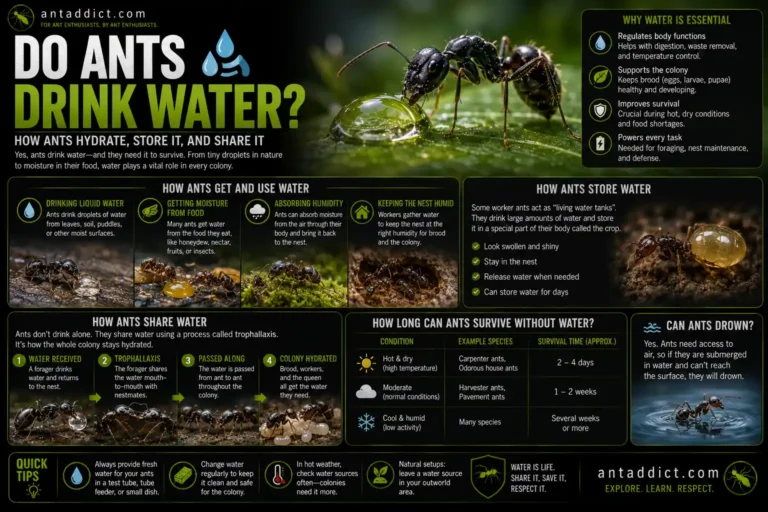
- Keep water available. Dormant does not mean dehydrated. The nest still needs humidity, and a hydration source prevents desiccation over a long rest.
- Feed before, not during. Build the colony’s reserves with protein and carbohydrates in the fall so it enters winter fueled. During the rest, the colony lives off that stockpile.
- Do not keep poking. Resist the urge to check constantly. Disturbance burns the energy the colony is trying to conserve.
What this looks like in practice: The clearest sign a colony is ready is the queen herself. In my colonies, laying tapers off weeks before I touch the temperature, and the workers stop taking sugar water and pull in around the brood. That is the colony asking for winter, not me forcing it. The most common way I see beginners lose a colony is the opposite move: dropping a warm, active nest straight into a refrigerator. Cold-shocked colonies that skip the slow transition tend to limp into spring with a fraction of their workers, if they make it at all.
Skip this rest for a temperate species and you often see a queen who lays weakly, or a colony whose internal cycle drifts out of sync. The seasonal pause is not optional maintenance for these ants; it is part of how the queen’s reproductive engine resets.
FAQ
Do ants hibernate or migrate in winter?
Neither in the strict sense. Temperate colonies stay in their nest and enter dormancy: larvae diapause and adults overwinter in a slowed state. They do not migrate to escape the cold.
At what temperature do ants become dormant?
There is no single number. Activity falls as temperatures drop through the 50s°F (around 10 to 15°C), and most temperate colonies are fully dormant near or below freezing. The exact threshold varies by species and is often cued by day length as much as temperature.
Do ants sleep all winter?
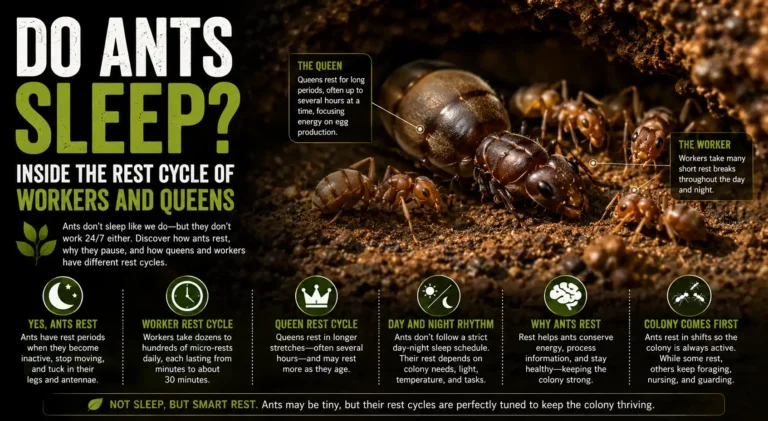
Not really. Adults are sluggish but still capable of movement, and their respiration runs at roughly half the summer rate. They are conserving energy, not unconscious.
Why do I see ants in my house in winter?
A colony nesting near a heat source, such as inside a warm wall or under a heated slab, may never get the full cold signal and stays partly active, sending out the occasional forager.
Do I have to hibernate my pet ants?
Only if the species is temperate. Temperate ants need a seasonal cool-down for a healthy reproductive cycle. Tropical and most exotic species should be kept warm year-round, and cooling them can be fatal.
How long do ants stay dormant in winter?
In temperate zones, dormancy usually runs from fall through early spring, roughly 3 to 5 months depending on latitude and the year. Keepers resting a temperate species typically give it at least 8 to 10 weeks for the cycle to reset properly.
Do carpenter ants and fire ants hibernate?
Carpenter ants go dormant in their nest until spring, though a colony inside a heated home can stay active all winter. Fire ants do not hibernate; they move their brood deep into the mound and stay near heat, resurfacing on warm days.
Do ants come back after winter?
Established colonies do. Dormancy ends gradually as soil temperatures climb back above about 50°F (10°C) and daylight lengthens, which is why ant trails reappear in early spring.