Can Ants Swim? Which Species Can, How They Do It, and How Long They Survive
Last reviewed: June 2026. Claims in this guide are drawn from first-hand keeping and the reference and peer-reviewed sources linked inline and listed below.
Quick answer
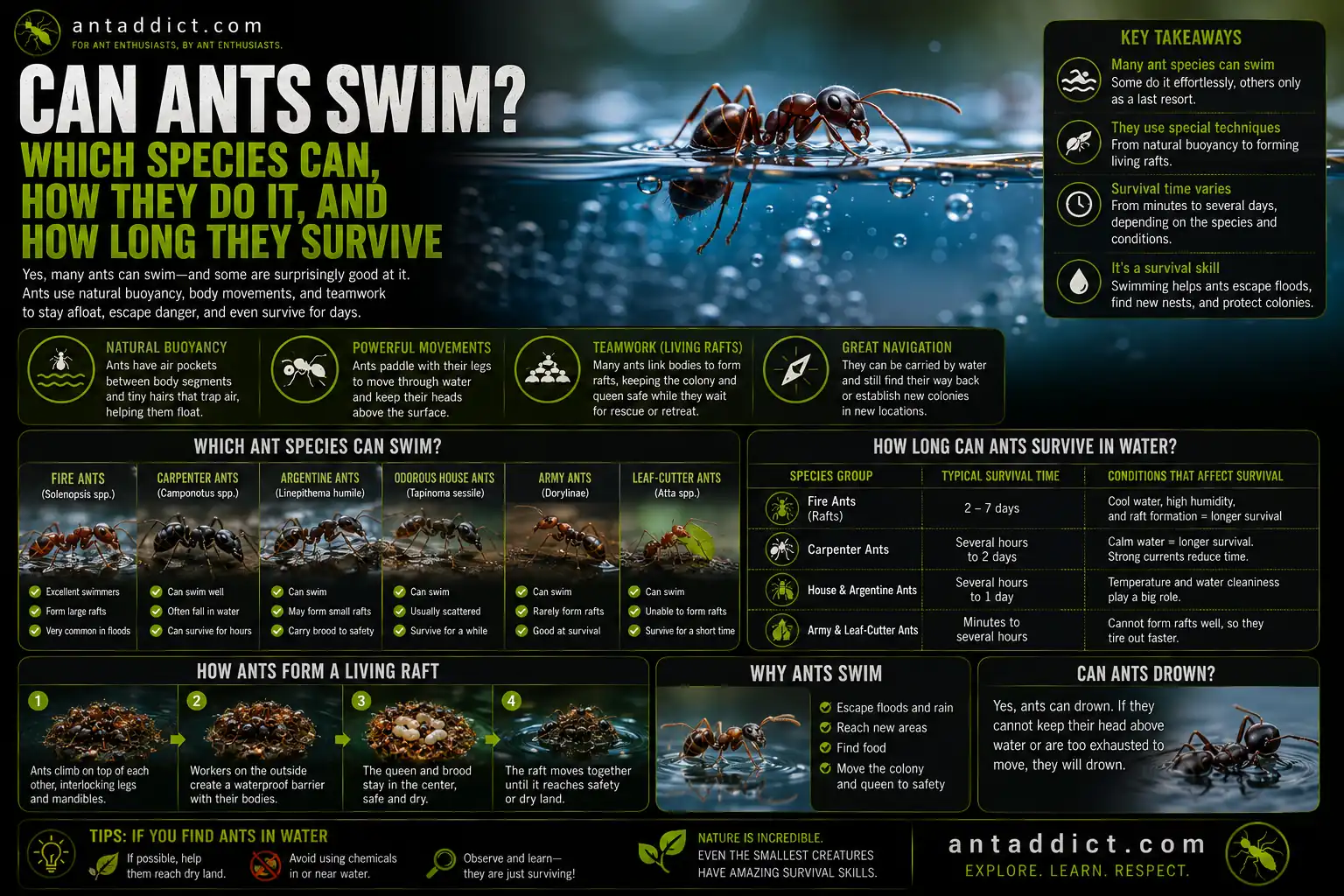
Yes — some ants can genuinely swim, but most ants only float, and a few drown within seconds. Whether an ant can swim depends entirely on the species. A small number of ants, such as carpenter ants and the underwater-diving Colobopsis schmitzi, actively propel and steer themselves through water. The majority of ants simply ride the surface, kept afloat by surface tension and a thin layer of trapped air, until they either reach dry land or sink. So the real answer to “can ants swim” is: some do, most don’t, and knowing the difference is the key to understanding everything ants do in water.
Key takeaways
- Only a minority of ant species truly swim; most only float.
- Swimming ants use their front and middle legs to paddle and their hind legs as rudders to steer.
- Ants stay afloat because they are light, water-repellent, and small enough for surface tension to hold them up.
- Ants breathe through spiracles, not lungs, and can close them to keep water out.
- Ants can survive from a few minutes to roughly 24 hours in water, depending on species, temperature, and water quality.
- Soapy water kills ants fast because it destroys the air layer that keeps them afloat.
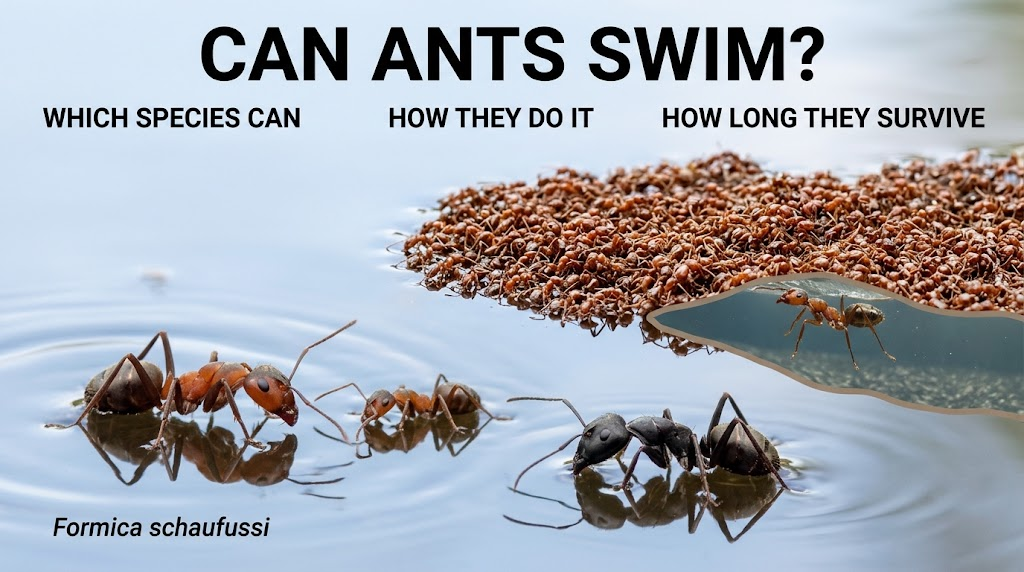
Can ants swim? The honest answer
Yes, some ants can swim — but the popular image of an ant confidently paddling across a pond applies to only a handful of species. Most of the ants you will ever encounter cannot swim in any meaningful sense. They can stay on top of the water for a surprisingly long time, but they are floating, not swimming, and the distinction is more than a technicality.
The confusion is understandable. When you drop an ant into a glass of water and it doesn’t immediately sink, it looks like the ant is coping deliberately. In reality, three completely different things can be happening: the ant might be actively swimming toward an exit, it might be passively floating and waiting for luck, or it might be moments away from drowning. Each of those behaviors involves different species, different body mechanics, and different odds of survival.
This is exactly why a simple yes-or-no answer to “can ants swim” is misleading. Ants are one of the most diverse animal families on Earth, with over 12,000 known species living in deserts, rainforests, floodplains, and your kitchen. Their relationship with water is just as varied. A desert harvester ant that almost never meets standing water has very different abilities from a tropical canopy ant whose home floods every rainy season. To answer the question properly, you have to look at what the ant is actually doing in the water — so let’s define the four possibilities before we go further.
Swimming vs. floating vs. rafting vs. drowning: the difference that matters
Most articles blur these four behaviors together, which is why the internet can’t seem to agree on whether ants can swim. Here is the clean distinction.
Swimming means active, directed propulsion. The ant coordinates its legs into a genuine stroke and moves toward a chosen destination, fighting the water rather than drifting on it. This is what carpenter ants and a handful of tropical species do, and it is comparatively rare.
Floating means passive buoyancy. The ant stays on the surface because it is light enough that surface tension supports it and because its water-repellent body traps a film of air. A floating ant isn’t propelling itself anywhere on purpose; it is being held up by physics. This is what most ant species do when they land in water.
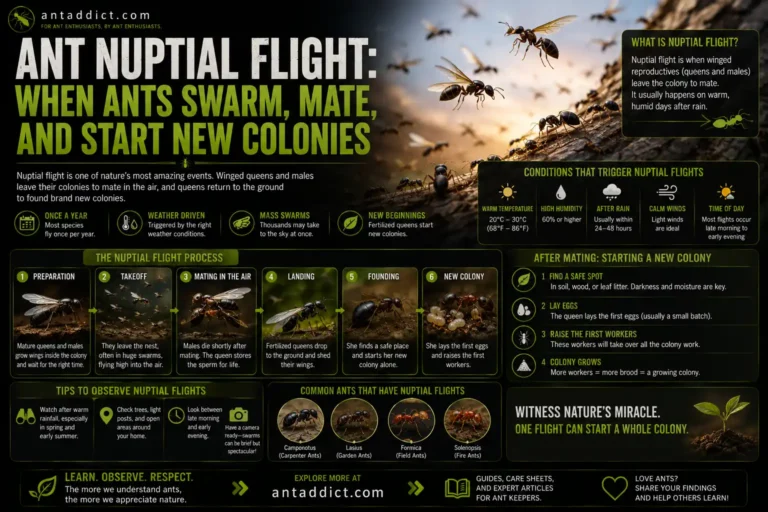
Rafting is a collective survival behavior. Instead of each ant fending for itself, an entire colony links legs and jaws into a single floating structure — a living raft. Fire ants are the famous example. Rafting is neither swimming nor individual floating; it is a group adaptation to flooding.
Drowning is what happens when buoyancy fails. Once the trapped air layer is stripped away or the ant’s breathing holes flood, it sinks and suffocates. Soapy or turbulent water causes this quickly; even calm water causes it eventually.
| Behavior | What’s happening | Which ants do it |
|---|---|---|
| Swimming | Active, directed leg propulsion toward an exit | Carpenter ants, Gigantiops, diving ants, some field ants |
| Floating | Passive buoyancy from surface tension and trapped air | Most ant species |
| Rafting | Colony interlocks into a living floating raft | Fire ants and other flood-adapted species |
| Drowning | Air film breaks, spiracles flood, ant sinks | Any ant in soapy or rough water |
Keep these four straight and the viral videos stop being confusing. Most clips labeled “ant swimming” actually show floating or rafting — genuine, directed ant swimming is the exception, not the rule.
How do ants swim? The mechanics
The ants that truly swim don’t just flail. Researchers who filmed swimming ants in high speed found a coordinated, repeatable technique that is measurably different from walking.
In a 2018 study published in the Annals of the Entomological Society of America, entomologist Evan Gora and colleagues at the University of Louisville compared how the black carpenter ant (Camponotus pennsylvanicus) and the silky field ant (Formica subsericea) move through water. Both species used a similar pattern: the front legs provided most of the propulsion, the middle legs did a bit of both propelling and steering, and the hind legs acted as rudders, trailing behind to hold a straight course. It is less a doggy paddle than a front-wheel-drive rowing stroke with a rear rudder.
That same research explained why some ants are dramatically better swimmers than others. The black carpenter ant doubled the silky field ant’s swimming velocity, top speed, and acceleration. The reason wasn’t a cleverer stroke — it was anatomy. The carpenter ant’s forelegs are proportionally longer and it carries far more muscle mass, giving each stroke more power. In other words, the better swimmer was simply the stronger, longer-limbed ant.
Why don’t ants sink?
Before an ant can swim, it has to stay on top of the water, and three factors make that possible. First, ants are tiny and light, so surface tension — the “skin” on top of water created by molecules clinging together — is strong enough to support their weight. At an ant’s scale, the water surface behaves like a taut trampoline. Second, an ant’s exoskeleton is hydrophobic, meaning water-repellent, and is covered in microscopic hairs that trap a layer of air against the body. That air layer adds buoyancy and keeps water off the ant’s breathing holes. Third, ants can spread their legs to distribute their weight across more of the surface, the same way snowshoes keep a person on top of soft snow.
This is why a dry ant dropped into still water often skates on the surface rather than breaking through it. It is also why anything that destroys that air layer — soap being the classic example — turns a floating ant into a sinking one almost instantly.
How ants steer in water
Staying afloat is only half the battle; an ant also has to know which way to go. Here swimming ants use a remarkable trick called skototaxis — orientation toward dark shapes. In flooded forests, the darkest object on the horizon is usually a tree trunk or the shoreline, which is exactly where a stranded ant needs to head.
Yanoviak and colleagues demonstrated this cleanly. When they placed swimming ants in a pool with a black pole on one side and a white pole on the other, about 87 percent of the ants swam straight toward the dark pole and climbed out, while their movement around the white pole was essentially random. The champion swimmers in these tropical surveys powered along at more than three body lengths per second — proportionally quick for an animal a few millimeters long. Skototaxis is one of the most elegant details in the whole topic, and it is something almost no general article on ant swimming ever mentions: these ants aren’t drifting aimlessly, they are navigating.
Which ants can actually swim?
Genuine, directed swimming is limited to relatively few species, but the documented cases are fascinating and well-supported by research.
Carpenter ants
Carpenter ants (Camponotus) are the standout swimmers among common temperate species. As the University of Louisville study showed, the black carpenter ant is a fast, powerful, directed swimmer — and carpenter ants are unusual in being able to both glide through the air when they fall from a height and swim once they hit the water. That combination makes them one of the most water-capable ants in North America. Carpenter ants are also the species most likely to be chewing through the damp wood in your home; if you’re finding them indoors, our guide to carpenter ant holes explains what to look for.
Silky field ants
Silky field ants (Formica subsericea) can swim too, though far less impressively than carpenter ants. The Louisville researchers noted an interesting split within the species: smaller silky field ants often simply walked across the water’s surface using surface tension, while larger individuals swam with their bodies lower in the water. It’s a reminder that even within one species, body size changes how an ant handles water.
Diving ants
If carpenter ants are the best surface swimmers, the diving ant (Colobopsis schmitzi, historically Camponotus schmitzi) is the true aquatic specialist. This Southeast Asian species lives in partnership with the carnivorous pitcher plant Nepenthes bicalcarata. The ants deliberately dive beneath the surface of the pitcher’s digestive fluid, swim underwater to retrieve large prey that has fallen in, and haul it back out — a behavior documented in a 2012 study in the Journal of Comparative Physiology A. No other ant is known to swim underwater on purpose as part of its everyday life. The diving ant is the definitive answer to anyone who insists ants can’t swim.
Tropical canopy swimmers
Beyond these familiar names, swimming turns out to be common in the rainforest canopy. When Stephen Yanoviak’s team tested 35 common tropical arboreal ant species, 10 proved to be strong, directed swimmers and another 10 showed at least some directed movement toward safety. Big-eyed jumping ants in the genus Gigantiops were among the capable swimmers. For ants that live high in trees above seasonally flooded forest, being able to swim — or glide — back to a trunk after a fall is a genuine survival skill, not a party trick.
The evolutionary picture
Perhaps the most striking finding is that ant swimming is not a single ancient trait passed down through the family. Yanoviak’s research indicates that surface swimming evolved independently several times in different ant lineages. Different groups of ants, facing the same problem of falling into water, each arrived at their own solution. That kind of repeated, independent evolution is biology’s way of telling you a skill is extremely useful — in this case, useful enough to appear again and again wherever ants live near water.
Which ants can’t swim but float
The most famous “ants in water” behavior of all isn’t swimming — it’s rafting. Fire ants (Solenopsis invicta) cannot swim as individuals, but a whole colony can survive a flood by linking legs and mandibles into a buoyant, waterproof living raft. These rafts trap air among thousands of interlocked bodies, float for days or even weeks, and constantly rotate members between the wet underside and the dry top so no single ant stays submerged long enough to drown. Researchers at Georgia Tech famously described this self-assembly in a 2011 study in the Proceedings of the National Academy of Sciences.
Rafting is a colony-level adaptation, not individual swimming, and it deserves a full treatment of its own. We cover exactly how the raft holds together, how ants survive floods, and why water is both a threat and a lifeline for a colony in our main guide to what water ants really are. If flood rafts are what brought you here, that’s the page to read next.
Can ants breathe underwater?
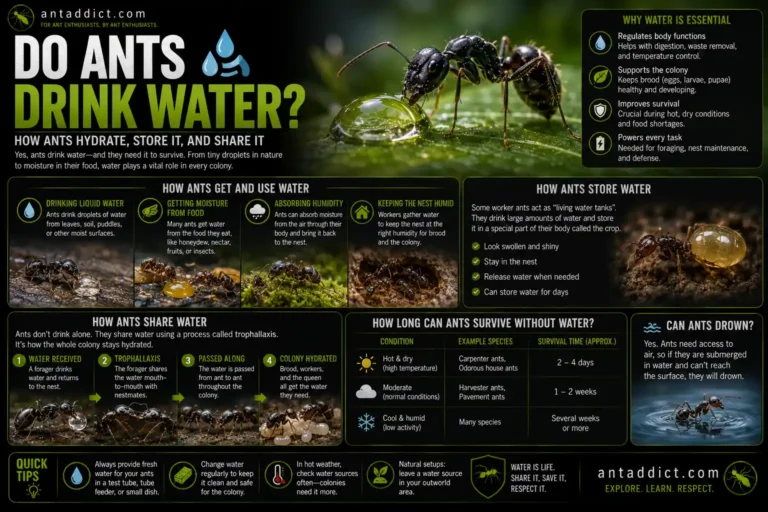
No — but they can hold out far longer than you’d expect, and the reason is fascinating. Ants don’t have lungs. They breathe through spiracles, a series of tiny holes along the sides of the body that open into a branching network of tubes called tracheae, delivering air directly to the tissues. Because breathing is passive rather than driven by lungs, an ant can simply close its spiracles when submerged or when it senses rising water, sealing itself off like shutting a hatch.
There’s a second, subtler mechanism at work. The film of air trapped against a water-repellent ant’s body can function as a plastron — a physical gill. Dissolved oxygen from the surrounding water slowly diffuses into that trapped air layer, letting the ant exchange a small amount of gas without ever surfacing. It isn’t true underwater breathing, and it won’t keep an ant alive indefinitely, but it is a big part of why a submerged ant can survive minutes or hours rather than seconds. Between sealable spiracles and a plastron air film, ants are far better equipped for accidental submersion than their size suggests.
How long can ants survive in water?
This is the question people most want answered, and the honest response is that it varies enormously — from a few minutes to around 24 hours — depending on the species and the conditions. Anyone who gives you a single confident number is overselling it.
Three factors decide the outcome. Species matters most: flood-adapted ants like fire ants tolerate submersion far better than dry-climate species that rarely meet standing water. Water temperature matters more than most people realize — cold water slows an ant’s metabolism, so it burns through its limited oxygen more slowly and survives longer, which is why an ant in cold water can outlast the same ant in warm water. And water quality and movement are decisive: in clean, still water the protective air film holds and the ant can wait for rescue, while turbulent or soapy water strips that film away in seconds.
In controlled observations, some submerged ants — especially those able to maintain a plastron air film — have survived for up to roughly a day. But those are best-case results under favorable conditions. The typical ant in ordinary water is looking at minutes to a few hours before it drowns, not days. So when you read a bold claim that “ants can survive 24 hours underwater,” treat it as a rare maximum for certain hardy species, not the everyday norm. Reality is a range, and the range is wide.
Can ants drown? And does soapy water kill them?
Yes, ants absolutely drown. Sealed spiracles and a trapped air film only buy time; they don’t grant immortality. Eventually water works its way into the spiracles, the tracheal system floods, and the ant suffocates. Every survival mechanism ants have is a delay tactic, not a permanent solution.
The fastest way to make an ant drown is soapy water, and understanding why explains a lot of household advice. Soap is a surfactant — a substance that breaks down water’s surface tension. When you add dish soap to water, two things happen at once: the surface loses the tension that was supporting the ant’s weight, and the soap strips away the hydrophobic air layer clinging to the ant’s body. Robbed of both buoyancy and its air film, the ant can no longer float or keep water out of its spiracles. It sinks and drowns within seconds instead of the minutes or hours plain water would allow. That’s the mechanism behind the classic “soapy water spray” for ants, and it’s genuinely effective on contact.
But here’s the veteran’s caveat: killing the ants you can see does nothing about the ones you can’t. A spray of soapy water or a bowl of it under a trail will drown the foragers that touch it, but the colony — and the egg-laying queen safe underground — is untouched. Drowning individual ants treats a symptom, not the cause. If ants keep appearing near water in your home, the durable fix is removing what draws them (moisture and food) and sealing their entry points, not drowning them one by one.
Can ants swim in a pool or the ocean?
A question the pest-control pages tend to skip: does the type of water change the answer? It does.
In a swimming pool, an ant faces two problems beyond the water itself. Chlorine and other pool chemicals act somewhat like soap, lowering surface tension and stripping the ant’s protective air film, so ants sink faster in treated pool water than in clean fresh water. The smooth, steep walls of a pool also rob ants of the dark, climbable edges they rely on for skototaxis, so even a capable swimmer may reach the side and find nothing to grip. That’s why you so often find drowned ants in pools even though many of them could, in principle, swim.
In salt water, the story is different again. Salt water is denser than fresh water, which actually makes floating slightly easier, but the open ocean offers no nearby shoreline to steer toward and relentless wave action that breaks up any trapped air film. A few coastal and mangrove ant species are genuinely adapted to salty, tidal environments and can even build rafts that survive brackish water, but the average inland ant blown onto the sea has essentially no chance. So “can ants swim in a pool or the ocean” comes down to the same rule as everything else here: it depends on the species and the conditions, and both a chlorinated pool and the open sea stack the odds heavily against the ant.
Why you’re seeing ants near water
If ants keep showing up at your sink, bathtub, or pet’s water bowl, they are almost certainly not a special “water-loving” species. They are ordinary ants foraging for moisture, a behavior that spikes in hot, dry weather when outdoor water sources dry up. Often they’re trailing in from a nearby ant nest that has lost its own water supply. The swimming, floating, and rafting abilities described in this article are survival adaptations for ants that fall into water by accident — they are not the reason ants come indoors looking for a drink.
If that’s your situation, the fix is to remove standing water, wipe down damp surfaces, fix small leaks, and seal the cracks the ants are using to get in. For the complete picture of what “water ants” actually means — moisture ants, ants drawn to water, and flood-surviving ants all get lumped under that one phrase — read our full guide to water ants.
The bottom line
Can ants swim? A few species genuinely can. Carpenter ants are fast, powerful surface swimmers; the diving ant Colobopsis schmitzi deliberately swims underwater to hunt; and swimming is widespread among tropical canopy ants, having evolved independently several times. But most ants don’t swim at all — they float on trapped air and surface tension, and some, like fire ants, survive by rafting together into living islands. Ants breathe through spiracles they can seal shut, they can hold out anywhere from minutes to about a day underwater depending on species and temperature, and they drown quickly the moment soapy water or chlorine strips away their protective air layer. “Can ants swim” turns out to be four questions wearing one coat — swimming, floating, rafting, and drowning — and now you can answer all four with confidence.
FAQ
Can all ants swim?
No. Only a minority of ant species actively swim, including carpenter ants, Gigantiops, and the underwater-diving Colobopsis schmitzi. Most ants can only float on the surface, held up by surface tension and a trapped layer of air, and are not swimming in any directed sense.
How do ants swim?
Swimming ants use their front and middle legs to paddle for propulsion while their hind legs trail behind as rudders to keep a straight course. Stronger, longer-legged species like the black carpenter ant swim noticeably faster than smaller, weaker ones.
Can ants breathe underwater?
Not truly. Ants breathe through spiracles rather than lungs and can close them to keep water out. A film of trapped air on their bodies can act as a plastron, absorbing a little oxygen from the water and extending survival, but this is not real underwater breathing.
Can ants drown in water?
Yes. Once water breaches an ant’s spiracles it suffocates. In plain water this can take minutes to hours; in soapy or chlorinated water it happens within seconds because the surfactant destroys the protective air layer that keeps the ant afloat.
How long can ants survive underwater?
Anywhere from a few minutes to about 24 hours, depending on the species, the water temperature, and whether the ant can hold an air film. Colder, cleaner, still water allows longer survival; warm, turbulent, or soapy water shortens it dramatically. Around 24 hours is a rare best case, not the norm.
Can ants swim in soapy water?
No. Soap breaks the water’s surface tension and strips away the hydrophobic air layer ants rely on to stay afloat, so they sink and drown almost immediately. This is exactly why soapy water is used as a contact spray against ants.
Can ants swim in a pool?
Some can swim, but pools are stacked against them. Chlorine lowers surface tension like soap does, and the smooth vertical walls give ants no dark edge to steer toward, so even capable swimmers often drown before finding a way out.
Which ant is the best swimmer?
Among common species, black carpenter ants (Camponotus pennsylvanicus) are the strongest directed swimmers. Overall, the diving ant Colobopsis schmitzi is the most specialized, being the only ant known to swim underwater on purpose to hunt inside pitcher plants.
Do fire ants swim?
Individually, no. Fire ants survive water by linking together into a floating living raft that can last for days, rotating members between the wet bottom and dry top so no single ant stays submerged too long.