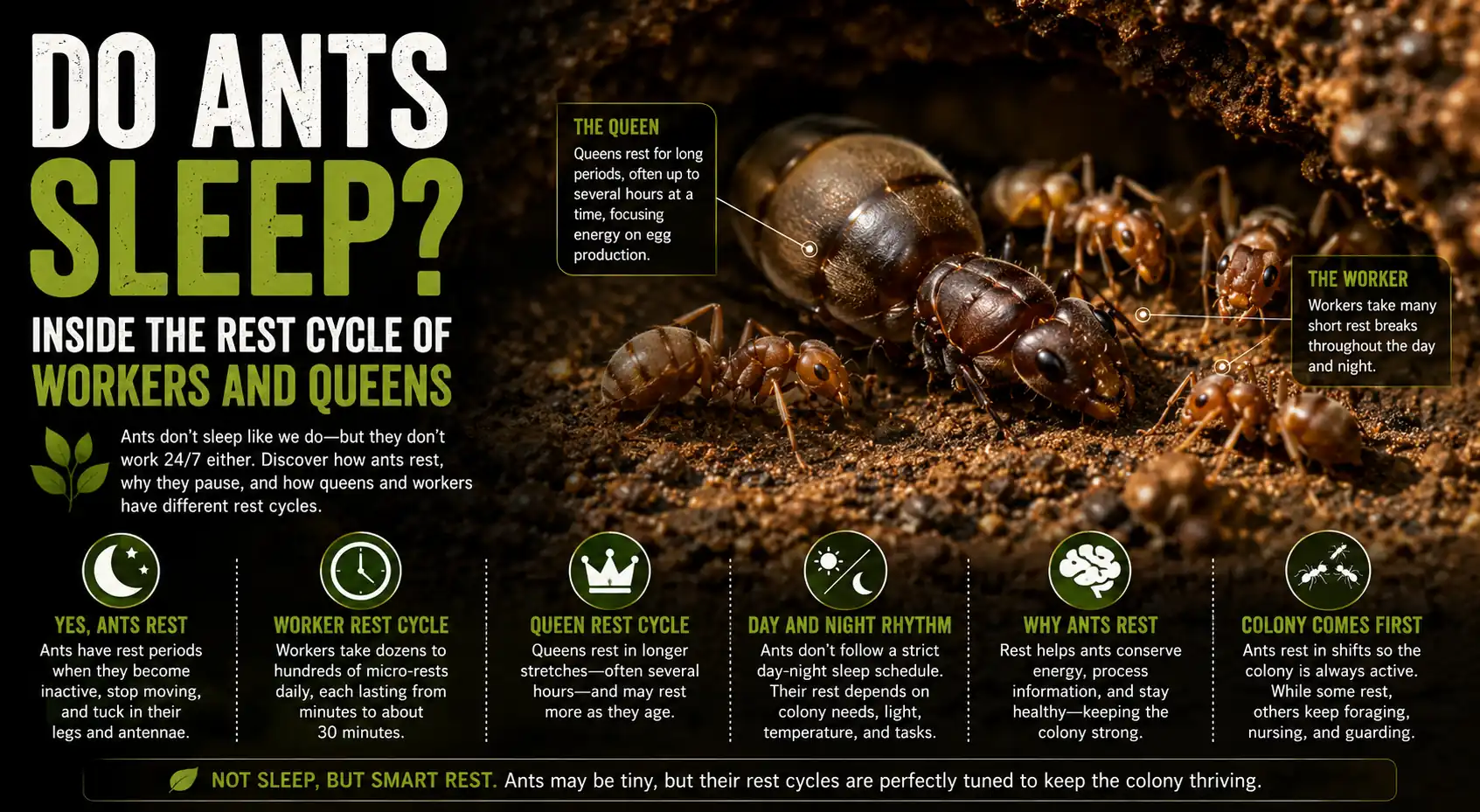
Do Ants Sleep? Inside the Rest Cycle of Workers and Queens
Last reviewed: June 2026. Claims in this guide are drawn from first-hand keeping and the peer-reviewed and university sources linked inline and listed below.
Do ants sleep? Yes, but nothing like we do. They have no eyelids and take no single nightly block of rest. Instead they nap in hundreds of short bursts around the clock. In the best-studied case, fire ant workers average about 250 one-minute naps a day, roughly 4.8 hours in total, while the queen sleeps far longer in deeper bouts. The colony itself never fully shuts down.
Watch a formicarium at 3am and it looks identical to noon: ants grooming, hauling food, tending brood. After six years of keeping colonies, that around-the-clock motion still catches visitors off guard, because they assume the ants must crash at night. They do rest. You just have to know what ant sleep looks like, because it breaks almost every rule we attach to the word.
Do ants really sleep, or just rest?
Scientists do not define sleep by closed eyes or a bed. They define it behaviorally, by four signs: a reversible drop into reduced activity, a raised threshold before something rouses you, a quick return to normal on waking, and a rebound of extra rest after you are kept from it. By that standard, insects genuinely sleep. As the entomologist Charlotte Helfrich-Förster lays out in her review Sleep in Insects, sleeping insects disconnect from the outside world, show changed brain activity, and bounce back with a rebound when deprived. So when we ask do ants sleep, the honest answer is yes, by every behavioral marker that counts.
How do scientists know an ant is asleep?
Proving that a creature with no eyelids sleeps takes patience. To study fire ants, Deby Cassill’s team recorded colonies with time-lapse video and scored the ants frame by frame, watching for the signature of sleep: sustained immobility paired with a particular posture, the antennae drooping or folded back against the body.
Stillness alone is not sleep, though, so they applied the same tests biologists use on any animal. A sleeping ant is harder to rouse than a merely resting one, needing a stronger nudge before it reacts, and it makes up for lost rest afterward. Put those together, immobility, a raised arousal threshold, quick reversibility, and rebound, and you have the fingerprints of true sleep. Ants show all four, which is why the science treats their naps as the real thing and not just idle pauses.

How ants sleep: hundreds of micro-naps
Ants are champions of polyphasic sleep, rest broken into many tiny episodes instead of one long stretch. The landmark measurement comes from a study of fire ants by Deby Cassill and colleagues, who filmed colonies around the clock.
Worker ants averaged about 253 naps per day, each lasting just over a minute, which added up to roughly 4.8 hours of sleep in 24 hours. The research also found their rest ignored the clock: activity was unaffected by light and dark, which fits an insect that lives underground in darkness year-round.
Because each worker naps on its own staggered schedule, the colony never goes offline. At any given moment, around 80 percent of the workforce is up and working: foraging, feeding larvae, excavating, and standing guard. The nest runs like a factory on three shifts that never close, and that constant readiness, not any single well-rested ant, is what keeps the colony safe.
To put those naps in perspective, humans are monophasic sleepers: we pile almost all our rest into one nightly block. An ant does the opposite, shattering the same kind of daily quota into hundreds of pieces so brief that no single nap would even look like sleep. Spread that thin, rest becomes nearly invisible, which is a big part of why people assume ants never sleep at all.
Where do ants sleep?
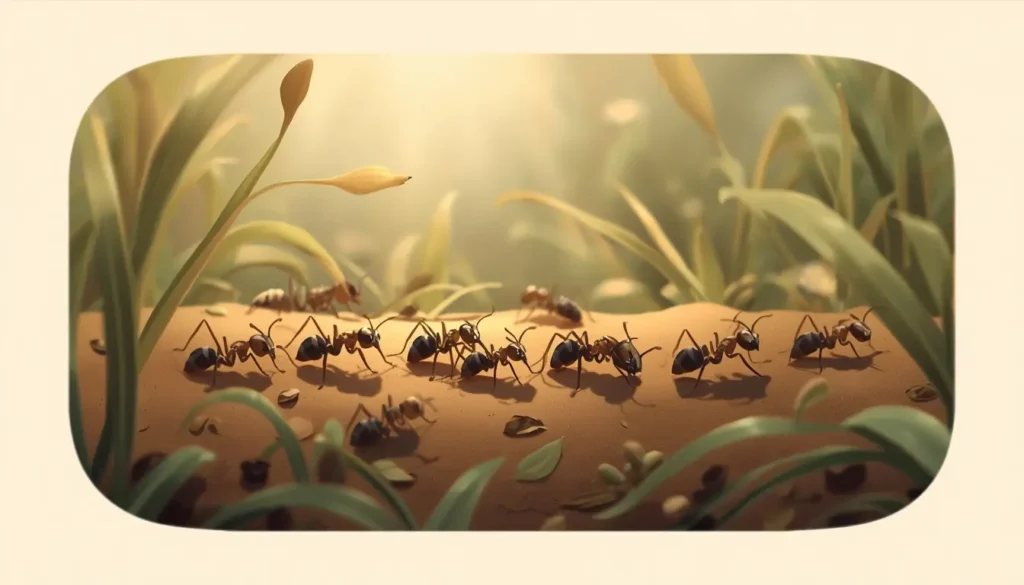
Sleeping ants do not just drop where they stand. In Cassill’s colonies, workers tended to rest in the quieter corners of the nest, tucked against a wall or up on the chamber ceiling, away from the busy floor where feeding and grooming never stop. Ants resting in those calmer spots slept in slightly longer, less interrupted bouts than those out in the traffic.
The queens went deeper still. They gathered in a cluster near the heart of the nest and rested together, shielded by workers and by distance from the entrance. Where an ant sleeps, in other words, mirrors its value to the colony: the disposable stay near the action, the irreplaceable retreat to the safest room in the house.
Workers vs queens: the sleep caste divide
Here is the part the other guides skip. Workers and queens sleep completely differently, and the gap is enormous.
| Caste | Naps per day | Length each | Total sleep per day |
|---|---|---|---|
| Worker | ~253 | ~1.1 minutes | ~4.8 hours |
| Queen | ~92 | ~6 minutes | ~9.4 hours |
Queens sleep almost twice as long as workers, and in far longer, deeper bouts. In Cassill’s colonies, queens even huddled together and drifted into synchronized sleep cycles, rising and resting in step with one another. Workers, by contrast, snatch fragmented one-minute naps wherever they happen to pause. The result is two completely different lives inside one nest: the queen banks long, restorative sleep in a protected chamber, while her daughters get by on scraps of it out on the floor.
Is the same true for every ant species?
Honest answer: most of this fine-grained detail comes from one well-filmed species, the fire ant. Sleep is genuinely hard to measure in an animal the size of a grain of rice, so few ants have been studied this closely. What we can say is that sleep itself is widespread across insects, and the caste pattern is not unique to fire ants.
In honey bees, another society built on division of labor, different worker castes also sleep differently: the youngest bees on indoor duties nap in short bouts scattered day and night, while older foragers consolidate more of their sleep into the night, closer to a daily rhythm. The safe takeaway for keepers: expect any ant to rest in short, scattered bouts, with the exact pattern shifting from species to species and even from job to job.
What happens when an ant loses sleep?
Sleep is not a luxury an insect can simply skip. Its main job seems to be maintaining the brain: research on insect sleep indicates that rest downscales the synaptic connections built up while an animal is awake, the housekeeping that keeps learning and memory intact. Take that rest away, and performance starts to fall apart.
The sharpest proof comes from honey bees. When researchers kept foragers awake, the sleep-deprived bees danced less accurately the next day, giving their nestmates sloppier directions to food in the waggle dance. Lost sleep literally degraded how a bee communicated with its colony, and other studies show sleep-deprived bees also hold onto memories worse. There is every reason to think an exhausted ant pays a similar price, which is exactly what makes the workers’ rationed rest a genuine cost rather than a harmless quirk.
Do ants dream? The clue is in their antennae
During deep sleep, both workers and queens fold their antennae flat and stop responding when nestmates touch them. But the queens showed something stranger: rapid antennal movement, which the team nicknamed RAM sleep. The twitching antennae during a queen’s deepest naps looked, to the researchers, a little like the rapid eye movement that marks dreaming sleep in mammals. They were careful not to overclaim, and so am I. Nobody can say an ant dreams. But the parallel is hard to ignore, and it is the closest thing to a dreaming insect anyone has yet put on film. Whatever the twitching means, it shows the queen’s deep sleep has a structure and intensity the workers’ scattered naps never reach.
Why so little sleep? The disposable-worker theory
If sleep matters that much, why do workers get so little of it? Cassill’s team offered a blunt explanation for the gap. Workers are a disposable caste: short-lived helpers whose job is to absorb risk and keep the queen safe and rested. The queen is the colony’s genetic future and can live for years, so she gets the deep, restorative sleep. Workers last only months, are run hard, and rest little. The researchers suspected their chronic sleep loss is part of why their lives are so short.
It is a stark trade-off, and it makes sense from the colony’s point of view. A worker is one of thousands and easily replaced, so the colony spends her freely, sleep included. The queen is irreplaceable, so she is protected and well rested. In an ant colony, sleep is a privilege of royalty.
Do other insects sleep too?
Ants are far from alone. Sleep, or a sleep-like state, turns up across the insect world, from cockroaches to bees to the humble fruit fly. In fact the fruit fly Drosophila has become the lab workhorse for sleep science, because its rest shows the same signatures as ours: it is governed by an internal clock, it deepens after deprivation, and it responds to the same stimulants, caffeine included, that keep people awake.
That shared biology is why studying a sleeping ant tells us something about sleep everywhere. Whatever ancient purpose it serves, sleep is old enough and important enough that a fly, a bee, an ant, and a human all still do some version of it. Losing the ability to sleep, so far as we know, is not an option evolution has handed to any of them.
So what are ants doing at night?
Plenty. Since ant rest is not pinned to darkness, a colony stays busy well after sundown, and many species actually prefer it. Desert and warm-climate ants often forage at night to dodge daytime heat and predators, which is why you spot trails on a warm evening. If you see ants marching at midnight, they are not sleepwalking or restless. They are simply on a schedule that never had a fixed bedtime to begin with. For a keeper, that is worth remembering the first time you find your colony wide awake at 1am: nothing is wrong, and nothing needs fixing.
What sleeping ants look like in a formicarium
For keepers, the question is usually the worried one: my ants are completely still, are they dead? Almost always, no. Here is what rest actually looks like in captivity.
- Stillness in clusters. Resting ants go motionless, often piled together or tucked against the nest wall with antennae folded down. It looks alarming the first time you see it.
- Activity at all hours. Your colony will forage at 2am and rest at noon. Ants do not run on our day-night schedule, so do not expect them to settle when you switch the lights off.
- No day-night lamp needed. Because their rest ignores light cycles, you do not have to simulate night. A stable, undisturbed setup matters far more than any light schedule.
- Do not poke a still colony to check it. Nudging resting ants just costs them the rest they are taking. Look for a slow antennal twitch or a worker repositioning instead.
One more distinction worth knowing: if your whole colony goes sluggish at once, that is usually temperature, not sleep. A cold room drops ants into a chilled torpor that lifts as soon as they warm back up, and a true seasonal cool-down is different again from both sleep and torpor.
What this looks like in practice: In my own colonies, the giveaway that a cluster is sleeping and not sick is the slow twitch of an antenna or a leg, and the way one or two workers always peel off to keep working while the rest go still. A genuinely dead ant curls up tight and dries out. A sleeping one is loose-limbed and springs back the instant the colony needs it.
Do pet ants need darkness or a day-night cycle?
Short answer: no. Because ant rest is not tied to light, you do not need to give a captive colony a day-night lamp or a strict lighting schedule. Most keepers keep the nest dark almost all the time, since ants dislike light on the nest and will work to cover a clear one. A red light lets you watch them without disturbing them, because ants see poorly at the red end of the spectrum and mostly behave as though it is still dark.
What does matter is quiet. Vibration, constant handling, and frequent nest checks rob a colony of the fragmented rest it depends on. Give it a stable temperature, steady humidity, and long stretches left alone, and the rest schedule takes care of itself. In captivity, the kindest thing you can do for a sleeping colony is leave it be.
The bottom line
So, do ants sleep? Yes, just on their own terms: in hundreds of micro-naps, with no eyelids, no real nighttime, and a queen who rests like royalty while her workers run on fumes. It is one of the strangest and most efficient rest systems in nature. The colony behaves like a machine that never powers down, kept running by thousands of ants taking turns to nap, and once you know the signs, you can watch the whole cycle play out in your own formicarium.
FAQ
Do ants sleep at night?
Not specifically. Ant rest is spread evenly around the clock and is not tied to day or night, so a colony is just as likely to nap at noon as at midnight. Underground species live in darkness anyway.
How long do ants sleep each day?
It depends on the caste. In fire ants, workers get about 4.8 hours total, taken as roughly 250 one-minute naps, while queens sleep about 9.4 hours in longer, deeper bouts.
Do worker ants sleep?
Yes, but very little and in tiny fragments. A fire ant worker takes around 250 naps a day of about a minute each, totaling under five hours, and never all at once, so most of the workforce is always awake.
Where do ants sleep in the nest?
Wherever it is calmest. Workers rest against the walls or up on the chamber ceiling, away from the busy floor, while queens gather deep inside the nest and sleep together in a protected cluster.
Do ants close their eyes when they sleep?
No. Ants have no eyelids. The clearest outward sign of a sleeping ant is folded, lowered antennae and a lack of response to nestmates, not closed eyes.
How do scientists know ants sleep?
By filming colonies and scoring each ant for sustained stillness and folded antennae, then confirming it is sleep and not just a pause, because the ant is harder to wake and rebounds with extra rest afterward.
Do ants dream?
We cannot say. Queens show rapid antennal movement during deep sleep that loosely resembles the rapid eye movement of dreaming mammals, but researchers treat this as an intriguing parallel, not proof.
Do ants get tired?
Almost certainly. Sleep loss impairs insect brains, and sleep-deprived honey bees communicate and remember worse. An ant kept from its naps very likely suffers the same drop in performance.
Do all insects sleep?
Effectively yes. A sleep-like state appears across insects, from cockroaches to bees to fruit flies. The fruit fly is now a leading model for sleep research because its rest works so much like ours.
Do ants sleep more in winter?
Temperate colonies slow down dramatically in winter, but that cold dormancy is a separate process from daily sleep. See do ants hibernate for how colonies handle the cold.