What Do Harvester Ants Eat? The Seed Specialists of the Ant World
Written from an ant keeper’s perspective, with peer-reviewed sources. Last updated: June 2026.
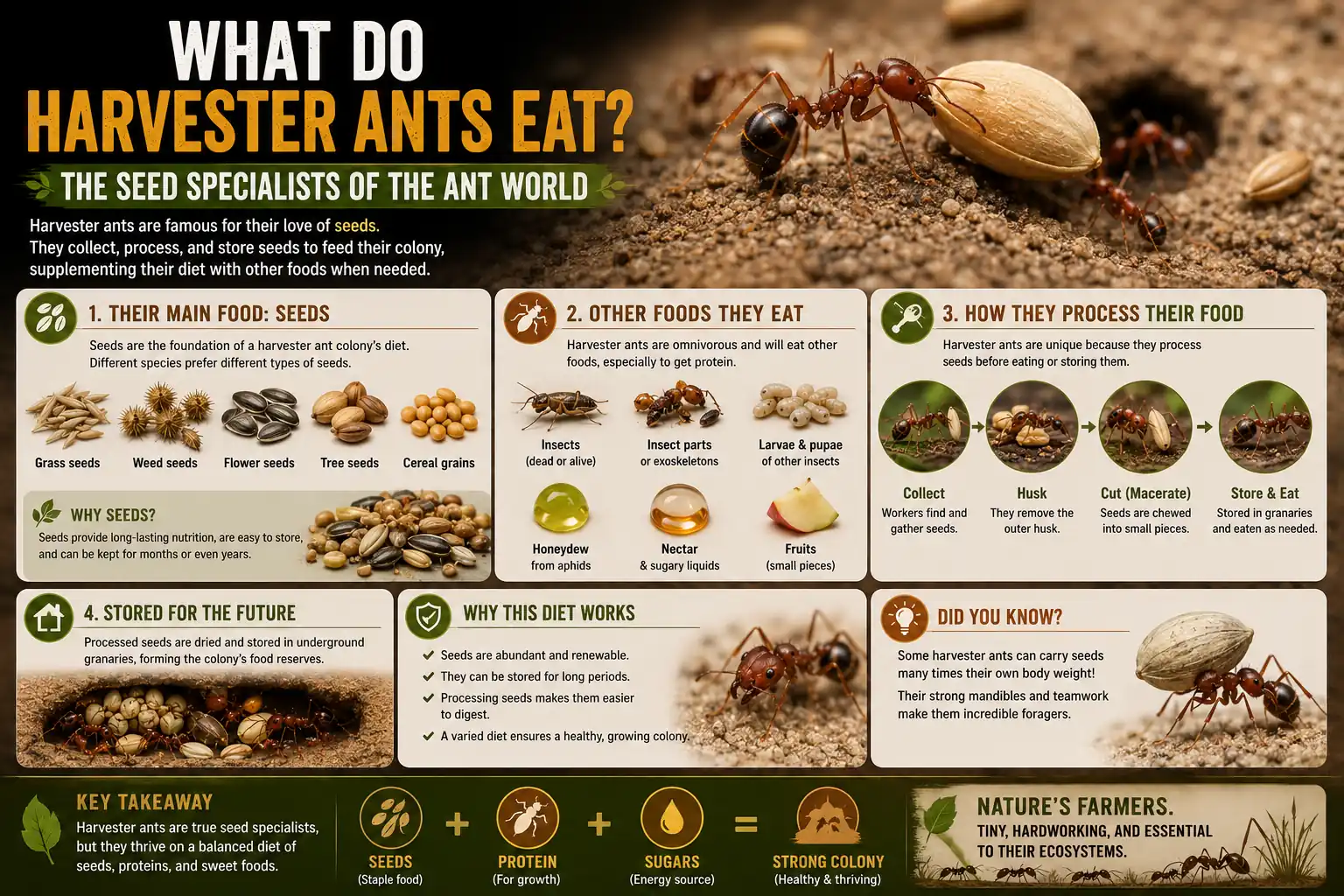
Most ants chase sugar and protein, but harvester ants do something different, and it is right there in their name. So what do harvester ants eat? The short answer is seeds. Harvester ants are granivores: they collect, store, mill, and eat seeds, hauling them home by the thousands to underground pantries called granaries. They grind those seeds into a paste, time their entire foraging system around how fast seeds come in, and even pull their drinking water out of the seeds they eat. It is one of the most farmer-like diets in the ant world, and it is exactly why harvester ants are one of the most popular ants to keep.
Quick answer: Harvester ants (mainly the genera Pogonomyrmex in North America and Messor in Europe and North Africa) are primarily seed-eaters. Workers gather seeds, store them in dry underground granaries, crack them open with powerful mandibles, and chew the starchy insides into a paste, sometimes called “ant bread,” that feeds the larvae and queen. They are not strictly vegetarian: they also collect insects and other protein, especially to feed growing brood, and they get much of their water directly from the seeds themselves.
The short answer: harvester ants are seed specialists
Across your other ant questions, the answer is usually some mix of sugar and insect protein, or in the case of leafcutters, fungus. Harvester ants are the outlier. They are the great granivores of dry grasslands and deserts, and seeds are the backbone of everything they do.
How specialized depends on the species. At one extreme, Veromessor pergandei of the American Southwest is almost entirely granivorous. The Pogonomyrmex harvester ants, the classic red and western harvesters of North America, sit across a range, from a heavy reliance on seeds to a partial dependence on insect protein and other foods. The Old World Messor harvesters of the Mediterranean are likewise seed-focused. Whatever the exact balance, if you see a steady column of ants carrying seeds rather than insect parts or droplets of liquid, you are almost certainly looking at harvester ants.
How harvester ants actually eat seeds
Here is where harvester ants get more interesting than any pest-control page will tell you. They do not just swallow seeds whole.
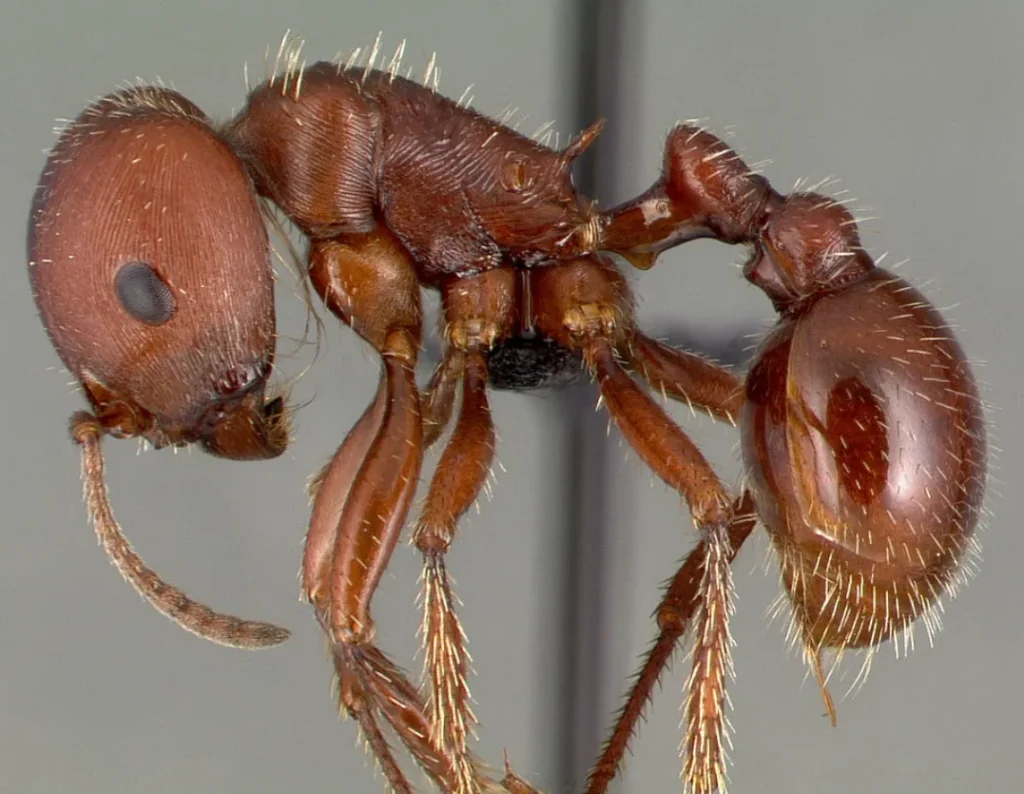
A seed is a tough, armored package. To get at the nutritious starchy center, workers crack and abrade the seed coat with their heavy mandibles, opening it through repeated grinding. This is hard work, and it literally wears them down: in Pogonomyrmex, you can age a worker by the wear on its mandibular teeth, because milling seeds slowly grinds them flat. The colony’s biggest, strongest-jawed major workers act as dedicated seed-crackers, speeding up how fast small and medium seeds get opened.
Once a seed is open, workers strip away the husk and chew the soft inside into a moist paste, mixing it with saliva. Keepers and biologists call this paste “ant bread,” and it is the form most of the colony actually eats. The larvae and the queen are fed this processed seed paste rather than whole seeds. In effect, harvester ants are millers and bakers: they turn raw grain into a kind of dough the colony can digest.
The granaries: underground seed banks
Harvester ants do not eat their harvest all at once. They store it, on a scale that genuinely earns the comparison to human agriculture.
Seeds are stockpiled in dedicated underground chambers called granaries. In the Florida harvester ant (Pogonomyrmex badius), these granaries sit roughly 40 to 100 centimeters below the surface, and a single colony can stockpile over half a kilogram of seeds, more than 300,000 of them at once. That is a strategic reserve, letting the colony survive long dry stretches when no new seeds are available.
A seed bank underground creates an obvious problem: seeds want to sprout. Harvester ants manage this constantly. They keep the granaries dry, shuffle and turn the seeds, and quickly remove any that begin to germinate. There is even a clever twist in the Florida harvester ant, which struggles to open its largest seeds: rather than waste them, the colony lets some of those big seeds start to germinate, because sprouting softens and splits them open, making the contents accessible. The ants turn a storage hazard into a tool.
Not only seeds: protein for the brood
Calling harvester ants seed specialists does not make them strict vegetarians. Seeds are the staple, but the colony also needs protein, especially to raise larvae, and harvester ants get it the way most ants do.
They collect insects, both live prey and scavenged dead ones, and some species also take other protein sources such as other plant material and even bird droppings. The balance between seeds and insect protein shifts with the season and with what the colony needs: when there are many hungry larvae, protein matters more, and the ratio of seed to insect food a colony assimilates can even differ between worker castes. So the honest, full answer to what harvester ants eat is: mostly seeds, processed into ant bread, supplemented with insect protein when the brood demands it.
The science competitors miss: the “Anternet”
This is the standout, and it connects the harvester ant’s diet to one of the most famous discoveries in modern ant science.
Because harvester ants forage for seeds scattered across the desert, and because a single ant can pick up a single seed on its own, they do not lay pheromone trails to food the way sugar-seeking ants do. Each forager heads out, searches until it finds a seed, and brings it straight home. That raises a question: how does the colony decide how many foragers to send out on any given morning?
The answer, worked out by Deborah Gordon and colleagues at Stanford, is a feedback system so elegant that computer scientists recognized it instantly. A forager will not leave the nest for its next trip until returning foragers come back with seeds. When seeds are plentiful, foragers return quickly, which triggers more ants to head out. When seeds are scarce, foragers take longer to return, returns slow down, and the colony throttles back its foraging. The regulation runs on the rate at which successful foragers come back, sensed through brief antennal contacts at the nest entrance.
Researchers found this so similar to the protocol that controls data flow on the internet (which also slows transmission when acknowledgements come back slowly) that they nicknamed it the “Anternet”. In other words, the harvester ant’s seed diet is managed by a distributed algorithm, with no ant in charge, that independently resembles how the internet manages congestion. No competitor on this topic comes anywhere near this.
Water from seeds: how desert ants drink without drinking
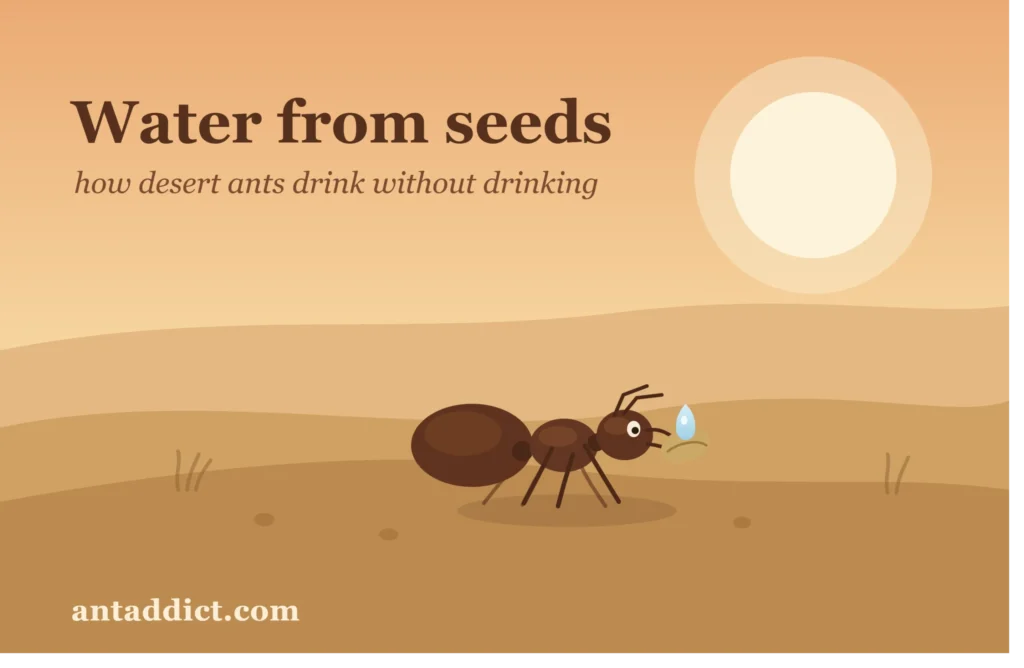
Harvester ants live in hot, dry places where standing water is scarce, so their diet does double duty as their water supply.
When harvester ants metabolize the fats and starches in the seeds they eat, the chemical reaction releases water inside their bodies. Red harvester ants gain much of their moisture this way, by oxidizing the fats in seeds. There is a catch, as the Stanford team found: a colony has to lose water in order to gain it. Foragers give up moisture to the dry air every minute they are outside searching, yet each seed they carry home is also a small packet of future water. This trade-off is part of why harvester ant foraging is so finely regulated. The colony is balancing a water budget, not just a food budget.
Why their diet matters: seed planters of the desert
The harvester ant’s appetite for seeds reshapes the landscape around it, which is why these ants are considered keystone species in many arid ecosystems.
By collecting enormous numbers of seeds, harvester ants influence which plants grow where. They strip vegetation in a clean disc around their mound entrances, a familiar sight in deserts and rangeland. They drop and discard seeds along trails and in their refuse middens, where some of those seeds sprout, so the ants effectively plant gardens of their own. Over time, a harvester ant colony can change the mix of plant species across its foraging range. Their diet is not just a way of feeding a colony, it is a force that shapes whole plant communities.
As an aside that has nothing to do with diet but everyone asks about: harvester ants sting, and the venom of the Maricopa harvester ant (Pogonomyrmex maricopa) is often cited as among the most toxic of all insect venoms, drop for drop. They are not aggressive, but a disturbed mound will defend itself, so wild colonies are best admired from a respectful distance.
What do pet harvester ants eat?
Here is the good news for keepers, and the reason harvester ants are a beloved beginner species: because they live on seeds, they are about the easiest ant in the hobby to feed.
A quick keeping note: Harvester ants are widely and legally kept. In Europe, Messor barbarus is arguably the most popular harvester ant in the hobby. In North America, native Pogonomyrmex species are kept, though founding queens can be hard to obtain and there are rules about shipping live queens across state lines. Do not import non-native harvester ants (such as European Messor) into countries where they are not established, since any non-native ant can become invasive. Beyond that, harvester ants are a forgiving, rewarding ant to keep.
The core principle is simple: give them seeds, a little protein, and water, and manage humidity carefully.
Seeds (the staple)
A varied seed mix is the foundation of the diet. Good options include:
- Poppy, chia, flax, and sesame seeds
- Millet, canary seed, and small bird-seed mixes
- Grass and dandelion seeds
Scatter the seeds in the outworld and let the ants harvest and store them, which is one of the great pleasures of keeping this species. A common keeper tip is to put dry seed mixes in the freezer for about 48 hours before offering them, to kill any grain mites or other pests.
Protein (for the brood)
When the colony has larvae, offer occasional protein:
- Small feeder insects such as fruit flies, small roach nymphs, or mealworms, freshly killed or pre-frozen
Many harvester colonies need less insect food than other ants because so much of their nutrition comes from seeds, but growing brood still benefits from it.
Water and humidity
This is the one area that needs care. Provide a constant water source (a water-filled test tube plugged with cotton works well), but keep it away from the seed store. Harvester ants need a humidity gradient: a moist area for the brood and queen, and a bone-dry area for the granary. If the seeds get damp, they sprout or mold, which can sicken or kill a colony.
A simple keeper feeding guide
| Colony stage | Staple | Protein | Notes |
|---|---|---|---|
| Founding queen | A few small seeds | None usually needed | Keep dry; minimal disturbance |
| Small colony with first workers | Small seed mix, refreshed as taken | Tiny feeder insect occasionally | Keep granary area dry |
| Growing colony with larvae | Steady seed supply | Feeder insects 1 to 2 times per week | Maintain moist-brood, dry-granary gradient |
| Large colony | Generous, varied seed mix | Protein as brood demands | Watch humidity; remove sprouted seeds |
For matching feeding plans to other species you keep, try our interactive ant food finder. For the wider picture, start with our pillar guide, What Do Ants Eat?, or compare very different feeders in What Do Carpenter Ants Eat? and What Do Leafcutter Ants Eat?
What do harvester ants eat? The short version
If you take one thing away, make it this: harvester ants are seed specialists. They forage for scattered seeds, store them by the thousands in dry underground granaries, crack them open with powerful mandibles, and chew the insides into a paste called ant bread that feeds the larvae and queen. They round out that diet with insect protein for the brood, and they pull much of their water straight out of the seeds they metabolize. Their whole foraging system is even tuned to the seed harvest, regulated by how fast foragers return, in the elegant feedback loop scientists named the Anternet.
For a keeper, that seed-based biology is a gift: scatter a varied seed mix, add a little protein when there is brood, keep a moist nest and a dry granary, and a harvester colony will thrive. Understand the harvest, and you understand the animal.
FAQ
What do harvester ants eat in the wild?
Mostly seeds. Harvester ants collect, store, and process seeds as their staple food, supplementing with insects and other protein, especially to feed larvae. They are among the most specialized seed-eating ants.
Do harvester ants only eat seeds?
No. Seeds are the staple, but harvester ants also collect insects (live and dead) and some other protein sources, particularly when the colony has growing larvae that need protein. The balance shifts with the season and the colony’s needs.
What is “ant bread”?
It is the paste harvester ants make by removing seed husks and chewing the starchy seed interior with saliva. This processed seed paste is fed to the larvae and the queen, and it is the form in which most of the colony consumes its seed harvest.
Why do harvester ants store seeds?
To survive lean periods. Harvester ants stockpile huge numbers of seeds in dry underground chambers called granaries, sometimes hundreds of thousands of seeds, so the colony has food during dry spells when little is available. They keep the store dry and remove any seeds that start to sprout.
How do harvester ants get water in the desert?
Largely from their food. When harvester ants metabolize the fats and starches in seeds, the reaction releases water inside their bodies, so the seeds are both food and a water source. Kept colonies should still always have a separate water source available.
Are harvester ants good for beginners to keep?
Yes. Because their diet is seed-based, harvester ants such as Messor barbarus are among the easiest and most popular ants to keep. You feed them a seed mix, occasional protein, and water, and manage humidity so the granary stays dry.
Do harvester ants eat grass or plants?
They eat the seeds of grasses and other plants rather than the leaves or stems. They are seed predators, not leaf-eaters, and they can clear vegetation around their mounds, but they do not consume foliage the way some insects do.
What do you feed pet harvester ants?
A varied seed mix (such as poppy, chia, flax, millet, and grass seeds) as the staple, occasional small feeder insects for protein when there is brood, and a constant water source kept away from the dry seed store. Freezing seed mixes before use helps prevent pests.