What Do House Ants Eat? The Sweet and Greasy Truth
Written from an ant keeper’s perspective, with peer-reviewed sources. Last updated: June 2026.
You spot a thin line of ants marching across the kitchen counter to a single sticky spot, and the question is immediate: what do house ants eat, and what brought them in? The short version is that house ants are opportunists drawn indoors by your food. They are after sweets, greasy and protein-rich foods, and water, and the exact preference depends on the species and even the time of year. Understanding what the ants in your home actually want is the single most useful thing you can know, because it tells you what is attracting them, why they suddenly appeared, and what will and will not get rid of them.
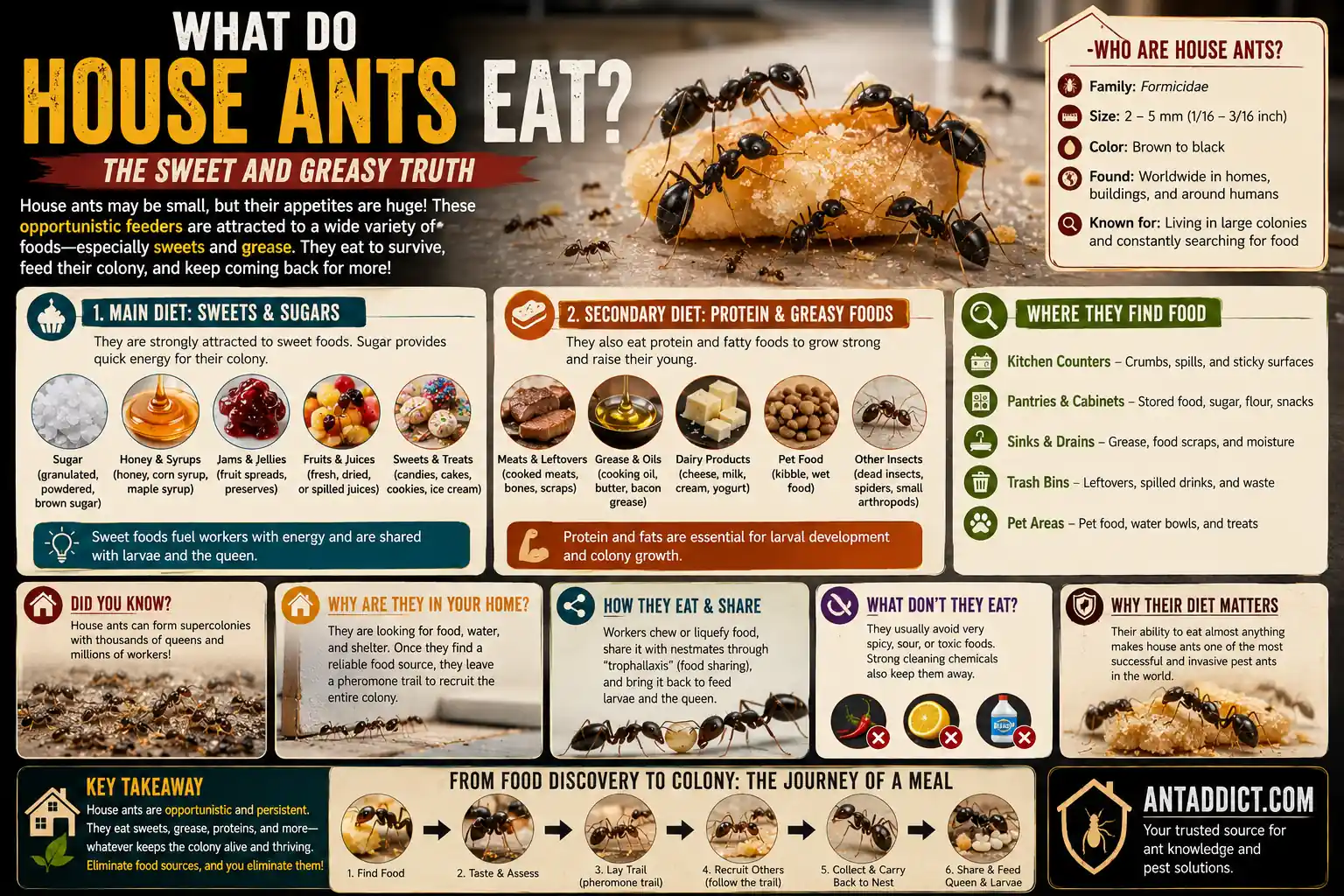
Quick answer: “House ants” are the handful of ant species that commonly come indoors, including odorous house ants, pavement ants, pharaoh ants, Argentine ants, carpenter ants, ghost ants, and acrobat ants. As a group they are omnivores that eat sweets and sugary liquids, greasy and protein-rich foods like meats and pet food, and dead or live insects, and they are strongly drawn to moisture. Most have a sweet tooth, but several readily switch to grease and protein, especially when the colony is raising young. They follow scent trails to whatever food they find, which is why you see them in a line.
This is a practical guide to the ants in your home. For the full biology of ant diets across all species, see our pillar guide, What Do Ants Eat?
The short answer: opportunists after sweets, grease, and water
Almost all the ants you find indoors actually nest outside, or in a wall void, and come into your living space for one reason: food and water. They are not trying to live in your kitchen, they are foraging in it. Remove what they are eating, and most of the reason for them to be there disappears.
As a group, house ants will take a remarkably wide range of foods. The big categories are sugars (sweets, syrups, fruit, honeydew), fats and proteins (greasy residues, meats, pet food, dead insects), and water or moisture. Like all ants, they use the protein mainly to feed their growing larvae and the carbohydrate to fuel the adult workers. That split, protein for the brood and sugar for the workers, is the key to understanding why their preferences shift, and it leads to the single most useful distinction for anyone with ants in the house.
Sweet ants or grease ants? The one distinction that matters
If you remember nothing else, remember this: house ants tend to be feeding on either sweets or grease and protein at any given moment, and knowing which one tells you almost everything practical.
Some house ants are sweet specialists most of the time. Odorous house ants and ghost ants, for example, are strongly drawn to sugary foods and honeydew. Others are confirmed generalists that happily take grease and protein, like pavement ants and pharaoh ants. And many sit in between, swinging from one to the other.
This matters for a simple reason. The bait or food that attracts a sweet-feeding ant will be ignored by an ant that is currently after protein, and the other way around. So the most useful thing you can do is watch what the ants in your home are actually carrying away. Are they swarming a drop of juice and the sugar bowl, or are they at the cat food, the bacon pan, and the grease spots by the stove? That observation, sweet versus greasy, is worth more than any species guess, because it tells you what they want right now.
Why a house ant’s diet keeps changing
Here is the part that frustrates people, and the science behind it. The same ants that mobbed your sugar last month may completely ignore it this month, because a colony’s nutritional needs change with its life cycle and the season.
Ants balance two key nutrients: protein, which their larvae use to grow, and carbohydrate, which the workers burn for energy. When a colony has lots of hungry larvae to raise, often in spring and early summer, it sends foragers out hunting for protein, so the ants go for meats, insects, and greasy foods. Once that brood has matured, the colony tilts back toward carbohydrate to fuel the adult workforce, and the same ants become sugar-seekers again. Research on seasonal foraging confirms that ant colonies actively shift the balance of protein and carbohydrate they collect depending on the time of year and the colony’s needs.
For you, this explains two things: why the ants in your kitchen seem to change their minds, and why an ant bait that worked beautifully in spring can suddenly stop working in summer. The ants did not leave, they changed what they were shopping for. If a sweet bait stops pulling them, try a protein or grease-based one, and vice versa.
When house ants are most likely to appear
House ants tend to show up at predictable times, and it ties straight back to food. In spring, as colonies wake up and begin raising brood, foragers fan out hunting protein, which is often when the first trails appear in kitchens.
Weather matters too. Heavy rain can flood outdoor nests and push ants indoors for shelter, while a hot, dry spell can send them inside searching for water. And any time you leave out something they want, a sugary spill or an open pet food bowl, you hand a scout a reason to come in and recruit the colony. A sudden invasion usually means one of three things changed: the season, the weather, or what is available to eat.
The common house ants and what each one eats
“House ant” is not a single species. It is a small cast of usual suspects, and each has its own diet quirks. Here is what the most common ones actually eat, with links to the full diet guide for each.
Odorous house ants
The odorous house ant (Tapinoma sessile) is the ant most people literally mean by “house ant,” and the one most often nicknamed the “sugar ant.” It strongly prefers sweets: sugary foods, fruit, and especially honeydew, which it farms from aphids outdoors. Indoors it goes for sugar, syrups, pastries, fruit juice, and pet food, and when nothing sweet is available it will take dead insects. You can identify it by the rotten-coconut or blue-cheese smell it gives off when crushed. It is a tramp ant that nests in wall voids and around pipes and spreads by budding, which matters a lot for control, as we will see.
Argentine ants
Argentine ants (Linepithema humile) are sugar-loving invaders that form enormous supercolonies. They eat a wide range of foods, including sweets, meats, pet food, and sugary drinks, and they are known for switching between hunting protein and feeding on honeydew depending on what their colony needs. Their huge, cooperative colonies make them persistent once established. For the full picture, see What Do Argentine Ants Eat?
Pavement ants
Pavement ants (Tetramorium species) are the small dark ants you see nesting in cracks in sidewalks, driveways, and slabs. They are true generalists with a “we will eat anything” attitude: sweets, grease, meats, dead insects, and whatever crumbs hit the floor. They do not usually nest indoors but will trail inside to forage. Their broad appetite means both sweet and protein baits tend to work on them.
Pharaoh ants
Pharaoh ants (Monomorium pharaonis) are tiny yellowish ants that feed on a wide range of foods rich in sugars, fats, and protein, and they are notable for how readily they take greasy and protein foods alongside sweets. They are a serious pest in hospitals and apartment buildings. Critically, pharaoh ant colonies fragment and spread when sprayed with repellent insecticides, so they must be controlled with bait, never spray. See What Do Pharaoh Ants Eat?
Carpenter ants
Carpenter ants (Camponotus species) are large ants that worry homeowners because they nest in wood, but here is the crucial correction: carpenter ants do not eat wood. They excavate it to make galleries, pushing out sawdust, but their actual food is honeydew and other sugars plus protein from insects, meats, and pet food. Finding them often signals damp or damaged wood. See What Do Carpenter Ants Eat?
Ghost ants
Ghost ants (Tapinoma melanocephalum) are tiny ants with a dark head and a pale, almost translucent body, common indoors in warm regions. They are close relatives of the odorous house ant and share its strong sweet tooth, feeding heavily on honeydew and sugary foods, with some protein from live and dead insects for the brood. See What Do Ghost Ants Eat?
Acrobat ants
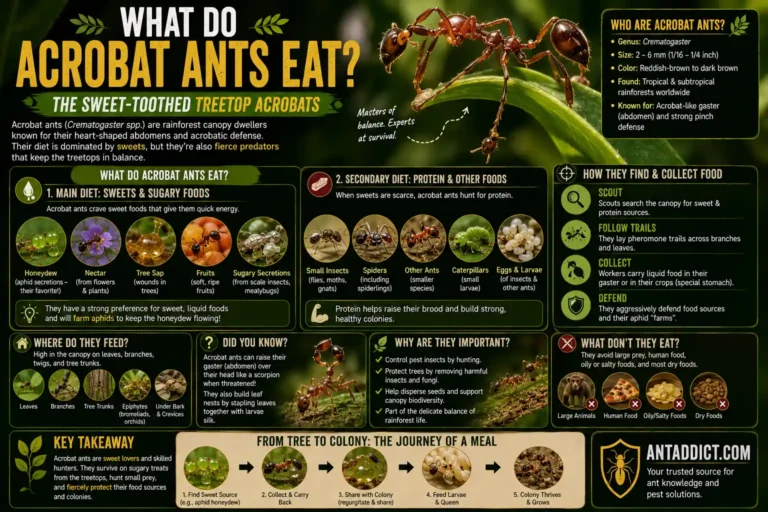
Acrobat ants (Crematogaster species) are recognizable by the heart-shaped abdomen they raise over their heads when disturbed. They are honeydew-loving omnivores that also take live and dead insects, and indoors they go for sweets and protein. Like carpenter ants, they nest in damp or already-damaged wood without eating it. See What Do Acrobat Ants Eat?
Other occasional visitors
You may also meet little black ants (small, dark generalists that take sweets, grease, and protein) and fire ants, which mostly stay outdoors but will come inside for food and water, eating sugars, fats, protein, and greasy foods. Fire ants are best handled with caution because of their sting.
How house ants find your food
Understanding how house ants locate food explains the single most recognizable thing they do: forming a line.
A few scout ants wander more or less randomly until one finds food. On the way back to the nest, it lays down a chemical scent trail, a line of pheromone. Other workers follow that trail to the food and reinforce it with their own scent on the return trip, so a good food source quickly builds a strong, well-marked highway that more and more ants pour along. That is the marching line on your counter: a scent road leading straight to whatever they found.
House ants are especially good at this indoors because they tend to run their trails along edges and structural lines, the base of a wall, the edge of a counter, a pipe or wire, which makes buildings easy for them to navigate. It also points to a simple, useful tactic: wiping down their trail with soapy water erases the scent road and disrupts the flow, at least until they re-establish it. It will not solve an infestation on its own, but it buys time and tells you where they are getting in.
Common house ant myths, corrected
A lot of bad information circulates about house ants, much of it from sources that never identify the species properly. Three corrections matter most.
“They are all sugar ants.” No. “Sugar ant” is a loose nickname, usually for odorous house ants, but plenty of house ants readily take grease and protein, and most switch between sweets and protein depending on the season. Treating every house ant as a pure sugar-feeder is exactly why people put out sweet bait that the ants ignore.
“Carpenter ants eat my house.” No. Carpenter ants tunnel through wood to nest, but they do not eat it. Their food is honeydew, sugars, and insect protein. The wood damage is from excavation, not feeding, and it usually means you have damp or decaying wood that should be addressed anyway.
“Just spray the trail and they are gone.” Often wrong, and sometimes it makes things worse. Several common house ants, including odorous house ants and pharaoh ants, respond to repellent sprays by budding, splitting the colony into multiple new nests. Spraying the visible ants can turn one problem into several. Slow-acting baits that workers carry back to the colony are usually far more effective.
What is attracting house ants to your home
Because everything house ants do indoors is about food and water, what attracts them is simply your available food and moisture. The usual magnets, all tied directly to their diet, are sugary spills and residues (juice, soda, honey, syrup, fruit), greasy and protein foods (cooking grease around the stove, meat scraps, pet food bowls), open or loosely sealed pantry items (cereal, crackers, sugar, pet kibble), garbage and recycling with food residue, and standing moisture (leaky pipes, sink edges, damp areas), since ants need water as much as food.
There is one outdoor magnet worth knowing about: honeydew. Many house ants farm aphids and scale insects on plants for their sugary honeydew, including on indoor potted plants. If you have ants on your houseplants, check the leaves for aphids, because the ants may be there for the honeydew, not your kitchen.
Using diet knowledge to deal with house ants
You do not need to be an exterminator to use all this. The diet-first approach is straightforward.
First, watch what they are taking, sweet or greasy, and where the trail leads. Second, remove the food and water that is drawing them: clean up spills, seal food, empty trash, fix leaks, and wipe their trails with soapy water.
Third, if you use bait, match it to what they are currently eating, a sweet bait for sugar-feeders and a protein or grease-based bait for the others, and switch if it stops working. Fourth, never reach for repellent spray on budding species like odorous house and pharaoh ants, as it scatters them; let workers carry slow-acting bait back to the colony instead. Identifying the species helps with all of this, which is why each one above links to a full guide.
A keeper’s note
A quick note from the ant-keeping side, since this is an ant-keeping site: a couple of these “house ants,” notably ghost ants and acrobat ants, are actually kept on purpose by hobbyists, who feed them sugar water and small insects in a sealed enclosure. That is a world apart from an uninvited kitchen colony. If you are curious which ants make good, responsibly kept pets and how to feed them, our interactive ant food finder is a good place to start. If you have an unwanted colony, though, the goal is the opposite: make your home a place that offers them nothing.
What do house ants eat? The short version
If you take one thing away, make it this: house ants come indoors for food and water, and as a group they eat sweets, greasy and protein-rich foods, and dead or live insects, with a strong but changeable sweet tooth. Which one they want depends on the species and the season, because colonies hunt protein to feed their larvae and seek sugar to fuel their workers.
Watch whether your ants are after sweets or grease, remove the food and moisture drawing them, wipe their scent trails, and if you bait, match the bait to what they are eating and never spray the budding species. Identify the species, from sweet-loving odorous house and ghost ants to grease-tolerant pharaoh and pavement ants, and you will know exactly what they want and how to make them leave.
FAQ
What do house ants eat?
House ants are omnivores that eat sweets and sugary liquids, greasy and protein-rich foods like meats and pet food, and dead or live insects, and they need water. Most have a strong sweet tooth but readily switch to grease and protein, especially when the colony is raising larvae.
Do house ants prefer sweets or grease?
It depends on the species and the season. Some, like odorous house ants and ghost ants, lean strongly sweet. Others, like pavement and pharaoh ants, readily take grease and protein. The same colony also shifts toward protein when raising young and toward sugar to fuel workers, so watch what your ants are actually taking.
Do house ants eat wood?
No. The ant people worry about, the carpenter ant, tunnels through wood to nest but does not eat it. Its food is honeydew, sugars, and insect protein. No common house ant eats wood; wood damage from carpenter ants is from excavation, and usually signals damp or decaying timber.
Why did a line of ants suddenly appear in my kitchen?
A scout ant found food and laid a scent trail back to the nest, and other workers are now following and reinforcing it. The marching line leads straight to whatever they found, often a sugary or greasy spill. Cleaning the food source and wiping the trail with soapy water disrupts it.
What attracts house ants indoors?
Food and water. Sugary spills and fruit, greasy residues and pet food, loosely sealed pantry items, food in the trash, and moisture from leaks or sinks all draw them. Aphids on indoor plants can also attract ants to the honeydew the aphids produce.
Do house ants bite or sting?
Most common house ants are harmless nuisances that do not meaningfully bite or sting people. Exceptions include fire ants, which have a painful sting, and acrobat ants, which can give a noticeable bite. If you are dealing with stinging ants, take more care.
How do I get rid of house ants using what they eat?
Watch whether they want sweets or grease, then remove that food and any water, seal food away, and wipe their trails. If you bait, match the bait to their current preference and switch if it stops working. Avoid repellent sprays on budding species like odorous house and pharaoh ants, which only scatter them.