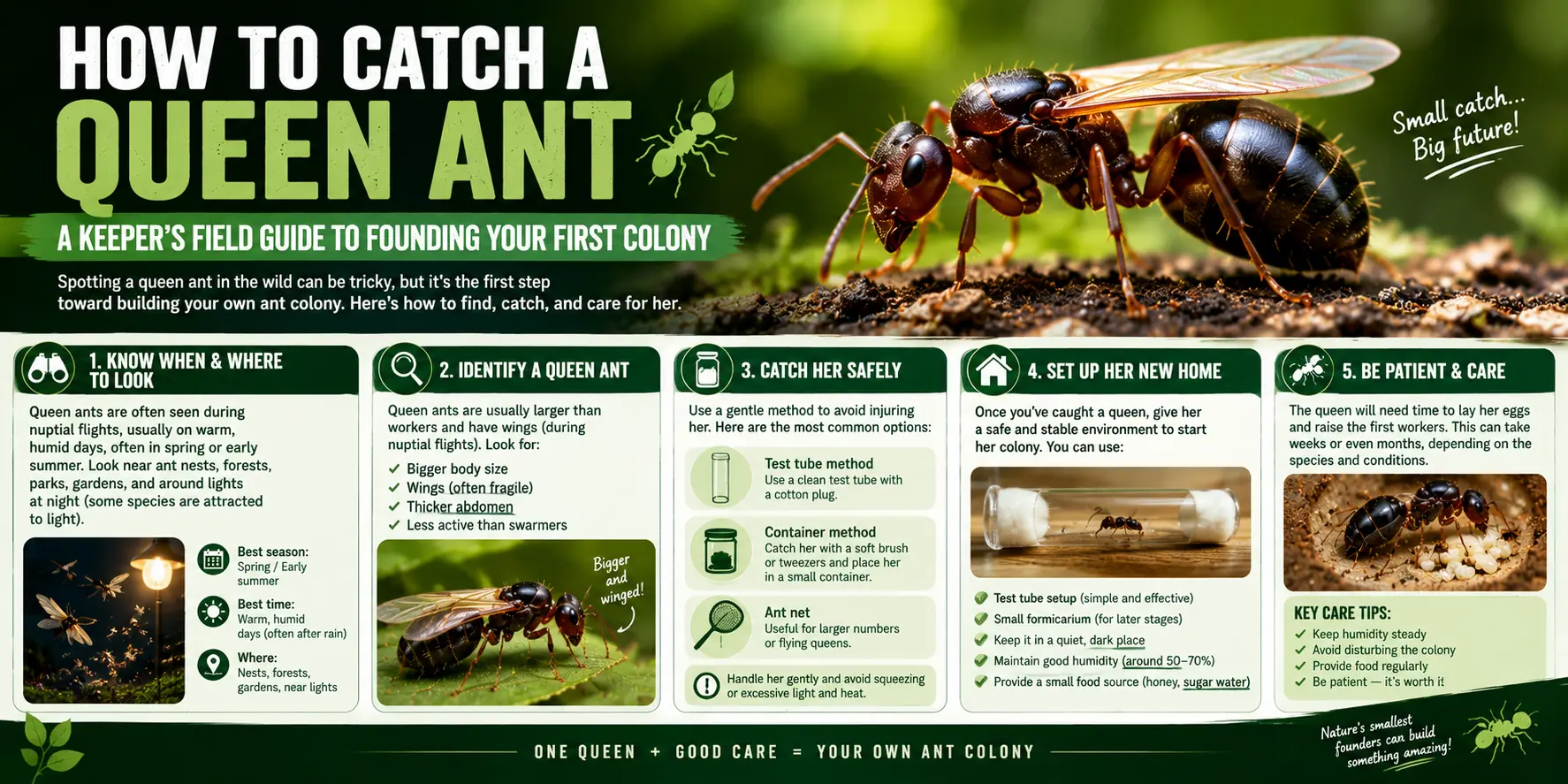
How to Catch a Queen Ant: A Keeper’s Field Guide to Founding Your First Colony
The complete, science-backed method for finding, catching, and keeping a queen that will actually start a colony, not one that dies in a test tube two weeks later.
Last reviewed: September 2026. This guide draws on both firsthand ant-keeping experience and published myrmecological research. Where a claim depends on species-specific biology, it has been checked against the primary literature cited below, and simplified rules of thumb are flagged as such.
Quick Answer: To catch a queen ant, go out during a nuptial flight (a warm, humid afternoon or evening, usually after rain in late spring or summer), and look for a large, wingless queen walking alone on pavement, patios, or walls. A queen that has already shed her wings has almost certainly mated, which is exactly what you want. Gently coax her into a clean test tube with a water reservoir, keep her dark and undisturbed, and do not feed her. Within a couple of weeks she will lay eggs, and her first workers emerge in roughly one to two months, raised entirely on her own body reserves. That is the whole game: catch a mated, dealate queen, then leave her alone.
I have been keeping ants for six years, and I still remember catching my first queen: a fat Lasius niger dealate crossing a sidewalk after a July thunderstorm. I did almost everything wrong afterward and she still founded a colony, because the single decision that matters was already made the moment I picked the right ant. Most guides bury that point under equipment lists. This guide covers how to catch a queen ant the right way, from reading a nuptial flight to setting up the test tube, plus the physiology that explains why some queens thrive and others never lay a single egg.
What Is a Queen Ant, and Why Does Catching One Start a Whole Colony?
A queen ant is the single reproductive female that founds and sustains a colony. Every worker you have ever seen is her sterile daughter. Catch one mated queen and you have, in effect, caught an entire future colony compressed into one insect.That is why ant keepers hunt queens and not workers. A jar of workers with no queen is a countdown timer: they cannot reproduce, so within weeks or months they age out and the group collapses. A single mated queen is the opposite. She carries a lifetime supply of stored sperm and enough body fuel to raise her first brood from scratch. Get her, and everything else is patience.
When Is the Best Time to Catch a Queen Ant?
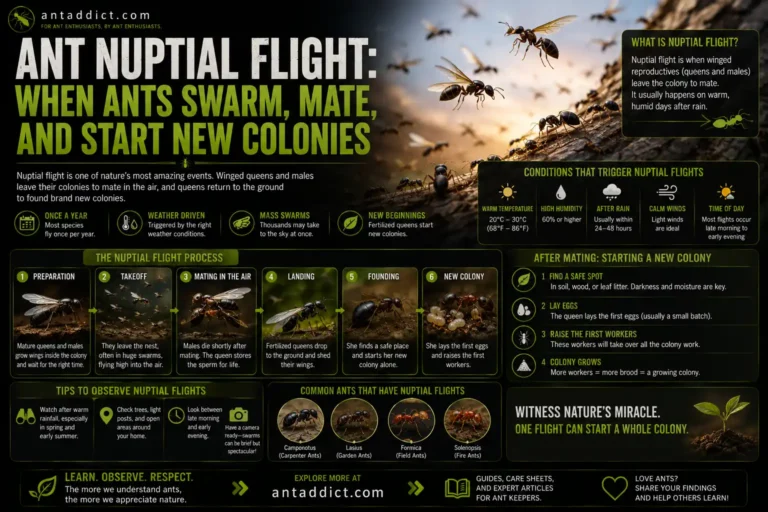
The best time is during a nuptial flight, the brief annual window when winged queens and males leave their colonies to mate. In most temperate regions this runs from late spring through late summer, with each species flying on its own narrow schedule, often triggered by a specific combination of temperature, humidity, and a recent rain.
You are not really hunting queens year-round. You are waiting for a few specific afternoons. Warm (usually above 75 F / 24 C), humid, still air a day or two after rainfall is the classic trigger. In many species flights peak in the hours after a summer storm breaks the heat.
Because timing is so species-specific, guessing wastes seasons. Use a species flight schedule for your region, or run conditions through our Nuptial Flight Predictor tool before you head out. Learning to read a nuptial flight is the single highest-leverage skill in this hobby.
Where Do You Actually Find Queen Ants?
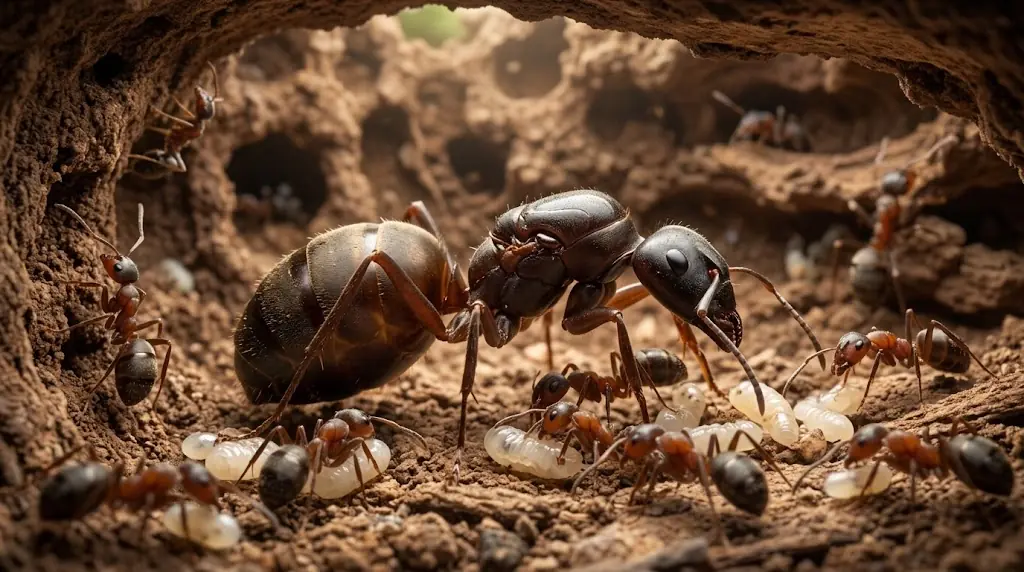
Look where a large, slow, low-flying insect would land and get stranded on a hard surface. In practice that means:
- Sidewalks, driveways, and patios, especially light-colored concrete where a dark queen stands out
- The bases of walls and buildings, where flying queens hit a vertical surface and drop
- Under and around outdoor lights and lit windows at night, which pull in night-flying species
- Swimming pools and their edges, which trap queens by the dozen after a flight
- Cars, curbs, and bright painted surfaces that queens mistake for open ground
The pattern is simple: queens fly, mate, land, then shed their wings and walk to find a nest site. You are intercepting them during that vulnerable walk. Open, hard, light surfaces near vegetation are your best odds.
How Do You Identify a Queen Ant (and Not Waste Your Time on a Worker or Male)?
A queen is built differently from her workers. Compared to a worker of the same species she is noticeably larger, with a bulky, boxy thorax (the mid-section that once anchored her flight muscles) and often a swollen abdomen. That heavy thorax is the tell, even after the wings are gone.
Do not confuse a queen with a male. Males are usually smaller, with tiny heads, large eyes, and a thin, wasp-like body, and they die within a day or two of mating. Males cannot found anything. If it looks delicate and gnat-like, skip it.
The most useful field signal is wings. A queen you find still winged may not have mated yet. A queen you find wingless, or actively shedding her wings, has almost certainly already mated, because in most species wing loss is triggered by mating itself. That single observation is worth more than any equipment.
Winged or Wingless: Which Queen Should You Catch?
Catch the wingless (dealate) queen every time you have the choice.
Wing-shedding, called dealation, is not random. In most ant species a queen holds onto her wings until she has mated, and the act of mating triggers the physiological cascade that makes her drop them and begin colony founding. So a dealate queen walking alone on the pavement is broadcasting that the hard part is done: she is mated and looking for a nest.
A still-winged queen is a gamble. She may be freshly emerged and unmated, in which case she will never produce workers, only unfertilized male eggs, if anything. If a winged queen is all you can find, you can still collect her and hope she mated before you arrived, but your odds are far lower. When in doubt, prioritize the wingless ones.
What Equipment Do You Need to Catch a Queen Ant?
Almost nothing. This is a hobby you can start for the price of a coffee:
- Test tubes (about 5 to 6 inches / 13 to 15 cm) for both catching and housing
- Cotton balls to make a water reservoir and a plug
- A small container or vial for grabbing queens quickly in the field
- Optional: soft featherweight forceps or a manual aspirator (pooter) for nervous or fast species
- Optional: red cellophane or a dark cloth to keep the queen calm
Skip the gloves-and-tweezers drama most shops sell you. For the common beginner species, a queen cannot sting and barely bites. Your hands and a test tube are enough. The forceps matter only for species that bite hard or move fast, and even then, a light touch beats a strong grip that crushes her.
How Do You Catch the Queen Without Hurting Her?
Work slowly and let her walk, do not pinch. The safest capture is to place the open mouth of a test tube or vial directly in her path and nudge her in from behind with a finger, a leaf, or a soft brush. Most queens walk straight into a dark tube because it reads as a burrow.
If she is skittish, cup her loosely with your hand or use a pooter to draw her in with gentle suction. Avoid grabbing the abdomen; it is soft and full of the fat reserves she needs to raise her brood. Once she is in the tube, plug the opening loosely with cotton so she gets air but cannot climb out.
If you find several queens of the same species on the same day, you can sometimes house two or three together to found faster (called pleometrosis), but many species turn on each other, so when in doubt, one queen per tube.
How Do You Set Up a Test Tube for a Newly Caught Queen?
The test tube setup is the foundation-stage home, and it is deliberately minimal:
- Fill roughly one-third of the tube with water.
- Pack a cotton ball down against the water so it stays put and the water cannot slosh onto the queen. The cotton wicks moisture, creating a humid chamber without drowning her.
- Drop the queen into the dry section.
- Plug the open end with a second, looser cotton ball for airflow.
- Wrap the tube in foil, red cellophane, or a cloth so it stays dark, and put it somewhere quiet at room temperature.
That is the entire habitat for the first several weeks. Humidity, darkness, and stillness are what she needs. Resist every urge to decorate, feed, or check on her.
Should You Feed a Newly Caught Queen Ant?
For most beginner species: no, do not feed her. This is where new keepers do the most damage.
The common beginner queens (like Lasius and Camponotus) are fully claustral, meaning they seal themselves away and raise their first workers entirely on internal body reserves, without eating anything. Offering food is not just unnecessary; it invites mold, fouls the tube, and stresses the queen into eating her own eggs.
The exception is semi-claustral species (many Pogonomyrmex harvester ants, some Myrmecia), which do forage during founding and need small amounts of food, such as a fruit fly or a drop of sugar water, offered carefully. If you do not know which type you caught, identify the species first. When you are ready to feed the growing colony, our guide on what queen ants eat breaks down the diet by founding type and colony stage.
How Long Until the First Workers Appear?
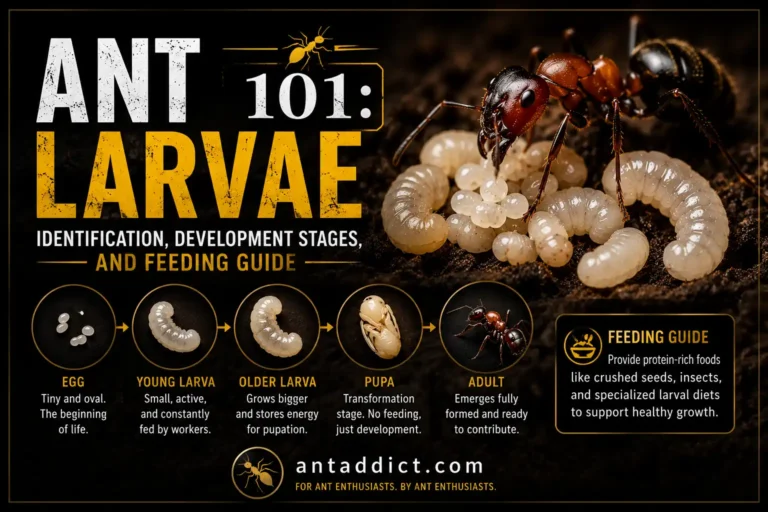
Plan on two to eight weeks from egg-laying to the first workers (called nanitics), and sometimes longer for slower species, depending on temperature. Warmer conditions speed it up; cooler ones slow it down.
The sequence is eggs, then larvae, then pupae, then the first small workers. Once those nanitics emerge and start tending the queen and foraging, the founding gamble is over and the colony is self-sustaining. From here you begin light feeding and, eventually, move them into a formicarium.
Do not panic during a long, quiet stretch. A queen sitting on a small egg pile for weeks with no visible change is completely normal. Opening the tube to “check” is how good foundings get ruined.
Beginner Queen Species: Which Are Easiest to Found?
Not all queens are beginner-friendly. Some found effortlessly on their own; others need specialized conditions or host colonies. Start with fully claustral, independent founders.
| Species (common name) | Founding type | Beginner difficulty | Notes |
|---|---|---|---|
| Lasius niger (black garden ant) | Fully claustral | Very easy | The classic first queen; hardy, forgiving, common |
| Camponotus spp. (carpenter ants) | Fully claustral | Easy | Large, slow-growing, very visible brood |
| Tetramorium spp. (pavement ant) | Fully claustral | Easy | Extremely common in urban areas |
| Pogonomyrmex spp. (harvester ant) | Semi-claustral | Moderate | Must be fed during founding; can sting |
| Solenopsis spp. (fire ants) | Fully claustral | Moderate | Fast growth but stings; often regulated |
| Formica spp. | Often social parasite | Hard | Many need a host colony to found; not for step one |
If this is your first catch, hunt for a Lasius niger or a Camponotus dealate and ignore everything else until you have founded one successfully.
Is It Legal and Ethical to Catch Wild Queen Ants?
In most places, collecting a few queens of common native species during a nuptial flight is legal and has negligible impact, because a single colony releases hundreds or thousands of queens and the vast majority die naturally within hours. You are harvesting from a surplus nature already discards.
That said, two rules matter. First, never move queens between regions or countries. Releasing or accidentally establishing a non-native species is how invasive ant problems start, and it can be seriously illegal. Second, check local restrictions, especially for regulated species like fire ants and for collection inside parks or protected land. Catch common local species, keep them contained, and never release a captive colony into the wild.
Here Is the Part Everyone Else Skips: Why a Dealate Queen Is Not Always a Mated Queen
Every competing guide tells you “wingless queen equals mated queen.” That is a good rule of thumb, and it is what I told you above, but the biology underneath it is more interesting, and knowing it will save you a wasted season.
In most ant species, mating triggers dealation through a hormonal and neural cascade, not the reverse. Recent work on fire ants found that compounds transferred by the male during mating actually switch on the female’s reproductive development, tying insemination directly to the shift from flying gyne to founding queen (Communications Biology, 2021). So a queen who has shed her wings has, in the overwhelming majority of cases, mated. But some queens dealate after handling, stress, or age without a successful insemination, which is why the occasional dealate lays only unfertilized eggs that hatch into males and no workers ever appear.
The deeper mechanism explains the no-feeding rule too. A fully claustral queen fuels her entire first brood by cannibalizing her own body. Her large flight muscles, no longer needed once she lands, are broken down (histolysis) and the released nutrients are repackaged, in Lasius queens forming a thoracic crop that is coordinated in time with the muscle breakdown to feed the developing larvae (Arthropod Structure & Development, 2022). Her stored fat does the rest. Experimental work confirms just how much this matters: when researchers fed Lasius niger founding queens, better-conditioned queens raised significantly larger first broods, meaning a queen’s body condition at capture directly caps her founding success (Szabó et al., Biological Journal of the Linnean Society, 2023). Classic work by Keller and Passera (Oecologia, 1989) showed decades ago that independently founding queens are specifically loaded with fat for exactly this purpose.
The practical payoff: pick the fattest, most robust dealate you can find, keep her warm and dark, and do not feed her. You are not starving her. You are letting a system that runs on her own flight muscles and fat do precisely what 100 million years of evolution built it to do. Feed her and you just add mold to a process that needed nothing from you.
A Keeper’s Honest Take
Here is what six years taught me that no equipment list will. The catch is 90 percent of the outcome and 10 percent of the effort, and new keepers invert that. They obsess over the perfect formicarium and the ideal feeding schedule, then catch a thin, still-winged queen at the wrong time of year and wonder why nothing happens.
Get the flight timing right, grab a heavy wingless queen, put her in a plain test tube, and then genuinely forget about her for a month. My best-founding colonies are always the ones I checked the least. The hardest skill in this hobby is doing nothing, on purpose, while trusting the biology. Master that and you will found colonies more reliably than keepers with ten times your gear.
The Bottom Line
Learning how to catch a queen ant comes down to one decision made well: intercept a mated, wingless queen during her nuptial flight, then get out of her way. Time your hunt to a warm, humid, post-rain window; search open hard surfaces; identify the queen by her bulky thorax; prioritize dealate individuals; house her in a dark, humid test tube; and do not feed a fully claustral founder. Two to eight weeks later, her first workers appear and you have a colony. Everything else in ant keeping is downstream of getting that first catch right.
FAQ
How do you catch a queen ant for beginners?
Go out during a nuptial flight on a warm, humid day after rain, find a large wingless queen walking on pavement, and coax her into a test tube with a cotton-plugged water reservoir. Keep her dark and undisturbed and do not feed her. Beginners should target Lasius niger or Camponotus queens.
How can you tell if a queen ant is mated?
The best field indicator is that she has shed her wings. In most species mating triggers wing loss, so a wingless (dealate) queen has very likely mated. Final confirmation comes weeks later: a mated queen produces worker daughters, while an unmated one lays only eggs that become males.
Do you need to feed a newly caught queen ant?
Usually not. Most beginner species are fully claustral and raise their first workers on stored body reserves without eating. Feeding invites mold and stress. Only semi-claustral species, like many harvester ants, need small feedings during founding.
How long can a queen ant survive in a test tube?
A properly set up test tube with a water reservoir can sustain a founding queen for months, easily long enough to raise her first brood. The main risks are the tube drying out, mold from added food, or the keeper disturbing her too often.
What time of year do queen ants come out?
Mostly late spring through late summer in temperate regions, with each species flying on its own schedule. Flights are typically triggered by warm, humid conditions a day or two after rainfall. A species flight schedule for your region is the reliable way to know.
Can you catch a queen ant without a nuptial flight?
Directly digging a queen out of an established wild nest is extremely difficult and usually destroys the colony without securing the queen. Catching newly flown queens during a nuptial flight is far easier and far more ethical. Some keepers also buy queens from reputable sellers.
Why did my caught queen never produce workers?
The most common reason is that she was not actually mated (she may have dealated from stress without insemination), so she can only lay male eggs. Other causes are excessive disturbance, a dried-out or moldy tube, or offering food to a claustral queen and triggering egg cannibalism.
How many queen ants should you catch?
Catch a few of the same species if you can, since founding failure is common and it improves your odds of one succeeding. House them individually unless you have confirmed the species tolerates multi-queen founding.
Can a queen ant sting or hurt you?
The common beginner species cannot sting and only give a mild, harmless pinch if they bite at all. Some species, like harvester and fire ants, can sting, so identify what you are catching before handling it bare-handed.
What is the difference between a queen ant and a male ant?
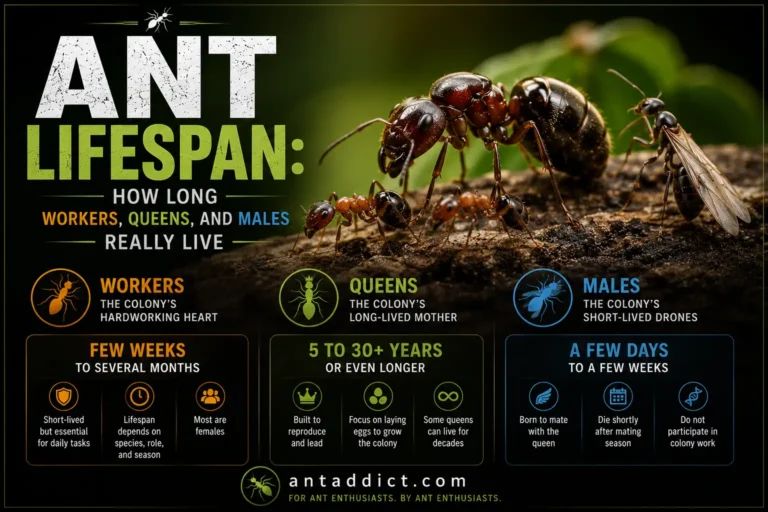
Queens are larger with a bulky thorax and a substantial abdomen, and they live for years. Males are small and wasp-like with tiny heads and large eyes, exist only to mate, and die within a day or two. Only mated queens found colonies.
Should I catch a queen with wings or without?
Without, whenever possible. A wingless queen has almost certainly mated. A winged queen may still be unmated and unable to produce workers.
Is it illegal to keep wild queen ants?
Keeping common native species is legal in most areas. The key rules are to never transport ants between regions (which risks introducing invasive species), to avoid regulated species like fire ants, and to never release a captive colony into the wild.