Types of Carpenter Ants: The Species, Colors, and Castes Explained
Last reviewed: June 2026. Species and identification details are drawn from government, university, and peer-reviewed sources linked inline and listed below. This article is educational and is not a substitute for professional pest control.
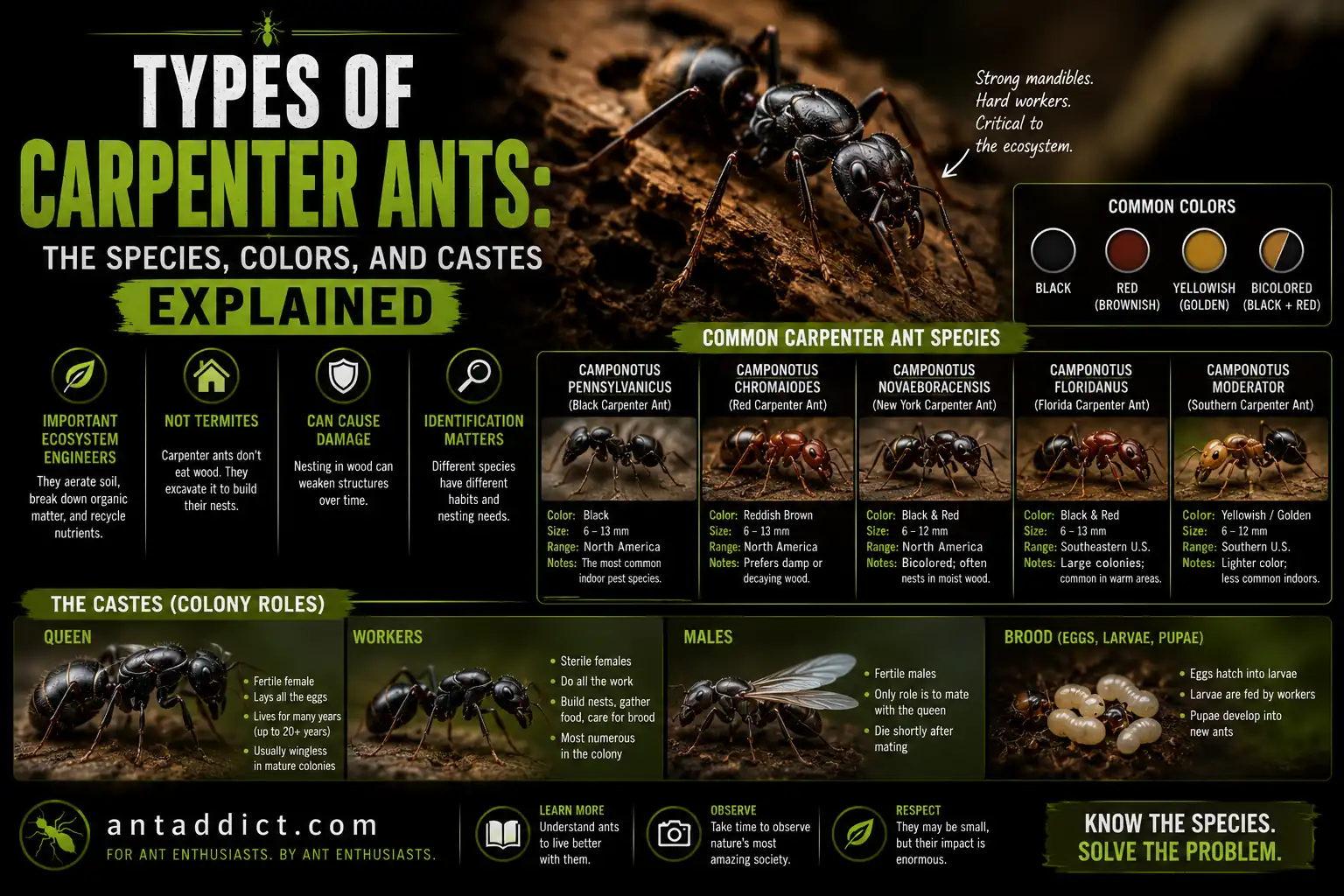
“Types of carpenter ants” means two different things, and this guide covers both. First, the species: carpenter ants belong to the genus Camponotus, the largest ant genus on Earth with over 1,000 species worldwide and roughly two dozen in the United States. The ones you are likely to meet are the black carpenter ant, the red carpenter ant, the Florida carpenter ant, and the western carpenter ant, and you tell them apart mostly by color and region. Second, the types within a single colony: every carpenter ant nest contains different-sized workers, called majors and minors, plus a queen and seasonal winged males and females. Those big and small ants are not different species; they are the same colony.
Most pages answer only half of this. They either list species or describe the castes, and the confusion between the two is exactly why people search the question in the first place. Someone sees a large black ant one day and a smaller one the next and wonders how many kinds they have.
I keep and study ants, so I will give you both halves clearly: the handful of species a US reader actually encounters, how to identify each, and why one colony contains several “types” of ant that share the same genes. This is an identification guide, so for damage and treatment I will point you to the right resources rather than pretend to be an exterminator.
What counts as a “type” of carpenter ant?
Before the list, it helps to separate the two meanings, because they lead to very different answers.
A type by species is a distinct kind of carpenter ant, a separate species in the genus Camponotus, such as the all-black eastern species or the bicolored Florida species. These differ in color, size range, region, and habits.
A type by caste is a different-looking ant within one colony: a large major worker versus a small minor worker, or a wingless worker versus a winged reproductive. These are all one species and one family, just built for different jobs.
Both are legitimate answers to “types of carpenter ants,” so this guide walks through the species first, then the castes.

The main types of carpenter ants (by species)
There are far too many Camponotus species to list, but only a few matter for a US homeowner or keeper. Here are the ones you are realistically going to see, with the quick identifiers.
| Type | Species | Color | Region |
|---|---|---|---|
| Black carpenter ant | Camponotus pennsylvanicus | Solid black, dull | Central and eastern US |
| Red carpenter ant | Camponotus chromaiodes | Reddish head and thorax, black abdomen | Southeast and Mid-Atlantic |
| Florida carpenter ant | Camponotus floridanus (and C. tortuganus) | Bicolored, orange-red and black | Florida and the Gulf Coast |
| Western black carpenter ant | Camponotus modoc | Black with dark reddish legs | Pacific Northwest and West |
| Bicolored western carpenter ant | Camponotus vicinus | Red-orange thorax, black abdomen | West and Pacific Northwest |
Workers of all of these run large, roughly 6 to 13 millimeters, which is part of what marks them as carpenter ants in the first place. A worker much bigger than half an inch is almost always a Camponotus of one species or another.
Black carpenter ant (Camponotus pennsylvanicus)
The classic. The black carpenter ant is the large, dull-black species most people picture, and the dominant carpenter ant across the central and eastern United States. It is also the one most associated with structural wood damage, since it readily excavates nests in the wood of homes.
If you live in New England, New York, the Midwest, or the Mid-Atlantic and you find a big solid-black ant indoors, this is almost certainly your species.
Red carpenter ant (Camponotus chromaiodes)
Often confused with the black carpenter ant because they overlap and look similar in shape and size, the red carpenter ant is distinguished by reddish or reddish-brown coloring on the head and thorax, with a black abdomen. It is the classic red-and-black carpenter ant of the Southeast and Mid-Atlantic, common from roughly Mississippi up to Virginia.
In much of the Southeast, a large ant with a reddish front half and dark rear is typically this species rather than the all-black one.
Florida carpenter ant (Camponotus floridanus and C. tortuganus)
Florida has its own bicolored complex. The Florida carpenter ants are a pair of common species, Camponotus floridanus and Camponotus tortuganus, both showing an orange-red head and thorax with a darker abdomen. They are among the largest ants in Florida and are highly visible as they forage, often at night.
There is an important behavioral difference here: unlike the black carpenter ant, Florida carpenter ants tend to seek out existing cavities and only excavate soft, rotten, or pithy wood, so they are generally less of a structural threat. They also do not sting, though they can deliver a bite and spray formic acid.
Western black carpenter ant (Camponotus modoc)
On the West Coast and through the Pacific Northwest, the black carpenter ant’s counterpart is Camponotus modoc, a large blackish species with dark reddish legs. It forms very large colonies, often nesting in rotting logs, stumps, and the dead wood of living trees, and it is a significant structural pest when it moves into homes.
Bicolored western carpenter ant (Camponotus vicinus)
Sharing much of the same western range is Camponotus vicinus, a red-and-black species with a red-orange thorax and black abdomen. In parts of the West and Pacific Northwest, you can find the solid-black modoc and the bicolored vicinus in the same yard, sometimes near the same structure.
Other and exotic types
Beyond these, the genus is vast and varied. Florida has picked up an exotic day-active species, Camponotus planatus. The tropics hold spectacular ones like the golden carpenter ant (Camponotus sericeiventris), and eastern Asia has the large Japanese carpenter ant (Camponotus japonicus). For a US identification, though, the five species above cover almost everything you will encounter.
How to tell which type of carpenter ant you have
You can usually narrow it down with two clues: color and region.
Start with color. A solid dull-black ant points to the black carpenter ant in the East or modoc in the West. A two-toned ant with a reddish or orange front and a dark rear points to the red carpenter ant in the Southeast, the Florida carpenter ants in Florida, or vicinus in the West.
Then use region to break the tie, since the color groups overlap. In the Northeast and Midwest, a big black ant is almost certainly C. pennsylvanicus. In the Southeast, a red-and-black one is typically C. chromaiodes. In Florida, it is the Florida carpenter ant complex. In the Pacific Northwest, expect modoc if black and vicinus if red-and-black.
Size will not separate the species, because they are all large, and it will not separate the castes either, which is the next and more common point of confusion.
Black vs red carpenter ants
Because this is the single most common “types” question, it deserves a direct answer. The practical difference between a black carpenter ant and a red carpenter ant is mostly color and geography, not behavior. Both excavate wood, both can nest in structures, both forage the same way, and both are controlled the same way. The red-and-black species simply dominate the Southeast and parts of the West, while the solid-black species dominate the Northeast, Midwest, and Pacific Northwest.
In other words, telling black from red is useful for satisfying curiosity and confirming you have carpenter ants, but it rarely changes what you should do about them.
Types within a single colony: majors, minors, and reproductives
Here is the other half of the question, and the source of a lot of the confusion. Within one carpenter ant colony you will find several distinct types of ant, all the same species.
Carpenter ants are polymorphic, meaning their workers come in a range of sizes. The largest are major workers, sometimes loosely called soldiers, with big heads and powerful jaws suited to defense and heavy work. The smallest are minor workers, which do most of the foraging and brood care. In many colonies there is a whole continuum of sizes in between.
On top of the workers, a colony contains a queen, larger still and the only one that lays eggs, and, at breeding time, winged males and females called swarmers or alates. Those winged carpenter ants are the reproductives that fly off to start new colonies, and they are the “flying carpenter ants” people often report in spring. All of these, from the tiniest minor to the queen, belong to one family in one nest.
So when someone finds a big ant and a small ant and assumes they are two types of carpenter ant, they are usually right that they are two types, but wrong that they are two species. They are looking at the castes of a single colony, decided not by different genes but by how each ant was raised as a larva.
What actually sets a major apart from a minor is the larval stage. The size and caste an ant grows into are shaped during development by nutrition and conditions in the nest, not by its genetics, which is how sisters carrying the same genes end up as a hulking soldier and a tiny forager in the same brood.
Here is the part everyone skips: same genes, different ant
This is where carpenter ants become genuinely remarkable, and where every other “types” page stops short. A major worker and a minor worker in the same colony carry essentially the same genome. The dramatic difference between them, in size, brain, and behavior, is not written in different DNA. It is largely epigenetic, a matter of which genes are switched on and off.
The Florida carpenter ant is a world-famous model organism for exactly this question. Researchers found that the behavioral differences between major and minor workers are regulated by chemical marks on the ants’ DNA-packaging proteins, the histones. Minors forage and scout; majors mostly guard and rarely forage.
Then they did something astonishing. By injecting a compound that alters those histone marks into the brains of young major workers, scientists reprogrammed the majors to forage like minors, and the change stuck. They had rewritten a caste’s behavior without touching a single gene.
That reframes the whole idea of “types” within a colony. The major and the minor are not two different kinds of ant in any fixed sense. They are the same instrument played in two different ways, which is the same deep principle that lets a queen and a worker share a genome yet live wildly different lives, explored in the guide to ant lifespan.
Which types of carpenter ants damage wood?
Since most people asking about types are worried about their home, here is the honest breakdown. All carpenter ants excavate wood to nest, and none of them eat it, but they do not all pose the same structural risk.
The serious structural offenders are the big black species, the black carpenter ant (C. pennsylvanicus) in the East and the western black carpenter ant (C. modoc) in the West, because they readily tunnel into sound structural wood and build large colonies. The red carpenter ant (C. chromaiodes) can also damage wood but often nests outdoors in logs and stumps.
The Florida carpenter ants are the gentlest on structures, since they prefer existing voids and only dig into soft, already-decaying wood. Whichever type you have, the tell-tale sign is the same: smooth galleries and coarse frass, covered in the guide to carpenter ant holes.
Do the different types matter for control?
For the most part, no, and this is worth saying plainly. Identifying the exact species of carpenter ant is satisfying and useful for confirmation, but it rarely changes the response. The approach is the same across the common types: find and fix the moisture drawing them in, locate the nest, which may be an outdoor parent colony with satellites indoors, and use a licensed pest professional for treatment.
Where identification really matters is the bigger fork: making sure you have carpenter ants at all, and not termites, which look different, eat the wood, and are handled differently. That distinction is covered in the guides to carpenter ant holes and whether carpenter ants eat termites.
The bottom line
There are two honest answers to “types of carpenter ants.” By species, a US reader meets a handful out of the thousand-plus in the genus Camponotus: the black carpenter ant in the East, the western black carpenter ant in the West, the red carpenter ant in the Southeast, and the bicolored Florida carpenter ants in the Gulf states, sorted mostly by color and region. By caste, every colony contains majors, minors, a queen, and seasonal winged swarmers, all one species.
The most fascinating part is that those in-colony types share a genome and are shaped by epigenetics, so completely that a major worker can be reprogrammed to behave like a minor. Whether you are identifying the ant on your windowsill or marveling at the biology, the key is knowing which kind of “type” you are actually asking about.
FAQ
What are the main types of carpenter ants?
By species, the common US types are the black carpenter ant (Camponotus pennsylvanicus), the red carpenter ant (C. chromaiodes), the Florida carpenter ants (C. floridanus and C. tortuganus), and the western black carpenter ant (C. modoc), plus the bicolored western C. vicinus.
How many species of carpenter ants are there?
Carpenter ants belong to the genus Camponotus, which has more than 1,000 species worldwide, making it the largest of all ant genera. Roughly two dozen species occur in the United States, but only a handful are commonly encountered.
What is the difference between black and red carpenter ants?
Mostly color and region. Black carpenter ants are solid dull-black and dominate the Northeast, Midwest, and Pacific Northwest. Red carpenter ants have a reddish head and thorax with a black abdomen and dominate the Southeast. Their behavior and control are essentially the same.
Are big and small carpenter ants different types?
Not different species. A carpenter ant colony is polymorphic, containing large major workers and small minor workers of the same species, along with a queen and winged reproductives. The size difference is caste, not species.
What are the winged carpenter ants I see in spring?
They are the reproductive swarmers, winged males and new queens, leaving the colony to mate and found new nests. Their appearance indoors often signals a mature carpenter ant colony nearby.
Which type of carpenter ant causes the most damage?
The large black species do the most structural damage: the black carpenter ant in the eastern US and the western black carpenter ant on the West Coast. Florida carpenter ants are the least damaging, since they favor existing voids and soft wood.
What is the biggest carpenter ant?
Queens are the largest members of any colony, and among workers the major caste is largest. Across species, carpenter ants are among the biggest ants in their regions, with major workers around half an inch long and queens larger still.
Do all carpenter ants eat wood?
No carpenter ant eats wood. Every type excavates wood only to nest, chewing out galleries and pushing out sawdust-like frass. They cannot digest cellulose, so wood is shelter, not food.
Are Florida carpenter ants dangerous?
They do not sting, but they can bite and spray formic acid, which may briefly sting the skin. Structurally they are milder than the black species, since they prefer existing cavities and soft wood rather than sound timber.
How do I identify which carpenter ant I have?
Use color and region together. Solid black points to C. pennsylvanicus in the East or C. modoc in the West; red-and-black points to C. chromaiodes in the Southeast, the Florida species in Florida, or C. vicinus in the West.
Are red and black carpenter ants controlled differently?
No. Despite the color difference, the common carpenter ant species share the same habits and are managed the same way: fix the moisture, locate the nest, and treat it, ideally with a licensed professional.
Can different types of carpenter ants live in the same area?
Yes. In parts of the West, the black C. modoc and the red-and-black C. vicinus occur together, sometimes near the same structure. Ranges of black and red species overlap in several regions.
How does a carpenter ant become a major or minor worker?
It is decided during the larval stage, not by genetics. Nutrition and developmental conditions in the nest determine whether a larva grows into a large major worker or a small minor worker, which is why sisters with the same genes end up very different sizes.
What does a carpenter ant queen look like?
The queen is the largest ant in the colony, noticeably bigger than even the major workers, and she sheds her wings after her mating flight. She is the only egg-layer, and the common species usually keep a single queen per colony.