Best Formicarium for Every Colony Stage (Keeper Guide)
How to choose the right nest type, the right size, and the right moisture setup for a colony that grows for years
Quick Answer: The best formicarium is the one that matches your colony’s current size and your species’ moisture needs. For most beginners, that means a small acrylic or 3D-printed nest with a built-in hydration area and an outworld, upgraded as the colony grows. Humidity-loving species often do better in Ytong or plaster, and diggers do well in sand. Keep a founding queen in a test tube until her colony has a few dozen workers, and avoid gel farms entirely.
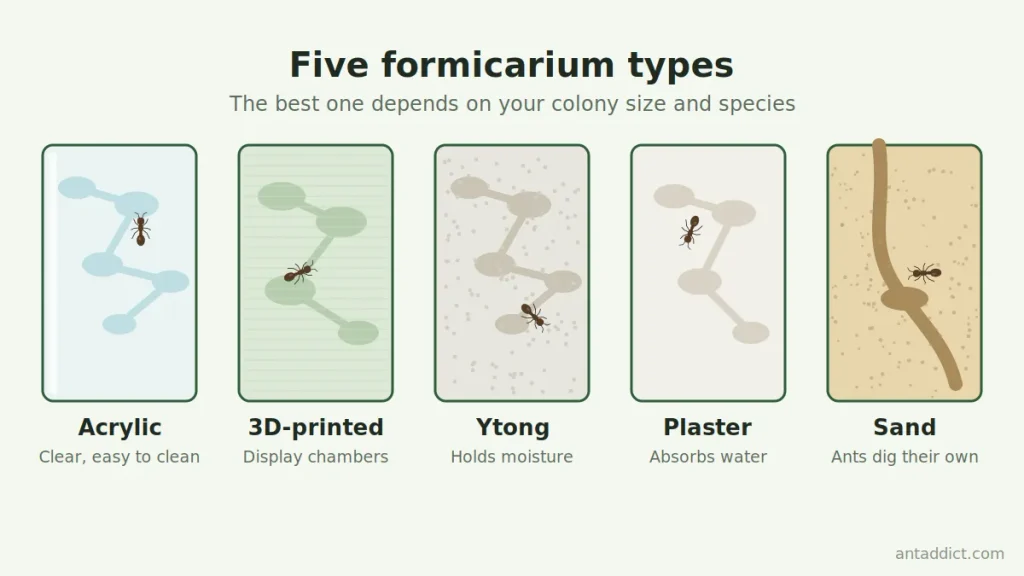
Best formicarium types compared: acrylic, 3D-printed, Ytong, plaster, and sand nests
I have kept ant colonies for six years, and for many new keepers, choosing the nest is harder than choosing the species. The honest answer is that there is no single best formicarium. There is a best formicarium for your colony, right now, and it changes as the colony grows.
This guide covers what a formicarium is, how each nest material compares, how big your nest should be at each colony stage, why oversized nests fail, which features actually matter, and my picks for every stage from founding queen to mature colony.
What is a formicarium?
A formicarium is an enclosure built to house a living ant colony, usually a nest area plus an “outworld,” the open foraging space where you place food and water. The word comes from Formica, Latin for ant. Modern formicaria are mostly acrylic or 3D-printed, and most are designed to house a queen (Wikipedia: Formicarium).
That last point is the key difference from a toy ant farm. A toy farm holds a tube of workers for a few months. A formicarium is built for a queen-right colony that can live for years. If you want the toy side of the market, see our guide to the best ant farm.
Do you need a formicarium for a new queen?
Not at first. A newly mated queen should start in a test tube with a water reservoir and a cotton plug, because a small, dark, humid space is what founding queens look for in the wild. Our ant test tube setup guide walks through it, and how to catch a queen ant covers finding one.
Move the colony into a formicarium once the tube starts to feel crowded or the water runs low. Many keepers make the move somewhere between 20 and 50 workers, depending on the species.
What are the main types of formicarium?
| Type | Visibility | Moisture control | Mold risk | Best for |
|---|---|---|---|---|
| Acrylic | Excellent | Built-in reservoir or sponge; needs monitoring | Low to medium | Beginners, most species, clean viewing |
| 3D-printed | Good to excellent | Usually a separate hydration chamber | Low to medium | Attractive display nests, small to medium colonies |
| Ytong (aerated concrete) | Good | Excellent; the block wicks water | Low | Humidity-loving species |
| Plaster or hydrostone | Good | Very good; absorbs and releases water | Medium | Medium colonies, natural look |
| Sand or soil | Varies | Depends on you | Medium | Watching ants dig |
| Gel | Excellent | Not adjustable | High | Not recommended |
Mold risk depends heavily on feeding habits and ventilation; ratings are typical keeper experience, not lab measurements.
Hobby suppliers such as Canada Ant Colony sell acrylic, 3D-printed, Ytong, and plaster nests side by side, which shows how established these designs are (Canada Ant Colony). Gel is the odd one out; our gel ant farm guide explains why.
Is an acrylic formicarium good for beginners?
Yes. Acrylic is one of the most common choices for a first real nest. You get clear viewing, easy cleaning, and usually a built-in water reservoir or sponge that keeps one area of the nest humid. The trade-off is that acrylic does not hold moisture itself, so you must keep the hydration area topped up and watch for condensation.
Many acrylic nests also include expansion ports for connecting tubes or extra modules. That matters more than it sounds, because it lets you add space as the colony grows instead of rehousing it.
When should you choose Ytong or plaster?
Choose Ytong or plaster when your species likes steady humidity, or when you live somewhere dry. Both materials soak up water and release it slowly, so the nest stays damp between refills.
The catch is durability. Ytong is soft, and some keepers report ants chewing into it over time. Plaster can grow mold if it stays wet with food debris. Keep food in the outworld, never in the nest.
Are sand formicariums worth it?
They are if you want to watch construction. In a sand nest, the ants build their own chambers, which no premade nest can show you. The trade-off is more work: you manage moisture and accept that some tunnels will be hidden. Our sand ant farm guide covers the right sand, the right moisture, and the right gap width.
How big should a formicarium be?
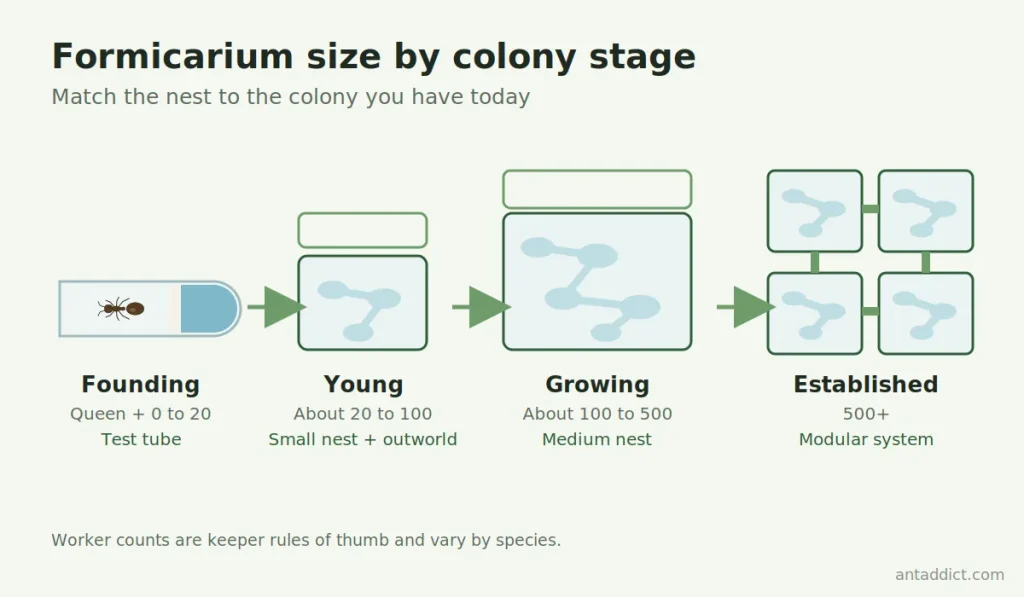
Small. Match the nest to the colony you have today, not the colony you hope to have next year. A nest that is far too big is one of the most common beginner mistakes.
| Colony stage | Workers | Recommended home |
|---|---|---|
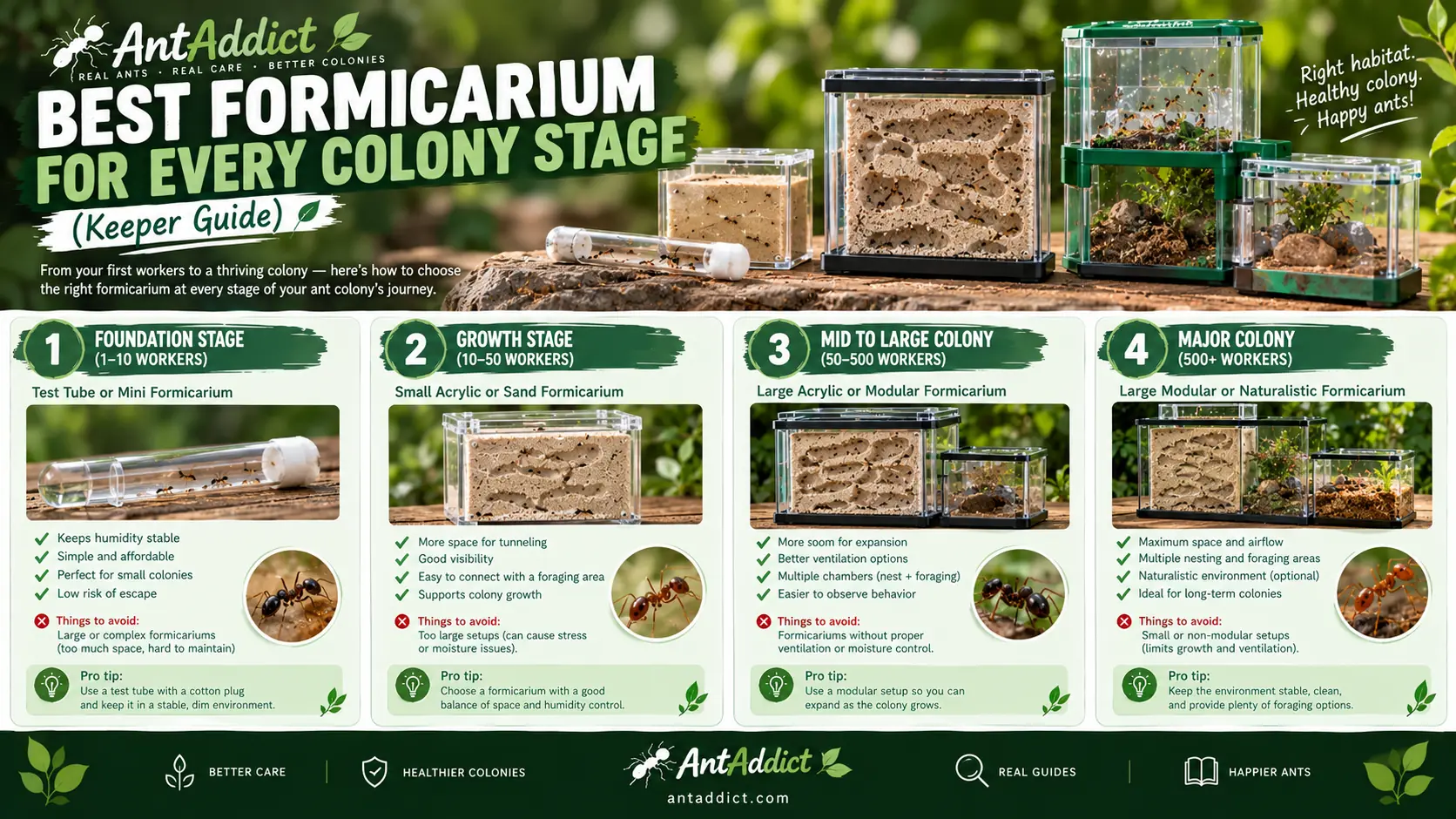
| Founding | Queen plus 0 to 20 | Test tube with water reservoir |
| Young | About 20 to 100 | Small nest (palm-sized) with a small outworld |
| Growing | About 100 to 500 | Medium nest, or small nest plus one expansion module |
| Established | 500+ | Modular system or large nest with a large outworld |
These ranges are keeper rules of thumb and vary by species; a colony of large carpenter ants needs more room per worker than a colony of small pavement ants.
Formicarium sizing by colony stage: test tube, small nest, medium nest, and modular system
Here is the part everyone else skips: ants size their own nests
Most buying guides say “don’t buy a nest that’s too big” without explaining why. The reason is that ants regulate the size of their own homes.
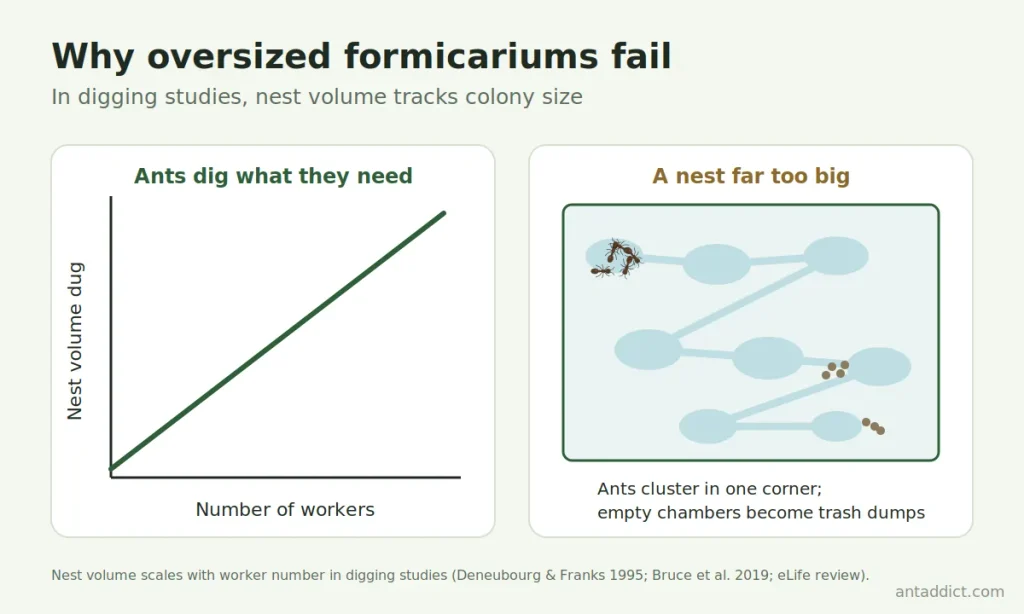
In digging experiments, a group of ants excavates rapidly at first, then slows down and stops once the nest is big enough. Across studies on several species, the final volume scales roughly in proportion to the number of workers, as summarized in a recent eLife study on Camponotus fellah (eLife reviewed preprint). The ants do not measure the nest directly. Digging simply becomes less likely as space grows and workers spread out (Deneubourg & Franks, 1995; Bruce et al., 2019).
Why oversized formicariums fail: nest volume tracks colony size, and ants in a nest far too big cluster in one corner
A premade nest removes that feedback loop. If the chambers are far bigger than the colony needs, the ants cannot shrink them, so they cluster in one corner and treat the rest as empty space. Keepers often see unused chambers turn into trash dumps, which is where mold starts.
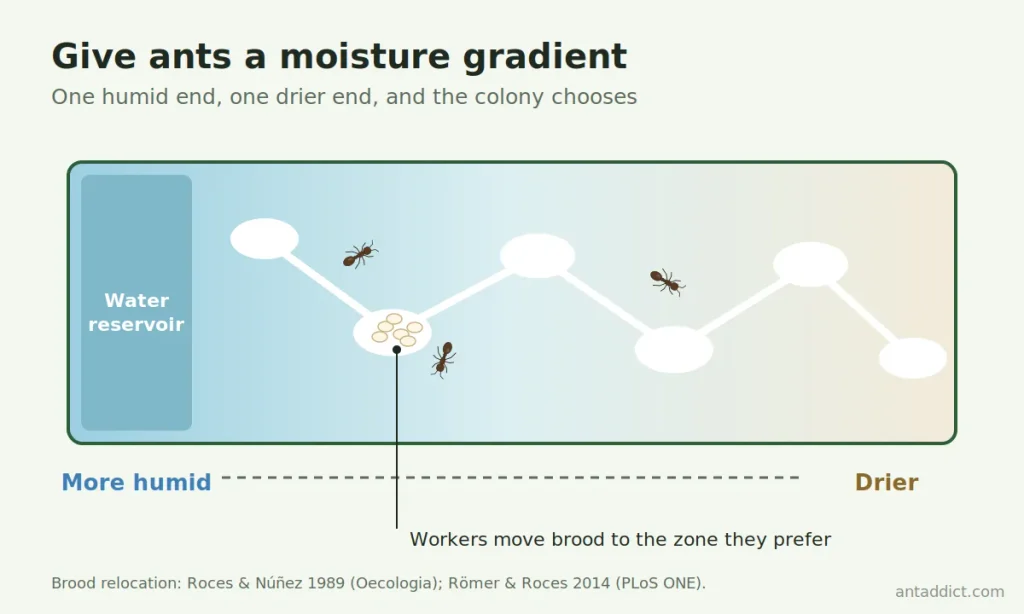
There is a second mechanism, and it is why a good formicarium needs a gradient of conditions rather than uniform humidity. Ants actively move their brood to the spot with the best temperature and moisture. Camponotus mus nurse workers shift brood along a temperature gradient on a daily rhythm (Roces & Núñez, 1989), and leaf-cutter ants relocate brood away from dry or cold spots (Römer & Roces, 2014).
Diagram of a formicarium moisture gradient: humid chambers near the water reservoir, drier chambers away from it, with brood moved to the preferred zone
Put those together and you get the two design rules that matter more than any brand: size the nest to the colony, and give the ants a choice of conditions. A nest with one humid end and one drier end lets workers place brood where it develops best. A nest that is uniformly wet, or uniformly dry, takes that choice away.
What features matter most in the best formicarium?
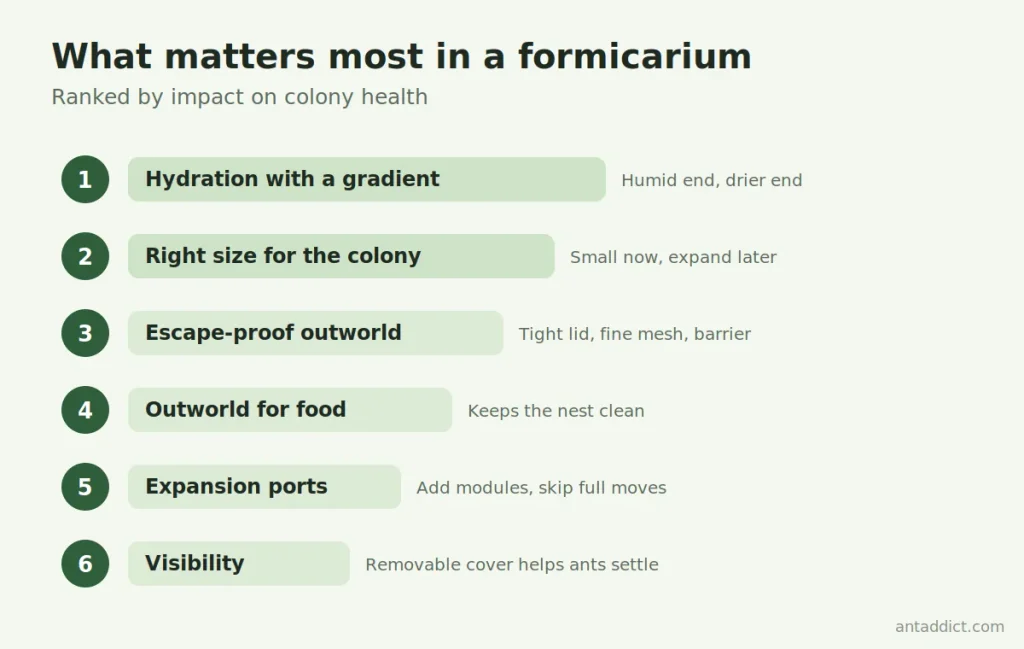
Formicarium features ranked by impact on colony health: hydration gradient, right size, escape-proof outworld, feeding outworld, expansion ports, visibility
Ranked by how much they affect colony health:
- Hydration system with a gradient. A reservoir, sponge, or wicking block at one end, so humidity falls off across the nest.
- Right size for the colony. See the sizing table above.
- Escape-proof outworld. A tight lid with fine mesh ventilation, and a barrier coating or lip on the rim.
- Separate outworld for food and waste. Keeps debris out of the nest.
- Expansion ports. Let you add modules instead of forcing a full move.
- Visibility. Nice to have, but most ants prefer a dark nest; a removable cover helps them settle.
When you compare options for the best formicarium, price, color, and decorative shapes come last. A plain acrylic box with a good hydration setup beats an expensive display nest that is twice as big as it needs to be.
How do you move ants into a new formicarium?
Do not pour them in. Connect the old home (a test tube or small nest) to the new formicarium’s outworld with a tube, make the old home slightly less attractive by letting it dry out or exposing it to light, and keep the new nest dark and humid. The colony usually moves itself, often within days to a couple of weeks. Patience prevents crushed brood and stressed queens.
How do you feed a colony in a formicarium?
Always in the outworld. A nest with food inside it is a mold farm waiting to happen. For a full breakdown, see what ants eat.
| Food | Amount | How often | Notes |
|---|---|---|---|
| Water | Feeder or test tube in outworld | Always available | Separate from the nest’s humidity reservoir |
| Sugar water or honey water | A few drops | 2 to 3 times a week | Carbohydrates for workers |
| Protein (fruit flies, crickets, mealworm pieces) | Roughly 1 insect per 10 to 20 workers | 2 to 3 times a week | Needed for larvae; feed more when brood is present |
| Seeds | A small pinch | Keep stocked | Only for seed-harvesting species such as Messor and Pogonomyrmex |
| Leftovers | Remove | Within 24 to 48 hours | Prevents mold and mites |
What is the best formicarium for my species?
Match the material to the species’ natural nesting habits:
| Species | Good nest types | Notes |
|---|---|---|
| Lasius (garden ants) | Acrylic, 3D-printed, Ytong, sand | Hardy; moderate humidity |
| Camponotus (carpenter ants) | Acrylic, 3D-printed, Ytong | Large workers need wider chambers; many keepers keep them on the drier side |
| Messor and Pogonomyrmex (harvester ants) | Sand, acrylic with a dry seed chamber | Keep seeds dry to prevent sprouting and mold |
| Tetramorium (pavement ants) | Acrylic, 3D-printed, Ytong | Small workers; check that gaps are escape-proof |
| Pheidole (big-headed ants) | Acrylic, Ytong | Tiny workers; fine mesh and tight fits are essential |
Keep species native to your region, and check local rules before collecting or buying live ants.
What is the best formicarium for each stage?
Here are my picks for the best formicarium at each stage, by type rather than brand, because the right design matters more than the logo.
Best for a founding queen: a test tube setup. Cheap, dark, humid, and exactly what she needs. Start here every time.
Best first formicarium: a small acrylic nest with a hydration area and an attached outworld. Clear, easy to clean, and sized for 20 to 100 workers. Hobby makers such as Buckeye Myrmecology build acrylic nests for this stage (Canada Ant Colony: Buckeye Myrmecology acrylic nests).
Best for humidity-loving species: a Ytong or plaster nest. The material holds water and releases it slowly, which smooths out humidity swings.
Best display nest: a 3D-printed nest. Natural-looking chambers, often with modular add-ons. Check that the hydration chamber is separate from the living area.
Best for watching digging: a sand nest with an outworld. The best setup for watching ants build their own home.
Best for big colonies: a modular system. Several connected nests let the colony expand into new space on its own schedule. If you are unsure which system fits, some sellers, such as ANTCUBE, offer an online formicarium finder that matches nests to species (ANTCUBE Formicarium Finder).
Affiliate note: the Amazon links below are affiliate links; Antaddict may earn a small commission at no cost to you.
- Acrylic starter formicarium (Amazon): a small first nest.
- Sand ant farm formicarium (Amazon): for digging species.
Which formicarium types should you avoid?
Avoid gel farms, oversized nests for small colonies, and any nest with no way to add water. Also be wary of very cheap “castle” sand kits marketed to kids. They can be fun for a short demo, but they rarely have proper hydration, fine mesh, or expansion ports for a long-term colony.
Is an expensive formicarium worth it?
Sometimes. Paying more makes sense for better hydration design, tighter escape-proofing, and modular expansion. It does not make sense for size. Buying a large, expensive nest for a young colony is one of the most common ways to waste money in this hobby, because the colony will not use it properly for a long time.
My honest keeper’s take: buy the smallest good nest your colony needs today, put your money into a solid outworld and a reliable hydration setup, and expand with modules as the colony grows.
The bottom line
The best formicarium is not a brand. It is the nest that fits your colony’s size and your species’ moisture needs. Start a founding queen in a test tube, move her colony into a small acrylic or 3D-printed nest with a hydration gradient and an outworld, choose Ytong or plaster for humidity-loving species, choose sand if you want to watch digging, and expand with modules as the colony grows. Ants size their own homes and move their brood to the best conditions, so a good formicarium simply gives them the right amount of space and a choice of humidity.
FAQ
What is the best formicarium for beginners?
A small acrylic or 3D-printed nest with a built-in hydration area and an attached outworld, sized for 20 to 100 workers.
What is the difference between a formicarium and an ant farm?
A formicarium is built for a queen-right colony that can live for years. Toy ant farms usually hold queenless workers for a few months.
What size formicarium do I need?
One that matches your current colony. Founding queens belong in a test tube, young colonies in a small nest, and large colonies in modular systems.
Can a formicarium be too big?
Yes. Ants regulate nest size to their population. In an oversized nest, they cluster in one corner and unused chambers often fill with trash and mold.
Is acrylic or Ytong better for ants?
Acrylic gives the clearest view and easy cleaning. Ytong holds moisture better and suits humidity-loving species. Many keepers use both.
Do formicariums need a humidity gradient?
It is strongly recommended. Ants move their brood to the conditions they prefer, so a nest with a humid end and a drier end lets them choose.
When should I move my queen into a formicarium?
When the test tube gets crowded or its water runs low, often between 20 and 50 workers depending on species.
How do I move ants into a new formicarium?
Connect the old home to the new outworld with a tube, let the old home dry out slightly, and keep the new nest dark and humid. The colony will usually move itself.
Where do you put food in a formicarium?
Always in the outworld, never in the nest. Remove leftovers within 24 to 48 hours.
Are gel formicariums good?
No. Gel habitats are not designed to support a growing colony and are prone to mold.
Is a sand formicarium good?
Yes, for digging species and for watching nest construction, as long as you manage moisture carefully.
How often should I water a formicarium?
Refill the hydration reservoir when it runs low, often every one to three weeks depending on nest design and room humidity.