Moisture Ants: How to Identify Them and Find the Leak They’re Telling You About
Those small yellow ants in your bathroom are not the real problem. They are the alarm.
Quick Answer: Moisture ants are small (1/8 to 3/16 inch, 3 to 5 mm), yellow to light-brown Lasius ants that nest in wood already softened by water and decay. They do not attack sound, dry wood, and they do not sting. If you find them indoors, you almost certainly have a hidden leak or chronic dampness. Fix the water, replace the rotted wood, and the colony loses its home. Spraying the ants without fixing the leak almost never works.
I have kept ant colonies for six years, and one of the most common questions non-keepers ask about ants is some version of “what are these little yellow ants coming out of my wall?” Often the answer is moisture ants, and the honest reply is that the ants are the least important part of the story.
This guide covers how to identify moisture ants, how to rule out carpenter ants and termites, which species actually count as “moisture ants,” why they need wet wood, how to trace the leak from where you saw them, and how to get rid of them for good. It also corrects several myths you will find on page one of Google.
What Are Moisture Ants?
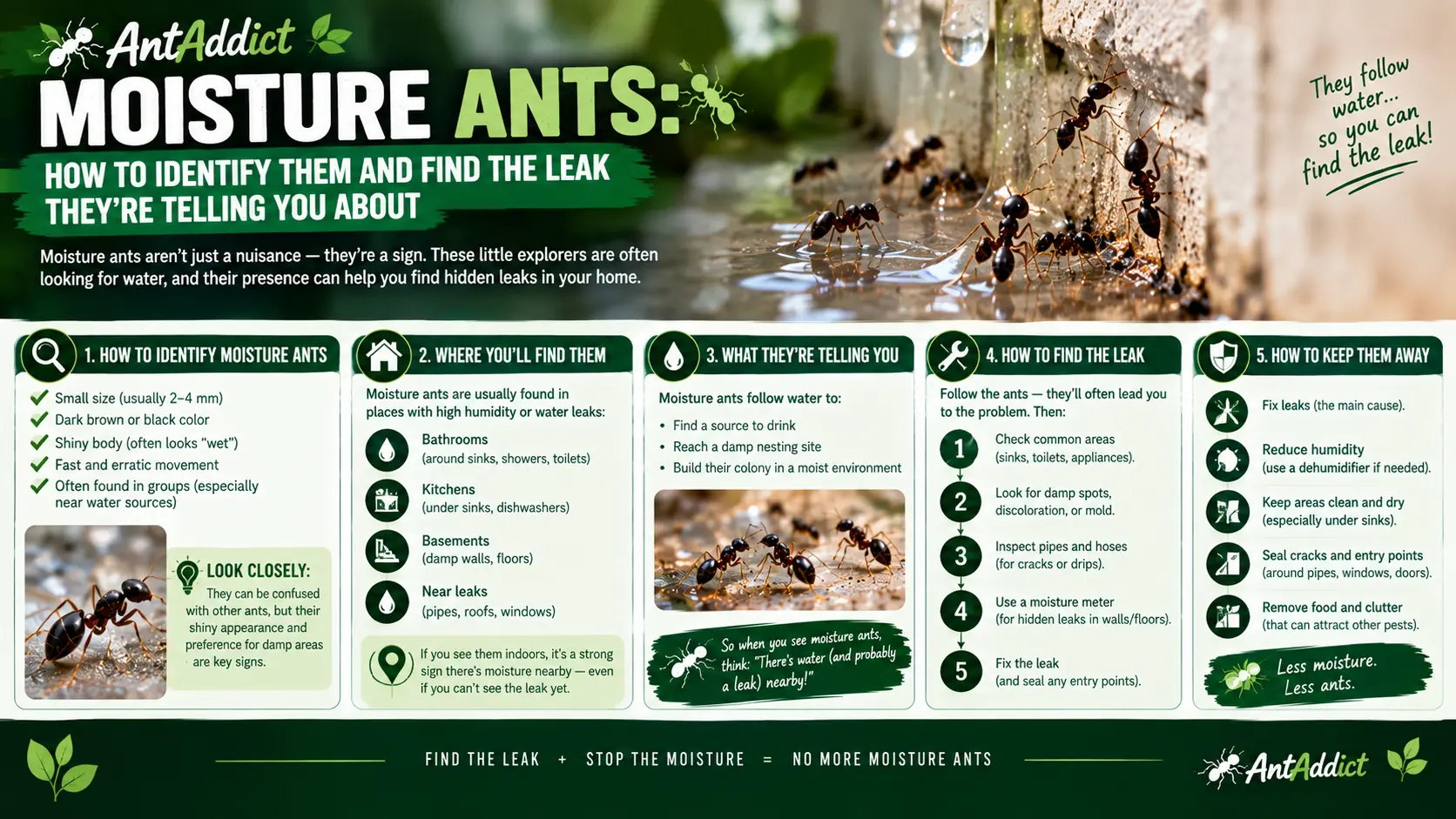
“Moisture ant” is not a single species. It is a homeowner’s name for several small ants in the genus Lasius that nest in damp, decaying wood or wet soil. Washington State University’s extension bulletin describes the label as a collective name for several wood-invading ant species that look superficially alike.
You may also hear them called “water ants,” a catch-all name we untangle in our guide to water ants in the house.
Two groups do almost all of the house-calling:
- Citronella ants (the old genus Acanthomyops, now part of Lasius): bright yellow, mostly underground, famous for a lemony smell.
- Cornfield-type Lasius: yellowish to dark brown, more likely to forage openly, and, according to WSU, the most common moisture ants in home structures in Washington.
| Group | Example species | Color | Lemon smell? | Forages above ground? |
|---|---|---|---|---|
| Citronella ants | Lasius interjectus, L. claviger, L. latipes | Bright yellow | Yes | Rarely |
| Cornfield-type Lasius | L. neoniger, L. americanus, L. pallitarsis | Yellow-brown to dark brown | Generally no | Yes |
Why does the split matter? Because the two groups behave differently, and the treatment advice that works for one can fail for the other. Most pest-control pages lump them together. That is where a lot of bad advice starts.
What Do Moisture Ants Look Like?
Workers are small. WSU describes cornfield-type pest species as 3 to 5 mm long, usually yellow but sometimes dark brown, with all workers the same size. Citronella ant workers are similar in size but more variable, about 0.10 to 0.15 inch, yellow, and noticeably hairy.
Look for these traits:
- One node (bump) on the waist between thorax and abdomen.
- Elbowed antennae, like every ant.
- Winged forms (alates) at swarming time, with smoky-tinted wings on citronella species.
If the ants you see are black and bigger than about 1/4 inch, you are probably looking at carpenter ants, not moisture ants.
Moisture Ants vs Carpenter Ants: The Thorax Test
Size is the quick filter. The thorax profile is the confirmation.
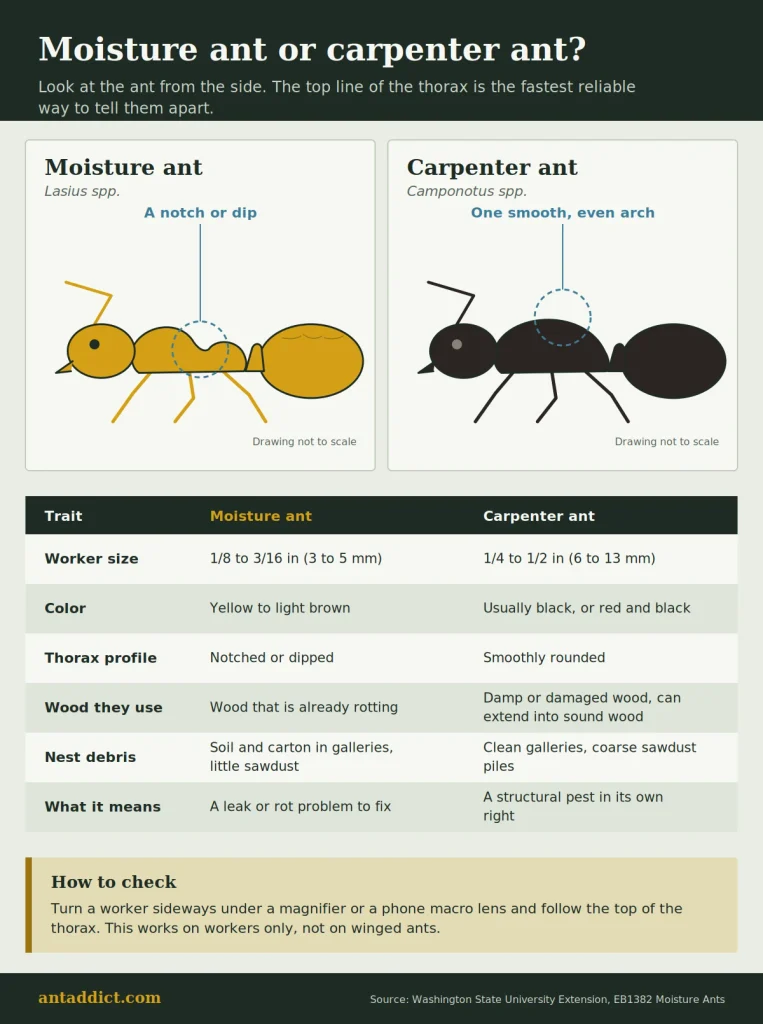
Turn a worker sideways under a magnifier or a phone macro lens and look at the top line of the thorax (the middle body section). WSU gives the cleanest rule I know: carpenter ants have an evenly rounded thoracic profile, while moisture ants show a notch or dip. The test works on workers only, not on winged reproductives.
| Trait | Moisture ants | Carpenter ants |
|---|---|---|
| Worker size | 1/8 to 3/16 in (3 to 5 mm) | 1/4 to 1/2 in (6 to 13 mm) |
| Color | Yellow to light brown | Usually black, or red and black |
| Thorax profile | Notched or dipped | Smoothly rounded |
| Wood they use | Already rotting | Damp or damaged, but can excavate sound wood |
| Debris | Galleries often packed with soil and carton, sometimes with a little sawdust | Clean, smooth galleries and piles of coarse “sawdust” frass |
The practical difference: carpenter ants can extend into sound lumber, so they are a structural pest in their own right. Moisture ants are a symptom. For the carpenter ant side of that comparison, see our guide to carpenter ants on your house.
Moisture Ants vs Termites (Including Dampwood Termites)
This is the comparison almost nobody makes, and it is the one that matters most in the Pacific Northwest.
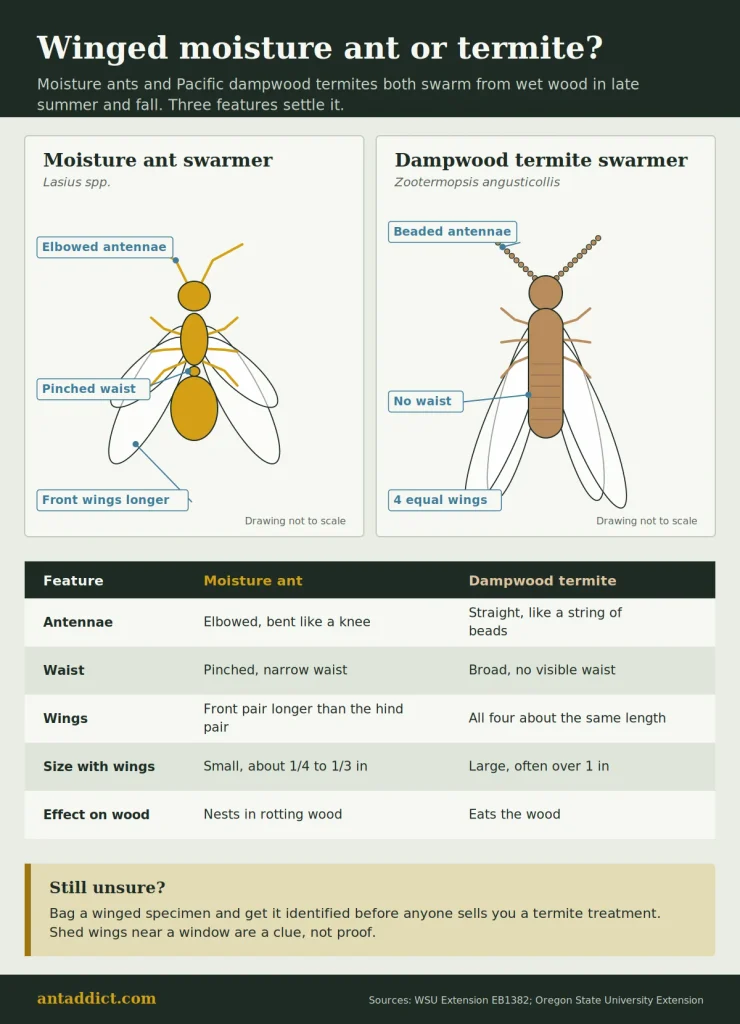
The Pacific dampwood termite (Zootermopsis angusticollis) lives in exactly the same habitat: wet, decaying wood. Its swarms leave the nest in late summer and fall, the same window in which moisture ants fly. So a homeowner finding winged insects next to rotten wood in September could be looking at either.
| Trait | Moisture ant swarmer | Dampwood termite swarmer |
|---|---|---|
| Antennae | Elbowed | Straight, beaded |
| Waist | Pinched | Broad, no waist |
| Wings | Front pair longer than hind pair | All four about equal length |
| Size | Small, roughly 1/4 to 1/3 in | Large, reproductives over 1 inch long |
| What it does to wood | Nests in it, packs galleries with debris | Eats it |
There is one more trap. WSU warns not to confuse moisture ant galleries with the more linear, tube-like tunnels of subterranean termites. And moisture ants can build earthy tubes of their own (more on that below). If you are unsure, bag a specimen and get it identified before anyone sells you a termite treatment.
Do Moisture Ants Smell Like Lemons?
Some do. Many don’t.
The lemon or citronella smell belongs to the citronella ant group. When disturbed, these ants release an alarm-defense secretion from glands in the head, and the odor comes from terpenoid compounds such as citronellal. The classic chemistry work is Regnier and Wilson’s 1968 study of Acanthomyops claviger.
Two corrections to what you will read elsewhere:
- It is not formic acid. Formicine ants do produce formic acid, but formic acid smells sharp and vinegary, not like lemons.
- No lemon smell does not rule out moisture ants. The common cornfield-type Lasius generally lack the citronella odor, so the “crush test” gives false negatives on a lot of real moisture ant problems.
Which Ants Count as Moisture Ants Today?
If you read older extension material, you will see Acanthomyops treated as a separate genus. WSU’s bulletin even describes Acanthomyops yellow ants as a separate genus not found in Washington.
That framing is out of date. Many specialists, including Philip Ward in 2005, treated Acanthomyops as a subgenus of Lasius, and the 2022 revision of the genus by Boudinot and colleagues made it a full synonym of Lasius, with an informal species-group system replacing subgenera. Today every moisture ant is simply a Lasius.
This is not just a naming footnote. It explains why “moisture ants” share so much biology: aphid farming, damp nest sites, and late-summer swarms. They all belong to one genus.
Why Do Moisture Ants Need Wet Wood?
Small ants have small mandibles. Sound lumber is too hard for them to work. Decay fungi do the hard part first, softening the wood until it can be dug and shaped.
That is why WSU states that a moisture ant colony initially started in wood already in an advanced stage of decay and advises against considering these ants a structural pest. The problem existed before the ants arrived.
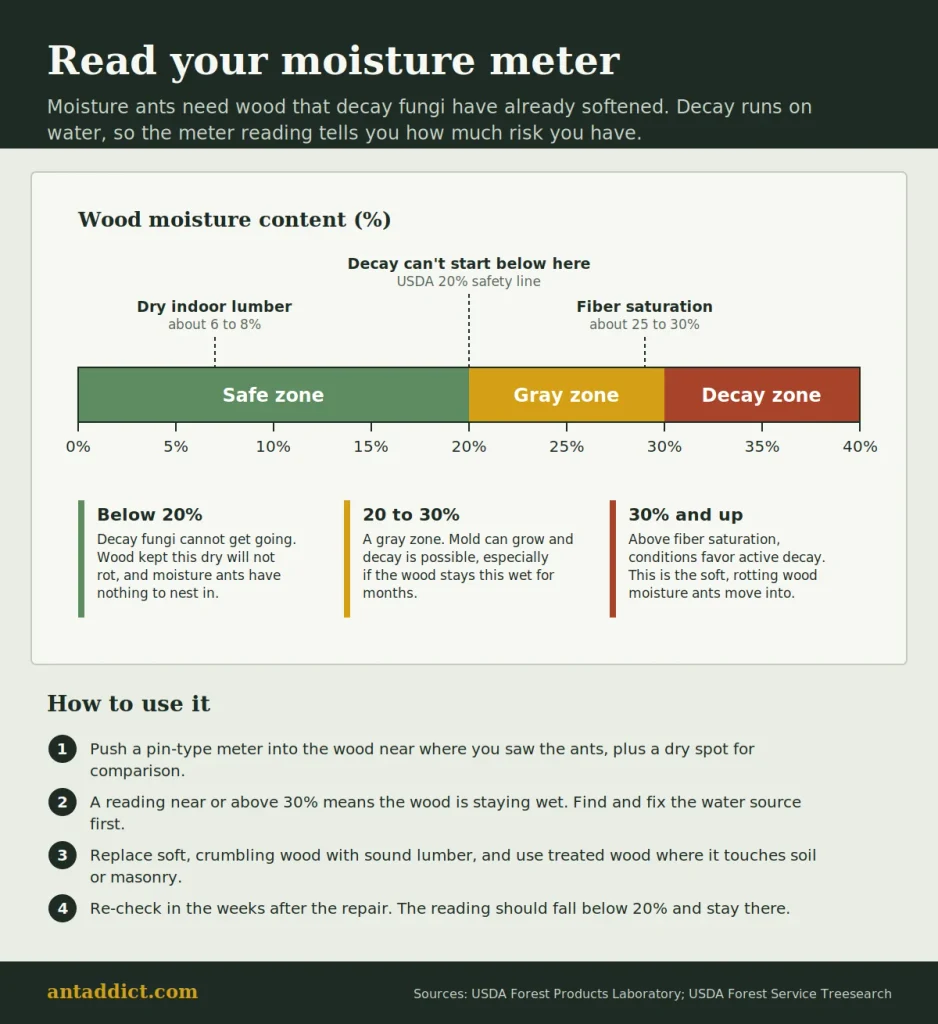
The decay itself runs on water. The USDA Forest Products Laboratory notes that wood decays above about 30% moisture content and will not decay below 20%, with 20 to 30% a gray zone. A Forest Service review adds that decay fungi do best above fiber saturation, usually around 25 to 30% moisture content. So moisture ants are, in effect, a living moisture-meter reading. If they are nesting in your framing, part of that framing has spent a long time above the decay line.
What Does a Moisture Ant Nest Look Like?
Moisture ant nests are messy and earthy, nothing like the clean, sanded galleries and carpenter ant holes you see with carpenter ants. If you want the bigger picture on how colonies build, see our guide to the ant nest.
WSU’s photos show galleries built from decayed wood glued together with saliva. Inspectors call this material “carton.” Seattle home inspector Charles Buell has documented nests where the carton was made from cellulose insulation inside the wall plus decaying wood. He has also photographed earthy carton tubes that look a lot like termite mud tubes.
Signs of a nest:
- Dirty, soil-like packing in wood seams, wall voids, or behind trim.
- Wood that crumbles or lets a screwdriver sink in with light pressure.
- Small piles of soil and wood debris pushed out of cracks.
- Soil appearing through slab or basement floor cracks, which homeowners often mistake for termite activity.
Buell’s most useful observation: a nest can soak up and “manage” a slow leak so well that the leak never shows itself inside the house at all. The ants may be your only early warning.
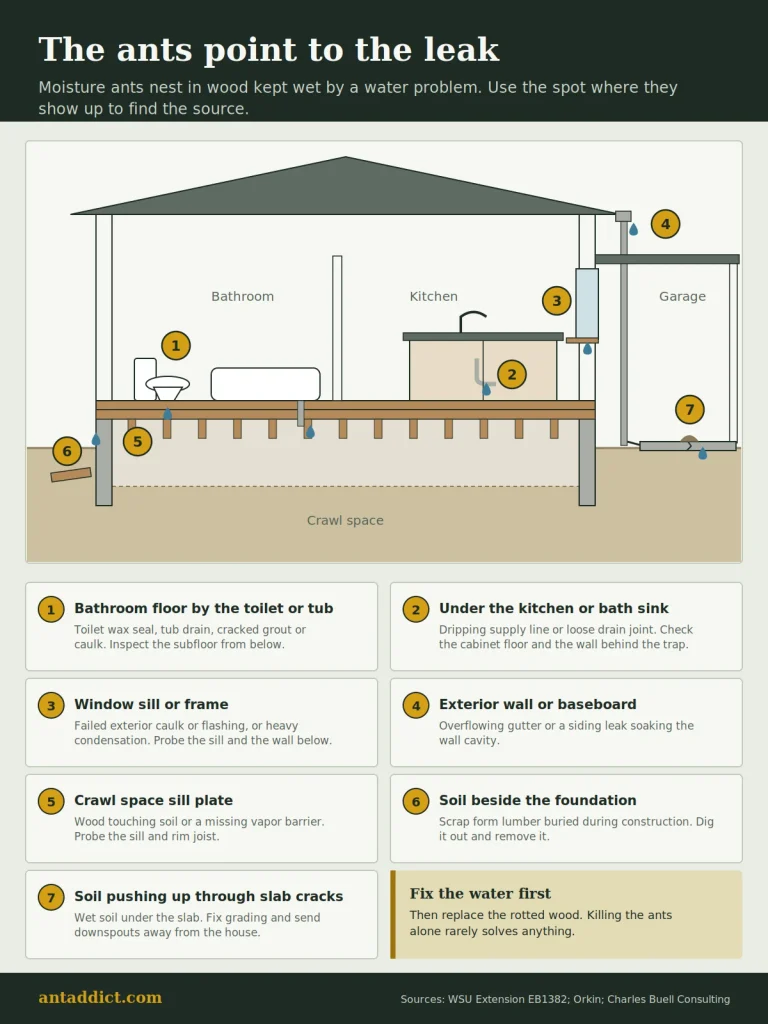
Where You Found Them Tells You Where the Leak Is
This is the most practical section in this guide. Treat every sighting as a pointer to a water source.
| Where you see moisture ants | Likely water source | Where to look |
|---|---|---|
| Bathroom floor near toilet or tub | Failed toilet seal, tub drain leak, cracked grout or caulk | Subfloor from below, around the bath trap |
| Under a kitchen or bathroom sink | Dripping supply line or slip-joint drain | Cabinet floor, wall behind the trap |
| Interior window sill or frame | Failed exterior caulk or flashing, heavy condensation | Sill, rough opening, sheathing below the window |
| Baseboard on an exterior wall | Siding or sheathing leak, overflowing gutter | Wall cavity behind trim, gutter above |
| Basement floor cracks with soil piles | Wet soil under the slab | Grading, downspouts, slab perimeter |
| Crawl space sill plate | Wood-soil contact, missing vapor barrier | Sill plate, rim joist, buried scrap wood |
| Door threshold or deck ledger | Flashing failure where deck meets house | Ledger board and rim joist |
| Winged ants indoors in winter | A colony inside or under a heated structure | Slab, wall voids near heat sources |
One detail from WSU that surprises people: these ants frequently nest in form lumber a contractor buried in soil next to the foundation. If you have a newer house and no obvious leak, check for buried construction scrap.
Do Moisture Ants Damage Your House?
Directly, not much. Indirectly, they can make a bad situation worse.
WSU’s position is that moisture ants are not a primary structural pest but can speed the deterioration of wood. Wet carton pressed against framing keeps that wood wet, which feeds more decay, which gives the ants more room. Buell describes this cycle in wall cavities, and notes the damage is generally fairly localized.
The real cost is almost always the rot, not the ants. Budget for wood repair and the leak fix, not for an extermination contract.
Why Ant Baits Often Fail on Moisture Ants
Baits work when foragers carry food home and share it. Many moisture ants barely forage.
Citronella ants live mostly underground and feed on honeydew from aphids and mealybugs that feed on plant roots. Pest Management Professional magazine notes they locate colonies near rich food sources and are not known to actively forage. A bait station on your counter gives them nothing to find.
Cornfield-type Lasius forage more openly and may take sweet baits. But even when a bait knocks back the colony, the wet wood stays wet, and another colony can move in later. WSU’s guidance is blunt: chemical control is rarely advised, because eliminating the moisture eliminates the ants.
When Do Moisture Ants Swarm?
Moisture ants usually produce winged reproductives once a year, in a classic ant nuptial flight. For cornfield-type moisture ants, WSU puts the flights in late summer to early autumn.
Citronella ants are less predictable. Pest Management Professional notes that soil kept warm by foundations and slabs can support erratic seasonal swarms, and University of Maryland entomologist Mike Raupp has described citronella ants swarming at his home in December. Penn State Extension adds that these swarms are often confused with termites when they reach living areas. Winged yellow ants inside your house in winter usually mean a colony is living in or under a warm part of the building, not that they blew in through a window.
If you want to predict flights for Lasius in your region, our Nuptial Flight Predictor scores your local weather against each species’ triggers.
Here Is the Part Everyone Else Skips: Root Aphids and Hijacked Colonies
Two pieces of biology explain almost every “mystery” about moisture ants.
First, they are farmers. Citronella ants keep herds of root-feeding aphids and mealybugs underground and live on their honeydew, a habit shared with their relative the black garden ant. That is why you rarely see them foraging, why baits fail, and why soil can push up through slab cracks: much of the colony lives in the soil, not in wood. For the bigger picture on honeydew diets, see what ants eat.
Second, many of them cannot start a colony alone. Citronella ant queens are temporary social parasites. In Lasius, parasite queens invade the nest of another Lasius species, kill the host queen, and use the host workers to raise their brood until the colony is entirely parasite workers. Keepers commonly report cornfield ants such as L. neoniger as hosts. A 2007 research abstract by Raczkowski notes that this founding mode was long suspected for the whole group but, at the time, had been confirmed in only two of its 16 species.
What this means for your house: a citronella colony can get established faster than you might expect, because the queen starts with a ready-made workforce instead of raising every worker herself. It also means a yard full of ordinary small Lasius ants provides the host colonies the next generation needs.
How to Get Rid of Moisture Ants for Good
The order matters. Water first, wood second, ants last.
- Find the water. Use the location table above. Check plumbing, gutters, downspouts, caulk, flashing, and crawl space conditions.
- Measure it. A pin-type wood moisture meter costs less than a single pest-control visit. Readings below 20% are in the safe zone. Readings near or above 30% mean active decay conditions.
- Fix the source. Repair the leak, regrade soil away from the foundation, extend downspouts, and install or repair a crawl space vapor barrier. WSU specifically lists leaking gutters, plumbing, and poorly caulked windows, and tells you not to let wood touch soil.
- Remove the rotted wood. WSU’s instruction is to remove decayed wood and replace it with sound material. Use treated lumber where wood will touch masonry or soil.
- Clear the outside. Move woodpiles, stumps, and buried scrap away from the foundation.
- Vacuum swarmers. Winged ants indoors can be vacuumed up. They will not start a colony in dry, sound wood.
- Treat only if needed. WSU notes that chemical control may become necessary if a colony nests near or under the house and becomes a nuisance. Follow the label exactly, or call a pest professional if the nest is in an inaccessible spot such as a narrow crawl space.
Notice who you call first: a plumber, roofer, or carpenter, not an exterminator. As one Seattle building consultant put it, you should not treat a home for ants without knowing why they are there.
Five Moisture Ant Myths You Will Read Elsewhere
| Myth | Reality |
|---|---|
| The lemon smell is formic acid | It comes from terpenoid alarm compounds in the head; formic acid smells like vinegar |
| All moisture ants smell like lemon | Only the citronella group does; cornfield-type Lasius generally don’t |
| Baits work well because colonies have one queen | Citronella ants rarely forage, so baits often never reach them |
| Moisture ants never make mud tubes | They can build earthy carton tubes that resemble termite tubes |
| Moisture ant queens lay eggs year-round | Temperate Lasius slow or stop brood production through winter (see below) |
Can You Keep Moisture Ants in a Formicarium?
This is the keeper’s take, and it depends on which “moisture ant” you mean.
Cornfield-type Lasius are some of the best beginner ants in the hobby. Queens found colonies alone, sealed in a chamber, so they are easy to start once you know how to catch a queen ant, and they do well in a standard test tube setup. Their one firm requirement is a cool winter rest, during which brood development largely stops until spring (the short version is in do ants hibernate). Our Diapause Manual explains why that pause is built in, not optional.
Citronella ants are an advanced project. Because queens are temporary social parasites, a newly mated queen needs host Lasius workers to start, and many keepers fail at that adoption step. In the wild they live underground on root aphids, and in captivity they tend to stay hidden rather than forage in the open.
Humidity is the other lesson. In the wild these ants choose damp wood and soil. In a formicarium, you still want a moisture gradient, not a swamp. Our Ants and Water manual goes deep on getting that balance right.
The Bottom Line
Moisture ants are small Lasius ants that follow water and rot into your home. They don’t start the damage, they don’t sting, and killing them alone rarely solves anything. Treat every moisture ant sighting as a leak report: trace it, measure the wood, fix the water, and replace what has rotted. Do that, and the ants have nowhere left to live.
FAQ
What are moisture ants?
Moisture ants are small, yellow to light-brown Lasius ants that nest in damp, decaying wood or wet soil. The name covers several species, including citronella ants and cornfield-type Lasius.
Are moisture ants harmful to people or pets?
No. Moisture ants don’t sting. They may nip if handled, but the bite is minor. Their main impact is on already-damaged wood, not on people or pets.
Do moisture ants mean I have water damage?
Almost always, yes. Moisture ants nest in wood that is already wet and decaying, so an indoor colony usually points to a leak, condensation problem, or wood-soil contact nearby.
Can moisture ants damage sound wood?
No. Moisture ants colonize wood that decay fungi have already softened. They can speed up damage in rotting wood by keeping it wet, but they don’t attack dry, sound lumber.
How do I tell moisture ants from carpenter ants?
Moisture ants are 1/8 to 3/16 inch and yellowish, with a notched thorax profile. Carpenter ants are usually 1/4 inch or larger, mostly black, with a smoothly rounded thorax.
How do I tell moisture ant swarmers from termites?
Ant swarmers have elbowed antennae, a pinched waist, and front wings longer than the hind wings. Termite swarmers have straight antennae, a broad waist, and four equal wings.
Why do some moisture ants smell like lemons?
Citronella ants release terpenoid alarm compounds, such as citronellal, from glands in the head. Cornfield-type moisture ants generally don’t produce this smell.
Will ant baits get rid of moisture ants?
Often not. Citronella ants rarely forage above ground, so they ignore baits. Even when baits work on foraging species, ants return unless the moisture source is fixed.
When do moisture ants swarm?
Cornfield-type moisture ants usually swarm in late summer to early fall. Citronella ant swarms are less predictable and can even appear indoors in winter when a colony lives under a warm building.
Why do moisture ants keep coming back?
Because the wet wood is still there. Killing a colony without fixing the leak and replacing rotted wood leaves ideal habitat for the next founding queen.
Should I call an exterminator for moisture ants?
Call a plumber, roofer, or contractor first to find and fix the water source. A pest professional is useful mainly for nests that persist after repairs or sit in inaccessible spots.