Ant Nuptial Flight: When Ants Swarm, Mate, and Start New Colonies
Last reviewed: June 2026. Claims in this guide are drawn from first-hand keeping and the reference and peer-reviewed sources linked inline and listed below.
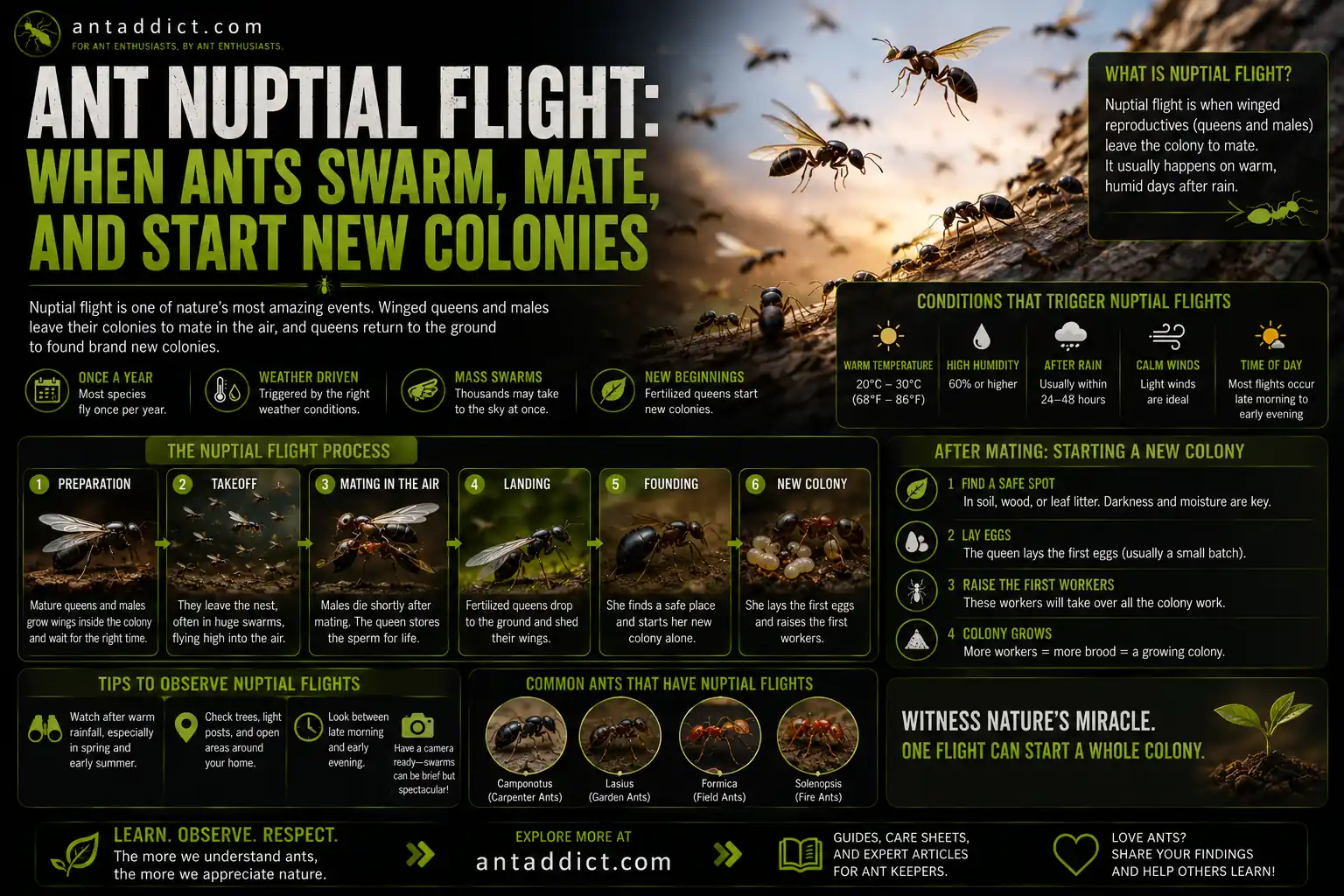
An ant nuptial flight is the mating flight of a colony, the event where winged reproductive ants, called alates, leave the nest to mate. On the right day, usually warm, humid, and still, often within a day of rain, virgin queens and males take to the air, and colonies of the same species across a whole area fly at the same time. Males and queens mate in the air or on the ground, after which the males die within a day or two and each newly mated queen sheds her wings, lands, and tries to found a colony of her own. For ant keepers, the nuptial flight is the one event of the year that matters most, because it is when wild queens can be found and collected.
If you keep ants, you already know the feeling: a hot, sticky afternoon after a rainstorm, and suddenly the air is full of flying ants. That is a nuptial flight, and it is both the strangest and the most important few hours in an ant’s life.
After six years of keeping ants, I still plan parts of my summer around these flights.
This guide covers what a nuptial flight actually is, who flies and why, what weather sets it off, the remarkable reasons whole regions swarm on the same day, and, for keepers, how to predict a flight and find the freshly mated queens afterward.
What is an ant nuptial flight?
An ant nuptial flight is the synchronized mating and dispersal flight of an ant colony’s winged reproductives. It is how ants breed and spread, and it is the single moment a new queen is made.
A mature colony spends most of the year producing only workers. Then, seasonally, it raises a special generation of winged males and virgin queens whose only job is to leave, mate, and start the next generation. When conditions are right, they fly. Queens mate, males die, and the survivors, the mated queens, scatter to become the founders of entirely new colonies.
In other words, every ant colony you have ever seen began with a single queen who flew, mated, and landed on one particular day. The nuptial flight is the doorway every colony passes through to exist.
The alates: who actually flies
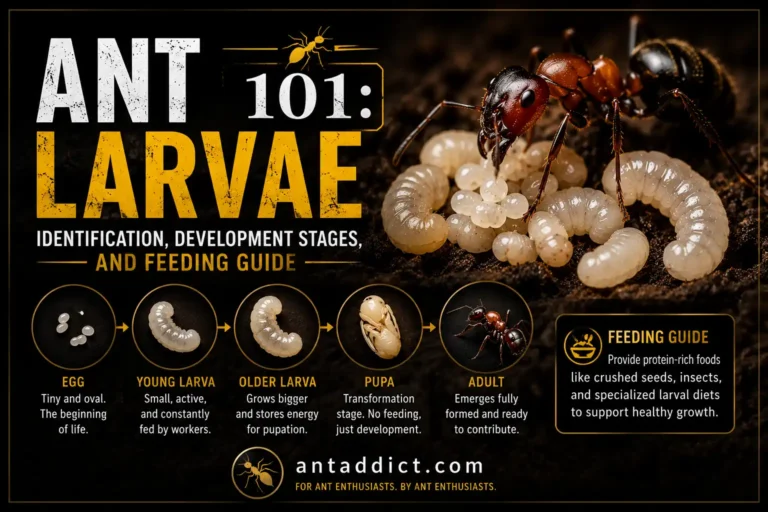
The flyers are called alates, the winged reproductive caste, and they come in two kinds: virgin queens and males.
The males develop from unfertilized eggs, which makes them genetically unusual, they have a mother but no father, and they exist for one purpose only. They do no work in the nest, are fed and tolerated until the flight, and are, in the memorable phrase of biologists, little more than flying sperm delivery units.
The virgin queens develop from the same fertilized eggs that could have become workers, but they were raised with richer feeding as larvae, which set them on the reproductive path.
Both grow wings, which workers never have, and both wait inside the nest until the colony’s cue to fly arrives. Until that day, they are passengers, kept and fed by their sisters for the single flight ahead.
What triggers an ant nuptial flight?
Weather is the trigger, and the conditions are surprisingly specific. Ants do not fly on just any warm day.
The classic combination is warm, humid, and still, shortly after rain. Flights very often happen within about a day of moderate or heavy rainfall, on warm days with high humidity and little or no wind. Rain matters for two reasons: the damp air suits the delicate flyers, and the softened, moistened soil afterward is far easier for a landed queen to dig into and found her colony.
The exact thresholds differ by species. Each kind of ant responds to its own particular mix of temperature and humidity, which is part of how different species avoid flying at the same moment and mating with the wrong partners. In cooler, temperate climates, temperature is usually the key that unlocks a flight; in the tropics, where it is warm year-round, rainfall tends to be the dominant cue. A calm, muggy afternoon after a summer storm is the archetype.
This weather dependence is also why flights feel sudden. The reproductives sit ready for days or weeks, and when the trigger finally lands, the colony empties into the air within hours.
What happens during the flight?
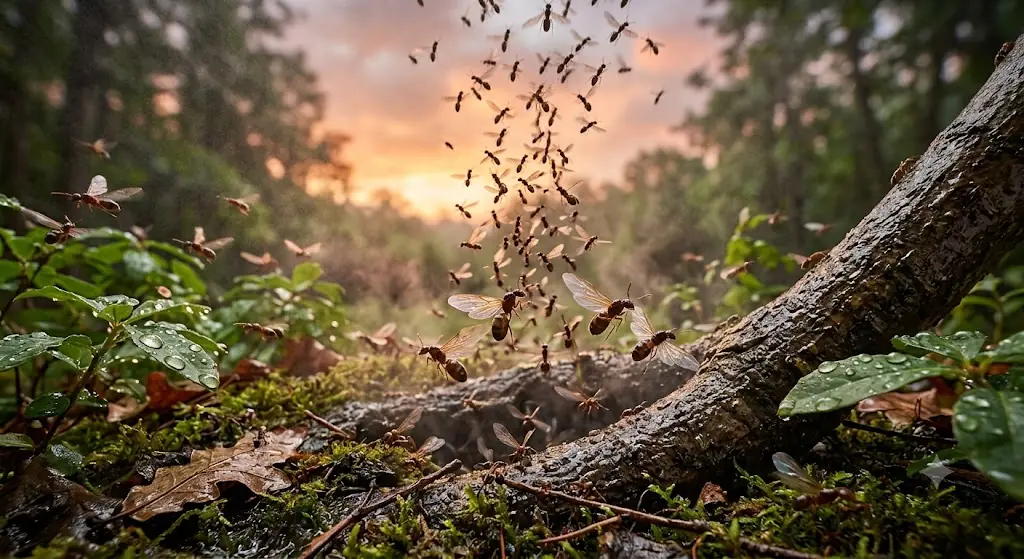
Once airborne, the nuptial flight becomes a fast, competitive scramble to mate.
The queens and males first scatter and rise, filling the air, an emergence AntWiki vividly describes as “snowfall in reverse”. Virgin queens release sex pheromones that draw males, and the males pursue. In many species the queen actively makes them work for it, flying hard so that only the fastest and fittest males catch and mate with her, a filter for good genes.
Mating itself happens in the air in many species, or on the ground in others. How many males a queen mates with varies: many queens mate with a single male, while others mate with several in one flight, a strategy called polyandry that is well developed in groups like leafcutter and harvester ants. Multiple mating stocks the queen with a more diverse supply of sperm and gives her future colony broader genetic variety.
For the males, mating is the end. Having done the one thing they were built for, they die within a day or two, their entire lives compressed into a single afternoon. The mated queens, meanwhile, are just getting started.
Here is the part everyone skips: why the whole region flies at once
The most striking feature of nuptial flights is their synchrony. It is not just one colony that flies, it is most colonies of that species across an entire area, on the same day, often within the same hour. Ants have no way to phone each other, so how and why does this happen?
The how is the shared weather cue. Because every colony of a species is tuned to the same environmental trigger, temperature, humidity, and rainfall, they all reach the “fly now” threshold together, like thousands of alarm clocks set to the same conditions. No communication is needed; the weather is the signal.
The why is where it gets clever, because synchrony solves two different survival problems at once.
The first is predator satiation. Flying ants are slow, soft, and utterly exposed, and every bird, spider, and dragonfly treats a flight as a feast. By erupting all at once in overwhelming numbers, the ants swamp their predators: there are simply too many to eat, so the vast majority get through. A trickle of flyers would be picked off; a flood cannot be.
The second is outbreeding. Because all the colonies release their reproductives together, queens and males from different, unrelated nests end up mixed in the same swarm. That forces mating between colonies rather than within them, avoiding inbreeding and keeping the population genetically healthy. The genetic data back this up, showing that ants outbreed almost completely. Synchrony, in short, is how a colony protects its reproductives and promotes healthy genes in one move.
One flight, a lifetime of eggs
Here is the fact that reframes the whole event. A queen mates only during this one nuptial flight, and never again, yet she may go on laying fertilized eggs for decades.
During mating, the sperm she receives is stored in a special organ in her abdomen called the spermatheca. There it is kept alive and viable for the whole of her life. From that single afternoon’s mating, a queen banks tens of millions of sperm, and she doles them out one at a time to fertilize eggs across her entire reproductive career.
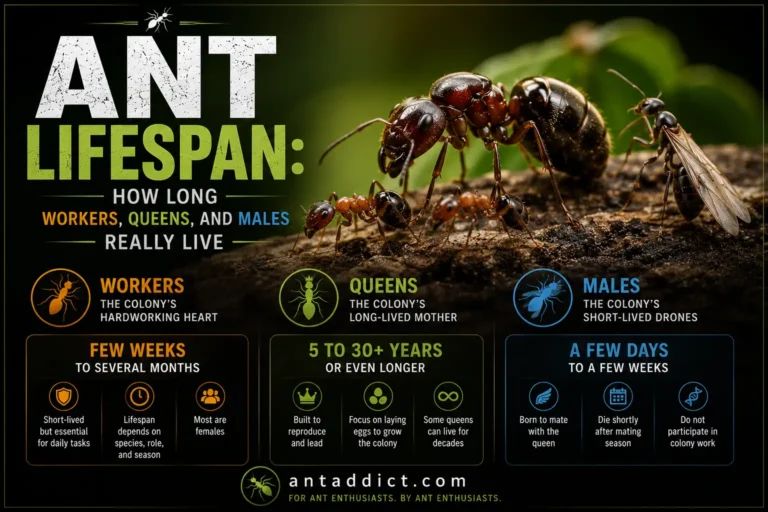
That career can be astonishingly long. A black garden ant queen can live around 15 years, and far longer in captivity, laying fertilized eggs the whole time from sperm banked on day one. She will build a colony that may grow to tens of thousands of workers, all of them her daughters, all fathered during one flight she took as a young winged queen.
So the modest queen wandering your patio after a flight is carrying her entire genetic future, sealed and stored, from a mating that will never be repeated. It is one of the most extreme reproductive strategies in the animal world, and it all hinges on this one flight, a theme explored further in the guide to ant lifespan.
What happens after the nuptial flight?
For the mated queen, landing is the start of the hardest and most dangerous chapter of her life.
As soon as she is down, she breaks off or chews away her own wings, which have done their single job and are now useless. This wing loss, called dealation, is the mark of a queen who has mated and is ready to found a colony, and it is exactly what a keeper looks for. She then searches for a nest site, a crack, a space under a stone, or soft soil made diggable by the recent rain.
There she seals herself in and begins claustral founding, raising her first tiny workers alone on her own body reserves, without eating, until they can open the nest and forage. Most queens do not survive this stage; predation and failure are enormous. The lucky few that succeed become the founders of the next generation of colonies, the full story of which is covered in the guide to ant colonies.
The males, by contrast, have no after. Their story ends on the day of the flight.
When do ant nuptial flights happen?
Timing depends heavily on species and climate, but there are strong patterns.
Most temperate ants fly in the warm months, from late spring through early fall, with summer being the peak. Within that window, the exact date is set by the weather trigger, so a flight might come in June one year and July the next.
The time of day is species-specific too: some fly in the afternoon heat, some at dusk, and a few, like certain leafcutter ants, fly in the pre-dawn dark.
Because each species has its own temperature and humidity thresholds and its own preferred hour, a single region sees a rolling series of different species’ flights across the season rather than one big event. Keepers learn their local species’ patterns and watch the forecast around them.
Flying Ant Day: the swarm people notice
If you have ever seen a summer day when flying ants seemed to be everywhere at once, you witnessed the most visible nuptial flights of all, popularly called Flying Ant Day.
The name is a little misleading. Research on these swarms, including large public surveys, has shown that it is not really a single day but a flying ant season spanning several weeks, with one or more big peaks driven by the weather. On the right muggy, post-rain days, huge synchronized flights erupt, and because they are so visible, people notice.
In much of Europe, the overwhelming majority of these flyers are a single species, the black garden ant (Lasius niger), which is also the classic beginner’s queen for keepers. So the swarm that looks like an invasion is usually one common, harmless species doing exactly what it has done every summer for millions of years.
How to predict an ant nuptial flight
This is where keeping gets practical. You cannot force a flight, but you can learn to see one coming, and the payoff is finding queens.
Watch the weather for the classic recipe: a warm, humid, still day, ideally following a good rain that came after a hot spell. In much of the temperate world that means afternoons and evenings when temperatures climb into the high 70s Fahrenheit (mid-20s Celsius) or above, with high humidity and little wind. When a hot, dry stretch finally breaks with rain and then turns muggy, the next day or two is prime.
A few practical habits help. Track the species in your area and the months they tend to fly. Keep an eye on the forecast for that warm-humid-after-rain window, and check our nuptial flight tracker for flights already reported near you. And on a promising day, simply go outside and look, watch pavements, walls, and the ground along their base in the afternoon and early evening. Once you have seen one flight, you will recognize the conditions in your bones.
How to find and catch queens after a flight
For keepers, the flight itself is just the signal. The real goal is the newly mated, dealate queen looking for somewhere to found a colony, and the hours during and just after a flight are the time to find her.
Look on open, flat surfaces where queens land and wander: sidewalks, patios, driveways, the bases of exterior walls, and around outdoor lights in the evening. You are looking for a comparatively large ant with no wings, or one actively shedding them. A wingless queen is a mated queen, exactly what you want; a queen still carrying wings may not have mated yet.
Collect her gently into a small container, and set her up in a simple test tube setup to see whether she begins laying. Catching queens from a local flight is the classic, low-cost way to start a colony, and it connects you to the same event every wild colony started from. It is, for many keepers, the most exciting few hours of the year.
The bottom line
An ant nuptial flight is the brief, spectacular event in which a colony’s winged queens and males fly, mate, and scatter, triggered by warm, humid weather after rain and synchronized across whole regions at once. That synchrony is no accident: it overwhelms predators and forces the healthy outbreeding a population needs.
The males die within days, and each mated queen banks a lifetime of sperm from that single flight, then sheds her wings and gambles everything on founding a colony of her own.
For a keeper, it is the most important few hours of the year, the moment wild queens appear and a new colony can begin. Learn your local species, watch for the warm-humid-after-rain window, and go outside and look. Somewhere on the pavement, a queen carrying her entire genetic future is looking for a home.
FAQ
What is an ant nuptial flight?
It is the mating flight of an ant colony, when winged virgin queens and males, called alates, leave the nest to mate. Afterward the males die and each mated queen sheds her wings and tries to found a new colony.
What triggers an ant nuptial flight?
Specific weather: warm, humid, still conditions, very often within a day of rain. Each species has its own temperature and humidity thresholds, which is why different ants fly at different times.
When do ant nuptial flights happen?
Mostly in the warm months, from late spring through early fall, with summer the peak in temperate regions. The exact day is set by the weather, and the time of day varies by species, from afternoon to dusk to pre-dawn.
Why do ants all fly on the same day?
Because every colony of a species responds to the same weather cue, they reach the trigger together. Flying at once overwhelms predators and mixes queens and males from different nests, preventing inbreeding.
What is Flying Ant Day?
The popular name for the most visible summer nuptial flights. It is really a season of several weeks with weather-driven peaks, not a single day, and in Europe it is dominated by the black garden ant.
How many times does a queen ant mate?
Only during her one nuptial flight. Depending on the species she may mate with a single male or with several in that one event, then stores the sperm for life in an organ called the spermatheca and never mates again.
How long can a queen store sperm from the nuptial flight?
For her entire life, which can be many years and, in some species, well over a decade. She uses that one flight’s sperm to fertilize tens of millions of eggs across her whole reproductive career.
What happens to male ants after the nuptial flight?
They die within a day or two. Males exist only to mate; they do no work in the nest, develop from unfertilized eggs, and their lives end with the flight.
Why do queen ants lose their wings after mating?
Once a queen has mated and landed, her wings have served their only purpose. She breaks or chews them off, a process called dealation, and uses the muscle tissue as an energy reserve while founding her colony.
How do I catch a queen ant after a nuptial flight?
Look on pavements, patios, walls, and around lights during and just after a flight for a large, wingless ant. A queen that has shed her wings has mated; collect her gently and set her up in a test tube to see if she lays eggs.
How do I know if a flying ant is a queen or a male?
Queens are noticeably larger, with a big thorax and abdomen built for egg-laying. Males are smaller and more slender. After a flight, a large wingless ant is almost always a newly mated queen.
Are flying ants during a nuptial flight dangerous?
No. Flying ants are simply reproductives on their mating flight and are not aggressive. Most belong to harmless species such as the black garden ant, and they are a natural, brief seasonal event.