Ant Nest: What They Look Like, How Deep They Go, and How Ants Build Them
Last reviewed: June 2026. Claims in this guide are drawn from first-hand keeping and the peer-reviewed and university sources linked inline and listed below.
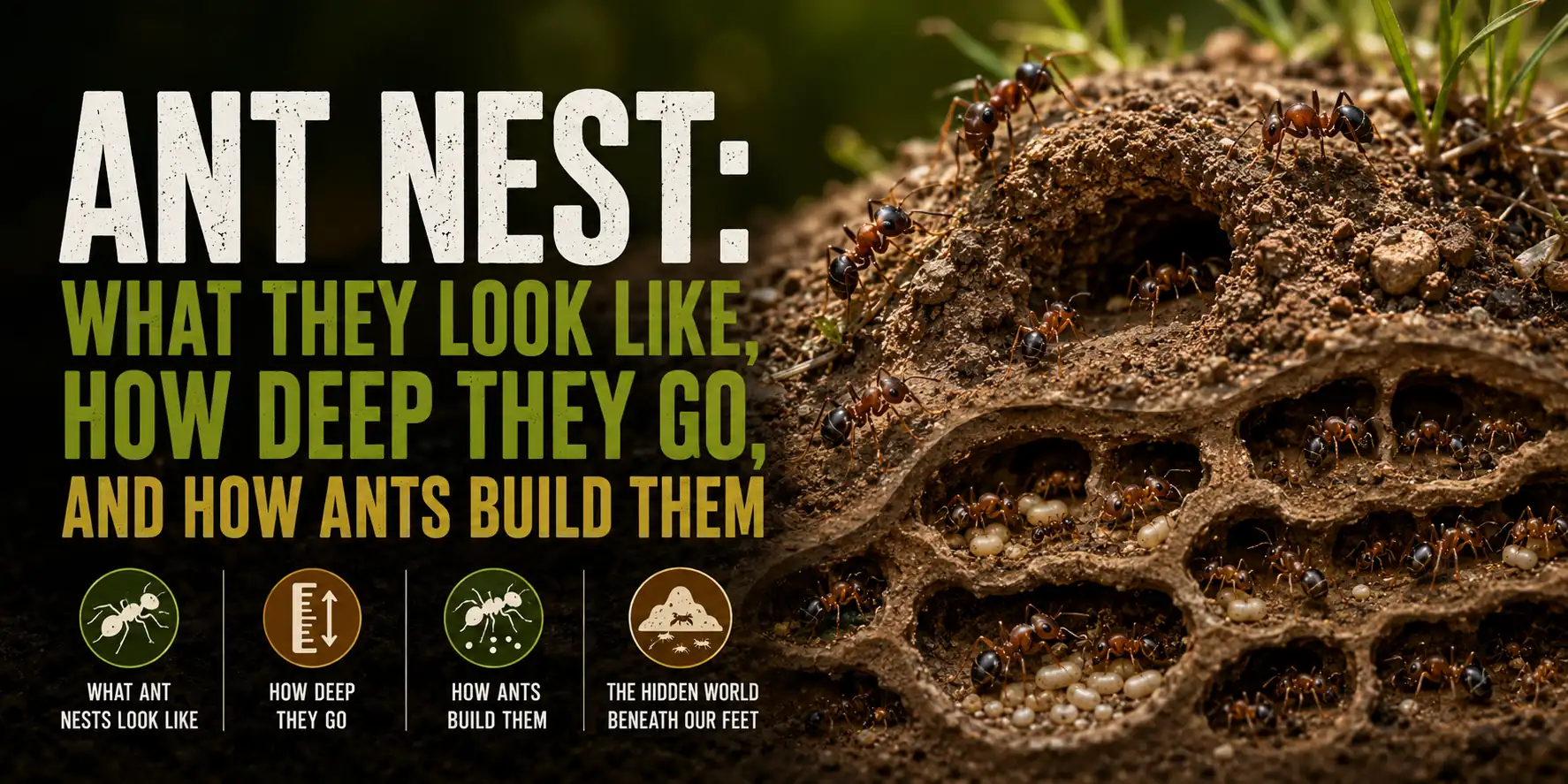
An ant nest is the home a colony builds to shelter its queen, brood, and food stores. Most are excavated in soil as a set of vertical shafts connecting horizontal chambers, stacked like beads on a string. They can run from a couple of inches to more than 13 feet (4 m) deep, and every bit of it is dug by workers following simple rules, with no blueprint and no architect in charge.
To most people an ant nest is just a hole in the ground or a mound on the sidewalk. What is actually down there is one of the most sophisticated pieces of animal architecture on Earth, and after six years of keeping colonies I still find it remarkable that a few thousand brains the size of a pinhead produce it. This guide covers what an ant nest is, what it looks like inside, how deep it goes, the main types, how ants build one, and what all of that means if you keep ants yourself.
What is an ant nest?
A nest is not the colony. The colony is the living society of ants; the nest is the structure they live in. Its job is to keep the vulnerable parts of the colony safe and stable: the egg-laying queen, the developing brood, the food stores, and the workforce itself.
A good nest does several things at once. It buffers temperature and humidity against the weather outside, hides the colony from predators, and gives the ants a sorted space to raise brood, store seeds or food, and dump waste. In most species the deeper chambers stay more humid and more stable in temperature, and the ants exploit that gradient, moving brood up and down to find the right conditions.
What does an ant nest look like inside?
This is the part almost no one gets to see, and it is the reason the entomologist Walter Tschinkel pioneered a way to cast nests by pouring in plaster or molten metal, letting it harden, then digging up the mold. The casts revealed a hidden order.
Despite an enormous range of size, most ground nests share one basic plan: more or less vertical shafts connecting more or less horizontal chambers. Picture a stairwell with rooms opening off each landing. The differences between species come down to how those two elements are sized, shaped, and spaced.
Nests are also usually top-heavy. In the Florida harvester ant, over half the total chamber space sits in the top quarter of the nest, with chambers shrinking and spreading farther apart as you go down. The ants sort themselves the same way, with foragers near the surface and the queen, brood, and youngest workers deep at the bottom.
The chambers themselves have a shape. Casts show that many are flattened, pancake-like rooms, and they often become lobed and branching as workers enlarge them. Near the surface, shallow chambers are little more than widened tunnels, while the deeper ones are larger and more distinct. Fungus-farming ants remodel the standard pancake into rounded, egg-shaped chambers to cradle their gardens.
How deep do ant nests go?
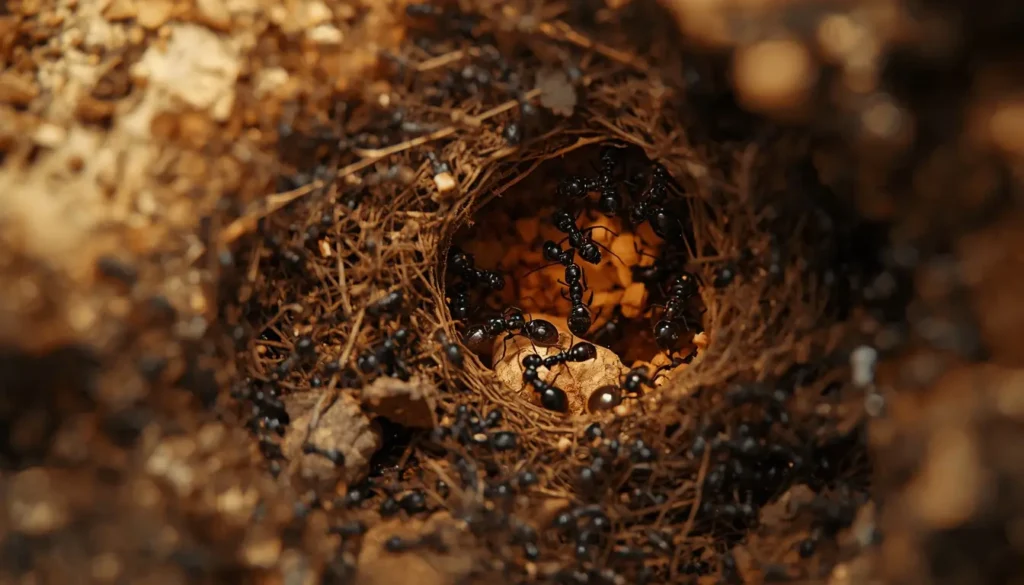
Deeper than you would guess. Ant nests range from a couple of inches for a small colony under a rock to more than 13 feet (4 m) for a large subterranean species. Florida harvester ant nests reach 7 to 10 feet (2 to 3 m) and can hold up to 150 separate chambers, linked by helical shafts only 1.5 to 2.5 inches (4 to 6 cm) wide.
Depth is not fixed, either. Many temperate colonies dig deeper before winter to sit out the cold below the frost line, which is part of how they survive the season. If you want the full picture of that seasonal move, see do ants hibernate.
How big can an ant nest get?
Some nests are less a burrow than a buried city. The record holders belong to the leaf-cutting ants of the genus Atta, whose colonies can hold several million workers. The nests of Atta laevigata can contain more than 7,000 chambers and reach 26 feet (8 m) deep, with horizontal foraging tunnels radiating more than 330 feet (100 m) from the center.
To map one, researchers poured nearly 7 tons of cement into a single Brazilian nest, let it set, then excavated the cast to reveal the structure. In a Texas leaf-cutter nest, some vertical shafts may plunge as deep as 105 feet (32 m), apparently acting as wells that reach down toward the water table. These colonies move so much earth in the process that they rank among the planet’s most powerful natural excavators.
The main types of ant nests
Not every nest is a hole in the ground. Ants have evolved several building strategies, and the type usually tracks the species and its habitat.
| Nest type | How it is made | Typical builders |
|---|---|---|
| Subterranean | Shafts and chambers excavated in soil | Most ants (Lasius, Pogonomyrmex, Formica) |
| Mound or thatch | Soil or piled plant material raised above ground to trap heat | Wood ants (Formica rufa), fire ants (Solenopsis) |
| Wood galleries | Smooth tunnels chewed inside damp or dead wood | Carpenter ants (Camponotus) |
| Arboreal carton | Chewed plant fiber built into papery nests in trees | Various tropical ants |
| Silk and leaf | Living leaves stitched together with larval silk | Weaver ants (Oecophylla) |
| Opportunistic | Adopted cavities: acorns, hollow stems, under stones | Acorn ants (Temnothorax) |
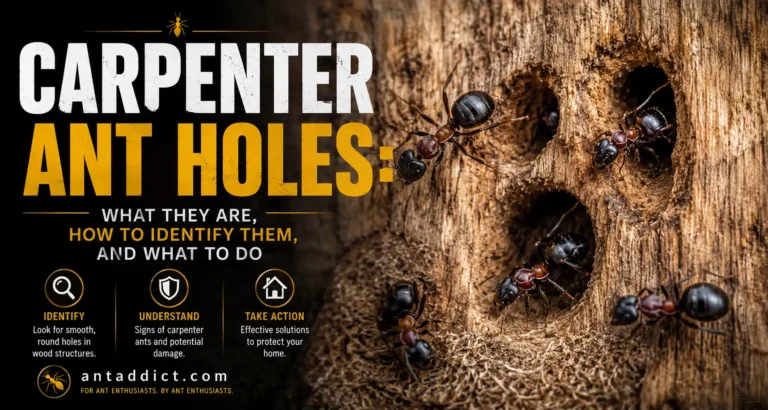
One myth worth killing: carpenter ants do not eat wood. They only carve galleries in it for shelter, unlike termites, which actually digest it. And weaver ants are the colony’s most theatrical builders, with workers forming living chains to pull leaf edges together while others squeeze silk-producing larvae like glue guns.
The line between these types can blur. Many mound builders are also digging deep chambers below the mound, and some species switch strategy with climate, nesting snugly under a warm stone in cool regions but going fully subterranean where it is hot. The nest type is a response to the environment, not a fixed trait.
How do ants build a nest without a plan?
Here is the genuinely mind-bending part. There is no foreman, no drawing, and no ant that understands the finished nest. A subterranean nest is not built so much as removed: workers carry out grain after grain of soil, and the structure is the empty space left behind.
The order emerges from simple local rules and cues that every worker follows, a process called self-organization. Ants seem to read depth partly from the rising carbon dioxide in the soil, which may act as a template telling them where to place chambers. The proof is dramatic: when a harvester ant colony is forced to relocate, it rebuilds a nest nearly identical to the one it left, at the same depths and proportions, in under a week, without anyone holding the plans.
The scale of that digging is staggering. A single large colony can lift tons of soil to the surface, which is why ants rank alongside earthworms as major movers of earth. Workers dig fastest in slightly moist soil, rolling it into pellets to haul out, but they also know when to stop: leaf-cutter workers tunneling upward toward standing water halt about half an inch (12 mm) short of it, an apparent safeguard against flooding the nest.
A nest is a climate machine
A nest is not just shelter; it is active climate control for the brood. Ants constantly shuttle eggs, larvae, and pupae through the nest to park them wherever temperature and humidity are best, which is why the brood often sits in different chambers in the morning than in the afternoon.
The structure itself does work, too. A wood ant’s thatch mound of needles and twigs acts as a solar collector, trapping heat so brood matures faster in cool climates. And in the enormous nests of leaf-cutting ants, surface turrets and openings harness the wind blowing across the mound to drive passive ventilation, pulling stale, carbon-dioxide-rich air out of the fungus chambers and drawing fresh air down. The nest, in effect, breathes.
One colony, many nests
A colony does not always live in a single nest. Many species are polydomous, spreading one colony across several linked nests connected by trails, sharing brood and workers between them. Wood ants and many others do this, extending their territory without abandoning the queen’s core nest.
At the far extreme are supercolonies, where cooperation stretches across huge distances. Introduced Argentine ants have formed supercolonies running for thousands of miles, with workers from nests far apart treating each other as nestmates rather than rivals. For them, the idea of a single, bounded ant nest breaks down entirely.
Where do ants nest in and around a home?
Because nests follow habitat, the ones people run into are the ones that like human spaces. Outdoors, that means soil beds, lawns, and the gaps under patios, driveways, and stepping stones, where the slab holds warmth and sheds rain. Indoors, ants exploit wall voids, insulation, and damp or damaged wood, especially near kitchens and bathrooms where water and food are close together.
A visible mound or a steady trail vanishing into a crack usually means the real nest is nearby but out of sight, often most of it below ground. Seeing a few ants is rarely the whole story.
Signs of an ant nest, and do they cause damage?
You can usually spot a nest without digging for it. Look for a soil mound or a fan of excavated grains, a steady two-way trail of workers, a faint rustling inside a wall, or small piles of what looks like sawdust. That sawdust, called frass, is the tell-tale sign of carpenter ants, which push wood shavings and dead nestmates out of their galleries.
Most ant nests are harmless and even useful, aerating the soil and eating other pests. A few cause real trouble. Carpenter ants weaken structural wood over time by hollowing it out, pavement ants can undermine slabs and patios, and fire ant mounds bring a painful stinging hazard to lawns and yards. Identifying which ant you are dealing with tells you whether a nest is a harmless curiosity or a problem worth addressing.
What an ant nest teaches you about keeping ants
Every good captive setup is really an attempt to fake a natural nest, and understanding the wild version makes you a better keeper. The two things that matter most are chambers and a moisture gradient.
- Give them structure, not a shoebox. Ants want defined chambers connected by narrow passages, not one big open room. Aerated concrete (ytong), cast plaster, or acrylic nests recreate the shaft-and-chamber logic that soil nests have naturally.
- Build in a humidity gradient. In the wild, one end of the nest is damp and one is drier, and the ants choose. Hydrate one side of the nest and leave the other dry so brood can be moved to the right spot.
- Match the nest to the species. Wood-dwellers like carpenter ants take to wood or ytong; deep soil diggers are happiest in a dirt or sand setup where they can actually excavate.
Timing matters as much as design. A newly mated queen does not need a nest at all at first. She is best started in a simple test tube with a water reservoir, which mimics the snug, humid founding chamber she would dig in the wild. Only once the colony has a couple dozen workers does it make sense to move them into a proper nest. And bigger is not better: ants prefer a snug space they can fill and defend, so an oversized nest often just gets sectioned off, stuffed with trash, or ignored.
What this looks like in practice: In my own colonies, the clearest lesson from the wild is that ants never stop renovating. Give a soil-nesting species a dirt setup and they will re-dig it constantly, sorting brood by humidity exactly like a wild nest. In a hydrated ytong nest, I watch them pack the most brood into the chamber nearest the water and leave the driest corner for trash. Work with those instincts instead of against them and the colony settles fast.
The bottom line
So an ant nest is far more than a hole. It is a self-built, self-organized structure of shafts and chambers that can plunge more than 13 feet down, climate-controlled, sorted by depth, and rebuilt from scratch in days if the colony has to move, all without a single ant knowing the plan. Once you understand how the wild version works, you can read your own colony’s behavior and give it a home it will actually thrive in.
FAQ
What does an ant nest look like?
From above, often just a small hole, a fan of loose soil, or a mound. Inside, it is a network of vertical shafts connecting horizontal chambers, usually with most of the space in the upper portion and the queen and brood kept deep.
How deep can an ant nest go?
From a couple of inches for a small colony to more than 13 feet (4 m) for large species. Florida harvester ant nests commonly reach 7 to 10 feet (2 to 3 m) with up to 150 chambers.
What is the difference between an ant nest and an ant hill?
An ant hill is just the mound of excavated soil at the surface. The nest is the whole structure, and most of it is the chambers and tunnels hidden below the visible hill.
Do ants build their nests with a plan?
No. There is no architect. Each worker follows simple local rules and cues such as soil carbon dioxide, and the ordered nest emerges from that collective behavior, a process called self-organization.
How do I find an ant nest?
Follow a worker trail back to its source, or look for a soil mound, a hole ringed with excavated grains, or ants streaming in and out of a wall or wood gap. Most of the nest will still be out of sight.
How big can an ant nest be?
Enormous. Leaf-cutting ant colonies of the genus Atta can number in the millions and build nests more than 26 feet (8 m) deep with over 7,000 chambers and foraging tunnels stretching hundreds of feet from the center.
Do ant nests damage your house or yard?
Most do not, but a few can. Carpenter ants hollow out structural wood, pavement ants can loosen slabs and patios, and fire ant mounds are a stinging hazard in lawns. Identifying the species tells you the risk.
How long does an ant nest last?
As long as the colony survives, which can be years or even decades depending on the species and the queen’s lifespan. Some colonies relocate often, while certain wood ant mounds persist and are inherited for many years.
Can one ant colony have more than one nest?
Yes. Many species are polydomous, spreading a single colony across several connected nests. Some introduced ants take this to the extreme, forming supercolonies that span vast distances.