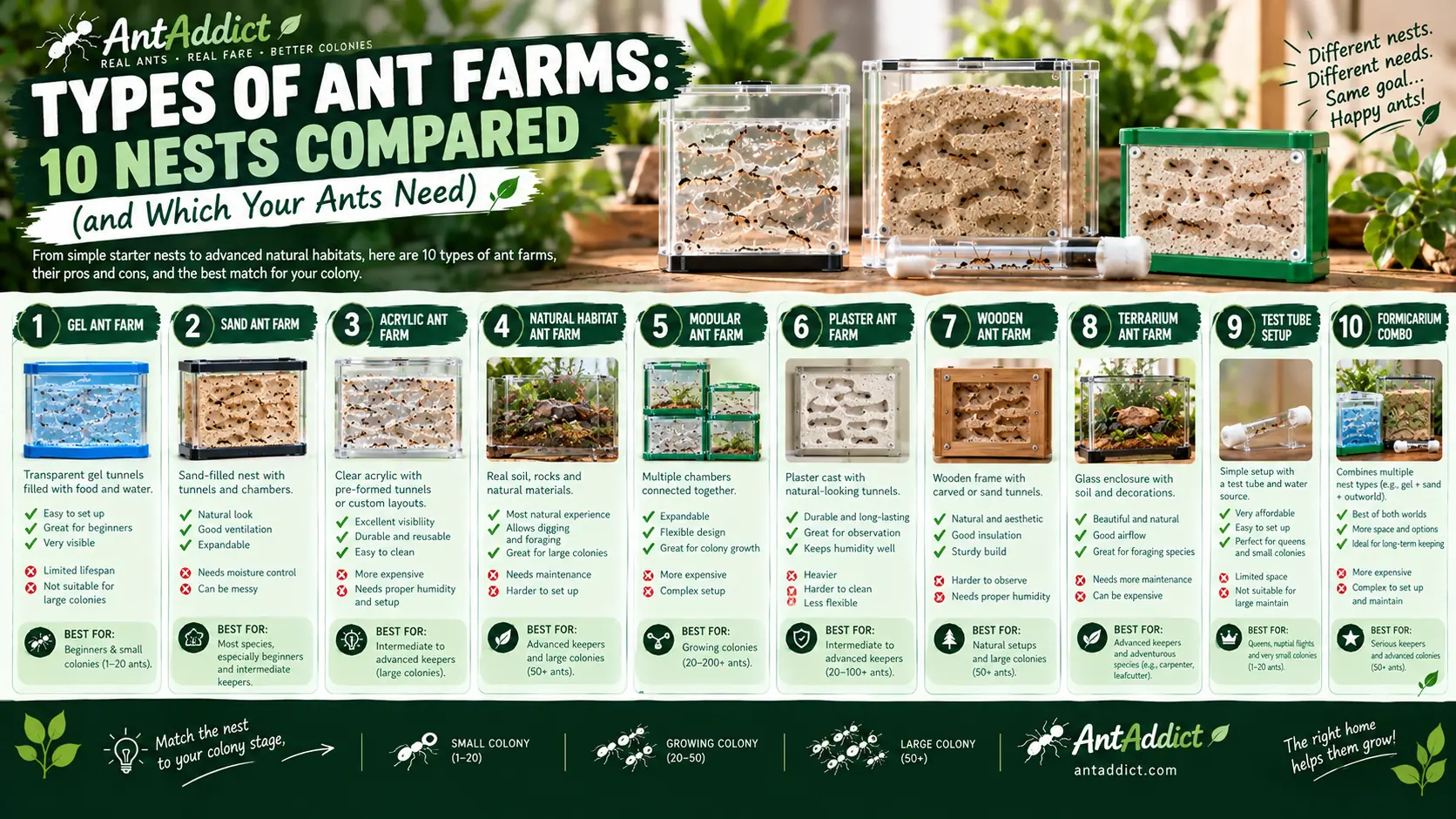
Types of Ant Farms: 10 Nests Compared (and Which Your Ants Need)
Ten nest designs, one honest verdict on each, and which ant species each one actually suits.
Quick Answer: There are 10 main types of ant farms: test tube setups, acrylic formicariums, Ytong (AAC) nests, plaster nests, 3D-printed or hybrid nests, cork or wood nests, natural soil or sand setups, leafcutter fungus setups, queenless sand kits, and gel ant farms. Only the first eight can house a real colony with a queen. Pick the material by your species’ humidity needs, mandible strength and colony size.
I have kept ants for six years, and the most common message I get is some version of “I bought an ant farm and my colony died.” Almost every time, the nest was fine. It was just the wrong type of ant farm for that species.
This guide covers all the types of ant farms on the market, what each one is good at, which species it suits, and what to skip. Every section has a shopping link. If you already know your species, the Ant Farm Finder picks one for you and sends you straight to the right section below.
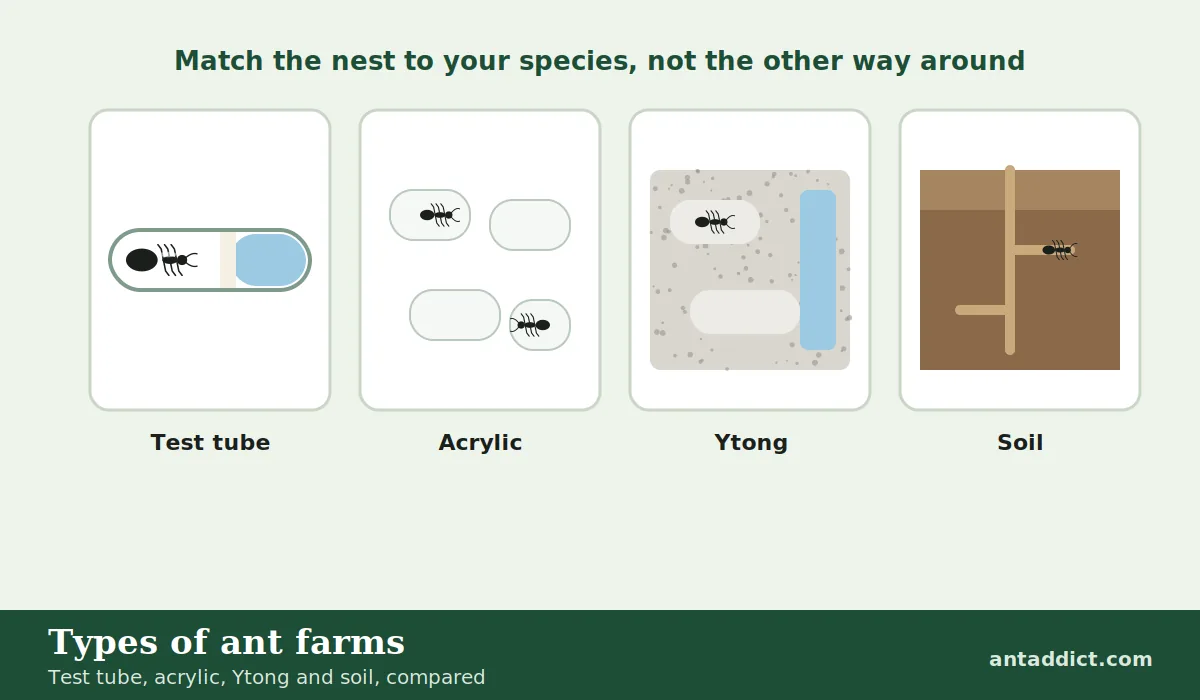
What are the types of ant farms, side by side?
| Type | Best for | Humidity | Visibility | Chew-proof | Typical price |
|---|---|---|---|---|---|
| Test tube | Founding queens, any species | Built-in | High | Yes | $5–15 |
| Acrylic | Viewing, harvesters, desert ants | Needs sponge or tower | Highest | Yes | $25–80 |
| Ytong (AAC) | Humid species, low maintenance | Excellent | Good | No | $20–60 |
| Plaster | Tight budgets, humid species | Good | Good | No | $10–30 |
| 3D-printed / hybrid | Seed harvesters, big colonies | Dry + humid zones | Good | Mostly | $35–120 |
| Cork / wood | Carpenter and acrobat ants | Low | Low | No | $15–50 |
| Soil / sand | Diggers, natural behavior | Natural | Low | N/A | $30–100 |
| Leafcutter setup | Atta, Acromyrmex | Very high | Medium | Yes | $60–200 |
| Queenless sand kit | Kids, short projects | N/A | High | N/A | $15–30 |
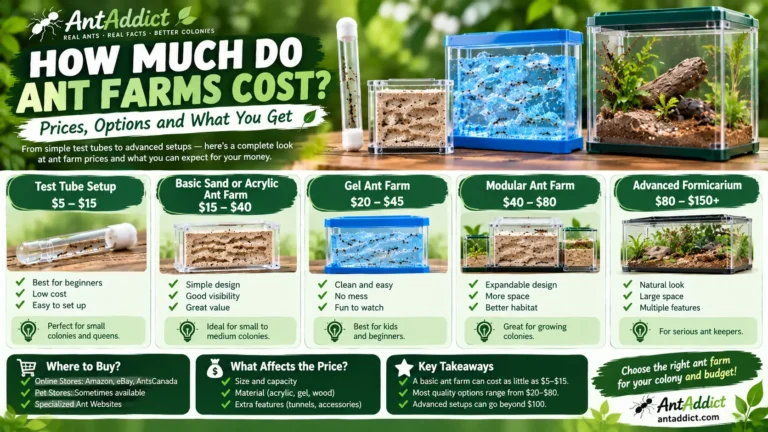
| Gel farm | Nothing alive for long | N/A | High | N/A | $10–25 |
Your Ant Farm Finder result
Is a test tube setup really an ant farm?
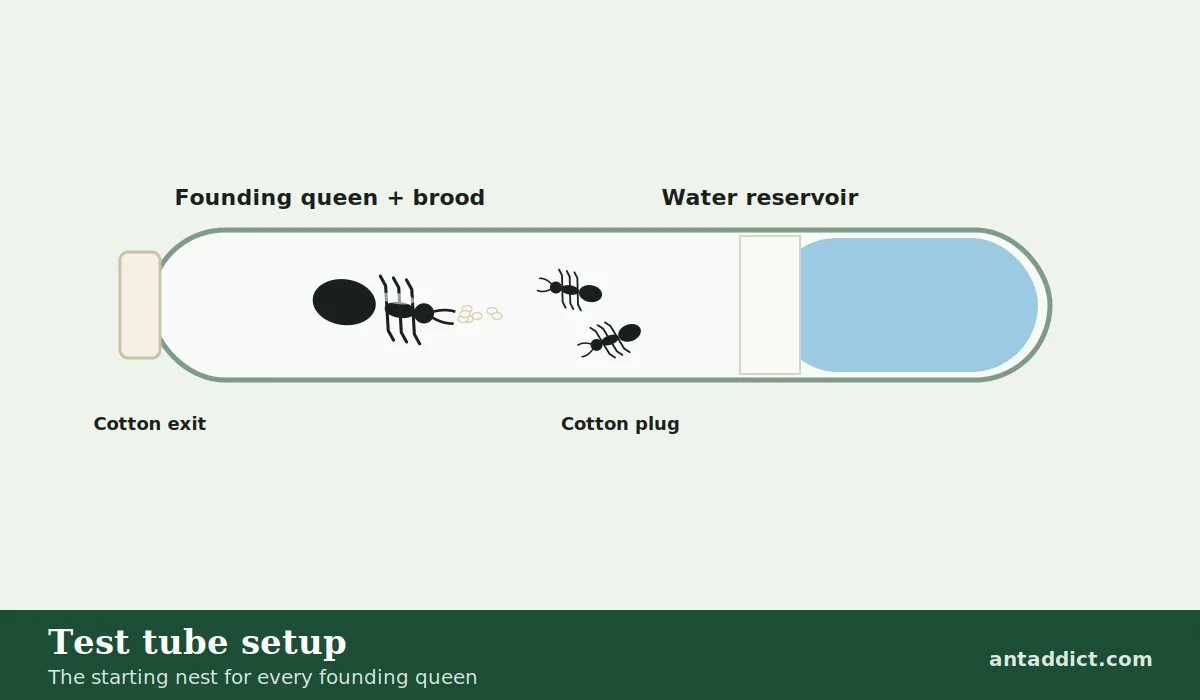
Yes, and it is the one every serious keeper starts with. A glass tube holds water behind a cotton plug, and the queen lives in the dry end. It mimics the small sealed chamber a queen digs after her nuptial flight.
Small is the point. A founding queen and her first workers feel safe in a tight space, and you can watch the brood without disturbing them. Move up once you have about 20–30 workers or the water is running low.
Your Ant Farm Finder result
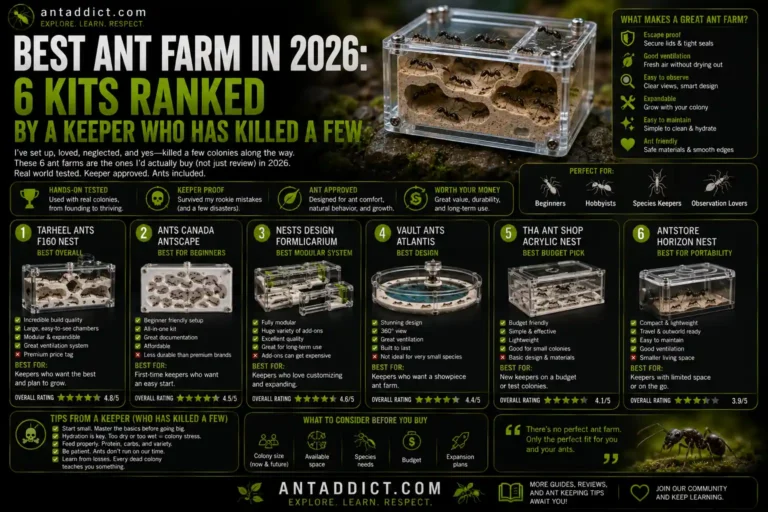
Is an acrylic formicarium worth it?
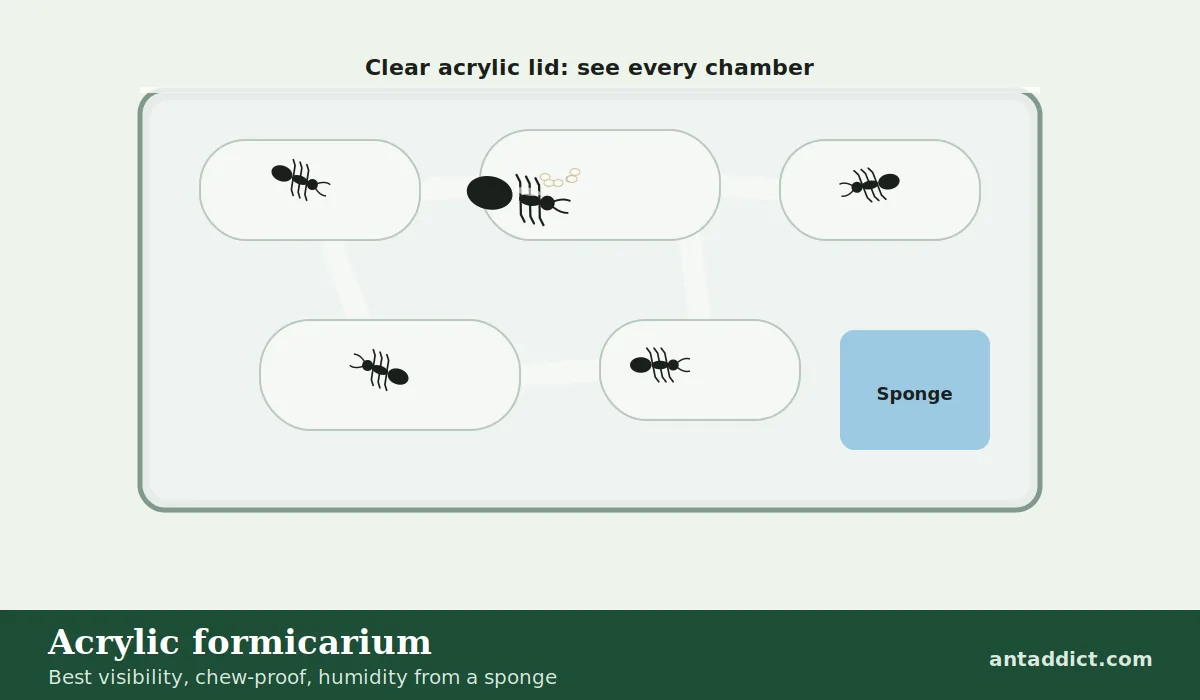
For viewing, nothing beats it. Acrylic nests are laser-cut chambers sealed under a clear lid, so you see every larva and every worker. Acrylic is also chew-proof, which matters for Messor and Pogonomyrmex.
The trade-off is humidity. Acrylic does not hold water, so the nest relies on a sponge, a water tower or a humid chamber. That makes it perfect for dry-loving species and fussier for humidity lovers like Aphaenogaster.
Your Ant Farm Finder result
Why do so many keepers swear by Ytong ant nests?
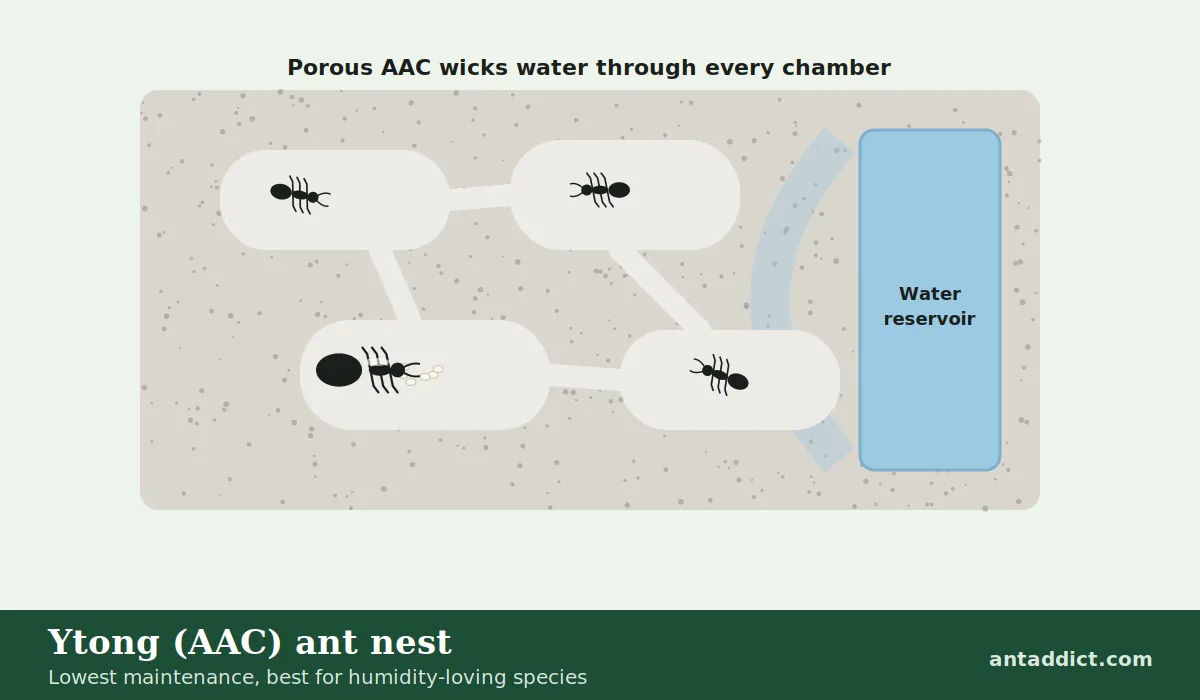
Ytong is aerated autoclaved concrete (AAC). It is full of tiny pores that wick water from a reservoir and spread it evenly through the chambers. Fill the reservoir every one to three weeks and the nest stays stable.
That makes it the low-maintenance pick for humid species like Lasius, Myrmica and Aphaenogaster. The weak spot is strength: Messor and Pogonomyrmex chew through it, and its even moisture can sprout stored seeds.
Your Ant Farm Finder result
Are plaster ant nests still a good choice?
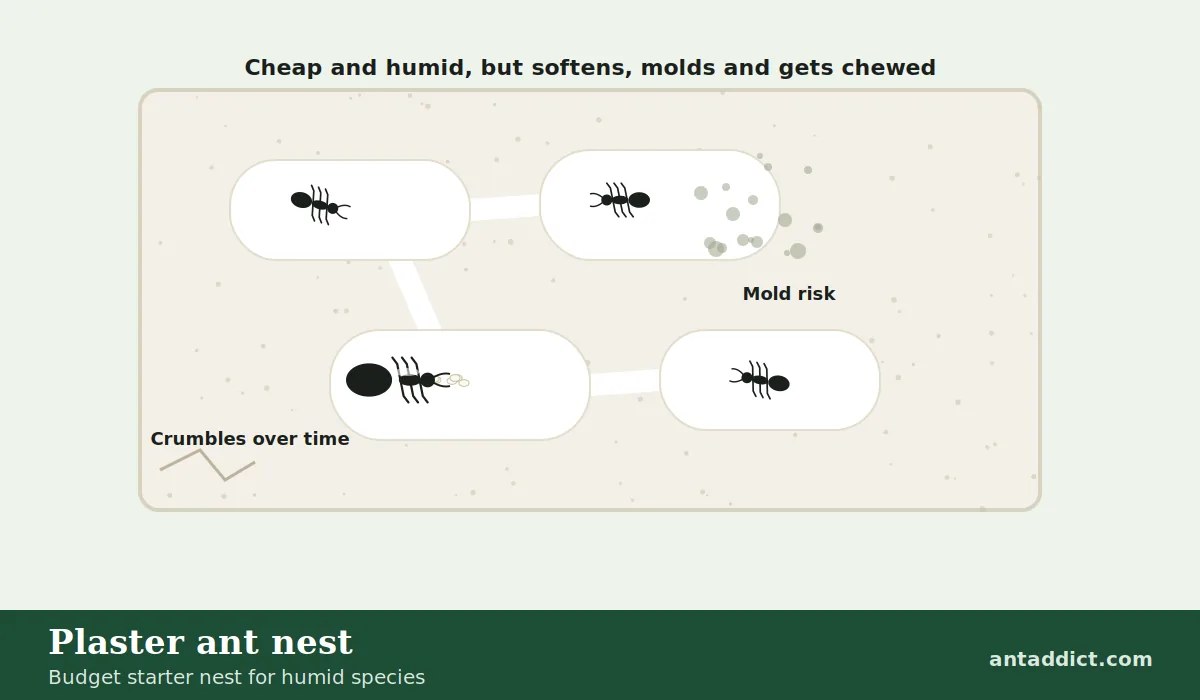
Plaster (gypsum) nests are the budget classic. They hold moisture well and are easy to cast at home. Many keepers raised their first colony in one.
They have real limits, though. Plaster softens when wet, molds more easily than AAC and crumbles under large colonies. Strong-jawed species dig straight through it. Treat it as a cheap starter nest, not a forever home.
Your Ant Farm Finder result
What makes a 3D-printed ant farm different?
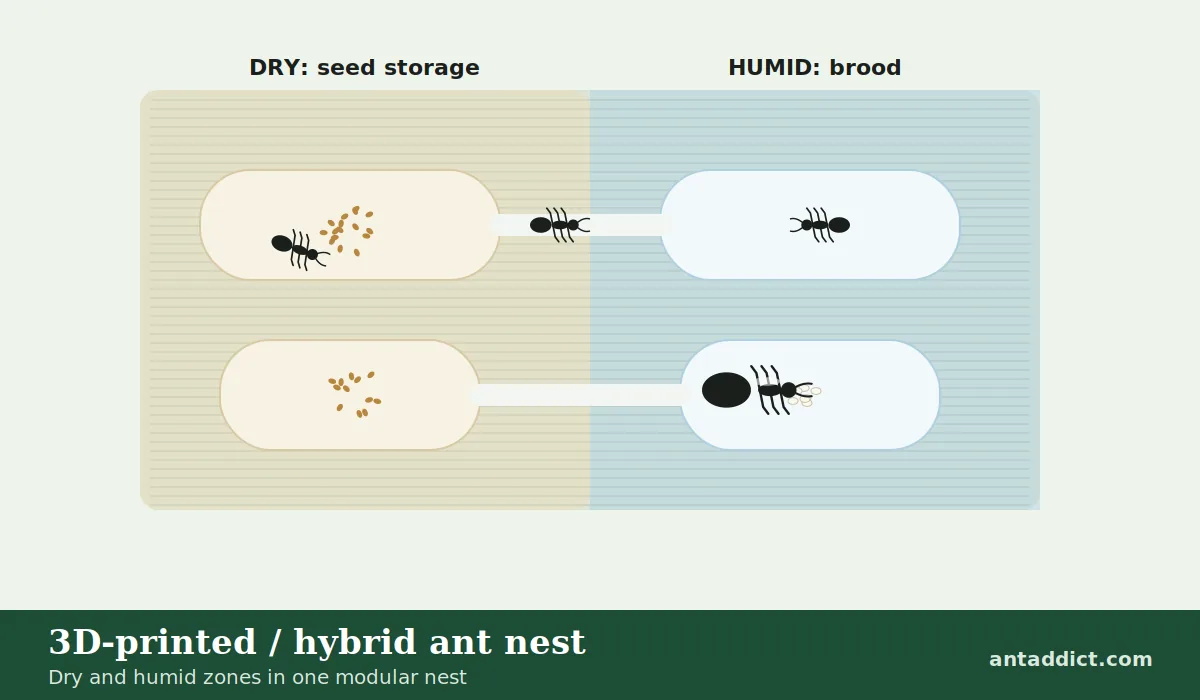
Hybrid nests combine materials: a printed or acrylic body with a separate humid module, often AAC or a sponge chamber. The result is a real humidity gradient, dry on one side and humid on the other.
That gradient is exactly what seed harvesters need. Messor stores seeds in dry chambers and keeps brood in humid ones. Most hybrids are also modular, so a fast-growing colony gets a new section instead of a new nest.
Your Ant Farm Finder result
Which ants need a cork ant nest?
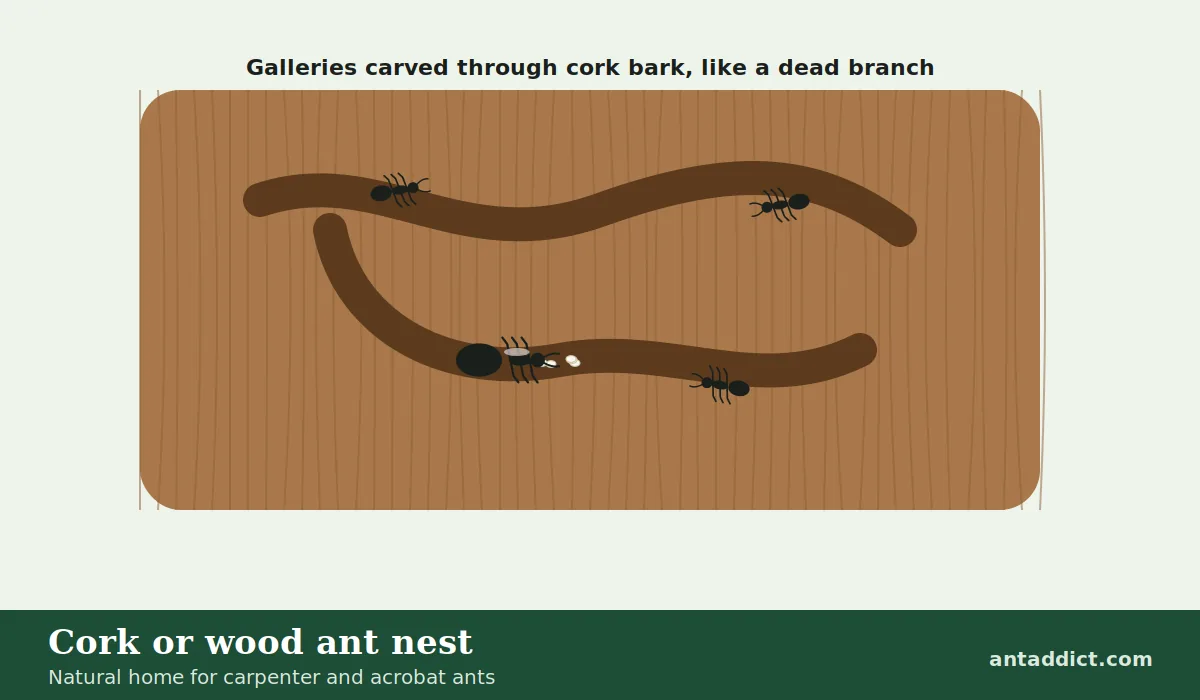
Carpenter ants (Camponotus) and acrobat ants (Crematogaster) nest in wood in the wild. Give them cork bark or a wood block and they settle fast and behave naturally.
You will see less, since most of the action happens inside the wood. Keep it on the dry side, because damp wood molds. Many keepers pair a cork nest with a small humid tube for brood.
Your Ant Farm Finder result
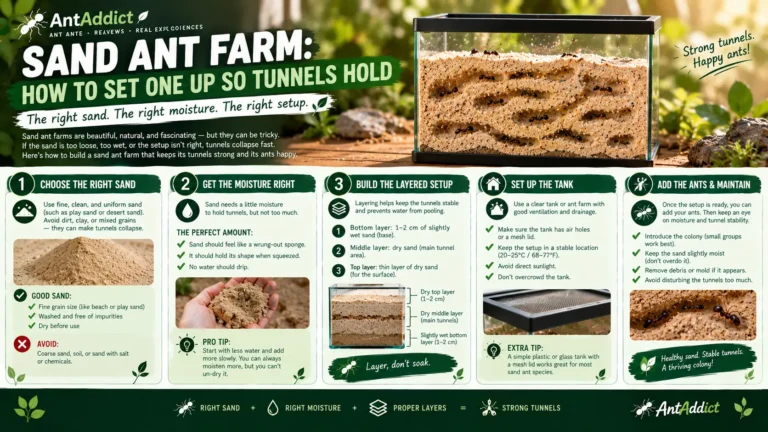
Is a natural ant farm with real soil better than a formicarium?
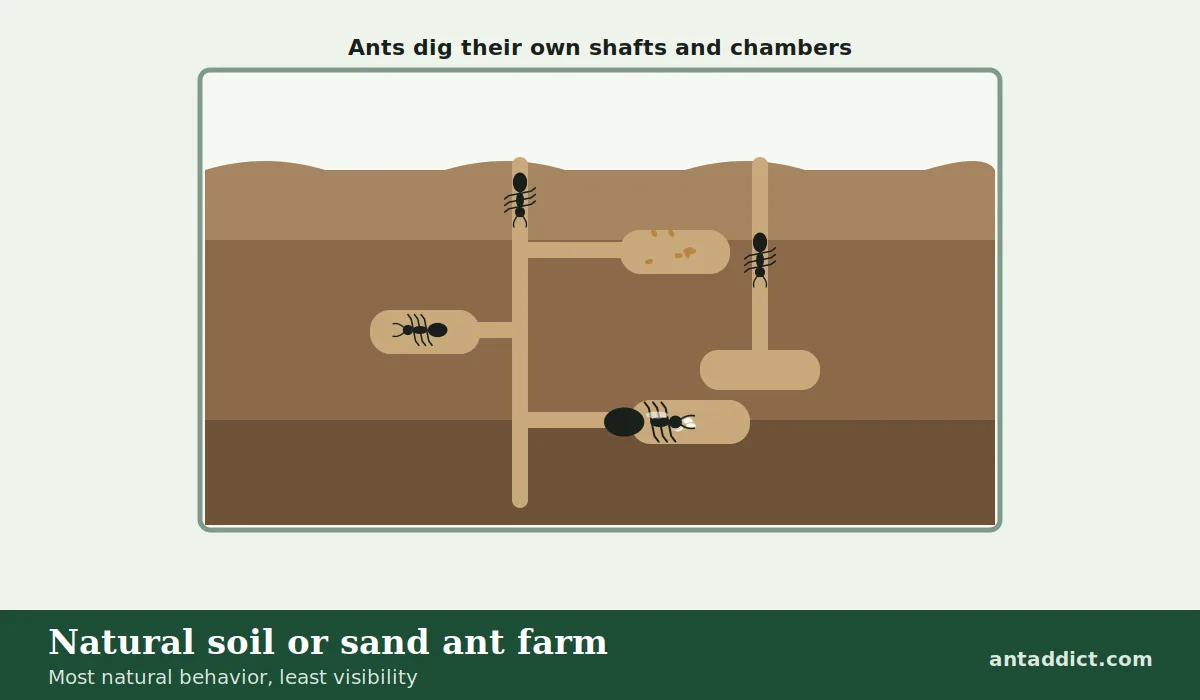
For behavior, yes. In a tank of soil or a sand-loam mix, ants dig their own architecture, sort waste and move brood the way they do outdoors. Wild harvester nests can run several feet deep as stacked chambers joined by shafts [2].
The cost is visibility. Most activity happens out of sight, and a small colony can vanish completely. Use it for established diggers like Messor, Pogonomyrmex, Lasius flavus and Cataglyphis.
Your Ant Farm Finder result
What is the right leafcutter ant farm setup?
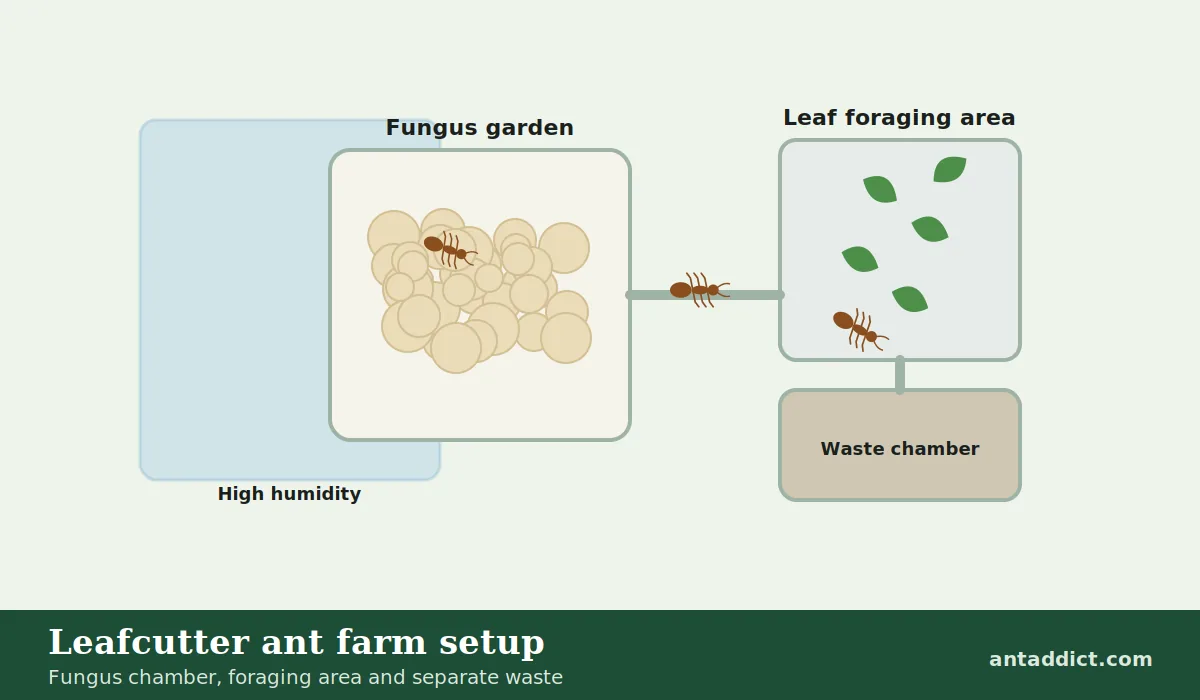
Leafcutters (Atta, Acromyrmex) do not eat leaves. They feed them to a fungus garden and eat the fungus. That garden needs very high humidity, and workers actively choose humid spots to grow it [4].
A proper setup has a fungus chamber, a foraging area for fresh leaves and a separate waste chamber, since these ants isolate their refuse carefully [3]. Check your local laws first: keeping leafcutters is restricted in many countries.
Your Ant Farm Finder result
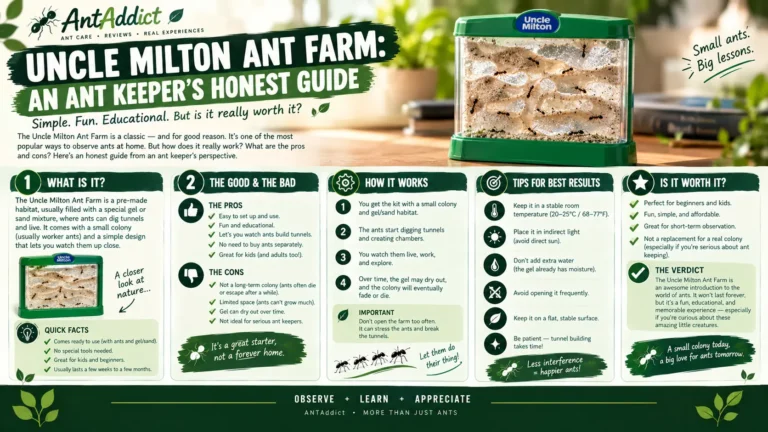
Are classic ant farm kits good for kids?
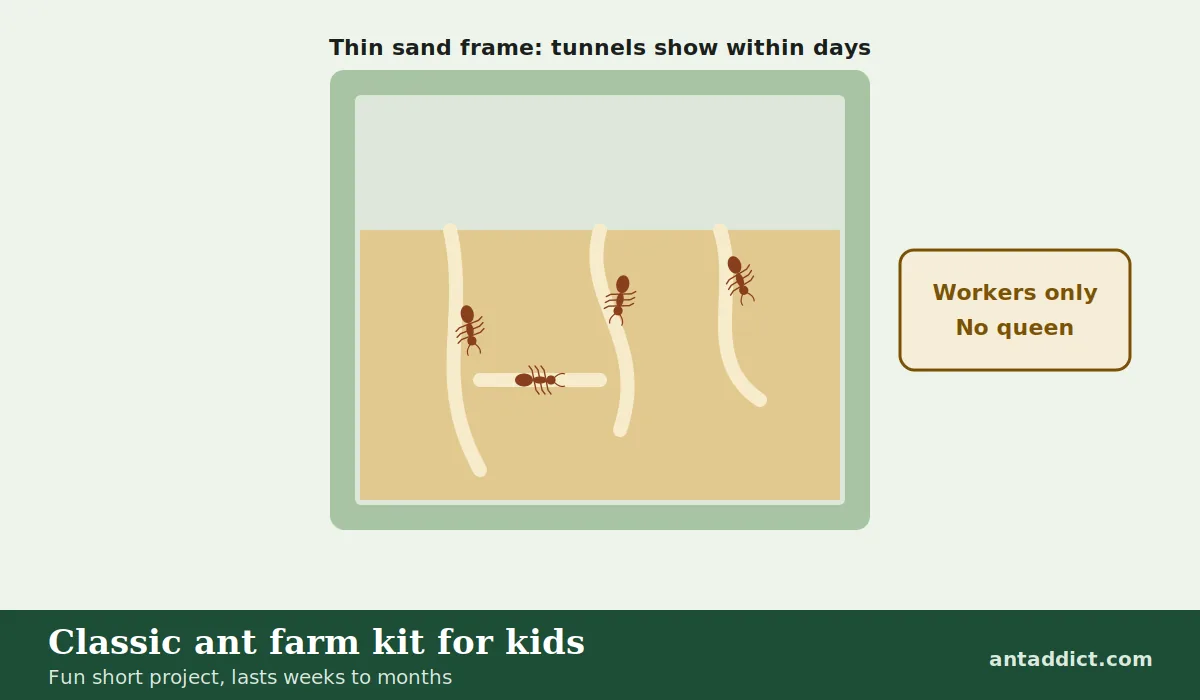
For a short project, yes. Classic kits like the Uncle Milton style ship a thin sand frame and a voucher for live workers. Kids watch tunnels form within days.
Know this before you buy: these kits ship workers without a queen. No queen means no new ants, so the farm lasts weeks to a few months. For a colony that lives for years, start with a caught queen in a test tube instead.
Your Ant Farm Finder result
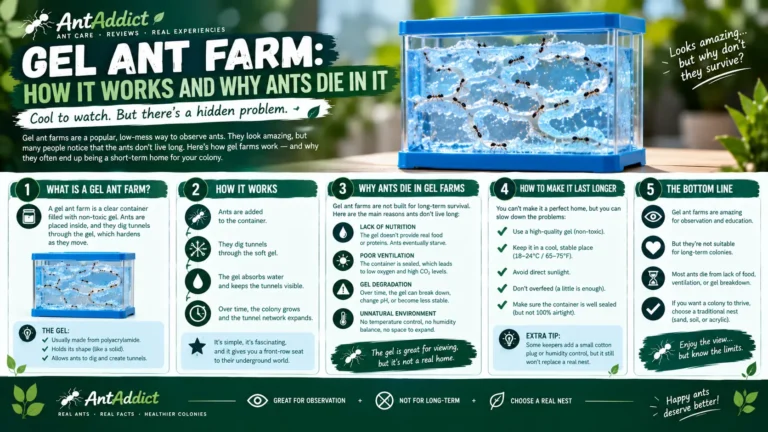
Why gel farms fail living colonies
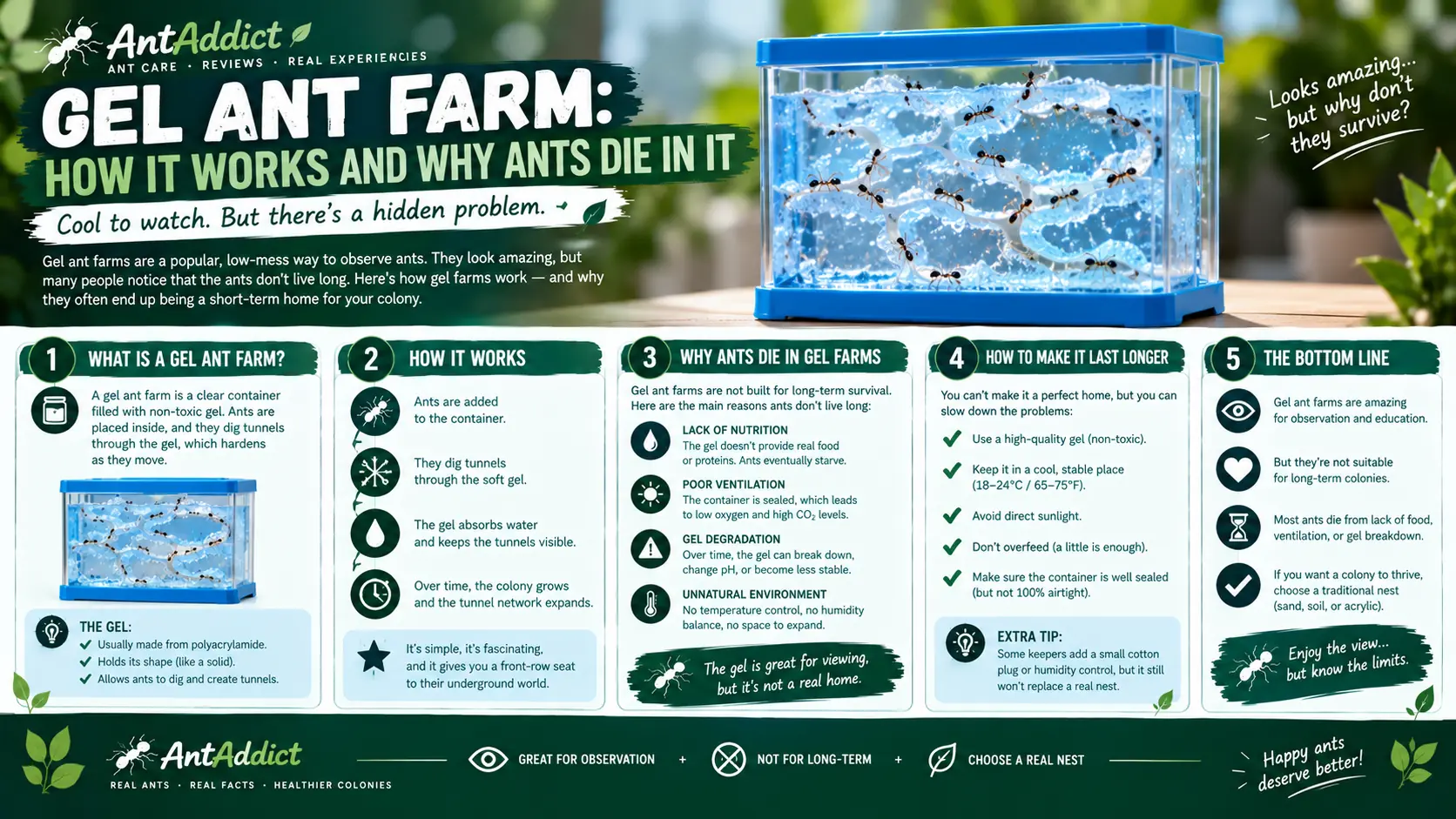
Gel farms look great on a shelf. The blue gel is both nest and food, and tunnels show clearly. As a home for living ants, they fail.
The problems: no room for a queen, a sugar-only diet with no protein, and gel that molds in warm rooms. Workers usually die within weeks. If you already own one, use it as an outworld decoration, not a nest.
Here is the part everyone else skips: an ant farm is a humidity machine
Ants are tiny, so they lose water fast relative to their body size. Species from dry habitats resist drying out far better than species from damp ones [5]. That is why a nest that keeps Myrmica healthy can kill Cataglyphis, and the reverse.
Colonies handle this by moving brood along humidity gradients, so the best nests give them a choice. Size matters too. In digging experiments with Messor sancta, the area excavated tracked the number of workers [6]. Wild colonies build only the space they need, which is why an oversized nest stresses a small colony.
How do I choose between the types of ant farms?
Ask three questions. How humid does my species need it? Can its workers chew soft materials? How big is the colony right now? Those three answers rule out most options. The Ant Farm Finder runs exactly that logic for 17 species.
My honest keeper’s take
If I could only own two nests, I would pick a stack of test tubes and one modular hybrid. Tubes handle every founding queen. The hybrid handles the gradient question and grows with the colony. Everything else is a specialist tool, useful when your species asks for it.
The bottom line
There is no single best ant farm, only the right type of ant farm for your species and colony size. Start every queen in a test tube. Then choose Ytong for humid species, acrylic or hybrid for harvesters and desert ants, cork for carpenter ants, and soil for diggers you don’t need to watch. Skip gel farms entirely.
FAQ
How many types of ant farms are there?
Ten main types: test tube, acrylic, Ytong (AAC), plaster, 3D-printed or hybrid, cork or wood, natural soil or sand, leafcutter fungus setups, queenless sand kits and gel farms.
What is the best type of ant farm for beginners?
A test tube setup for the founding queen, then a Ytong or acrylic nest once the colony reaches about 20–30 workers.
What ant farm is best for Messor ants?
Acrylic or a hybrid nest with separate dry and humid zones. Messor chews through Ytong and plaster, and humid seed chambers make stored seeds sprout or mold.
Do ant farms come with a queen?
Most kits do not. Classic sand kits ship workers only. To get a queen, catch one after a mating flight or buy a legal colony from a local seller.
How long do ants live in an ant farm?
Queenless workers last weeks to months. A queenright colony in the right nest can live for many years, since queens of some species live over a decade.
Are gel ant farms bad for ants?
Yes for long-term keeping. They hold no queen, offer no protein and the gel molds. Workers usually die within weeks.
When should I move ants out of a test tube?
Usually at about 20–30 workers, or when the water reservoir runs low. Connect the tube to the new nest and let them move on their own.
Can ants chew through a Ytong nest?
Strong-jawed species like Messor and Pogonomyrmex can. Most Lasius, Myrmica and Aphaenogaster colonies cannot do real damage.
Which type of ant farm needs the least maintenance?
Ytong. Its reservoir keeps the whole nest humid, and most keepers refill it every one to three weeks.
What ant farm is best for carpenter ants?
Cork or wood for natural behavior, acrylic for viewing. Both need a dry area beside a humid brood area.
Is a bigger ant farm better?
No. A nest far larger than the colony leads to scattered workers, waste in the chambers and mold. Size up as the colony grows.
Last reviewed: October 2026. Prices are typical ranges and change often. As an Amazon Associate, Antaddict earns from qualifying purchases. Check local laws before keeping any species.
References
- Hölldobler, B., & Wilson, E. O. (1990). The Ants. Harvard University Press.
- Tschinkel, W. R. (2004). The nest architecture of the Florida harvester ant, Pogonomyrmex badius. Journal of Insect Science, 4, 21. doi:10.1093/jis/4.1.21
- Hart, A. G., & Ratnieks, F. L. W. (2001). Task partitioning, division of labour and nest compartmentalisation collectively isolate hazardous waste in the leafcutting ant Atta cephalotes. Behavioral Ecology and Sociobiology, 49, 387–392. doi:10.1007/s002650000312
- Roces, F., & Kleineidam, C. (2000). Humidity preference for fungus culturing by workers of the leaf-cutting ant Atta sexdens rubropilosa. Insectes Sociaux, 47, 348–350. doi:10.1007/PL00001728
- Hood, W. G., & Tschinkel, W. R. (1990). Desiccation resistance in arboreal and terrestrial ants. Physiological Entomology, 15, 23–35. doi:10.1111/j.1365-3032.1990.tb00489.x
- Buhl, J., Gautrais, J., Deneubourg, J. L., & Theraulaz, G. (2004). Nest excavation in ants: group size effects on the size and structure of tunneling networks. Naturwissenschaften, 91, 602–606. doi:10.1007/s00114-004-0577-x