
Ant Farm Finder
Pick your species and colony size. You get one clear nest recommendation, the setup specs, and what to avoid.
1Your ant species
Beginner species (8)
Intermediate species (7)
Advanced species (2)
Not sure (1)
2Colony size
3What matters most
4Budget
Best ant farm for your colonyblack garden antcornfield antyellow meadow antcarpenter antsmediterranean harvester anttemperate harvester antred harvester antspavement antbig-headed antswood and field antswinnow antseuropean fire antacrobat antsdesert antshoneypot antstrap-jaw antsleafcutter ants
Species not identifiedLasius nigerLasius neonigerLasius flavusCamponotus pennsylvanicus / spp.Messor barbarusMessor structorPogonomyrmex spp.Tetramorium immigransPheidole spp.Formica spp.Aphaenogaster rudis / senilisMyrmica rubraCrematogaster spp.Cataglyphis spp.Myrmecocystus spp.Odontomachus spp.Atta / Acromyrmex · Queen only or under 20 workers20–200 workers200–1,0001,000+ · Watching themNatural behaviorLow maintenanceKids or classroom · Under $30$30–80$80+ · Change answers
Top pick
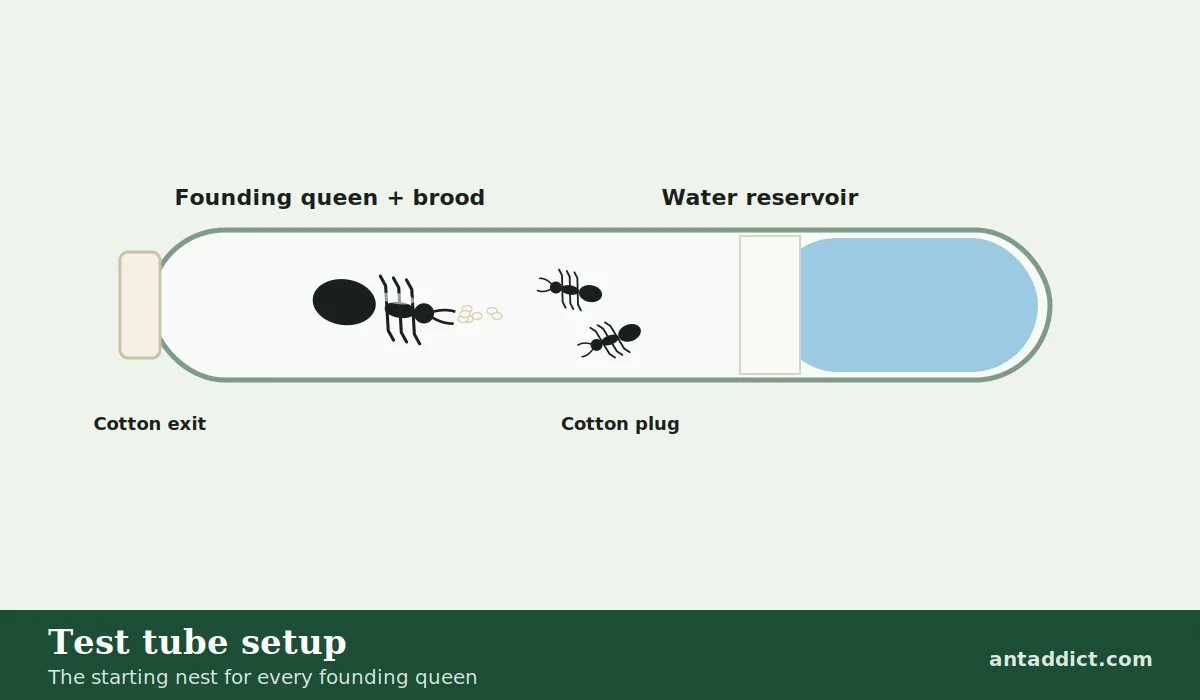
Test tube setup
Typical price $5–15
- Mimics the sealed chamber a queen digs after her flight.
- A tight space keeps a small colony calm and safe.
- You can watch the brood without disturbing them.
Top pick
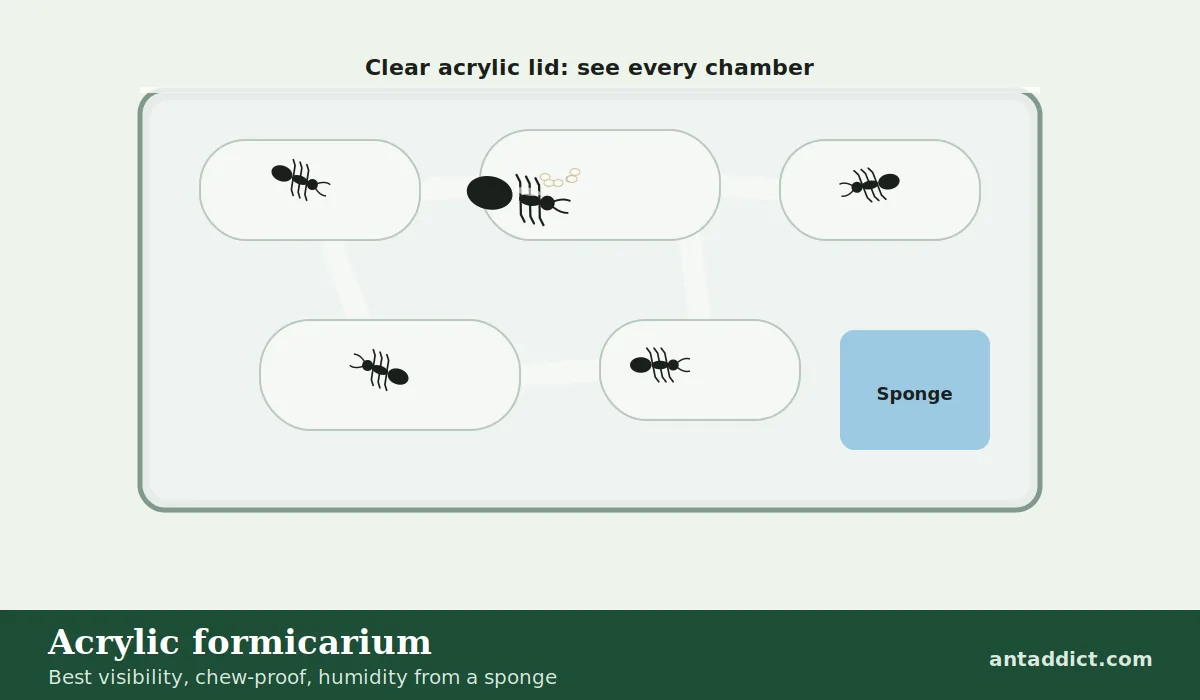
Acrylic formicarium
Typical price $25–80
- Best visibility: flat, clear chambers.
- Chew-proof, even for strong-jawed harvesters.
- You control humidity with the sponge or water tower.
Top pick
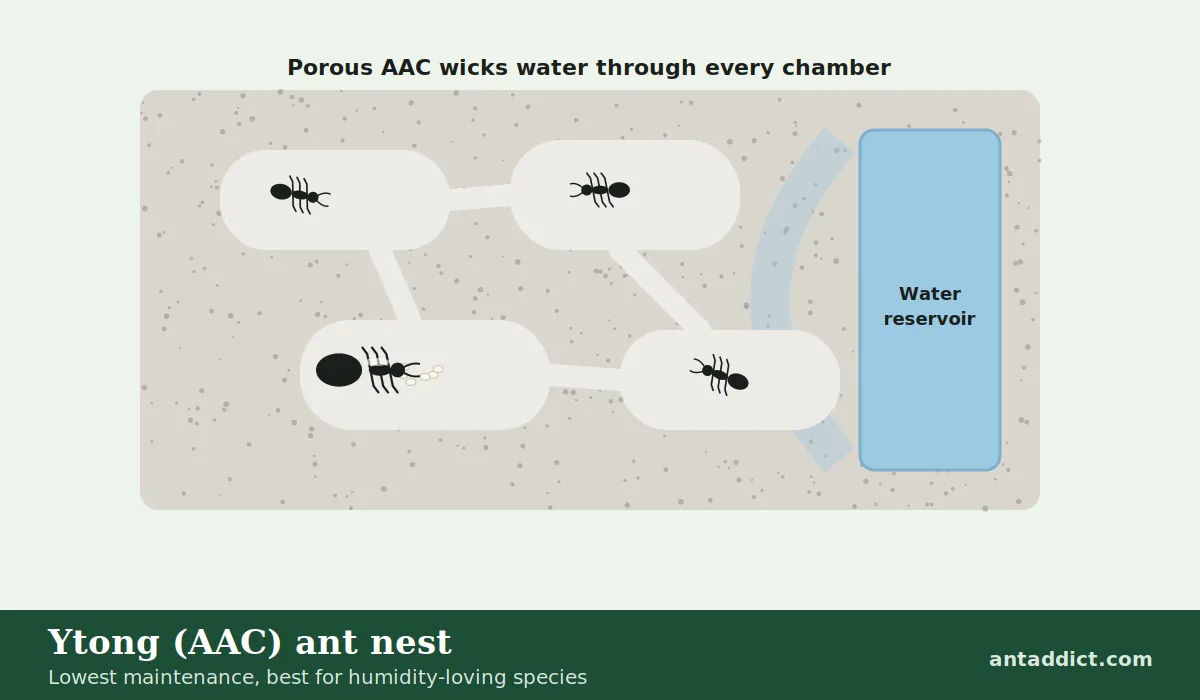
Ytong (AAC) nest
Typical price $20–60
- Porous AAC wicks water evenly through every chamber.
- Lowest maintenance: refill the reservoir every 1–3 weeks.
- Ideal for humidity-loving species.
Top pick
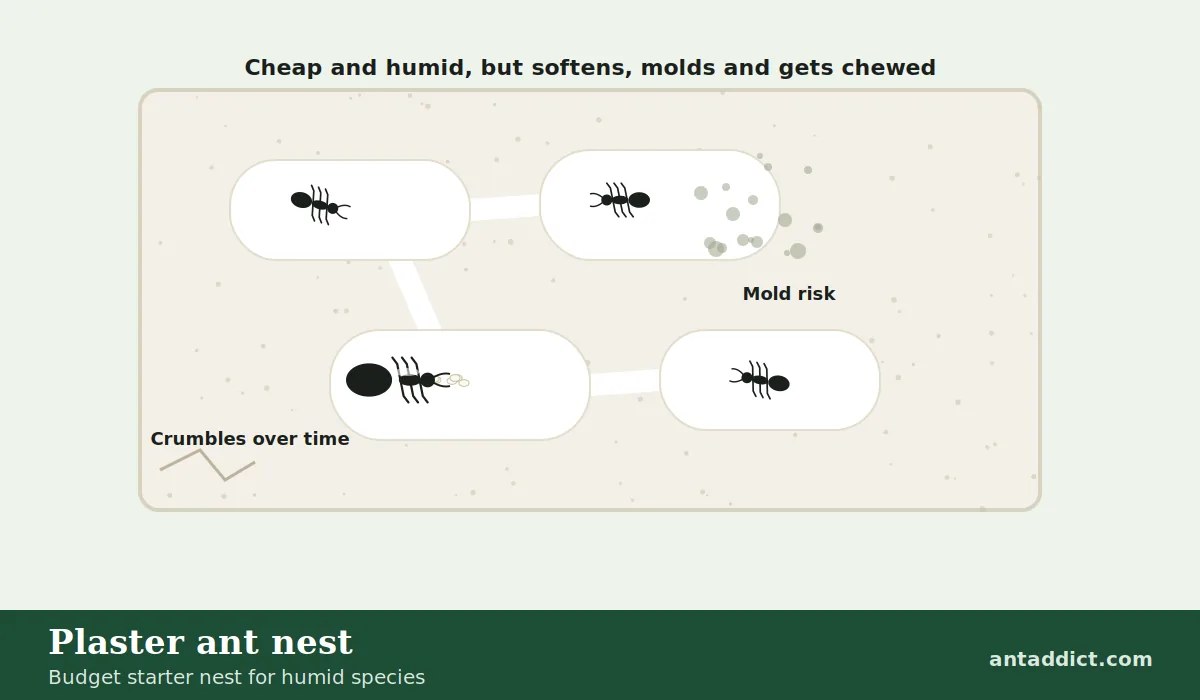
Plaster nest
Typical price $10–30
- Cheapest real nest you can buy or make.
- Holds moisture well for humid species.
- A good starter nest; plan to upgrade later.
Top pick
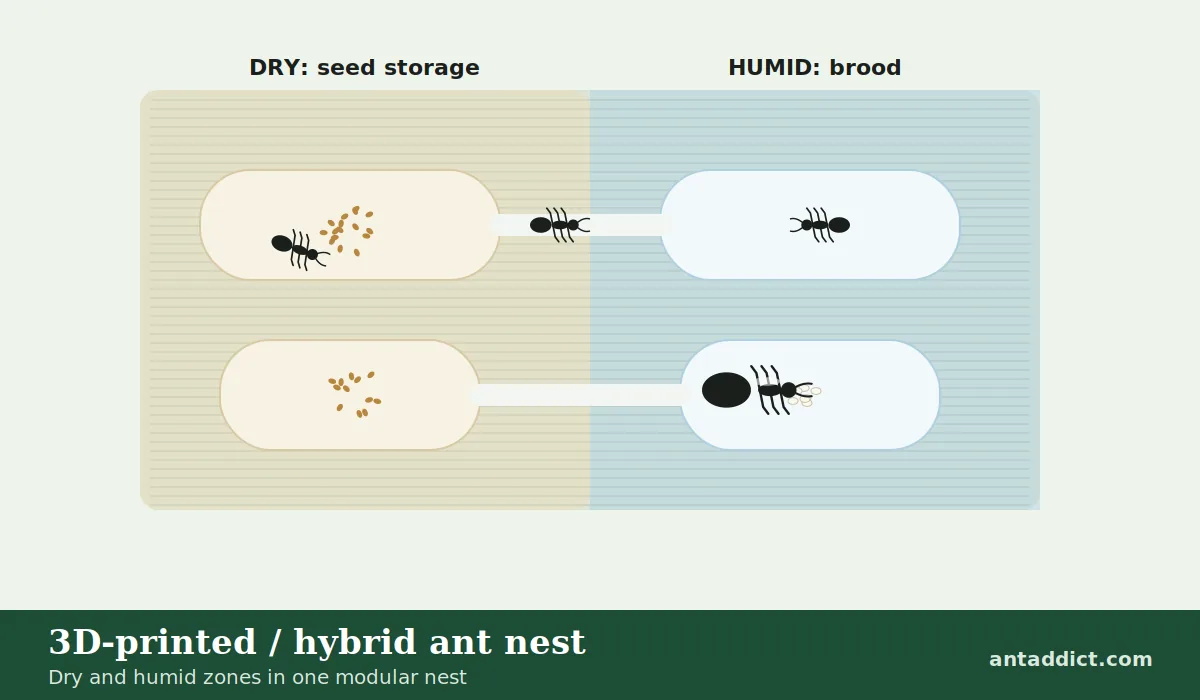
3D-printed / hybrid nest
Typical price $35–120
- Separate dry and humid zones in one nest.
- Modular: add sections as the colony grows.
- Ideal for seed-storing harvesters.
Top pick
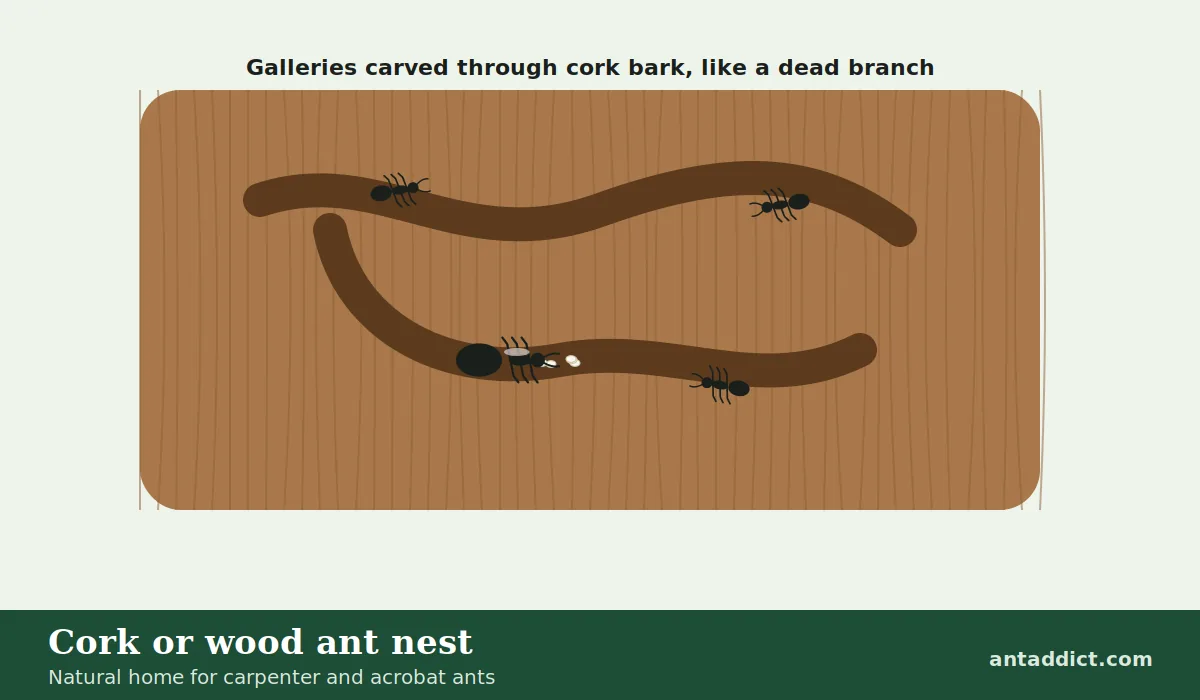
Cork or wood nest
Typical price $15–50
- A natural home for wood-nesting ants.
- Colonies settle fast and behave naturally.
- Keep it dry and pair it with a humid tube for brood.
Top pick
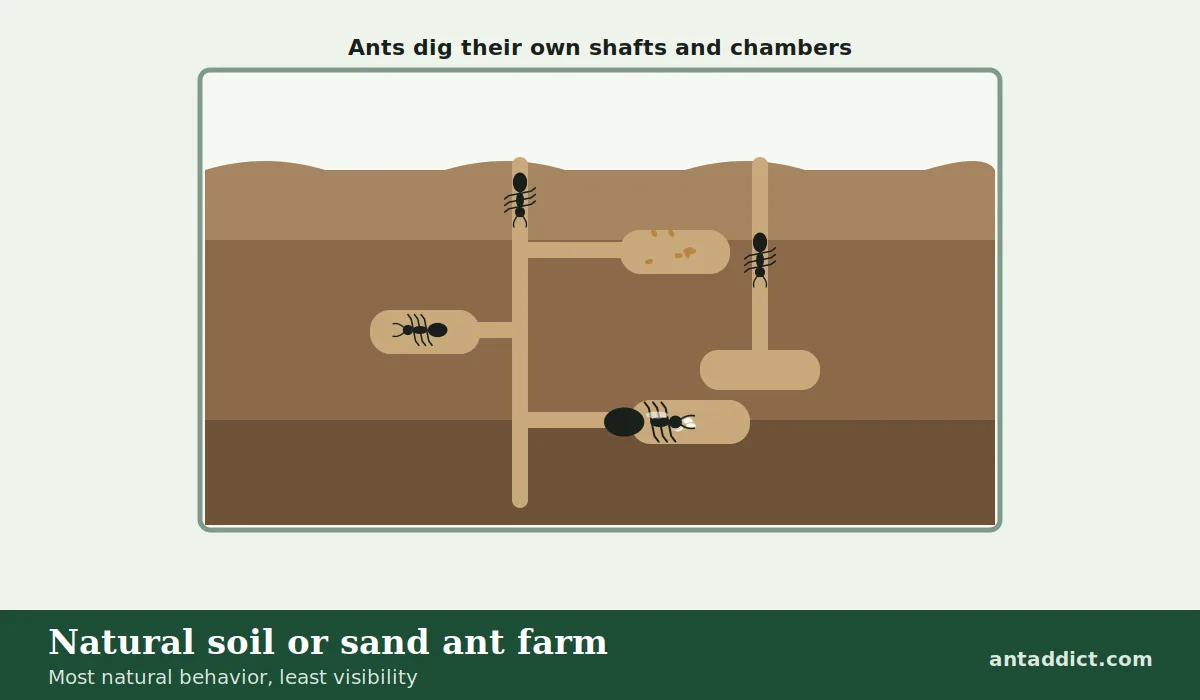
Natural soil or sand setup
Typical price $30–100
- Ants dig their own shafts and chambers.
- The most natural behavior you can watch.
- Best for diggers and established colonies.
Top pick
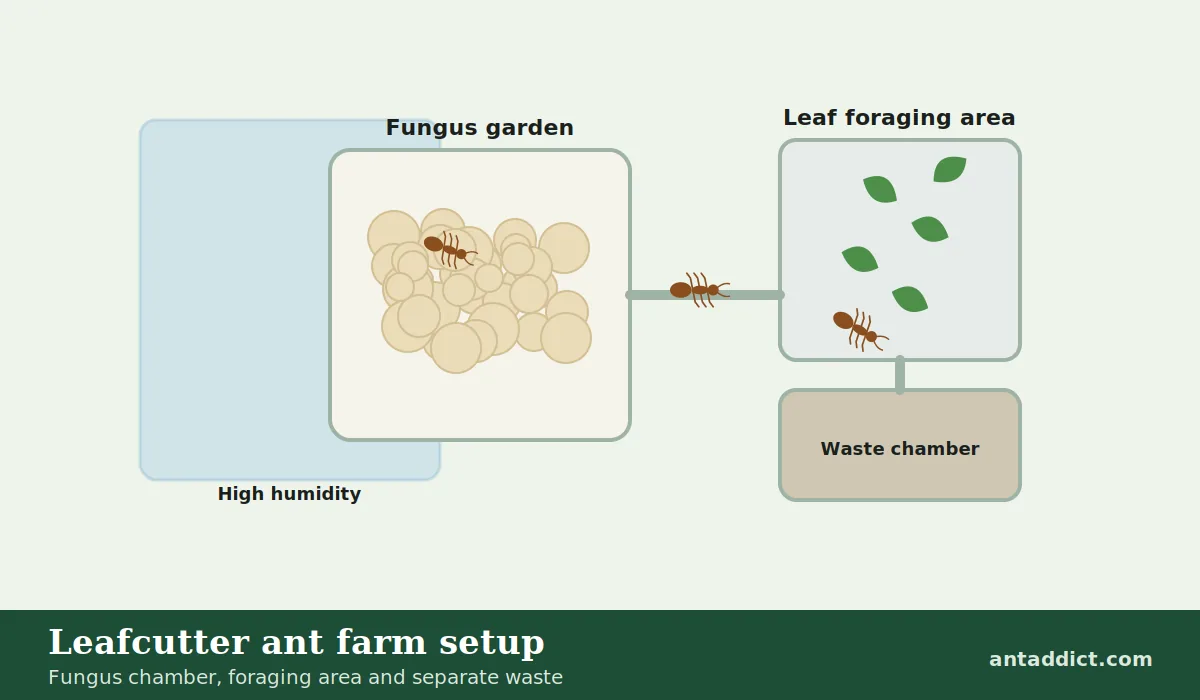
Leafcutter fungus-chamber setup
Typical price $60–200
- Room for the fungus garden leafcutters live on.
- Separate foraging and waste areas.
- Check local laws before keeping leafcutters.
Top pick
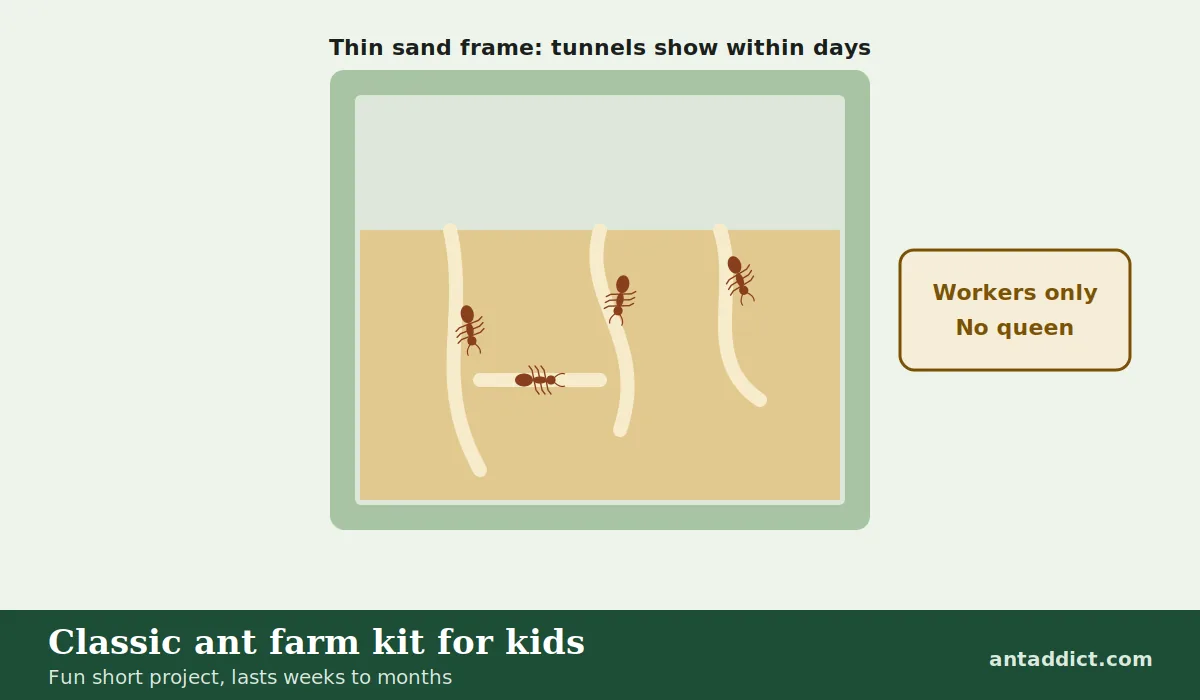
Sand ant farm kit (queenless)
Typical price $15–30
- Made for kids and classrooms: cheap and simple.
- Tunnels show within days.
- Ships workers only, so it lasts weeks to months.
Your next nest at 20–30 workers
Test tube setup
Mimics the sealed chamber a queen digs after her flight. Buy it a few weeks early so it is ready.
Your next nest at 20–30 workers
Acrylic formicarium
Best visibility: flat, clear chambers. Buy it a few weeks early so it is ready.
Your next nest at 20–30 workers
Ytong (AAC) nest
Porous AAC wicks water evenly through every chamber. Buy it a few weeks early so it is ready.
Your next nest at 20–30 workers
Plaster nest
Cheapest real nest you can buy or make. Buy it a few weeks early so it is ready.
Your next nest at 20–30 workers
3D-printed / hybrid nest
Separate dry and humid zones in one nest. Buy it a few weeks early so it is ready.
Your next nest at 20–30 workers
Cork or wood nest
A natural home for wood-nesting ants. Buy it a few weeks early so it is ready.
Your next nest at 20–30 workers
Natural soil or sand setup
Ants dig their own shafts and chambers. Buy it a few weeks early so it is ready.
Your next nest at 20–30 workers
Leafcutter fungus-chamber setup
Room for the fungus garden leafcutters live on. Buy it a few weeks early so it is ready.
Your next nest at 20–30 workers
Sand ant farm kit (queenless)
Made for kids and classrooms: cheap and simple. Buy it a few weeks early so it is ready.
Runner-up
Test tube setup
Mimics the sealed chamber a queen digs after her flight.
Runner-up
Acrylic formicarium
Best visibility: flat, clear chambers.
Runner-up
Ytong (AAC) nest
Porous AAC wicks water evenly through every chamber.
Runner-up
3D-printed / hybrid nest
Separate dry and humid zones in one nest.
Runner-up
Natural soil or sand setup
Ants dig their own shafts and chambers.
Runner-up
Leafcutter fungus-chamber setup
Room for the fungus garden leafcutters live on.
Runner-up
Sand ant farm kit (queenless)
Made for kids and classrooms: cheap and simple.
What any colony needs from a nest
- Identify the species before you buy anything big.
- Moderate humidity with a drier area.
Setup specs
- Humidity
- Moderate: humid brood area, drier elsewhere
- Temperature
- 72–79°F (22–26°C) suits most temperate species
- Winter diapause
- Most temperate species need one; confirm once identified
- Food
- Sugar water + small insects
- Escape risk
- High: tiny workers. Seal gaps and coat outworld walls with PTFE (Fluon).
Keeper note: Identify the species before buying a big nest, because the right material depends on it. A sharp photo of the queen posted on r/antkeeping or Formiculture usually gets an ID within a day.
What Lasius niger needs from a nest
- Moderate humidity with a drier area.
- Tight lids: tiny workers escape through 1/32 in (1 mm) gaps.
Setup specs
- Humidity
- Moderate: humid brood area, drier elsewhere
- Temperature
- 72–77°F (22–25°C)
- Winter diapause
- Yes, 3–4 months at 41–50°F (5–10°C)
- Food
- Sugar water or honey + small insects
- Escape risk
- High: tiny workers. Seal gaps and coat outworld walls with PTFE (Fluon).
Keeper note: Slow first year (often under 20 workers by winter), then fast. Do not rush it into a big nest.
What Lasius neoniger needs from a nest
- Moderate humidity with a drier area.
- Tight lids: tiny workers escape through 1/32 in (1 mm) gaps.
Setup specs
- Humidity
- Moderate: humid brood area, drier elsewhere
- Temperature
- 72–77°F (22–25°C)
- Winter diapause
- Yes, 3–4 months at 41–50°F (5–10°C)
- Food
- Sugar water + small insects
- Escape risk
- High: tiny workers. Seal gaps and coat outworld walls with PTFE (Fluon).
Keeper note: Behaves like L. niger. One of the most common late-summer queens in North America.
What Lasius flavus needs from a nest
- Most of the nest kept humid, never wet.
- Room to dig, or a nest it can expand into.
- Covered chambers: it is very light-shy.
- Tight lids: tiny workers escape through 1/32 in (1 mm) gaps.
- A small nest for a long time: it grows slowly.
Setup specs
- Humidity
- High: keep most of the nest damp, never wet
- Temperature
- 70–77°F (21–25°C)
- Winter diapause
- Yes, 3–4 months at 41–50°F (5–10°C)
- Food
- Sugar water + small insects (wild colonies farm root aphids)
- Escape risk
- High: tiny workers. Seal gaps and coat outworld walls with PTFE (Fluon).
Keeper note: Almost fully subterranean and light-shy. Expect to see little unless the nest is covered.
What Camponotus pennsylvanicus / spp. needs from a nest
- Moderate humidity with a drier area.
- Hard walls: majors can slowly scrape soft AAC.
- Wood or cork, which feels like home.
- A small nest for a long time: it grows slowly.
Setup specs
- Humidity
- Moderate: humid brood area, drier elsewhere
- Temperature
- 75–82°F (24–28°C)
- Winter diapause
- Yes, about 4 months at 41–50°F (5–10°C)
- Food
- Sugar water + insects
- Escape risk
- Moderate: coat outworld walls with PTFE (Fluon) or a talc barrier.
Keeper note: Very slow start; majors usually appear in year two. Wants a dry area next to a humid brood area.
What Messor barbarus needs from a nest
- Separate dry seed rooms and humid brood rooms.
- Chew-proof material. Skip Ytong and plaster.
- Room to dig, or a nest it can expand into.
- An expandable nest: it grows fast.
Setup specs
- Humidity
- Gradient: dry seed chambers plus humid brood chambers
- Temperature
- 77–86°F (25–30°C)
- Winter diapause
- Mild winter rest, about 2–3 months near 59°F (15°C)
- Food
- Seeds (grass, chia, poppy) + occasional insects
- Escape risk
- Moderate: coat outworld walls with PTFE (Fluon) or a talc barrier.
Keeper note: Stores seeds in dry chambers; humid seed chambers sprout and mold. Strong mandibles chew soft nest materials.
What Messor structor needs from a nest
- Separate dry seed rooms and humid brood rooms.
- Chew-proof material. Skip Ytong and plaster.
- Room to dig, or a nest it can expand into.
- An expandable nest: it grows fast.
Setup specs
- Humidity
- Gradient: dry seed chambers plus humid brood chambers
- Temperature
- 75–82°F (24–28°C)
- Winter diapause
- Yes, 3–4 months at 41–50°F (5–10°C)
- Food
- Seeds + occasional insects
- Escape risk
- Moderate: coat outworld walls with PTFE (Fluon) or a talc barrier.
Keeper note: Same seed-storage needs as M. barbarus, but needs a real winter diapause.
What Pogonomyrmex spp. needs from a nest
- A mostly dry nest with one humid spot.
- Chew-proof material. Skip Ytong and plaster.
- Room to dig, or a nest it can expand into.
Setup specs
- Humidity
- Low: mostly dry nest, one humid corner
- Temperature
- 80–90°F (27–32°C)
- Winter diapause
- Yes, cool winter rest near 50°F (10°C)
- Food
- Seeds + insects
- Escape risk
- Moderate: coat outworld walls with PTFE (Fluon) or a talc barrier.
Keeper note: Painful sting. Dry-country diggers that chew soft materials.
What Tetramorium immigrans needs from a nest
- Moderate humidity with a drier area.
- Tight lids: tiny workers escape through 1/32 in (1 mm) gaps.
- An expandable nest: it grows fast.
Setup specs
- Humidity
- Moderate: humid brood area, drier elsewhere
- Temperature
- 75–82°F (24–28°C)
- Winter diapause
- Yes, 3–4 months at 41–50°F (5–10°C)
- Food
- Sugar water, insects, some seeds
- Escape risk
- High: tiny workers. Seal gaps and coat outworld walls with PTFE (Fluon).
Keeper note: Explosive growth and tiny workers. Buy one nest size up and seal every gap.
What Pheidole spp. needs from a nest
- Most of the nest kept humid, never wet.
- Tight lids: tiny workers escape through 1/32 in (1 mm) gaps.
- An expandable nest: it grows fast.
Setup specs
- Humidity
- High: keep most of the nest damp, never wet
- Temperature
- 75–82°F (24–28°C)
- Winter diapause
- Depends on species: temperate yes, tropical no
- Food
- Insects, sugar water, seeds
- Escape risk
- High: tiny workers. Seal gaps and coat outworld walls with PTFE (Fluon).
Keeper note: Minors are tiny escape artists; majors crush seeds and prey.
What Formica spp. needs from a nest
- Moderate humidity with a drier area.
- Room to dig, or a nest it can expand into.
- An expandable nest: it grows fast.
Setup specs
- Humidity
- Moderate: humid brood area, drier elsewhere
- Temperature
- 72–79°F (22–26°C)
- Winter diapause
- Yes, 4–5 months at 41–50°F (5–10°C)
- Food
- Insects + sugar water
- Escape risk
- Moderate: coat outworld walls with PTFE (Fluon) or a talc barrier.
Keeper note: Fast, nervous climbers that spray formic acid. They need a big outworld and hate disturbance.
What Aphaenogaster rudis / senilis needs from a nest
- Most of the nest kept humid, never wet.
- Room to dig, or a nest it can expand into.
Setup specs
- Humidity
- High: keep most of the nest damp, never wet
- Temperature
- 70–77°F (21–25°C)
- Winter diapause
- Yes, 3–4 months at 41–50°F (5–10°C)
- Food
- Insects + sugar water
- Escape risk
- Moderate: coat outworld walls with PTFE (Fluon) or a talc barrier.
Keeper note: Shy, humidity-loving diggers. Very forgiving for a first colony.
What Myrmica rubra needs from a nest
- Most of the nest kept humid, never wet.
- Tight lids: tiny workers escape through 1/32 in (1 mm) gaps.
- An expandable nest: it grows fast.
Setup specs
- Humidity
- High: keep most of the nest damp, never wet
- Temperature
- 68–75°F (20–24°C)
- Winter diapause
- Yes, 3–5 months at 41–50°F (5–10°C)
- Food
- Insects + sugar water
- Escape risk
- High: tiny workers. Seal gaps and coat outworld walls with PTFE (Fluon).
Keeper note: Multi-queen and can sting. Likes it cool and damp.
What Crematogaster spp. needs from a nest
- Moderate humidity with a drier area.
- Wood or cork, which feels like home.
- Tight lids: tiny workers escape through 1/32 in (1 mm) gaps.
Setup specs
- Humidity
- Moderate: humid brood area, drier elsewhere
- Temperature
- 75–82°F (24–28°C)
- Winter diapause
- Temperate species: yes, 3–4 months
- Food
- Sugar water + small insects
- Escape risk
- High: tiny workers. Seal gaps and coat outworld walls with PTFE (Fluon).
Keeper note: Small, tree- and wood-nesting ants. Cork bark suits them well.
What Cataglyphis spp. needs from a nest
- A mostly dry nest with one humid spot.
- Room to dig, or a nest it can expand into.
Setup specs
- Humidity
- Low: mostly dry nest, one humid corner
- Temperature
- 86–95°F (30–35°C)
- Winter diapause
- Mild winter rest near 59°F (15°C)
- Food
- Mostly insects, a little sugar
- Escape risk
- Moderate: coat outworld walls with PTFE (Fluon) or a talc barrier.
Keeper note: Heat-loving sprinters. Bone-dry nest with a single humid spot.
What Myrmecocystus spp. needs from a nest
- A mostly dry nest with one humid spot.
- Room to dig, or a nest it can expand into.
- A small nest for a long time: it grows slowly.
Setup specs
- Humidity
- Low: mostly dry nest, one humid corner
- Temperature
- 80–90°F (27–32°C)
- Winter diapause
- Yes, cool winter rest near 50°F (10°C)
- Food
- Sugar water + insects
- Escape risk
- Moderate: coat outworld walls with PTFE (Fluon) or a talc barrier.
Keeper note: Repletes hang from chamber ceilings. Needs tall chambers and a dry nest.
What Odontomachus spp. needs from a nest
- Most of the nest kept humid, never wet.
- A small nest for a long time: it grows slowly.
Setup specs
- Humidity
- High: keep most of the nest damp, never wet
- Temperature
- 77–82°F (25–28°C)
- Winter diapause
- Most kept species: no
- Food
- Live or freshly killed insects
- Escape risk
- Moderate: coat outworld walls with PTFE (Fluon) or a talc barrier.
Keeper note: Small colonies that feed almost only on insects. Keep warm and humid.
What Atta / Acromyrmex needs from a nest
- A dedicated fungus chamber and fresh leaves every day.
- Most of the nest kept humid, never wet.
- Chew-proof material. Skip Ytong and plaster.
- An expandable nest: it grows fast.
Setup specs
- Humidity
- High: keep most of the nest damp, never wet
- Temperature
- 75–80°F (24–27°C), 80%+ humidity
- Winter diapause
- No
- Food
- Fresh leaves daily to feed their fungus
- Escape risk
- Moderate: coat outworld walls with PTFE (Fluon) or a talc barrier.
Keeper note: They farm fungus, not food. Check the law first: keeping them is restricted in many countries.
Nest size: Stay in the test tube until about 20–30 workers or until the water runs low. See the test tube setup guide.
Nest size: A nest with 2–4 small chambers. Colonies prefer it slightly cramped.
Nest size: A modular nest you can expand, with an outworld around 12×8 in (30×20 cm).
Nest size: A multi-module system or large tank, with an outworld of 16×12 in (40×30 cm) or more.
Skip these
Gel ant farms: no space for a queen, the gel molds, and it doubles as their only food. Why
Acrylic formicarium: Very light-shy: you will keep it covered most of the time anyway. Why
Cork or wood nest: Damp wood molds quickly. Why
Cork or wood nest: Damp wood molds quickly. Why
Cork or wood nest: Damp wood molds quickly. Why
Ytong (AAC) nest: Strong mandibles chew through AAC. Expect dust, tunnels and escapes. Why
Ytong (AAC) nest: Strong mandibles chew through AAC. Expect dust, tunnels and escapes. Why
Ytong (AAC) nest: Strong mandibles chew through AAC. Expect dust, tunnels and escapes. Why
Ytong (AAC) nest: Strong mandibles chew through AAC. Expect dust, tunnels and escapes. Why
Ytong (AAC) nest: Strong mandibles chew through AAC. Expect dust, tunnels and escapes. Why
Ytong (AAC) nest: Strong mandibles chew through AAC. Expect dust, tunnels and escapes. Why
Ytong (AAC) nest: Strong mandibles chew through AAC. Expect dust, tunnels and escapes. Why
Ytong (AAC) nest: Strong mandibles chew through AAC. Expect dust, tunnels and escapes. Why
Ytong (AAC) nest: Strong mandibles chew through AAC. Expect dust, tunnels and escapes. Why
Ytong (AAC) nest: Strong mandibles chew through AAC. Expect dust, tunnels and escapes. Why
Ytong (AAC) nest: Strong mandibles chew through AAC. Expect dust, tunnels and escapes. Why
Ytong (AAC) nest: Strong mandibles chew through AAC. Expect dust, tunnels and escapes. Why
Cork or wood nest: Damp wood molds quickly. Why
Cork or wood nest: Damp wood molds quickly. Why
Cork or wood nest: Damp wood molds quickly. Why
Cork or wood nest: Damp wood molds quickly. Why
Cork or wood nest: Damp wood molds quickly. Why
Cork or wood nest: Damp wood molds quickly. Why
Cork or wood nest: Damp wood molds quickly. Why
Cork or wood nest: Damp wood molds quickly. Why
Cork or wood nest: Damp wood molds quickly. Why
Cork or wood nest: Damp wood molds quickly. Why
Cork or wood nest: Damp wood molds quickly. Why
Cork or wood nest: Damp wood molds quickly. Why
Plaster nest: Plaster stays damp; this species wants it mostly dry. Why
Plaster nest: Plaster stays damp; this species wants it mostly dry. Why
Plaster nest: Plaster stays damp; this species wants it mostly dry. Why
Plaster nest: Plaster stays damp; this species wants it mostly dry. Why
Plaster nest: Plaster stays damp; this species wants it mostly dry. Why
Plaster nest: Plaster stays damp; this species wants it mostly dry. Why
Cork or wood nest: Damp wood molds quickly. Why
Cork or wood nest: Damp wood molds quickly. Why
Cork or wood nest: Damp wood molds quickly. Why
Cork or wood nest: Damp wood molds quickly. Why
Acrylic formicarium: No room for a fungus garden. Leafcutters starve without one. Why
3D-printed / hybrid nest: No room for a fungus garden. Leafcutters starve without one. Why
3D-printed / hybrid nest: No room for a fungus garden. Leafcutters starve without one. Why
Ytong (AAC) nest: No room for a fungus garden. Leafcutters starve without one. Why
At this size: Any big nest. Too much space makes a tiny colony scatter and lets mold build up.
At this size: Soil tanks. A small colony disappears into them.
At this size: Test tubes and tiny starter nests. The colony has outgrown them.
At this size: Single small nests. Plan for expansion modules from now on.
As an Amazon Associate, Antaddict earns from qualifying purchases. Prices are typical ranges, not live quotes. Species data reflects common keeper practice; check local laws before keeping any species.