Ant Farm: The Complete Guide to Keeping Ants at Home
What an ant farm is, how every type compares, how to set one up, which ants to keep, and how to choose one that lasts
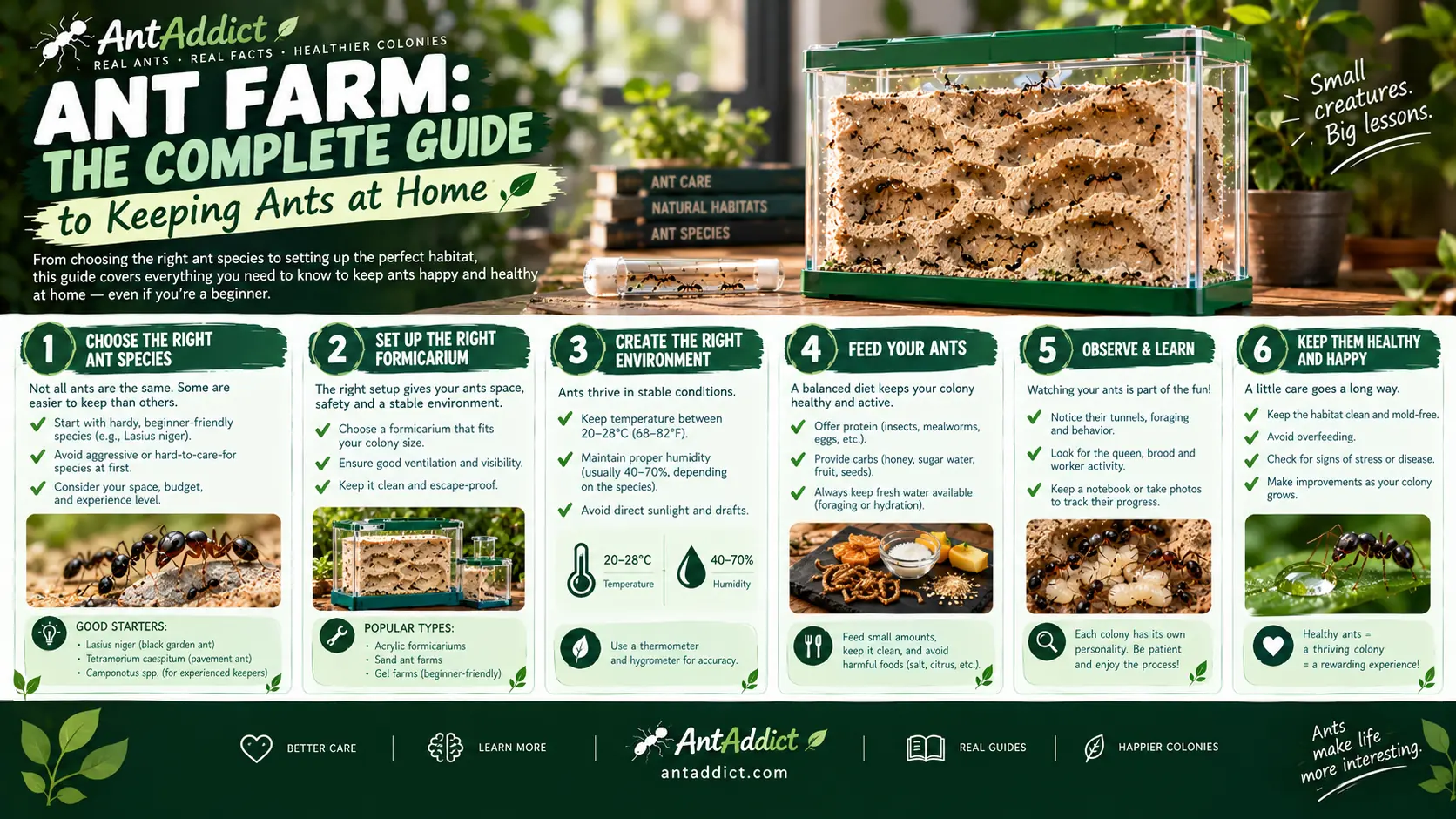
Quick Answer: An ant farm (also called a formicarium) is an enclosure that lets you house and watch a living ant colony. Toy ant farms hold a tube of queenless worker ants that live a few weeks to a few months. A real ant farm houses a queen-right colony that grows for years. For most people, the best start is a mated queen in a test tube, then a small formicarium with a water reservoir and a feeding area once the colony has a few dozen workers.
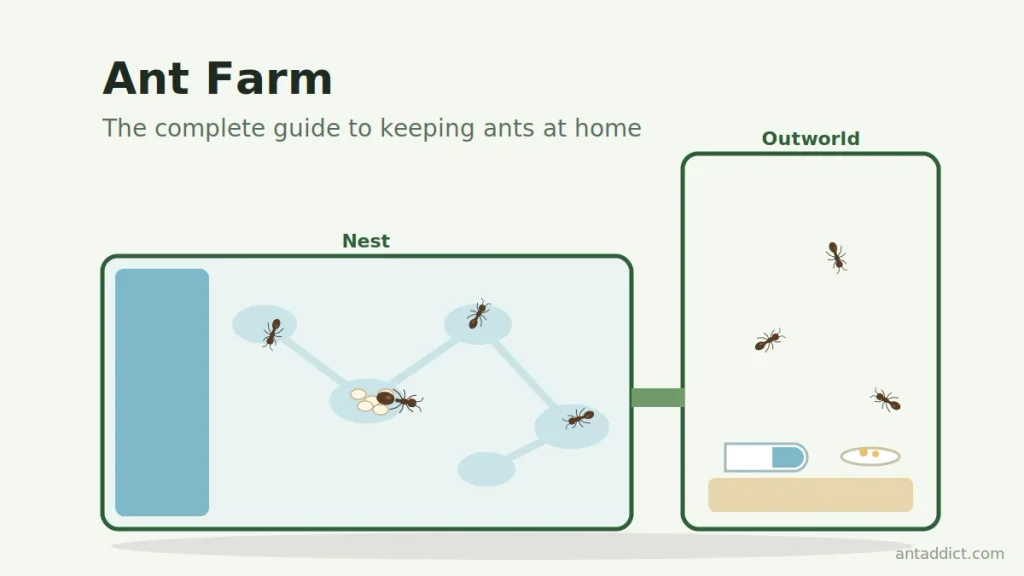
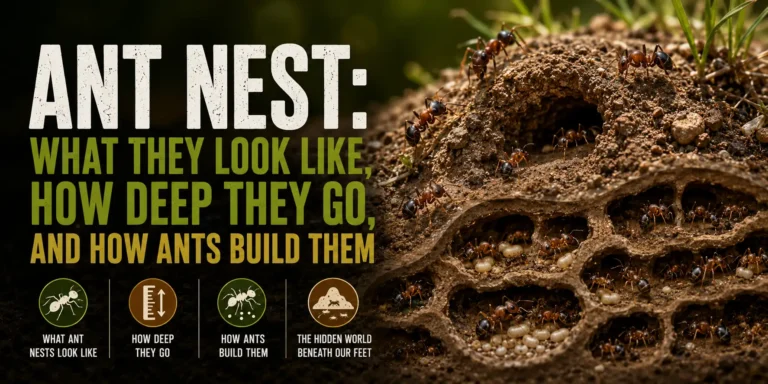
Ant farm overview: a living ant colony in a formicarium with nest chambers, brood, and an outworld
I have kept ant colonies for six years, and for many keepers the hobby starts the same way: with an ant farm. The phrase covers everything from an inexpensive toy with mailed harvester ants to a modular acrylic system housing thousands of workers. Those are very different things, and choosing the wrong one is why so many first ant farms end with an empty box.
This is the complete guide. It covers what an ant farm is, where it came from, every type on the market, how to set one up, which species to keep, how to feed and maintain a colony, the US rules on shipping queens, and which ant farm to buy. Each section links to a deeper guide when you want more detail.
Start here: the Antaddict ant farm guides
| If you want to… | Read this |
|---|---|
| Pick the right ant farm to buy | Best ant farm |
| Choose a hobby-grade nest for a real colony | Best formicarium |
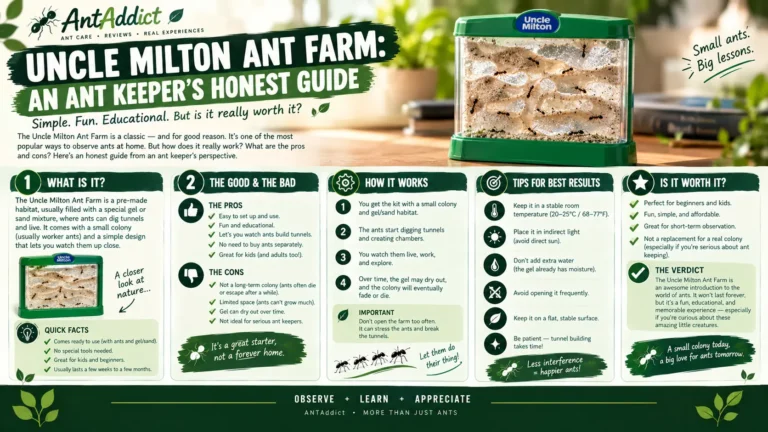
| Understand the classic toy kit | Uncle Milton ant farm |
| Watch ants dig their own tunnels | Sand ant farm |
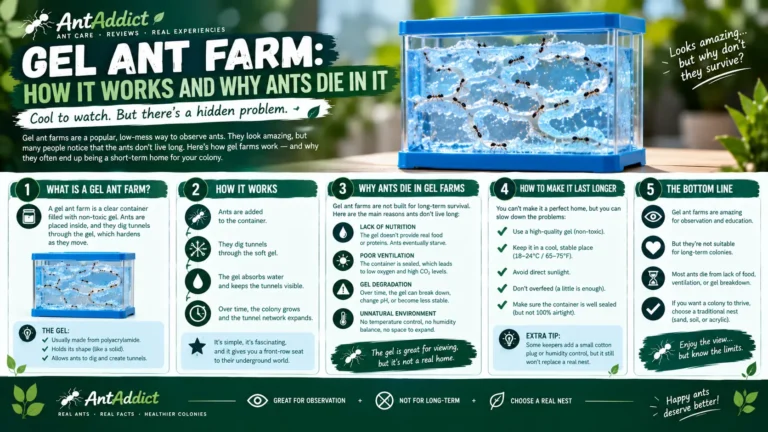
| Know the truth about blue gel farms | Gel ant farm |
| Start a colony from a single queen | Ant test tube setup |
| Find a queen | How to catch a queen ant |
| Feed your colony | What do ants eat? |
What is an ant farm?
An ant farm is an enclosure built so you can watch an ant colony live, work, and grow, whether for science or as a hobby. Keepers use “ant farm” and “formicarium” for the same thing (Wikipedia: Formicarium).
Every working ant farm has three parts:
- The nest: dark, enclosed chambers where the queen, eggs, larvae, and pupae live.
- The outworld: an open foraging area where you place food and water and where workers dump waste.
- A moisture source: a water reservoir, damp substrate, or wicking material that keeps the nest humid.
Toy ant farms often merge all three into one sandwich of sand or gel. Hobby ant farms keep them separate, which makes them far easier to keep clean and dry where it matters.
A short history of the ant farm
The ant farm is older than most people think, and its history explains why toy kits work the way they do.
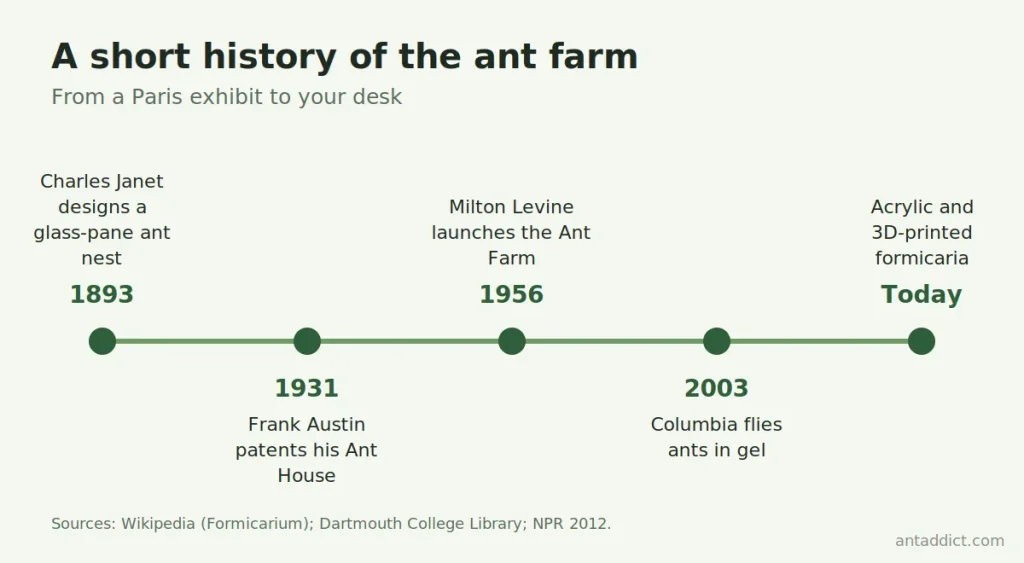
- 1893 to 1900: French entomologist Charles Janet designed a nest that squeezed an ant colony between two panes of glass. He published the design in 1893 and exhibited it at the 1900 Exposition Universelle in Paris, but never patented or marketed it (Wikipedia: Formicarium).
- 1929 to 1931: Frank Eugene Austin, a Dartmouth engineering professor, sold the first commercial formicarium around 1929 and patented his “Ant House” on June 16, 1931 (Dartmouth College Library Bulletin).
- 1956: Milton Levine created Uncle Milton’s Ant Farm after a Fourth of July picnic and registered “Ant Farm” as a trademark (Wikipedia: Formicarium). More than 20 million sold by the time he died in 2011 (The New York Times).
- 1995: The trademark made news when Uncle Milton’s lawyers sent letters to Dilbert creator Scott Adams over his use of the phrase in a comic strip (Wikipedia: Formicarium).
- 2003: A student harvester ant experiment flew on the space shuttle Columbia (STS-107). NPR credits the transparent ant farm gel to that project (NPR via WGBH).
- Today: Most formicaria on the market are acrylic or 3D-printed and designed to house a queen (Wikipedia: Formicarium).
Timeline of the ant farm from Charles Janet in 1893 to modern acrylic and 3D-printed formicaria
Read the full Uncle Milton story, or see how blue ant farm gel traces back to a space shuttle.
How does an ant farm work?
An ant farm works by recreating the conditions of a wild nest in a space you can see into. Ants need darkness, humidity, a safe place for the queen and brood, and access to food and water. The nest provides shelter and humidity. The outworld provides the “outside” where workers forage. Your job is to keep water available, food fresh, and the nest neither too dry nor too wet.
In a queen-right ant farm, the colony grows. The queen lays eggs, workers raise larvae on protein, and new workers emerge. In a toy ant farm with no queen, nothing grows; the workers you receive are the only ants you will ever have.
What are the different types of ant farm?
| Type | How it works | Lifespan with a queen | Best for |
|---|---|---|---|
| Sand or soil | Ants dig tunnels between two panes | Years, with careful moisture control | Watching ants build |
| Gel | Ants tunnel through and eat a nutrient gel | Not suitable for colonies | Short classroom demos only |
| Acrylic | Premade chambers with a water reservoir | Years | Beginners, clear viewing |
| 3D-printed | Printed chambers, often modular | Years | Display, expansion |
| Ytong (aerated concrete) | Carved block that wicks water | Years | Humidity-loving species |
| Plaster or hydrostone | Cast chambers that absorb water | Years | Medium colonies |
| Test tube | Tube with a water reservoir and cotton | Months, then upgrade | Founding queens |
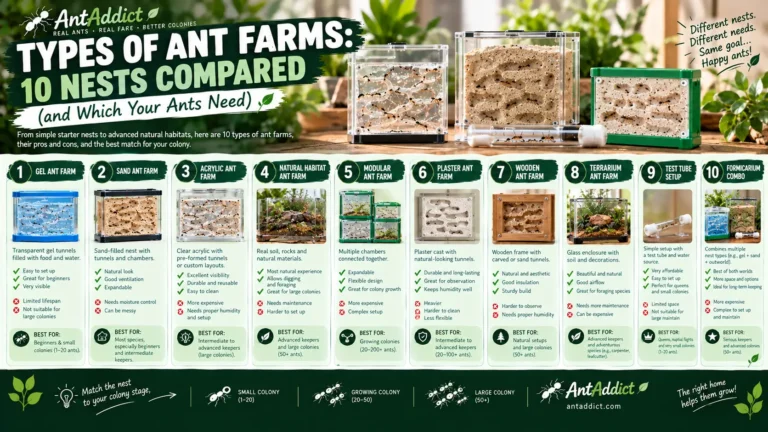
Ant farm types compared: sand, gel, acrylic, 3D-printed, Ytong, plaster, and test tube
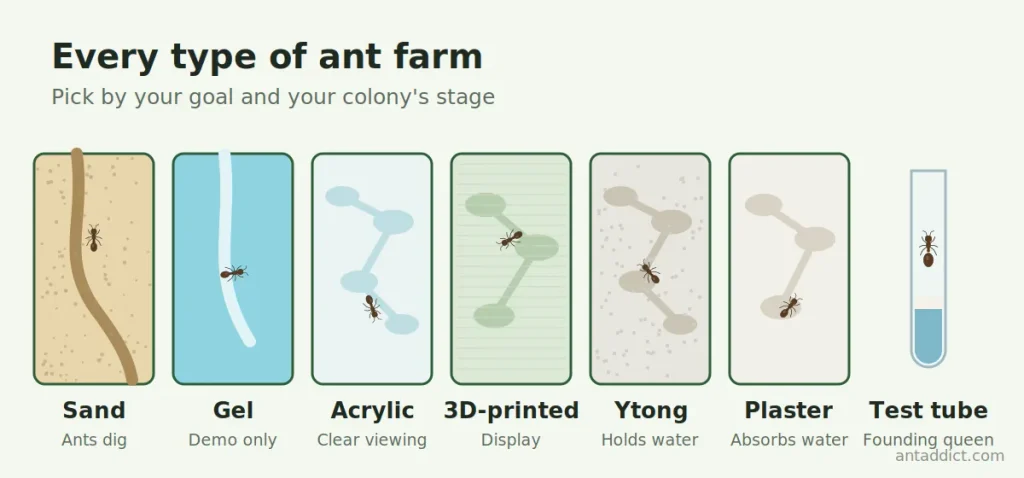
Each type has its own guide: the sand ant farm guide for digging setups, and our formicarium buying guide for acrylic, 3D-printed, Ytong, and plaster nests.
Toy ant farm vs real ant farm: which do you need?
This is one of the most important decisions in the hobby, and many buyers make it without realizing.
| Factor | Toy ant farm | Real ant farm (formicarium) |
|---|---|---|
| Ants | A tube of mailed workers, no queen | A queen-right colony |
| Growth | None; numbers only fall | Eggs, larvae, new workers |
| Typical lifespan | Weeks to a few months | Years; queens can live decades |
| Setup | Very easy | Easy once you know the steps |
| Cost to start | Low | Low (test tube) to moderate (formicarium) |
| Best for | A short science demo | A long-term pet colony |
Uncle Milton itself says its mailed ants live one to three months with proper care (Uncle Milton Ants FAQ). By contrast, the University of Florida Book of Insect Records lists a black garden ant (Lasius niger) queen kept for 28¾ years in captivity as the longest recorded adult life of any insect (University of Florida Book of Insect Records).
If you want something that lasts, the answer is always a real ant farm with a queen.
Here is the part everyone else skips: an ant farm houses a superorganism, not a group of pets
Most ant farm guides treat ants like tiny pets: keep them fed and they will be fine. That framing is why so many ant farms fail. Biologists call an ant colony a superorganism: a society that behaves like a single living thing (Hölldobler & Wilson, 2009). A useful way to picture it is that the workers are the body and the queen is the reproductive system.
Seen that way, every ant farm question gets a clearer answer:
- Why toy farms die: a box of workers with no queen is a body with no reproductive system. It can stay active for a while, but it cannot renew itself. Workers mailed for toy farms are also likely to be older foragers, as our Uncle Milton guide explains.
- Why gel cannot grow a colony: in a superorganism, adult workers run mostly on carbohydrates while larvae need protein (Dussutour & Simpson, 2009). A sugar gel feeds the body but not the next generation. Our gel ant farm guide covers the details.
- Why oversized nests fail: the colony regulates its own nest size. Studies and models of nest digging show nest volume tracking the number of workers (Deneubourg & Franks, 1995), so a nest far too big leaves empty chambers that fill with waste.
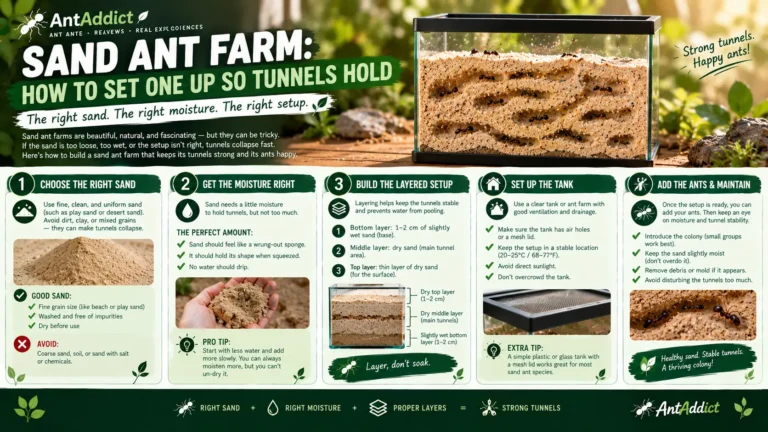
- Why moisture matters so much: in sand, water bridges between grains hold tunnel walls together, and fire ants in lab studies dug deepest at intermediate moisture (Monaenkova et al., 2015). Our sand guide has the numbers.
The ant colony as a superorganism: queen as the reproductive core, workers as the body, brood as the future of the colony
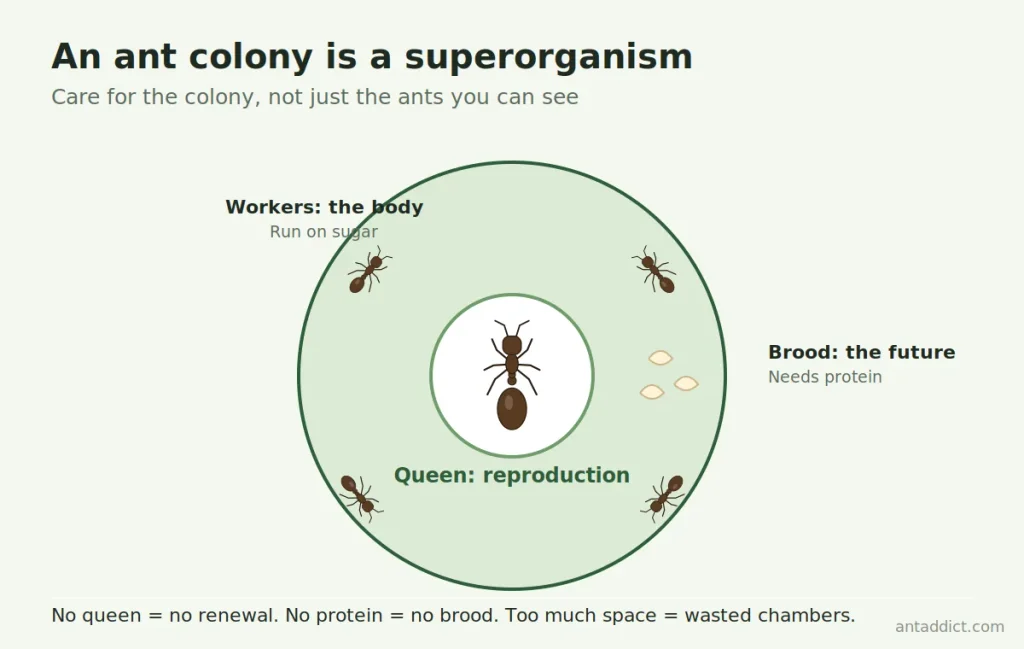
The practical rule that follows: buy and maintain your ant farm for the colony, not for the individual ants. Give the queen a safe, humid nest, give the brood protein, give the workers sugar and space that matches their numbers, and the superorganism takes care of the rest.
Do ant farms come with ants?
Most toy ant farms do not ship with ants in the box. They include a voucher you redeem for a tube of live worker ants. Uncle Milton ships its ants only within the continental United States, and its product page also excludes Oregon (Uncle Milton: Giant Ant Farm).
Hobby formicaria usually come empty. You add a colony you caught or bought from a permitted seller.
Do ant farms come with a queen?
Toy ant farms in the US do not include a queen. Uncle Milton says federal agricultural regulations prohibit it from shipping queens (Uncle Milton Ants FAQ).
The bigger picture: USDA oversees every ant species brought into the country or moved between states, since a few can turn into costly plant pests. To ship, import, or sell ants across state lines, you need a PPQ 526 permit that names both the species and the state receiving it (USDA, 2023). Buying ants from a seller is legal if the seller holds a valid permit for that species and is allowed to ship it to your state (USDA APHIS: Invertebrate Pets).
USDA itself recommends starting with ants you catch locally, which needs no federal permit (USDA APHIS: Invertebrate Pets). Some states add their own rules, so check locally before collecting.
Outside the US, rules vary widely. In the European Union, some native species are protected and cannot be kept or sold (Wikipedia: Formicarium).
How do you get a queen ant for an ant farm?
The best route is to catch a newly mated queen after a nuptial flight, when queens land, shed their wings, and search for a place to start a colony. Our guide on how to catch a queen ant explains what to look for, and the ant mating flight guide explains when flights happen. Antaddict’s nuptial flight page can help you time your search.
Once you have a queen, house her in a test tube, not a large ant farm. A small, dark, humid space is what founding queens look for in the wild. Our ant test tube setup guide walks through it step by step.
How do you set up an ant farm?
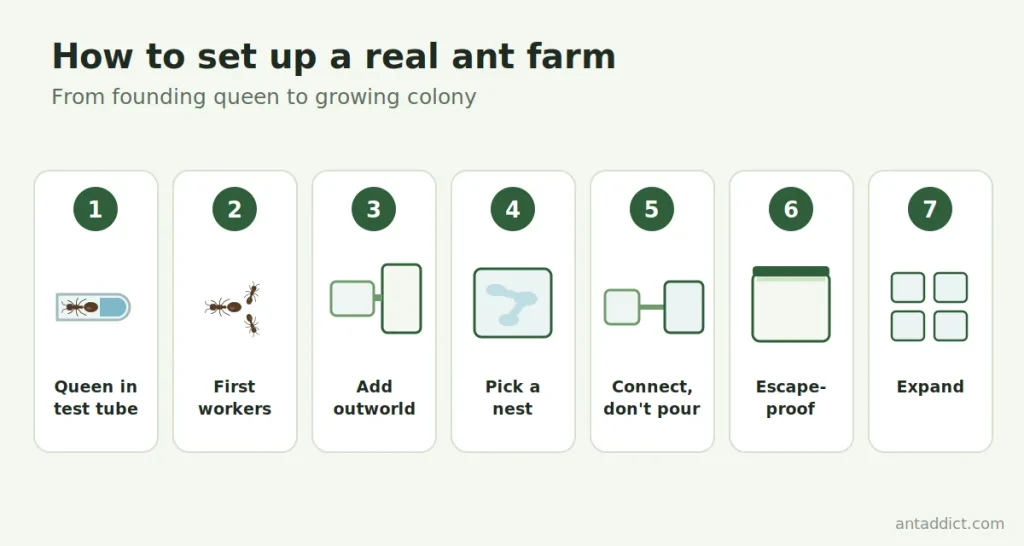
Here is the process for a real, queen-right ant farm:
- Start the queen in a test tube with a water reservoir, a cotton plug, and a loose cotton entrance. Keep it dark, still, and at room temperature.
- Wait for the first workers. Many claustral queens raise their first brood without eating, living on their own body reserves. Check our what do queen ants eat guide for species that do need feeding.
- Add a small outworld once workers appear, connected to the tube, so the colony can forage.
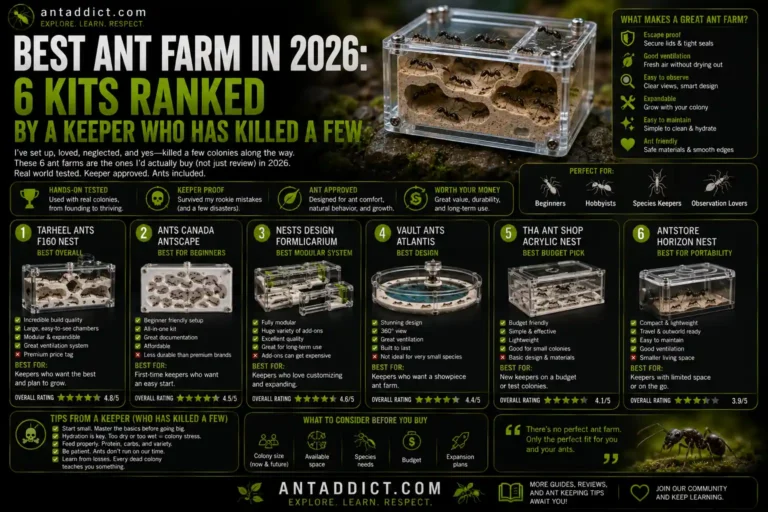
- Choose a formicarium that matches the colony’s size, usually a small acrylic or 3D-printed nest once you have a few dozen workers. See best formicarium.
- Connect, do not pour. Attach the test tube to the new outworld, let the tube dry out slightly, and keep the new nest dark and humid. The colony usually moves itself.
- Escape-proof everything. Use a tight lid with fine mesh, plus a barrier coating such as PTFE (Fluon) or petroleum jelly on outworld walls. Some keepers also stand the setup in a shallow water moat (Wikipedia: Formicarium).
- Expand gradually with extra modules as the colony grows.
Seven-step ant farm setup from founding queen in a test tube to an expanding formicarium
For a toy ant farm, the process is simpler: set up the habitat first, redeem the voucher, and move the ants in as soon as they arrive. Our Uncle Milton guide covers that routine.
What are the best ants for an ant farm?
The best ants for an ant farm are hardy, common, local species that tolerate beginner mistakes.
| Species | Region | Why it works | Watch out for |
|---|---|---|---|
| Lasius niger (black garden ant) | Europe | Hardy, fast-growing, classic beginner species | Can go dormant in winter |
| Lasius neoniger and other native Lasius | North America | The North American counterpart for beginners | Small workers; escape-proof carefully |
| Tetramorium immigrans (pavement ant) | Europe; introduced in North America | Very active, easy to feed | Tiny workers escape easily |
| Camponotus (carpenter ants) | Worldwide | Large, impressive workers | Slow-growing at first |
| Messor (harvester ants) | Europe, Africa, Asia, western North America | Eat seeds; easy diet | Need dry seed storage |
| Pogonomyrmex (harvester ants) | Americas | Classic sand-farm ants | Painful sting |
Keep species native to your region, and never release kept ants outdoors in an area where they are not native.
What do ants in an ant farm eat?
Ants need two things: carbohydrates for the workers and protein for the larvae. Feed in the outworld, never in the nest.
| Food | Amount | How often | Purpose |
|---|---|---|---|
| Water | Feeder or test tube | Always available | Drinking water |
| Sugar water or honey water | A few drops | 2 to 3 times a week | Energy for workers |
| Protein (fruit flies, crickets, mealworm pieces) | Roughly 1 insect per 10 to 20 workers | 2 to 3 times a week | Growth for larvae |
| Seeds (harvester ants only) | A small pinch | Keep stocked | Main food for Messor and Pogonomyrmex |
| Leftovers | Remove | Within 24 to 48 hours | Prevents mold and mites |
For a full breakdown, see what do ants eat and our list of the best foods to feed ants.
Toy farms are different: sand toy farms get a few drops of water and a tiny crumb, and gel farms need no food at all. Our Uncle Milton and gel guides explain why.
How do you take care of an ant farm?
Water and humidity
Keep the nest’s water reservoir topped up and give the colony a gradient: one humid end and one drier end. Ants move their brood to the conditions they prefer, so a gradient lets the colony choose (Roces & Núñez, 1989).
Temperature
Most common beginner species do well at normal room temperature. Avoid direct sunlight, radiators, and cold windowsills. Many species from temperate regions also need a cooler winter rest to stay healthy over the long term.
Light
Keep the nest covered when you are not watching. Most ants prefer a dark nest, and many keepers find a cover helps the colony settle and use chambers against the viewing panel.
Cleaning
Remove leftover food and dead insects from the outworld regularly. Do not clean the nest itself unless mold or flooding forces you to; disturbing the nest stresses the colony.
Escape-proofing
Check lids, tube connections, and barrier coatings every few weeks. Small species can squeeze through gaps you would not expect.
How long does an ant farm last?
| Setup | Typical lifespan | Why |
|---|---|---|
| Toy farm with mailed workers | 1 to 3 months | No queen to replace workers |
| Gel farm | Weeks to a few months | No queen; gel not designed for brood |
| Queen-right colony in a formicarium | Years | The queen keeps producing workers |
| Queen’s lifespan | Up to decades, depending on species | Record: Lasius niger, 28¾ years in captivity |
Sources: Uncle Milton Ants FAQ; University of Florida Book of Insect Records.
What are the most common ant farm problems?
| Problem | Likely cause | Fix |
|---|---|---|
| Mold | Food left too long; too wet; poor airflow | Remove leftovers within 48 hours; improve ventilation; feed only in the outworld |
| Ants escaping | Gaps, worn barrier coating, loose lid | Refresh PTFE or petroleum jelly; check tube fittings; use finer mesh |
| Ants not digging (sand farms) | Sand too dry or too wet; gap too wide | Aim for damp sandcastle sand; narrow the gap |
| Ants dying (toy farms) | Normal for queenless workers; heat; overwatering | Keep cool and out of sun; follow kit watering advice |
| Colony not growing | Too little protein; disturbance; queen too young | Offer protein regularly; check less often |
| Ants ignoring a new nest | New nest too big, too bright, or too dry | Darken and moisten it; dry the old home slightly |
| Mites | Rotting food; contaminated substrate | Clean the outworld; replace bad substrate |
Can you make a DIY ant farm?
Yes. The simplest DIY ant farm is a jar-in-a-jar: put a smaller jar inside a larger clear jar and fill the gap between them with damp sand or soil. The inner jar pushes tunnels toward the outer glass where you can see them. Add a ventilated lid and a feeding spot on top.
For a better DIY build, use two acrylic panes with spacer strips and a separate outworld. Our sand ant farm guide explains the gap width and moisture levels that make DIY sand nests work.
Which ant farm should you buy?
Here are my picks, based on what you actually want:
- For kids and a short science project: a toy sand ant farm with a voucher, such as the classic Uncle Milton ant farm. Treat it as a two-month demo.
- For a first real colony: a test tube setup for the queen, then a small acrylic formicarium with an outworld.
- For watching ants build: a sand ant farm with an outworld.
- For a gift or a quick comparison of products: see our roundup of the best ant farm options.
- To avoid: blue gel farms for anything beyond a short demo.
Affiliate note: the Amazon links below are affiliate links; Antaddict may earn a small commission at no cost to you.
- Uncle Milton Giant Ant Farm (Amazon): for kids and classrooms.
- Acrylic starter formicarium (Amazon): for a first real colony.
- Sand ant farm formicarium (Amazon): for digging species.
Are ant farms good for kids?
Yes, with adult help. A toy ant farm teaches tunneling, teamwork, and basic biology in a few weeks. Two cautions: harvester ants, the species shipped with many US kits, can sting, so an adult should handle the transfer. And explain up front that queenless ants will not last, so the ending is a lesson rather than a shock.
For older kids who want more, a queen in a test tube is a brilliant next step. They get to watch the whole life cycle, from eggs to workers.
Are ant farms cruel?
It depends on the type. Hobby keepers broadly consider gel farms unsustainable, because the workers cannot survive long term (Canada Ant Colony). A queen-right colony in a well-kept formicarium is a different story: it can live and grow for years.
My honest keeper’s take: an ant farm is only as ethical as its design. Give the colony a queen, the right space, the right food, and a moisture gradient, and it thrives.
Other meanings of “ant farm”
If you landed here looking for something else, the phrase has a few famous uses:
- A.N.T. Farm is an American Disney Channel teen sitcom that aired from May 6, 2011, to March 21, 2014, starring China Anne McClain (Wikipedia: A.N.T. Farm).
- Ant Farm was a San Francisco art and architecture group started in 1968 by Chip Lord and Doug Michels. Its most famous work is Cadillac Ranch (1974), a row of half-buried Cadillacs near Amarillo, Texas (SFMOMA).
- Alien Ant Farm is an American rock band.
The bottom line
An ant farm is not one product. It is a choice between a short toy demo and a living colony that can last for decades. Toy farms ship queenless workers that live weeks to months. Real ant farms start with a mated queen in a test tube, move into a formicarium sized to the colony, and feed in an outworld. Treat the colony as a superorganism: protect the queen, feed protein to the brood and sugar to the workers, keep the nest humid with a gradient, and expand as it grows. Do that and your ant farm becomes one of the most rewarding things you can keep at home.
FAQ
What is an ant farm?
An enclosure for housing and watching a living ant colony. It usually has a nest, an outworld for food and water, and a moisture source.
Is an ant farm the same as a formicarium?
Yes, the terms are often used interchangeably. “Formicarium” is more common among hobby keepers; “ant farm” is often used for toy kits.
Do ant farms come with ants?
Toy ant farms usually include a voucher for mailed worker ants. Hobby formicaria come empty.
Do ant farms come with a queen?
Not toy kits in the US. Uncle Milton says federal rules prohibit shipping queens, and moving any ants across state lines requires a USDA PPQ 526 permit.
How long do ants live in an ant farm?
Queenless workers in toy farms live weeks to a few months. A queen-right colony can last for years, and queens of some species live for decades.
What do ants in an ant farm eat?
Sugar water or honey water for workers, protein such as small insects for larvae, and seeds for harvester ants. Always feed in the outworld.
What is the best ant farm for beginners?
A mated queen in a test tube, followed by a small acrylic formicarium with an outworld once the colony has a few dozen workers.
What is the best ant species for an ant farm?
Hardy local species such as Lasius niger in Europe or native Lasius in North America, plus Tetramorium and Camponotus.
Can I put ants from my backyard in an ant farm?
Yes, and USDA calls capturing local ants the best way to start. Without a queen, though, backyard workers will not last.
How do I stop ants escaping from my ant farm?
Use a tight lid with fine mesh and a barrier coating such as PTFE or petroleum jelly on the outworld walls. Check fittings regularly.
Why is my ant farm moldy?
Usually leftover food, too much moisture, or poor airflow. Remove leftovers within 48 hours and feed only in the outworld.
Are gel ant farms good?
Only for short demos. Gel is not designed to support a growing colony and molds easily.
Can I make my own ant farm?
Yes. A jar-in-a-jar filled with damp sand or soil works, as long as it has ventilation, an escape-proof lid, and a feeding spot.
Are ant farms good for kids?
Yes, with adult supervision. Many kit ants can sting, and queenless colonies will not last, so explain that from the start.