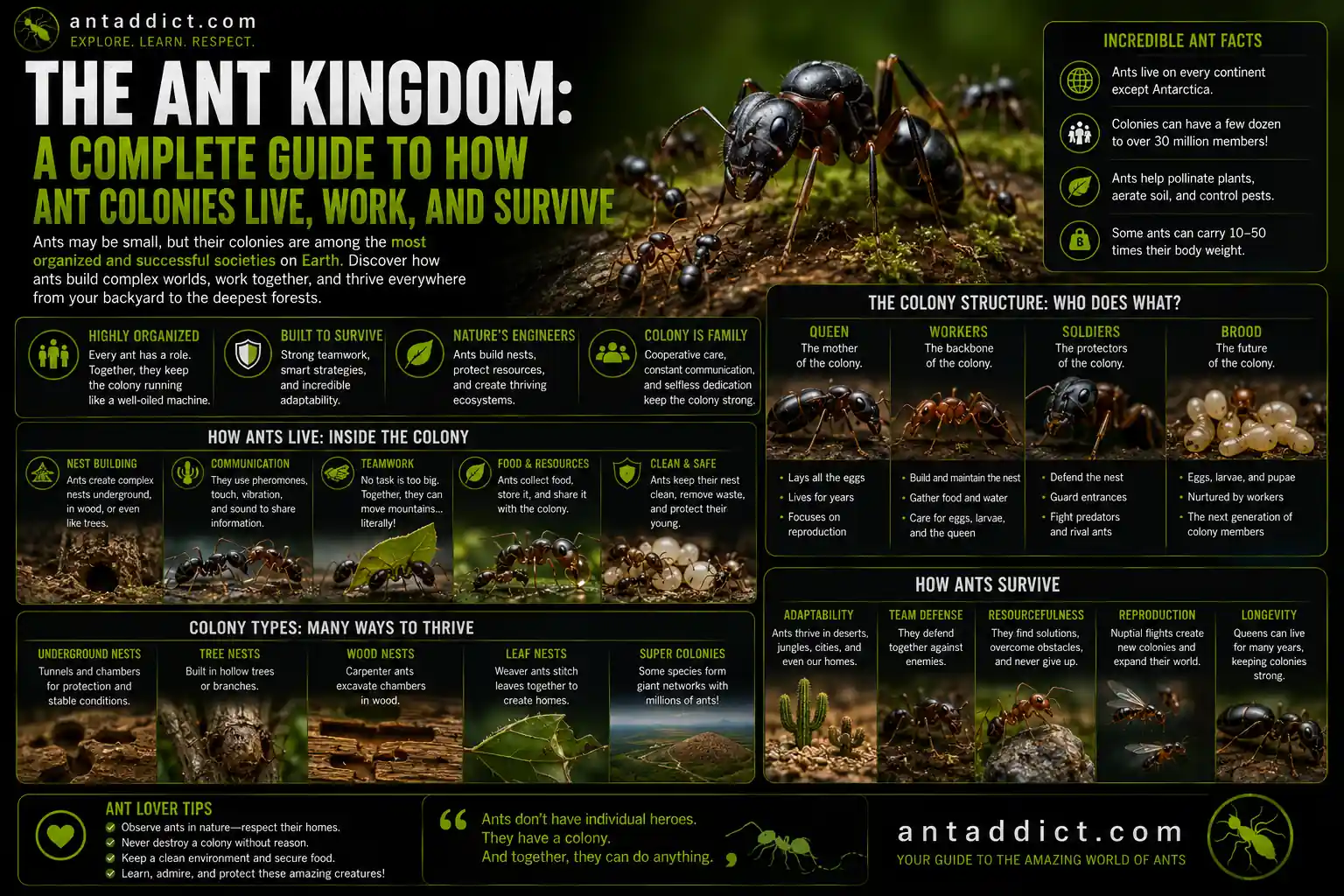
The Ant Kingdom: A Complete Guide to How Ant Colonies Live, Work, and Survive
Lift a garden stone and you don’t find a crowd of insects — you find a civilization. The ant kingdom beneath your feet has a ruling queen, a working population that never sleeps in the human sense, defenders, nurseries, food stores, waste stations, and a communication network sophisticated enough to solve problems no single ant could ever grasp. Ants have run these societies for more than 100 million years, and today they are among the most abundant animals on Earth — by some estimates making up a large share of all terrestrial animal biomass.
If you keep ants — or you’re about to start your first colony — understanding how the ant kingdom actually works isn’t trivia. It’s the difference between a founding queen that thrives and one that fails in her test tube. This guide walks through the whole system: who lives in the colony, how a new kingdom is founded, how the workforce is organized, how the colony grows over years, and how it survives winter and hard times. Everything here is written with the ant keeper in mind, so you can read your own formicarium with a trained eye.
What Is an Ant Kingdom, Really?
An “ant kingdom” is a colony — a single reproductive family living and working together in a shared nest. But the word kingdom is more accurate than it sounds, because a mature colony behaves less like a group of individuals and more like a single body.
Biologists call this a superorganism. In a superorganism, the individual ants function like the cells of one animal: the queen is the reproductive system, the workers are the hands and the immune system, the brood is the growing tissue, and the colony as a whole is the thing that competes, defends territory, and reproduces. No ant is “in charge” in the way a human ruler is — even the queen doesn’t issue orders. Order emerges from thousands of simple interactions.
That single insight reframes everything an ant keeper does. When you feed your colony, you’re feeding one organism through many mouths. When the colony stresses, it’s one organism reacting. Keep that superorganism lens on as we break the kingdom into its parts.
Quick scale check: Ant colonies range from a few dozen individuals to millions, and some species form “supercolonies” running into the hundreds of millions of ants across many connected nests. There are more than 13,800 described ant species, with estimates suggesting the true number may reach 22,000.
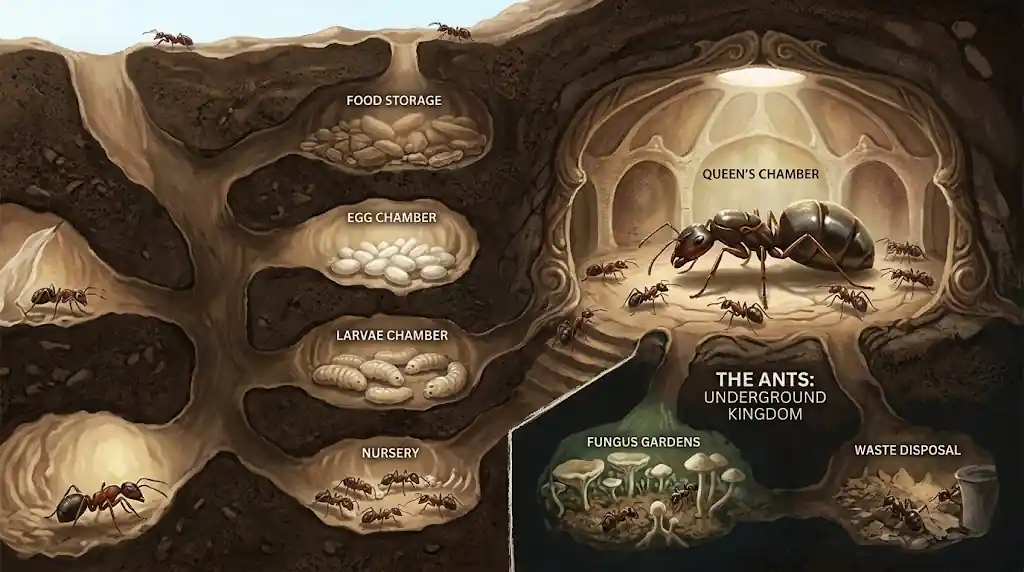
The Castes: Who’s Who in the Ant Kingdom
Every ant kingdom is built from a handful of distinct roles called castes. Unlike a beehive, an ant colony’s caste system is driven mostly by nutrition and chemistry during development, not by a fixed genetic destiny — the same egg can become a queen or a worker depending largely on how the larva is fed.
Here’s the cast of characters, and what each one costs and contributes in your colony.
| Caste | Sex | Role | Typical lifespan |
|---|---|---|---|
| Queen | Female (fertile) | Lays all eggs; founds the colony | Up to ~30 years in some species |
| Worker | Female (sterile) | Foraging, brood care, nest work, defense | 1–3 years |
| Soldier | Female (sterile) | Defense, seed/prey processing (large-jawed workers) | 1–3 years |
| Male (drone) | Male (fertile) | Mating during nuptial flight only | A few weeks |
| Brood | — | Eggs, larvae, pupae (the next generation) | Developmental stage |
The Queen — The Heart of the Kingdom
The queen is the single most important animal in the colony, and for the ant keeper she is the whole investment. She is the only ant that mates and lays fertilized eggs, and everything the colony becomes flows from her egg output.
What makes queens remarkable is their lifespan. Where a worker lives one to three years and a male only weeks, a queen can live up to around 30 years in some species — roughly 100 times longer than a solitary insect of similar size. She stores sperm from her single mating flight and uses it to fertilize eggs for her entire life. She never mates again.
For keepers, this means one thing above all: protect the queen. A colony can lose thousands of workers and rebuild, but a queenless colony is a dead colony walking. It has no way to produce new females and will slowly dwindle to nothing.
Workers — The Sterile Engine
Workers are sterile females, and they are the ant kingdom in motion. They forage, build and repair the nest, care for the brood, feed the queen, haul the dead to refuse piles, and defend the entrance. In most species, workers physically cannot mate — though thanks to the haplodiploid genetics we’ll cover below, workers in some species can lay unfertilized eggs that become males.
Workers aren’t identical. Many species show polymorphism — size classes ranging from tiny “minors” to hefty “majors.” The extreme case is dramatic: in Carebara diversa, the smallest and largest workers differ nearly 500-fold in dry weight. Different sizes suit different jobs, which brings us to the specialists.
Soldiers — The Colony’s Defense
Soldiers are simply large workers, often called majors or dinergates, with disproportionately big heads and powerful mandibles. Despite the military name, they’re still sterile female workers — they’ve just been built for muscle. Depending on the species, those oversized jaws crack seeds, dismember prey, block nest entrances with their own heads, or fight off invaders.
Not every species has a distinct soldier caste, so don’t be alarmed if your colony never produces them — many keeper-favorite species simply don’t.
Males (Drones) — Live Fast, Die Young
Males are the colony’s most short-lived and, frankly, most disposable members. They exist for one purpose: to fly out and mate. Winged but built for nothing else, they survive only a few weeks. They don’t forage, don’t defend, and don’t work. Once the nuptial flight is over, males die. The colony produces them seasonally as a reproductive expense, not as permanent residents.
The Brood — The Next Generation
The brood is every immature ant: eggs, larvae, and pupae. To a keeper it can look like a static pile of white specks, but the brood is where the colony’s future — and much of its labor — is concentrated. Workers constantly move, groom, and sort brood to optimal temperature and humidity zones in the nest, which is exactly why a well-built formicarium (ant nest) needs a moisture gradient.
Want more detail on how these roles fit together? Read our full guide to how an ant colony is structured.
How an Ant Kingdom Is Born
Every giant colony starts with a single ant alone in the dark. Understanding this founding process is the most practically important part of ant keeping, because it’s the stage where beginners most often succeed or fail.
The Nuptial Flight
On the right warm, humid days — often after rain — mature colonies release alates: winged virgin queens and winged males. They take to the air in a synchronized nuptial flight, mating in the air or on the ground. This is the only time a queen will ever mate, and the only time most of us can catch a founding queen for a colony.
After mating, the male’s job is done and he dies within weeks. The newly mated queen lands, and her transformation begins.
She Breaks Her Own Wings
A mated queen no longer needs to fly. Using the spurs on her legs, she breaks off her own wings — a sign to any keeper that she’s mated and ready to found a colony. She then searches for a nest site, seals herself in, and prepares to raise her first workers entirely alone.
Claustral Founding — Raising the First Workers on Body Fat
Here’s the part that amazes new keepers. In most common species, the queen founds her colony claustrally: she seals herself in a chamber and does not eat at all while raising her first brood. She metabolizes her own wing muscles and fat reserves, converting her flight machinery into eggs and into food for her larvae.
This is why the standard beginner setup is a simple test tube with a water reservoir behind a cotton plug — the queen needs humidity and darkness, not food, during founding. Opening the tube to “help” or feed her usually does more harm than good. Patience is the whole skill here.
A minority of species found semi-claustrally, where the queen does leave to forage during founding. Knowing which type your species is tells you exactly whether to leave her alone or offer food.
Nanitics — The First, Smallest Workers
The queen’s first workers emerge small and underfed, because she raised them on the limited reserves of her own body. These first workers are called nanitics. They’re undersized but fully functional, and the moment they appear, the colony crosses a threshold: the queen can finally stop working and become a pure egg-layer. The nanitics take over foraging and brood care, and growth accelerates from there.
For a deeper technical treatment, see AntWiki’s reference page on colony foundation.
How Ant Colonies Work Day to Day
Once a kingdom is established, how does it get anything done without a manager? The answer is one of the most studied phenomena in biology: decentralized self-organization.
Division of Labor by Age (Polyethism)
In many species a worker’s job changes as she ages — a pattern called temporal polyethism. Young workers start with the safest indoor jobs: tending the queen and nursing brood. As they age, they graduate to nest construction and food storage, and finally to the most dangerous work of all — foraging and defense outside the nest.
There’s a cold logic to it. Foraging is where ants die, so the colony sends its oldest workers, the ones with the least remaining life to lose. The colony spends its members the way a careful manager spends a budget.
Communication: How Ants “Talk”
Ants coordinate a kingdom of thousands almost entirely through chemistry and touch. The main channels:
- Pheromones — chemical signals are the ant kingdom’s primary language. Foragers lay scent trails to food that others follow and reinforce; a crushed ant releases an alarm pheromone that throws nearby nestmates into an instant defensive frenzy. Colony odor also lets ants tell nestmate from intruder.
- Trophallaxis — ants share liquid food mouth-to-mouth by regurgitating from a “social stomach” (the crop). This does double duty: it spreads nutrition through the colony and spreads chemical information about the colony’s needs and identity.
- Stridulation and touch — many ants produce sound by rubbing body segments together, and constant antennae contact passes information in close quarters.
For a keeper, this explains a lot of behavior you’ll watch through the glass — why a single forager finding your sugar drop quickly becomes a highway, and why disturbing the nest triggers a coordinated panic. You’re watching pheromones at work.
Haplodiploidy — The Genetics Behind the Kingdom
Ants determine sex through a system called haplodiploidy. Fertilized eggs (with two sets of chromosomes) become females — queens or workers. Unfertilized eggs (with one set) become males. This is why the queen’s stored sperm effectively lets her choose the colony’s makeup: fertilize an egg for a female, withhold sperm for a male. It’s also why, in some species, unmated workers can still produce males from their own unfertilized eggs.
The Life Cycle: How a Colony Grows Over Time
A colony isn’t just born and then static — it moves through distinct life stages, much like an individual animal grows up. Knowing which stage your colony is in sets realistic expectations.
1. The Founding Stage. A lone queen raises her first nanitics claustrally. This is slow, fragile, and quiet — often weeks of seemingly nothing happening while brood develops through egg, larva, and pupa. Ants develop by complete metamorphosis, so the larva goes through several molts, then pupates (sometimes in a cocoon), before emerging as an adult.
2. The Ergonomic (Growth) Stage. With workers now foraging, the queen becomes a dedicated egg-laying machine and the population climbs — slowly at first, then faster as more workers mean more brood care and more food. The colony produces only workers during this stage, pouring all resources into growth. For keepers this is the rewarding phase where a test tube becomes a busy formicarium.
3. The Reproductive Stage. Once a colony is large and secure enough — which can take a few years depending on species — it starts investing in the future by producing winged alates: new virgin queens and males. When these fly off on their own nuptial flights, the kingdom has successfully reproduced itself, and the cycle begins again.
The timeline varies enormously by species. Some fast growers build a strong colony in a single season; many take two to four years to reach reproductive maturity. This is why experienced keepers preach patience above every other virtue.
Knowing which stage your colony is in — founding, growth, or reproductive — sets realistic expectations for how fast it will grow.
How the Ant Kingdom Survives Hard Times
A civilization that lasts decades has to weather threats — cold, drought, starvation, and invasion. Ant kingdoms have deep strategies for all of them.
Surviving Winter
In cooler climates, colonies don’t die back in winter — they wait it out. Many species enter diapause, a programmed state of dormancy. Depending on the species, larvae may pause development in an inactive state, or the adults slow to minimal activity and stop laying, clustered deep in the nest.
This matters enormously for keepers in temperate regions. Many species need a cool diapause period (often achieved with a wine cooler or a cool room) to stay healthy and to trigger normal spring egg-laying. Skipping it can burn a colony out. Always research whether your species needs to hibernate — it’s one of the most common care mistakes.
Defense and Resilience
The superorganism structure is itself a survival strategy. Because the colony’s “value” is concentrated in the queen and brood deep inside the nest, the disposable outer workers can absorb losses. Alarm pheromones mobilize defenders instantly, soldiers block or fight at chokepoints, and a colony that loses a foraging party simply sends more. As long as the queen and enough brood survive, the kingdom regenerates.
Food Storage and Sharing
Trophallaxis and dedicated storage castes (in some species, living food stores called “repletes” — like honeypot ants — that hold liquid food in their own swollen bodies) let the colony bank resources against lean times and redistribute food across the whole population. The kingdom rides out shortages as one pooled economy rather than thousands of competing individuals.
What This Means for You as an Ant Keeper
Pulling it together, the biology translates into a short list of hard-won keeping principles:
- The queen is everything. Guard her, minimize disturbance, and never risk her to satisfy curiosity.
- Leave founding queens alone. For claustral species, a dark, humid test tube and weeks of patience beat any intervention.
- Let the colony set the pace. Growth is slow then exponential; resist overfeeding a tiny founding colony — what ants actually eat is less than most beginners assume.
- Respect diapause. If your species overwinters, give it the cool rest it evolved to need.
- Read behavior as chemistry. Trails, panics, and brood-moving are the colony communicating — learn to interpret them instead of interrupting them.
Do those five things and you’re working with the ant kingdom’s biology instead of against it.
Conclusion
The ant kingdom is one of nature’s great feats of organization: a decades-long civilization run without a manager, built from a single queen who founded it alone in the dark. Once you see the colony as one superorganism — queen as its heart, workers as its hands, brood as its future, all coordinated by chemistry — both the biology and the keeping click into place.
FAQ
What is an ant kingdom?
An ant kingdom is a colony — a single family of ants (one or more queens, their sterile female workers, brood, and seasonally produced males) living and working together in a shared nest. Biologists describe it as a superorganism because the colony functions as one coordinated body rather than a group of independent insects.
Who rules an ant colony?
No single ant “rules” in the human sense. The queen is the colony’s reproductive center and the source of every ant in it, but she doesn’t give orders. The colony’s behavior emerges from thousands of simple pheromone and touch interactions among workers — a self-organizing system with no manager.
How long does an ant queen live?
Queens are exceptionally long-lived for insects. In some species a queen can live up to around 30 years, storing sperm from a single mating flight to fertilize eggs for her entire life. Workers, by contrast, live one to three years, and males only a few weeks.
How does a new ant colony start?
It starts with a nuptial flight, when winged queens and males leave established colonies to mate in the air. A mated queen lands, breaks off her wings, seals herself in a chamber, and raises her first workers (nanitics) — usually without eating, living off her own fat and wing muscles until those first workers can forage.
How do ant colonies survive winter?
In cool climates, colonies enter diapause, a dormant state. Larvae may pause development and adults cluster deep in the nest with minimal activity, resuming normal egg-laying in spring. Many temperate species genuinely need this cool rest period, which is why ant keepers replicate winter with a cool room or wine cooler.