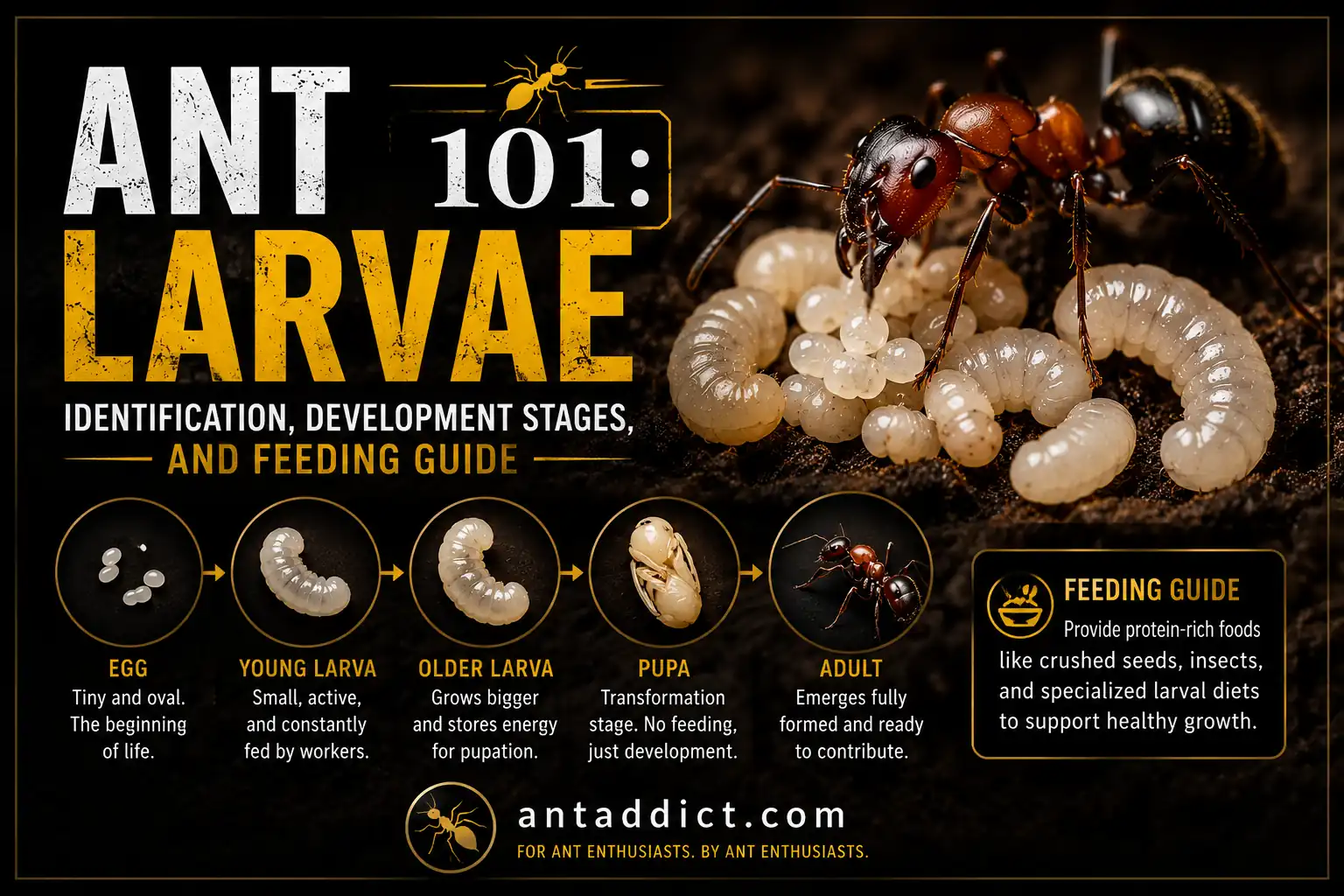
Ant Larvae 101: Identification, Development Stages, and Feeding Guide
Last reviewed: June 2026. Claims in this guide are drawn from first-hand keeping and the university and peer-reviewed sources linked inline and listed below.
Ant larvae are the soft, white, legless young of the colony, the grub-like stage that follows the egg in an ant’s life cycle. They look helpless, and in most ways they are: they cannot walk, see, or feed themselves. Yet they quietly run the colony’s digestion. Adult ants cannot eat solid food, so the larvae process it for everyone, and how a larva is fed decides whether it grows into a worker or a queen.
Open a healthy nest and the larvae are the pile everyone is fussing over: a heap of pale grubs, constantly groomed, sorted, and fed by workers. After six years of keeping colonies, I can tell you that brood pile is the single best gauge of a colony’s health.
When the larvae are fat and growing, everything is working. When they stall, something is wrong. This guide covers what ant larvae are, how to identify them, the stages they pass through, and how they get fed.
What are ant larvae?
Ants go through complete metamorphosis, the same four-stage change as butterflies: egg, larva, pupa, adult. The larva is the growth stage. Its whole job is to eat and get bigger, banking the resources the pupa will later reorganize into an adult.
A larva is essentially a feeding machine with no independence. It has no legs, no working eyes, and very limited movement. It relies completely on adult workers to clean it, carry it, and deliver its food. In return, as we will see, it pays the colony back in a way no adult can.
What do ant larvae look like?
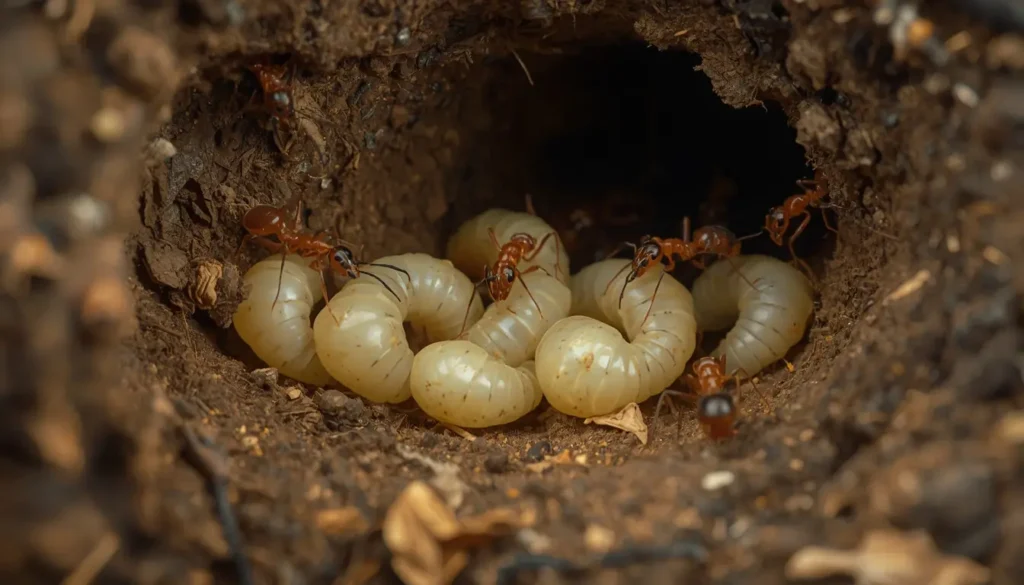
Ant larvae are small, soft, and creamy white to pale yellow, shaped like a fat comma or a curled grub. Most are broader at the rear and taper toward a tiny head. Under magnification, you can see they are covered in fine hairs.
Those hairs matter. Many are hooked or branched, which lets workers pick up and carry whole bundles of larvae at once, or anchor them to the nest wall. A larva that looks stuck to the ceiling is not glued there; it is hanging by its own hooked hairs.
Size depends on species and stage, from barely visible to several millimeters. In big-headed and leafcutter colonies, the largest queen-destined larvae can dwarf the workers tending them.
| Stage | What it looks like | Movement | Key feature |
|---|---|---|---|
| Egg | Tiny, white, oval, like a pinpoint | None | Smaller than larvae, smooth surface |
| Larva | White, legless, grub or comma shaped, hairy | Wriggles, opens its mouth | Grows and molts; the feeding stage |
| Pupa | Adult-shaped, legs and antennae folded in | None, resting | Looks like a pale ant; may be in a cocoon |
The most common mix-up is larvae versus pupae. A larva is a shapeless grub. A pupa already looks like an ant, just pale and motionless with its legs tucked in. If you can see ant-shaped legs, it is a pupa, not a larva.
People also confuse ant larvae with fly maggots when they find them at home. Ant larvae are usually in a tended pile deep in a nest, not writhing in food waste, and there are almost always workers nearby.
Larval shape also varies more than you might expect between species. Some are nearly straight, others tightly curled; some late-instar larvae have distinct necks or little tubercles. The shapes are consistent enough that myrmecologists such as George and Jeanette Wheeler built entire classifications on larval form, because a larva’s form can identify a species almost as reliably as an adult’s can.
Where larvae fit in the ant life cycle
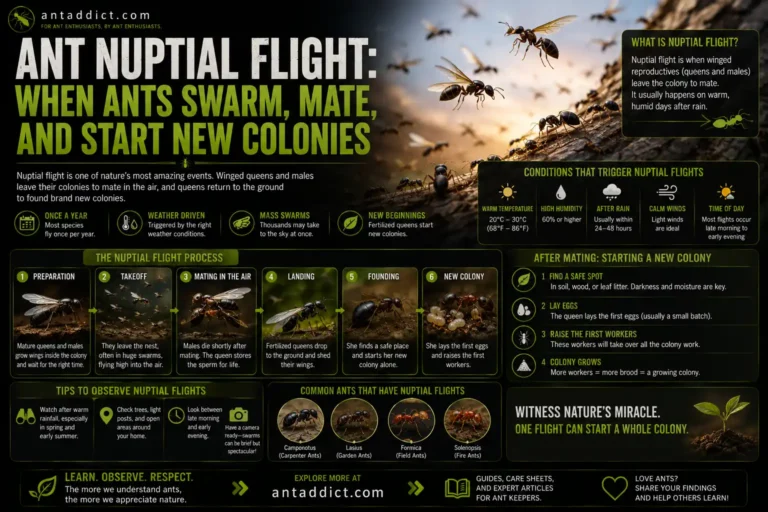
The full sequence runs egg, larva, pupa, adult. A fertilized egg hatches into a larva; the larva grows and molts; then it pupates and reorganizes into an adult that chews its way free. Ask A Biologist lays out the same four stages, a process that can take anywhere from a few weeks to a few months depending on species and temperature.
Only fertilized eggs become female larvae that can turn into workers or queens. Unfertilized eggs become males.
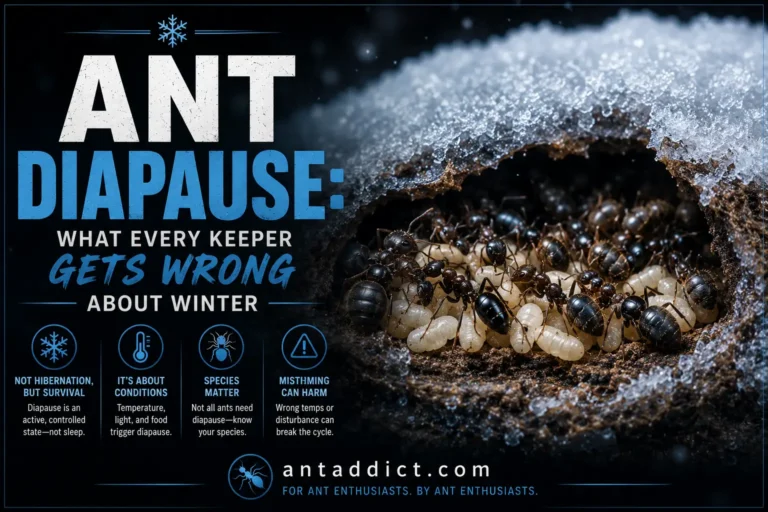
In temperate species, larvae are often the stage that overwinters, pausing development until spring, which is part of how colonies survive the cold. See do ants hibernate for that seasonal story. The larvae themselves live in the deeper, humidity-stable chambers of the ant nest, where workers can regulate their conditions.
Development stages: instars and molting
A larva does not grow smoothly. Like all insects with a hard cuticle, it grows in steps, shedding its skin each time it outgrows it. Each stage between molts is called an instar, and ant larvae molt through several instars, commonly three to five depending on the species and caste, before they pupate.
Early instars are tiny and barely mobile. Late instars are the large, plump larvae that do the heavy lifting of colony digestion, and they are the ones workers feed most intensively. The whole larval stage often lasts one to three weeks, though it stretches far longer when a larva overwinters.
When a larva reaches its final instar, it stops feeding and pupates. In many species it first spins a silk cocoon around itself, which is why some pupae are wrapped in tan capsules while others lie naked. Both are normal; the difference is just the species.
There is even a recently discovered twist. Ant pupae secrete a milk-like fluid that newly hatched larvae depend on, a colony-wide food source that went unnoticed by science until 2022.
How workers raise larvae
A larva may be helpless, but it is never neglected. Workers groom the brood constantly, licking each larva to strip off fungal spores and bacteria, because a warm, damp nursery is exactly where mold would take hold. That grooming is not affection; it is infection control.
Workers also sort the brood. They keep larvae arranged by size and stage, often clustering same-aged larvae together, and shuttle them between chambers to chase the best temperature and humidity. A colony’s brood is in near-constant motion, tended around the clock.
In one remarkable case, the larvae are the tools. Weaver ant workers pick up their own silk-producing larvae and pass them back and forth like living shuttles, squeezing out silk to stitch leaves into a nest. The larva is both the colony’s child and its construction equipment.
How many larvae does a colony have?
It varies enormously with colony size and season. A founding queen may tend just a handful of larvae by herself, while a mature colony can hold thousands at once, a living stockpile of future ants.
Because the larva is the growth stage, the size of the brood pile roughly tracks how fast a colony is expanding. Most colonies also raise brood in pulses rather than continuously, with a big surge in spring as the queen ramps up laying. A colony pouring resources into a large batch of larvae is a colony on the way up.
The colony’s stomach: how larvae digest for everyone
Here is the fact that reframes everything. Adult ants cannot eat solid food. A narrow waist and a filter in the throat let only liquids pass, so a worker can drink nectar or hemolymph but cannot swallow a crumb of solid protein.
That is a serious problem for a colony that needs protein to grow. The solution is the larvae. Workers carry solid prey, an insect, a seed fragment, a piece of your picnic, and hand it to the larvae, which process the solid food into a form the rest of the colony can use.
In many species the workers literally lay the food on the larva’s underside. The larva digests it, then shares back a protein-rich liquid the adults can drink. The queen is fed this larval gruel too.
In other words, the larvae are the colony’s communal stomach. The entire adult colony, queen included, eats through its own young.
Ant larvae decide who becomes a queen
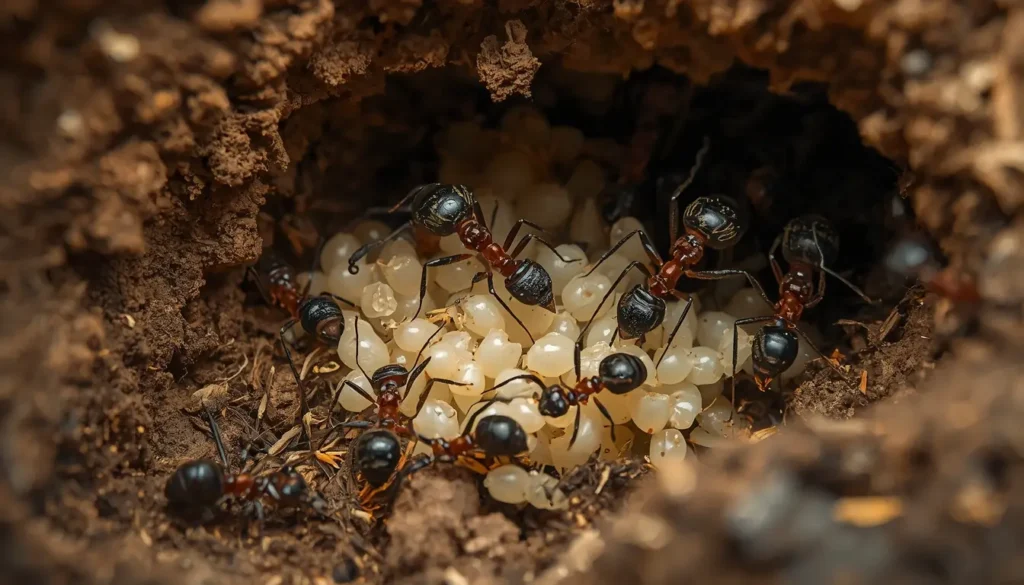
Larvae do more than digest. They are where the colony’s future is settled. A fertilized ant egg is totipotent: the same larva could become a sterile worker or an egg-laying queen. Which one it becomes is decided during the larval stage, mostly by how it is fed.
Feed a female larva richly, at the right temperature and time, and it develops into a queen. Feed it a normal ration and it becomes a worker. As Ask A Biologist puts it, queens are simply females that were fed more as larvae.
The mechanism is subtle. In one 2025 study, first-instar larvae given access to trophic eggs, special non-hatching eggs used as food, mostly became workers, while larvae denied them became queens. The colony, in effect, steers its own caste ratio through the larval menu. That is also why this page connects to the story of the queen ants themselves.
The strange side: hemolymph feeding and cannibalism
Larvae are valuable, and in some colonies that makes them a resource to tap. In the aptly named Dracula ants, adults cannot share food by mouth at all, so they practice larval hemolymph feeding: they pierce the skin of their own larvae and lap up the blood-like fluid that wells out. The larvae usually survive, but it is a startling image.
Cannibalism runs deeper still. When food is short, colonies eat their own eggs and weakest larvae to feed the survivors and the queen, recycling the protein rather than losing it.
Larvae themselves will eat eggs, and they show favoritism, preferring the eggs of less-related nestmates. In an ant colony, brood is both the future and, when times are hard, the pantry.
Feeding ant larvae: a keeper’s guide
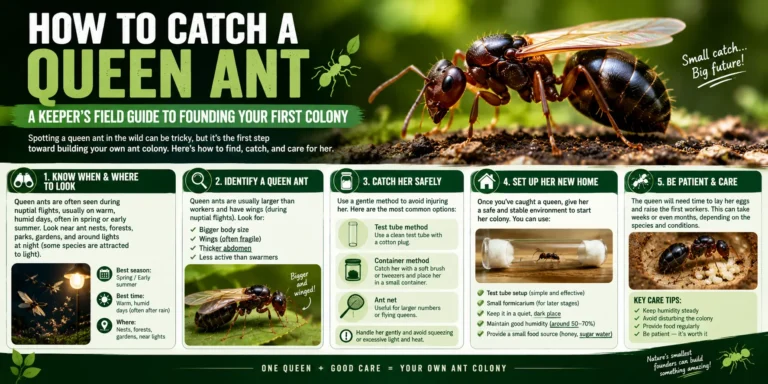
For keepers, the single most useful thing to understand is this: a colony with growing larvae needs protein. Workers fed only sugar will keep themselves alive, but the brood will stall. Protein, usually in the form of insects, is what larvae turn into new ants.
You do not feed larvae directly. You feed the workers, and they deliver it to the brood in the right amounts. Your job is simply to keep protein available whenever larvae are present: feeder insects, fresh-killed roaches or crickets, or whatever protein source your species accepts. For the full menu, see what do ants eat.
The payoff is visible. When I drop a protein item into a colony with hungry larvae, workers swarm it, cut it up, and pack it onto the brood within the hour. Over the next few days, the larvae visibly swell. A steady protein supply during a brood boom is how a small colony becomes a big one.
Let the brood set your timing, not the calendar. Protein demand spikes when the larval pile swells and eases once most have sealed themselves into pupae and stopped eating. Feed protein heavily while larvae are present and growing, then ease off when the pile turns mostly to pupae.
What this looks like in practice: In my own colonies, I read the brood pile like a dashboard. Fat, glossy, growing larvae mean the colony is fed and the queen is laying well. A shrinking pile, or larvae being carried off and eaten, tells me protein is short or something is stressing the colony, often before any adult behavior would show it. The larvae are the early warning system.
Common myths about ant larvae
A few misconceptions come up again and again, so it is worth clearing them.
Ants do not lay larvae. Queens lay eggs, and the eggs hatch into larvae. If someone says they saw an ant “laying larvae,” they saw eggs, or workers carrying larvae.
Larvae are not baby ants that will grow legs and walk. The larva is a completely different body form. It never walks; it dissolves and rebuilds into the adult during the pupal stage.
And finding larvae is not automatically an infestation crisis. Larvae deep in a nest simply mean an established colony. They are helpless and harmless on their own; it is the adult colony, not the brood, that matters for control.
Are ant larvae dangerous, or edible?
Ant larvae cannot hurt you. They have no sting, no meaningful bite, and no way to move toward anything. Every defensive weapon in a colony belongs to the adults, so a pile of larvae is the most harmless thing in the whole nest.
They are, however, food, and not only for the colony. In parts of Mexico, the larvae and pupae of certain ants are harvested as escamoles, a delicacy sometimes called insect caviar and prized for a buttery, nutty flavor. Across many cultures, ant brood has long been eaten as a rich, portable source of protein and fat, which makes sense given that concentrating protein is exactly what a larva is built to do.
The bottom line
So ant larvae are far more than a stage on the way to becoming an ant. They are the colony’s stomach, its nursery, and the crucible where every worker and queen is decided.
Learn to read them, keep protein flowing while they are growing, and you understand the engine of the entire colony. In a very real sense, the ants you see marching are just the delivery system for the larvae you do not.
FAQ
What do ant larvae look like?
Small, soft, white to pale yellow grubs, shaped like a fat comma with a tiny head and no legs. They are covered in fine, often hooked hairs that let workers carry them in bundles.
Do ant larvae move?
Barely. They can wriggle and open their mouths to beg for food, but they cannot walk or crawl to a new spot. Workers do all the moving for them.
What do ant larvae eat?
Mostly protein, delivered by workers. Larvae process solid food such as insect prey that adult ants cannot digest, which is why a colony raising brood needs a protein source, not just sugar.
What is the difference between ant larvae and pupae?
A larva is a shapeless white grub. A pupa already looks like a pale, folded ant at rest. If you can make out ant-shaped legs and antennae, it is a pupa, not a larva.
How long does the ant larval stage last?
Usually one to three weeks, depending on species and temperature, though larvae that overwinter can stay in the stage for months before resuming development in spring.
Can ant larvae become queens?
Yes. A female larva can become either a worker or a queen, and the outcome is decided mainly by how richly it is fed during the larval stage. Well-fed female larvae become queens.
Do ants lay larvae?
No. Queens lay eggs, and those eggs hatch into larvae. Larvae are the second stage of the life cycle, not something an ant lays.
Are ant larvae in my house a problem?
Finding larvae means an established nest is nearby, but the larvae themselves are harmless. Any control effort should target the adult colony and queen, not the brood.
Can you eat ant larvae?
Yes. In Mexico, ant larvae and pupae are eaten as escamoles, a protein-rich delicacy nicknamed insect caviar, and ant brood is a traditional food in several cultures. The larvae are harmless to handle.
Why do ants carry their eggs and larvae when disturbed?
Because the brood is both the colony’s future and its communal stomach. When a nest is threatened, workers rush the larvae to safety deeper inside before tending to almost anything else.