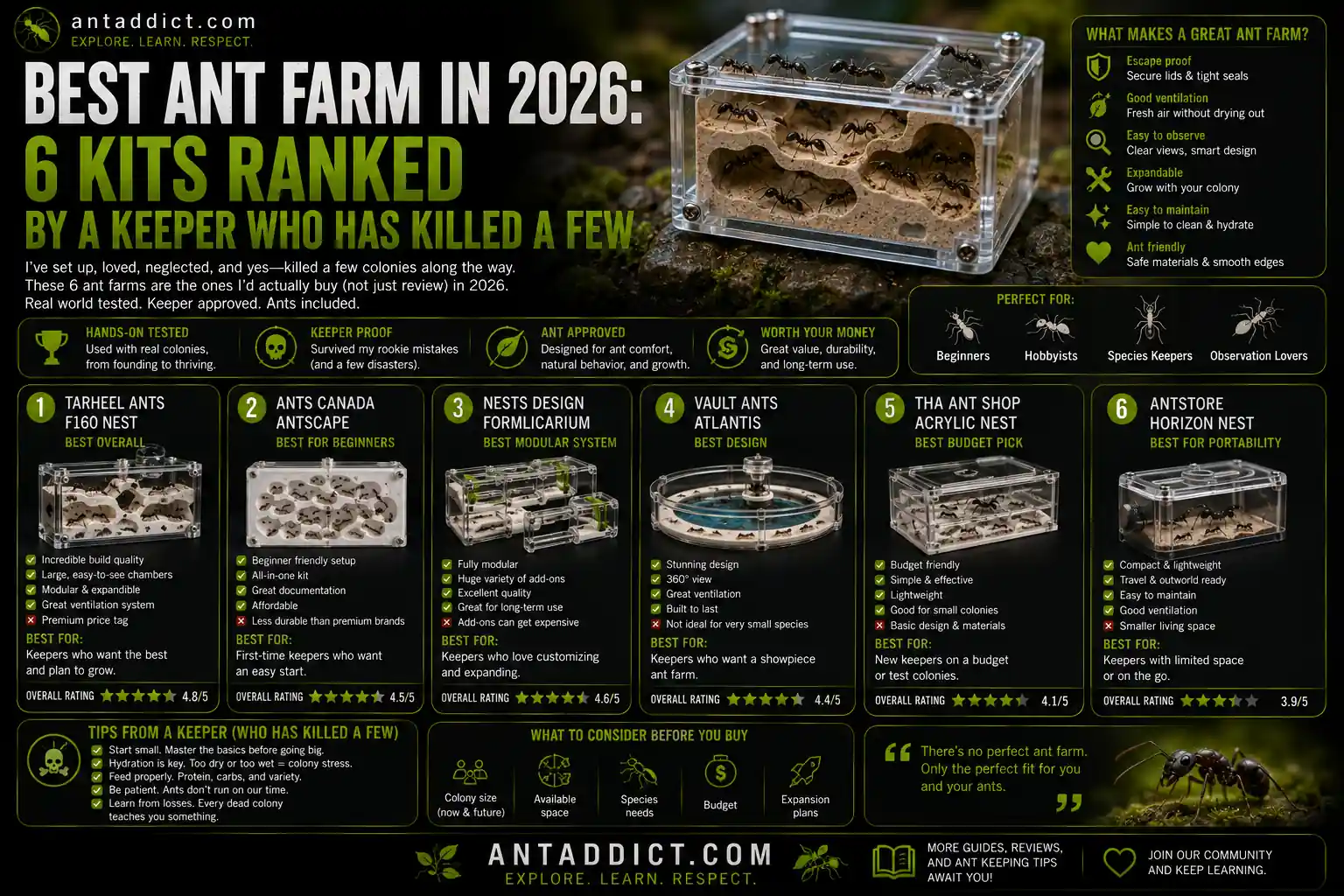
Best Ant Farm in 2026: 6 Kits Ranked by a Keeper Who Has Killed a Few
Last reviewed: August 2026. Product prices are approximate and were accurate at the time of writing; always confirm current pricing and live-ant availability with the seller before buying. Live-ant shipping is regulated and varies by country and state. This article contains affiliate links, and we may earn a commission on qualifying purchases at no extra cost to you. Care guidance is drawn from established ant-keeping practice and community consensus; see references below.
An honest buyer’s guide to the ant farms that actually keep a colony alive, and the ones that quietly kill it
Quick Answer: The best ant farm for most people in 2026 is a hydration-first acrylic formicarium paired with a laying queen, not a gel or sand novelty. For serious beginners in the US, the Tar Heel Ants Mini Hearth (about $41) is the pick, because its built-in water reservoir does the one thing that keeps a colony alive: it holds a stable humidity gradient. If you want a gift that works out of the box with a live queen already inside, an all-in-one Lasius niger starter kit is the better call. Skip gel farms entirely. They look like the future and perform like a coffin.
I have kept ants for years, and I have killed colonies in almost every way a beginner can. Drowned them, starved them, cooked them on a windowsill, and once watched a “space-age” gel farm turn green with mold in under three weeks. That experience is worth more to you than any spec sheet, because the difference between a farm that thrives and one that dies has almost nothing to do with how cool it looks and almost everything to do with two boring things: whether there is a queen, and whether the nest can hold water.
This guide covers the six ant farm types actually worth your money in 2026, ranked and labeled by who each one is for. You will get real prices, the honest tradeoffs, a comparison table, the science every other “best ant farm” list skips, and a plain answer to the question that trips up every first-time buyer: do the ants come with it, and will they last.
What is the best ant farm overall in 2026?
The best ant farm overall is the Tar Heel Ants Mini Hearth, at roughly $41 at the time of writing. It is not the flashiest and it does not ship with ants, but it gets the fundamentals right in a way toy-aisle farms never do.
The Mini Hearth is a compact acrylic nest with a cast hydration insert (a porous water-holding stone) built into the base. You add water to a port, the stone wicks it slowly, and the nest holds a gentle moisture gradient the colony can move around in. That single feature is why keepers who have owned dozens of setups keep coming back to Tar Heel Ants, a US maker that has been in the hobby since 2011. It is escape-resistant, expandable through tube ports as your colony grows, and small enough for a desk.
The catch, and it is the same catch for every genuinely good formicarium, is that you supply the colony. That sounds like a downside until you understand why it is actually the whole point, which I will get to in the section everyone else leaves out.
Best for: Beginners who want to keep ants for real, not just for a school semester. Price: ~$41 (Mini Hearth) to ~$51 (Mini Hearth XL).
What is the best all-in-one ant farm kit with a queen included?
If you want to open one box and have a living colony that same day, buy a complete Lasius niger starter kit with a queen already inside. This is the format sold by European ant specialists as “Claire,” “Antie,” and similar all-in-one kits, typically running £75 to £95 (roughly $95 to $120), and it is the single best gift-grade ant farm on the market.
Here is why the format wins for beginners and gift-buyers. It bundles the three things you otherwise have to source separately: an acrylic nest with a hydration area, a small outworld for foraging and waste, and a mated Lasius niger queen with a starter clutch of 10 to 20 workers. Lasius niger, the common black garden ant, is the ideal beginner species. The queen is hardy, tolerant of beginner mistakes, lives well over a decade in good conditions, and the colony grows fast enough to stay interesting without exploding out of a small nest.
A US buyer will source the same idea from a domestic vendor to avoid live-ant shipping restrictions across borders, but the principle holds: queenright, hydration built in, outworld attached. That is the trifecta.
Best for: Gifts, kids ages 8 and up with adult help, and anyone who wants zero sourcing hassle. Price: ~£75 to £95 / ~$95 to $120 depending on species and nest.
What is the best modular ant farm that grows with the colony?
For keepers who suspect they will get hooked, the modular 3D-printed ecosystem is the smart long game. Brands like Ant Shack (complete habitats around $55 to $65) and AntsCanada’s Hybrid and Omni nests (about $60 to $90) build every piece to plug into every other piece through standard tube ports.
The value here is not the individual nest; it is the architecture. You start with a small founding setup, then bolt on nests, outworlds, and water hubs as the colony outgrows each stage, never having to tear down and rehouse into a totally new system. A colony of 30 workers and a colony of 3,000 can live in the same expanding family of parts. For a hobby where a healthy Lasius colony can reach the thousands within two or three years, that expandability is real money saved.
The tradeoff: most modular systems, Ant Shack included, sell the hardware only and do not ship live ants, so you are back to sourcing a queen yourself. That is fine, and again, it is the correct way to do this.
Best for: Keepers planning for the long haul who want one compatible system for years. Price: ~$55 to $90 for a starter nest plus outworld.
What is the best ant farm for young kids and classrooms?
For a young child or a classroom demo where the goal is a few weeks of wonder rather than a decade-long pet, the classic Uncle Milton sand farm is still the honest pick. It runs about $13 to $25, the green frame is pure nostalgia, and it ships with a voucher for live harvester ant workers (usually Pogonomyrmex species).
Be clear-eyed about what you are buying. These farms ship workers only, no queen, because mailing queens of some species is restricted in the US. That means the colony is on a clock from day one. Worker harvester ants can tunnel and forage for several weeks to a few months, which is genuinely enough time for a kid to watch chambers appear and learn how a colony organizes itself. But it will not reproduce, it will slowly dwindle, and pretending otherwise sets a child up for a sad ending. Treat it as a living science lesson with a known end date, and it delivers.
Best for: Kids ages 6 and up, teachers, short-term projects, nostalgia gifts. Price: ~$13 to $25 plus a few dollars for the live-ant voucher.
What is the best ant farm for watching dramatic behavior?
If you want the most visually rewarding colony for the money, get a harvester ant kit built around Messor barbarus. These European harvester ants run in all-in-one kits around £85 to £95 (roughly $105 to $120) and they are the best show in the hobby.
Messor barbarus colonies are large, boldly polymorphic (you get tiny workers and hulking big-headed majors in the same colony), and they harvest and store seeds, cracking them in a communal granary. Watching a “seed factory” run inside a clear nest is a completely different experience from watching black ants dig. The majors’ oversized heads are muscle for milling seeds, and seeing that division of labor play out is the kind of thing that turns a casual buyer into a lifelong keeper.
They need a slightly larger foraging area and a seed mix rather than sugar water as their staple, so read the care card, but the payoff in watchable behavior is unmatched at this price.
Best for: Keepers who want maximum visible action and unusual biology. Price: ~£85 to £95 / ~$105 to $120 for a complete kit with queen.
What is the best budget ant farm?
The best true-budget entry is a DIY test-tube-and-outworld setup for under $20, and it is what most experienced keepers actually start a new queen in. A test tube with a water reservoir plugged by cotton becomes a perfect founding chamber: dead simple, cheap, and it holds humidity better than almost any commercial toy. Connect it to a small foraging container and you have a functional ant farm for the price of a sandwich.
The honest tradeoff is that it is not much to look at and it takes a little know-how, so it is a better fit for someone willing to learn than for a gift. But if budget is the constraint and survival is the goal, this beats any $25 gel farm on the shelf, every time.
Best for: Budget keepers and anyone founding a brand-new queen. Price: under $20 for tubes, cotton, and a basic outworld.
Best ant farm comparison table
| Ant farm | Best for | Approx. price | Queen included? | Hydration system | Expandable? |
|---|---|---|---|---|---|
| Tar Heel Ants Mini Hearth | Serious beginners (overall pick) | ~$41 to $51 | No (you supply) | Yes, cast water stone | Yes, tube ports |
| All-in-one Lasius niger kit | Gifts, hassle-free start | ~$95 to $120 | Yes | Yes | Limited |
| Modular 3D-printed system | Long-term keepers | ~$55 to $90 | Usually no | Yes, water hub add-on | Yes, fully |
| Uncle Milton sand farm | Kids, classrooms, short-term | ~$13 to $25 | No (workers only) | Manual misting | No |
| Messor barbarus kit | Watching dramatic behavior | ~$105 to $120 | Yes | Yes | Some |
| DIY test tube + outworld | Budget, founding a queen | under $20 | No (you supply) | Yes, water plug | Yes, DIY |
Here is the part every other “best ant farm” list skips
Nearly every roundup you will read ranks ant farms by how they look: the glowing gel, the retro green frame, the number of tunnels. That is ranking a fish tank by the picture on the box. Two things actually decide whether your ant farm is alive in six months, and both are biology, not design.
First: the queen is the colony, and everything else is disposable. Worker ants are sterile females with a finite lifespan, usually measured in months to a couple of years depending on species and caste. They do not reproduce. The queen is the sole reproductive engine, the only individual laying eggs, and in a species like Lasius niger she can live 15 years or more. The species even holds one of the longest documented ant-queen lifespan records on file: a captive queen that survived close to three decades. A farm with workers but no queen is not a colony; it is a countdown, and the moment the last worker dies it is over, with no replacements ever coming. This is exactly why the toy-aisle “farms” that ship workers only are guaranteed to fail, and why every genuinely good setup either includes a mated queen or is designed for you to add one. When you buy an ant farm, you are really deciding whether you are buying a pet or a slowly emptying box.
Second: ants regulate their brood by humidity, and they need a moisture gradient to do it. In the wild, a colony constantly moves eggs, larvae, and pupae between deeper, damper chambers and drier upper ones to keep the brood at the right humidity for each stage (our guide to ants and water covers this in depth). A real formicarium reproduces this with a porous water reservoir, a cast stone, plaster, or aerated concrete, that wicks moisture slowly and creates a gradient from wet to dry across the nest. The ants pick the spot they like. Remove that gradient and you get desiccated, dead brood at the dry end or drowned ants at the wet end.
This is the precise mechanism that makes gel farms a trap. The gel is sold as food and water in one, but experienced keepers and the ant-keeping forums are near-unanimous: gel molds within weeks, provides no real dietary variety (ants need separate sources of sugars, proteins, and fats), offers no true humidity gradient, and can physically trap and suffocate ants in its texture. Colonies in gel do not thrive, they “dig tunnels to nowhere” and waste away. A number of keepers now argue gel farms should be pulled from shelves entirely. Buy one only as a two-week disposable science demo, never as a home for ants you care about.
Get the queen and the hydration right and the rest is easy. Get them wrong and the prettiest ant farm on Earth is a mold experiment.
An honest keeper’s take
If someone handed me $60 and said set me up, I would not spend it on the farm. I would spend maybe $41 on a Mini Hearth, a few dollars on test tubes and cotton, and the rest on patience, and I would go find a queen myself during nuptial flight season. Catching your own Lasius niger queen after a summer rain and raising her from a single ant to a bustling colony is, honestly, the best part of this hobby, and it costs nothing.
But I also know that is not what most first-time buyers want, and that is completely fair. If you want the magic without the sourcing, the all-in-one kit with a queen already inside is the right buy and I would not talk you out of it. What I will talk you out of is the gel farm and any “complete” kit that quietly ships workers with no queen. Those are not shortcuts, they are disappointments with a two-week fuse.
Whatever you pick, keep it out of direct sun, away from heaters and vibration, refresh the water on schedule, and give the ants a week or two of quiet to settle before you expect activity. Ants reward patience and punish fussing.
The bottom line
The best ant farm in 2026 is the one built around a queen and a working humidity gradient; everything else is decoration. For serious beginners, the Tar Heel Ants Mini Hearth is the overall pick because it nails hydration and expands with your colony. For a gift or a zero-hassle start, an all-in-one Lasius niger kit with a queen included is the smart buy. Long-haul hobbyists should invest in a modular 3D-printed system, kids and classrooms are well served by the honest, short-term Uncle Milton sand farm, and anyone chasing dramatic behavior should go straight for a Messor barbarus harvester colony. Whatever you do, walk past the gel. Your ants will live years longer for it.
FAQ
Do ant farms come with ants?
Some do, most of the good ones do not. All-in-one starter kits usually include a live queen and a small worker force. Serious formicaria like the Tar Heel Ants Mini Hearth, and most modular systems, sell the nest only so you can add the species and queen you want. Toy sand farms often ship workers only, with no queen, via a mail-in voucher.
Can you keep an ant farm alive without a queen?
Not for long. Without a queen there is no reproduction, so the colony cannot replace workers as they die. A queenless farm of workers lasts a few weeks to a few months at most, then ends permanently. For a lasting colony you need a mated queen.
Are gel ant farms bad for ants?
Yes, for anything beyond a short demo. Gel molds quickly, fails to provide the varied diet ants need, offers no proper humidity gradient, and can trap ants. Experienced keepers overwhelmingly advise against them for any colony you want to keep alive. Use one only as a disposable two-week science project.
What is the best ant species for a beginner ant farm?
Lasius niger, the common black garden ant. The queen is hardy and forgiving of mistakes, lives well over a decade, and the colony grows at a satisfying but manageable pace. Messor barbarus harvester ants are a great second choice if you want more dramatic behavior.
How much does a good ant farm cost?
A quality beginner formicarium runs about $40 to $55 for the nest alone, or roughly $95 to $120 for a complete all-in-one kit that includes a queen. Budget DIY setups can come in under $20. Gel novelties are cheap at $15 to $30 but are not worth it.
Where should I put my ant farm?
Somewhere with stable room temperature, out of direct sunlight, away from heat sources, radiators, and vibration. Sunlight cooks the nest and can trigger algae or mold, and constant vibration stresses the colony. A quiet shelf or desk away from windows is ideal.
How long do ant farm colonies live?
A queenright Lasius niger colony can live and grow for well over a decade, since the queen herself may live 15 years or more. Queenless worker-only farms last only weeks to months. The presence of a healthy queen is the single biggest factor in longevity.
Do I need to feed ants in an ant farm, or does the farm feed them?
You feed them. Even farms sold with built-in “food” like gel do not provide adequate long-term nutrition. Ants need a rotation of sugar (sugar water or honey) for energy and protein (small insects) for the brood. See our guide on what ants eat and how to feed a colony for a full feeding schedule.
Can I catch my own queen instead of buying one?
Yes, and many keepers consider it the best part of the hobby. Queens leave the nest to mate during seasonal nuptial flights, usually after warm, humid weather. Catch a mated queen, house her in a test tube setup, and raise the colony from scratch for free. Our nuptial flight predictor can help you time it.
Is an ant farm a good gift for a child?
It can be a great one, with the right expectations. For a lasting pet, choose an all-in-one kit with a queen and plan to help with care. For a short, magical few weeks, a classic sand farm is fine as long as everyone understands it is temporary. Avoid gel farms as gifts, since a colony dying of mold is a poor introduction to the hobby.
Are ant farms escape-proof?
Good formicaria are designed to be escape-resistant, with sealed ports and barriers, but no setup is perfectly escape-proof, especially with tiny species. A barrier of fluon or a light smear of petroleum jelly around the outworld rim, plus properly sealed tube connections, keeps almost all species contained.