Do Ants Drink Water? How Ants Hydrate, Store It, and Share It
Quick answer
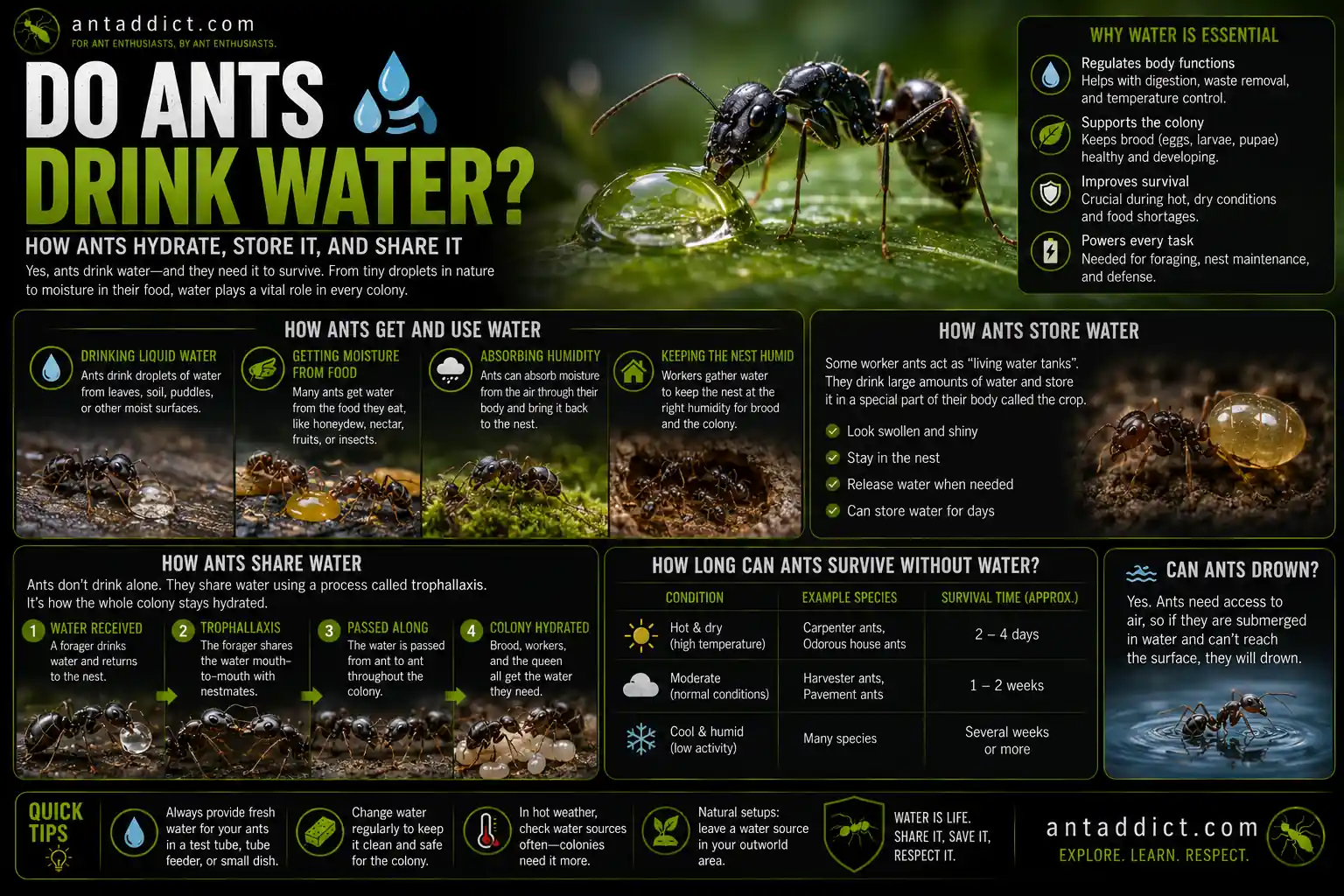
Yes, ants do drink water. They lap and suck it up through specialized mouthparts, and they also get a large share of their moisture from the food they eat, such as nectar, honeydew, and prey. But the most surprising part is what happens next: an ant doesn’t just drink for itself. It stores liquid in a special “social stomach” called the crop and shares it mouth-to-mouth with nestmates through a process called trophallaxis. So when you watch a single ant drink, you’re really watching the whole colony take a sip.
Key takeaways
- Ants genuinely drink liquid water, using a tongue-like mouthpart (the labium) to lick or suck it up.
- They also absorb a lot of moisture from food — nectar, honeydew, fruit, and prey — so they don’t always need standing water.
- A single ant drinks only a few microliters at a time — a fraction of one raindrop.
- Ants store liquid in a “social stomach” (the crop) separate from their digestive stomach.
- They share that stored water and food mouth-to-mouth through trophallaxis, hydrating the entire colony.
- Ants do need water to survive; foragers seek it out and haul it back to the nest, which is often why they appear at your sink.
Do ants drink water?
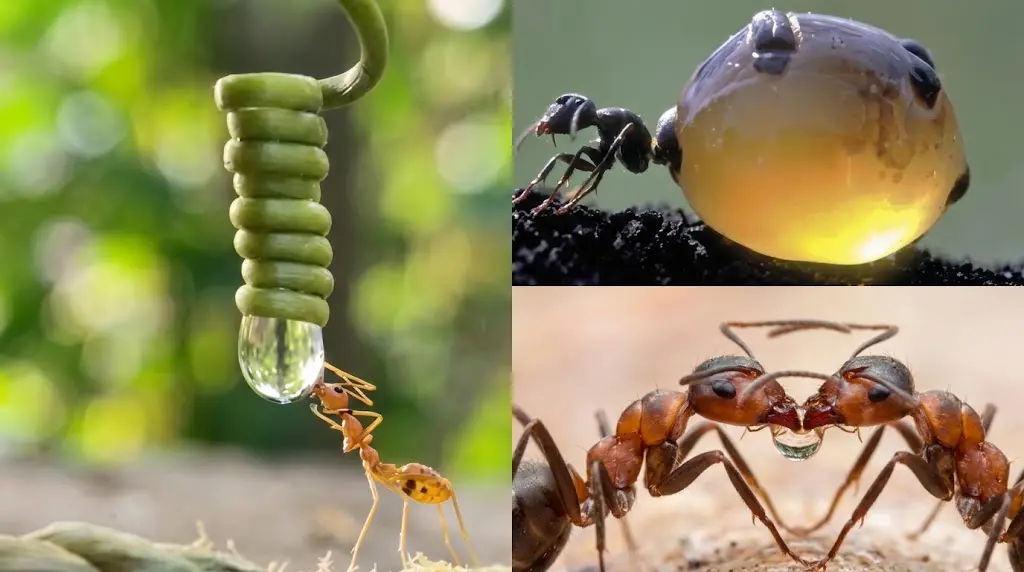
Yes — ants do drink water, and it’s easy to see for yourself. Place a drop of water near an active ant trail on a warm day and you’ll often watch a forager stop, lower its head, and stay there for several seconds with its mouthparts pressed to the surface. It is drinking, in the most literal sense.
But “do ants drink water” hides a more interesting question, because ants have two ways of staying hydrated and they use both. Some of their water comes from drinking free-standing liquid — a dewdrop, a puddle, condensation on a pipe, the rim of a pet bowl. The rest comes bundled inside their food. Nectar, honeydew, ripe fruit, and the body fluids of prey are all mostly water, so an ant feeding on a drop of honeydew is drinking and eating at the same time.
That dual system is why you’ll sometimes read that ants “don’t need to drink.” It’s an overstatement — ants absolutely need water — but it points at something real: an ant colony with a rich, moist food supply can go a long time without ever visiting open water, while a colony in dry conditions or feeding on dry seeds has to send out foragers specifically to find and carry water home. Whether ants drink standing water on any given day depends less on biology than on how thirsty the colony is and what its food is providing.
How do ants drink water?
Ants don’t have a straw-like proboscis the way a butterfly does, and — despite a common belief — they don’t “bite” chunks of water off. Instead they drink using the labium, a flexible, tongue-like mouthpart on the underside of the head. On the tip of the labium sits a small structure called the glossa, which works like a tiny tongue, and behind the mouth is a muscular sucking pump (the cibarial and pharyngeal pump) that pulls liquid inward. Between the tongue and the pump, an ant has two different drinking techniques.
Licking vs. sucking
Researchers who studied carpenter ants feeding found that ants switch between two modes depending on how thick the liquid is. With thick, viscous liquids like concentrated sugar syrup, an ant tends to lick — dabbing the glossa in and out to physically ferry the liquid up, the way you’d lick honey off a spoon. With thin, watery liquids, it switches to sucking, using the internal pump to draw a steady stream up through the mouth like sipping through a straw. The thinner the liquid, the more an ant relies on suction; the thicker it is, the more it licks. Plain water, being about as thin as it gets, is drunk almost entirely by sucking.
Do ants bite water off? (The myth)
A surprisingly common question — and the honest answer is no. Ants can’t bite or chew water; it isn’t solid. Their mandibles (the jaws) are tools for cutting, carrying, and fighting, not for eating or drinking. All liquid intake happens behind the mandibles, at the labium and the sucking pump. When an ant appears to be “chewing” at a droplet, it’s actually lapping and sucking, its mandibles simply held out of the way. So if you’ve wondered whether ants bite water off in little pieces, they don’t — they drink it much the way we do, just at a scale you need a microscope to appreciate.
How much water can an ant drink?
Not much, by human standards — but a lot relative to their size. Studies of the carpenter ant Camponotus mus, one of the most-measured species for feeding behavior, found that a mid-sized worker typically takes in around 6 to 8 microliters of sugar water in a single feeding, and a really hungry ant can pack in up to roughly 35 microliters by stretching its crop.
To put that in perspective, a single raindrop is somewhere around 50 microliters, so even a full ant is carrying only a fraction of one raindrop inside it. The smallest recorded sips are around 0.1 microliter — a droplet you could barely see. Intake also depends on the liquid: ants drink watery solutions faster but stop sooner, and drink thick syrups more slowly but often cram in more total volume because the calories are worth the effort. Either way, the amount one ant carries is tiny — which makes the colony’s plumbing all the more impressive, because those microliters add up when thousands of foragers pool them together.
The social stomach: how one ant drinks for the whole colony
Here is the part almost every other article on ant drinking leaves out, and it’s the most remarkable thing about how ants use water.
The crop vs. the digestive stomach
An ant actually has two stomachs. The first is its own digestive stomach (the midgut), where food is broken down to nourish that individual ant. In front of it sits the crop, often called the “social stomach” — a stretchy storage sac in the foregut where an ant holds liquid before it’s digested. A one-way valve called the proventriculus sits between the crop and the midgut and controls how much passes through to be digested. Everything held in the crop, above that valve, is still “public” — it can be brought back up and given away.
So when a forager drinks at a puddle, most of that water doesn’t go toward feeding herself. It goes into the crop as colony property, to be carried home and redistributed.
Trophallaxis: mouth-to-mouth sharing
Back at the nest, the forager passes its stored liquid to other ants mouth-to-mouth, a behavior called trophallaxis. The receiving ant strokes the donor with its antennae, the donor brings a droplet of crop fluid back up to its mouth, and the two ants briefly connect while the liquid transfers. Through a chain of these exchanges, water and liquid food ripple outward from a few foragers to hundreds or thousands of nestmates — including nurse workers, the queen, and the developing brood, which never leave the nest and rely entirely on this delivery system.
Trophallaxis turns out to carry more than just water and calories. Research on trophallaxis has found that the fluid ants pass around also contains proteins, hormones, and other signaling molecules, meaning trophallaxis helps regulate colony growth and development as well as hydration. In other words, the crop isn’t just a canteen — it’s part of how the colony functions as a single connected organism. This is why “do ants drink water” has such a surprising answer: for an ant, drinking is a social act, not a private one.
Do ants get water from their food?
A great deal of it, yes. Much of an ant’s diet is already wet. Honeydew — the sugary liquid excreted by aphids and other sap-feeding insects — is mostly water, and it’s the single biggest food source for many ant species. Nectar from flowers and plants, ripe fruit, tree sap, and the soft bodies of insect prey all deliver moisture along with their sugars and proteins. An ant feeding on any of these is hydrating without ever visiting a puddle.
On top of dietary water, ants gain a small amount of metabolic water — water produced internally when the body breaks down fats and carbohydrates for energy. It’s the same process that lets a camel go a long time between drinks. For most ants metabolic water is a minor contribution, but for desert species it becomes a genuine survival tool (more on that below).
Because so much water arrives inside food, an ant’s need to drink free water rises and falls with its diet. Colonies feeding on juicy honeydew and prey may rarely seek open water, while those eating dry seeds — like harvester ants — have a stronger, more constant drive to find and haul liquid. For the full picture of what ants eat and how those foods double as hydration, see our guide to what ants eat.
Do ants need water to survive?
Absolutely. The idea that ants are “afraid of water” or don’t need it is a myth — water is essential to every ant colony. It keeps individual ants from drying out, and just as importantly it keeps the brood (eggs, larvae, and pupae) from desiccating, since developing ants are especially vulnerable to low humidity. Colonies invest real effort in water: foragers actively hunt for it, workers haul it home, and many species position or build their nests to stay humid.
How long can ants last without it? Honestly, it varies too much to give a single number. A well-fed colony with a moist food supply and a humid nest can coast for a considerable time on dietary and stored water, while ants in hot, dry conditions dehydrate quickly. Small ants have a lot of surface area relative to their volume, so they lose water fast in dry air — which is exactly why you see ant activity spike indoors during heat waves and droughts, when outdoor moisture disappears and colonies come looking for it. Rather than a fixed survival window, think of it as a balance: as long as water coming in (from drinking, food, and metabolism) keeps pace with water lost to dry air, the colony is fine. Tip that balance and the ants must find water fast.
Where do ants find water?
Ants are resourceful about moisture. Outdoors they drink from dew on leaves and grass in the early morning, from rain puddles, from the damp soil around their nest, from plant exudates, and from the honeydew and prey already discussed. They’re small enough that a film of overnight condensation or a single dewdrop is a meaningful drink.
Indoors, the water sources are obvious once you think like an ant: the sink, the tub, the base of a leaky pipe, a pet’s water bowl, condensation on a cold window, a damp sponge. This is why ants so often appear in kitchens and bathrooms, especially in dry weather — they’re not lost, they’ve found your reliable water supply and are laying a scent trail so nestmates can follow. If ants keep showing up around water in your home, they aren’t a special “water-loving” species; they’re ordinary ants foraging for moisture, and the fix is removing standing water and sealing their entry points. Our full guide to water ants breaks down every version of that situation and how to handle it.
How desert ants survive with almost no water
Some of the most remarkable ants on Earth live where free water almost never exists. Desert species like the Sahara’s silver ants and North American harvester ants have turned water conservation into an art. They lean heavily on metabolic water wrung from their food, minimize water loss through a waxy, sealed cuticle, and adjust their behavior to avoid the worst of the heat — foraging in short bursts during cooler hours and sheltering deep in the nest when the surface bakes.
Nest architecture does a lot of the work too. Many desert ants dig deep vertical shafts that reach cooler, more humid soil far below the scorching surface, effectively building their own underground humidity reserve. Combined with dietary moisture, these adaptations let desert colonies thrive on a water budget that would kill most insects — a reminder that “do ants drink water” has very different answers depending on where an ant lives. A rainforest ant swims in moisture; a desert ant may go its whole life without ever drinking a visible drop.
How to give pet ants water safely
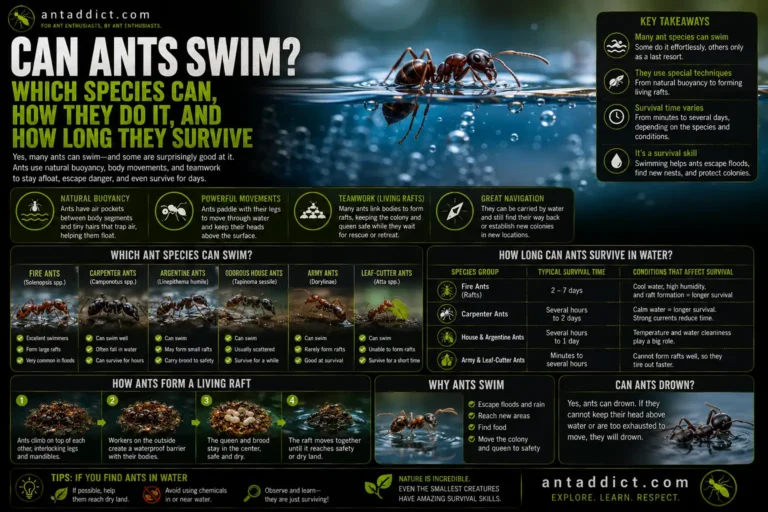
If you keep an ant colony — and if you’re reading this on AntAddict, you might — hydration is one of the easiest things to get wrong, because the same water your ants need can also drown them. Ants are tiny enough that an open dish of water is a hazard, not a drink — and while some ants can swim, most simply sink once they break the surface.
The standard, safe solution is a hydration source with a barrier the ants can’t fall into. In a classic test-tube setup, water is held behind a plug of cotton: the cotton stays damp, and the ants drink from the moist fibers without ever meeting open water. In larger formicariums, keepers use water towers, cotton-plugged tubes, or a small sponge kept damp, and provide humidity gradients so ants can choose how wet an area they want. Sugar water and honey can be offered separately as food, ideally on a small dish or cotton so foragers don’t get stuck in the liquid. The guiding principle is simple: give ants moisture they can sip from a surface, never a pool they can fall into. Get that right and a captive colony stays hydrated with essentially no drowning risk.
The bottom line
Do ants drink water? Yes — they lap and suck it up through a tongue-like labium, taking only a few microliters at a time, and they supplement it with all the moisture packed inside nectar, honeydew, fruit, and prey. What makes ant drinking extraordinary isn’t the act itself but what surrounds it: an ant stores liquid in a social stomach separate from its own gut and shares it mouth-to-mouth through trophallaxis, so a single forager’s drink hydrates the queen, the brood, and countless nestmates back home. Ants genuinely need water, they’re clever about finding it, and desert species survive on almost none of it. The next time you see one ant pause at a droplet, remember you’re not watching an individual quench its thirst — you’re watching the first sip of a drink the whole colony will share.
FAQ
Do ants drink water?
Yes. Ants drink liquid water using a tongue-like mouthpart called the labium, either licking it up or sucking it in with an internal pump. They also get significant moisture from foods like nectar, honeydew, and prey.
How do ants drink water?
They use the labium and glossa (a tongue-like tip) together with a muscular sucking pump behind the mouth. For thin liquids like water they mostly suck; for thick syrups they lick. They do not bite or chew water.
Do ants bite water to drink it?
No. Ants cannot bite liquid — their mandibles are for cutting and carrying solids. All drinking happens at the labium and sucking pump, with the jaws held out of the way.
How much water can an ant drink at once?
Only a few microliters — studies of carpenter ants found about 6 to 8 microliters in a typical feeding and up to roughly 35 microliters when fully loaded. That’s a fraction of a single raindrop.
Do ants get water from their food?
Yes, a lot of it. Nectar, honeydew, fruit, sap, and prey are mostly water, so ants hydrate as they eat. They also make a little metabolic water internally when they burn food for energy.
Do ants need water to survive?
Yes. Water is essential for ants and especially for their developing brood, which dries out easily. Colonies actively forage for water and store it, and ant activity often increases indoors during dry weather as they search for moisture.
How do ants share water with the colony?
Foragers store water in a “social stomach” (the crop) and pass it mouth-to-mouth to nestmates through a behavior called trophallaxis, distributing it to workers, the queen, and the brood that never leave the nest.
How do desert ants get water?
Desert ants rely mainly on metabolic water from their food, minimize water loss through a sealed waxy cuticle, forage during cooler hours, and dig deep nests that reach more humid soil, allowing them to survive with almost no free water.
How should I give water to pet ants?
Never use an open dish, which can drown them. Provide moisture behind a barrier — a cotton-plugged water tube, a water tower, or a damp sponge — so ants can sip from a wet surface without falling into standing water.