Honeypot Ants: The Living Honey Jars of the Desert
Last reviewed: June 2026. Claims in this guide are drawn from first-hand keeping and the peer-reviewed and university sources linked inline and listed below. The cultural material is presented with respect for the Aboriginal communities to whom the honey ant belongs.
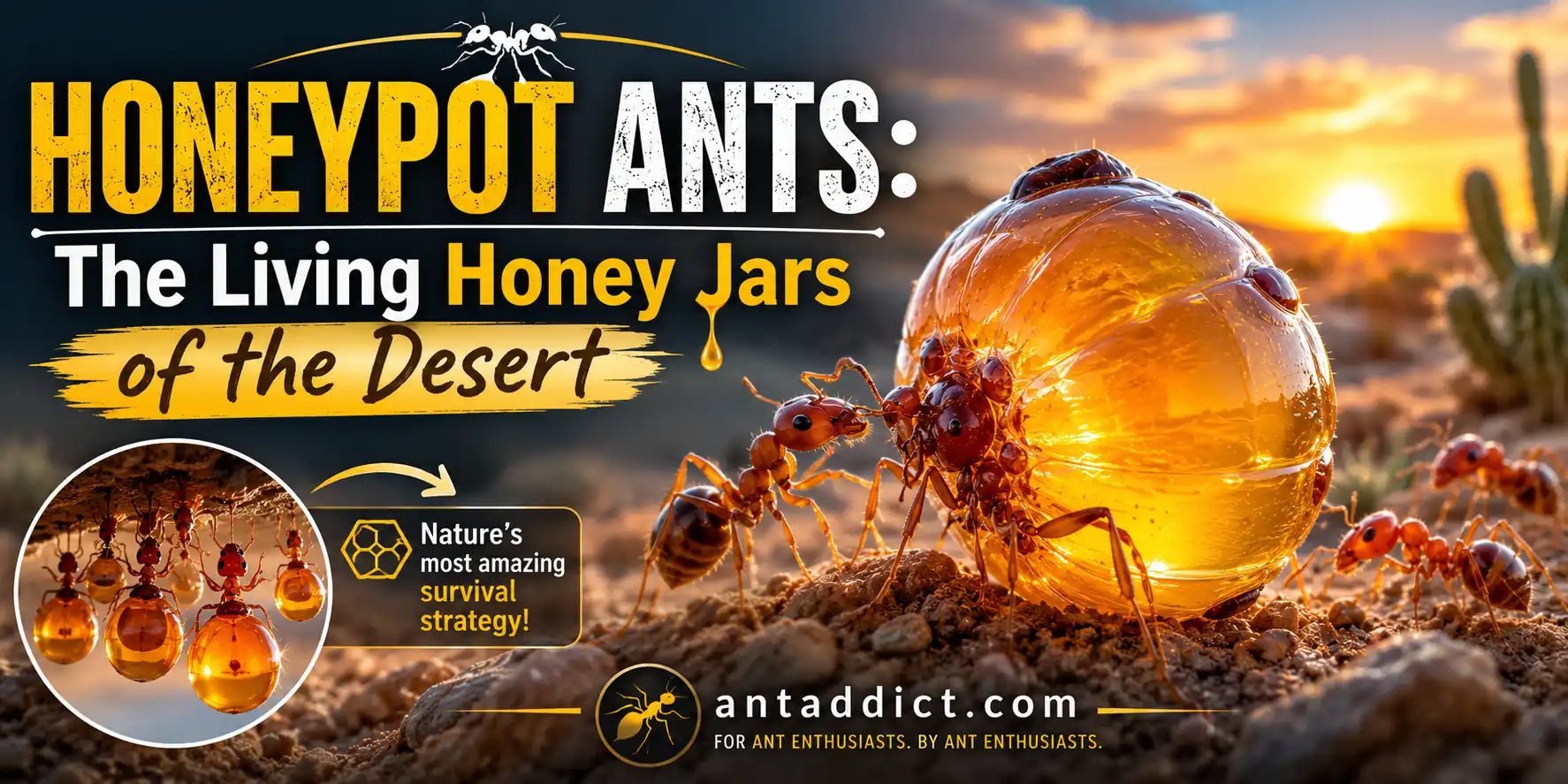
Honeypot ants are desert ants that turn some of their own workers into living storage tanks. These specialized workers, called repletes, gorge on nectar, honeydew, and water until their abdomens swell to the size of a small grape, then hang motionless from the nest ceiling. When food runs short, the colony taps them, and each replete regurgitates its stored harvest to feed its sisters. The strategy is so useful that it has evolved independently in deserts around the world, and Aboriginal Australians have prized these ants as food for thousands of years.
Of all the strange things ants do, this is the one that stops people mid-sentence. A colony that stores its pantry inside the bodies of living workers sounds invented, yet it is real, ancient, and beautifully practical. After six years of keeping ants, I still find honeypots the hardest group to believe evolution actually built.
This guide covers what honeypot ants are, what a replete really is, the species that make them, why the desert drove this bizarre solution, and the two things that make honeypots culturally famous: they are eaten, and they sit at the heart of one of the world’s great art movements.
What are honeypot ants?
Honeypot ants are not a single species. The name describes a lifestyle, not a family tree. Any ant that keeps a caste of workers specialized to store liquid food long-term inside their own bodies can be called a honeypot ant.
The stored-food workers are the whole point. A recent review by Rutgers researchers Bianca Nogueira and Lily Khadempour, Honeypots: A Review of Repletism Across the Ants, defines them by exactly this trait: a specialized set of workers, the repletes, that hold food in their crops for weeks or months so the colony can draw on it when the desert offers nothing.
That definition matters, because it is stricter than most guides admit. Plenty of ants have big, swollen abdomens for other reasons, such as fat storage, and get loosely called honeypots. A true honeypot ant stores liquid in its crop, the “social stomach,” and shares it back out later. Get that distinction right and the whole group makes sense.

What exactly is a replete?
A replete starts life as an ordinary worker, no different from its sisters. Early in adulthood, some young workers are chosen and fed relentlessly. They swallow load after load of liquid until the crop swells, the plates of the gaster pull apart, and the body ends up wrapped around a taut, translucent sphere of stored food.
The transformation is dramatic. In the Australian honey ant, ordinary workers run about 5 to 8 millimeters, while a full replete can swell to roughly 0.7 inch (17 mm), most of it a glistening liquid ball.
At that size a replete can no longer walk or forage. It becomes furniture. Workers carry the repletes to the ceilings of deep, cool storage chambers, where they cling upside down by their feet and wait, sometimes for months on end.
The repletes are not sick or trapped. They are doing their job: being the colony’s warehouse. When a nestmate strokes a replete and begs, the replete regurgitates a droplet of its stored liquid through trophallaxis, mouth to mouth. A single chamber of hanging repletes is a bank vault the colony can draw on for the leanest months of the year.
What do repletes store?
Mostly sugars, gathered when the desert briefly offers them. Repletes fill up on floral nectar, on honeydew milked from sap-sucking insects, and on the juices of prey, plus plain water, which in a desert is worth as much as any sugar.
Not every replete stores the same thing. In the North American honeypot Myrmecocystus mexicanus, the review notes that repletes in a single colony can carry different cargo: some crops are a milky, protein- and lipid-rich fluid, while others are clear amber packed with sugar. The colony is effectively running separate pantries, one for energy and one for growth, inside different living jars.
That water-storage role is easy to overlook and may be the most important of all. In a habitat where a colony can go months without rain, a chamber of repletes is not just a snack cupboard. It is a reservoir.
Honeypot ants are a masterclass in convergent evolution
Here is the fact that turns a novelty into real science. Honeypot ants are not one lineage that spread around the globe. The replete strategy has been invented over and over by unrelated ants: the 2026 review confirms repletes in at least eight different genera, spread across three separate subfamilies and multiple continents, each arriving at the same solution independently. Biologists call this convergent evolution, and honeypots are one of its most vivid examples.
The same harsh math produced the same answer every time: in a desert, the smartest place to store a windfall of nectar is inside a nestmate who will not spend it. Whenever ants faced that problem, some lineage eventually turned workers into tanks.
| Genus | Subfamily and range | Notes |
|---|---|---|
| Myrmecocystus | Formicinae; US Southwest and Mexico | The classic, best-studied honeypot; repletes almost immobile |
| Camponotus inflatus | Formicinae; arid Australia | The Australian honey ant, the only confirmed honeypot in this huge genus |
| Melophorus bagoti | Formicinae; Australian deserts | Its repletes stay mobile |
| Leptomyrmex | Dolichoderinae; Australia, New Guinea, Brazil | The “spider ants,” the odd lineage not tied to deserts; mobile repletes |
| Proformica | Formicinae; Spain and the Palearctic | The only honeypot ants known in Europe |
| Tapinolepis | Formicinae; southern Africa (Kalahari) | Formerly placed in the genus Plagiolepis |
| Brachymyrmex giardi | Formicinae; South America | A tiny honeypot from wetter grassland, not desert |
| Carebara perpusilla | Myrmicinae; Africa | The only confirmed honeypot in the vast Myrmicinae |
Notice who is missing from that list. Plenty of ants have big, swollen workers without being true honeypots. The famous winter ant (Prenolepis imparis), covered in do ants sleep, looks the part, but its bloated workers store fat, not crop liquid, so the 2026 review sorts it out of the honeypot club entirely.
That distinction, liquid held in the crop versus fat packed into the body, is the heart of the review. Sloppy labeling has muddied this science for a century, and being precise is exactly what separates a real honeypot ant from a look-alike with a swollen abdomen.
Where honeypot ants live
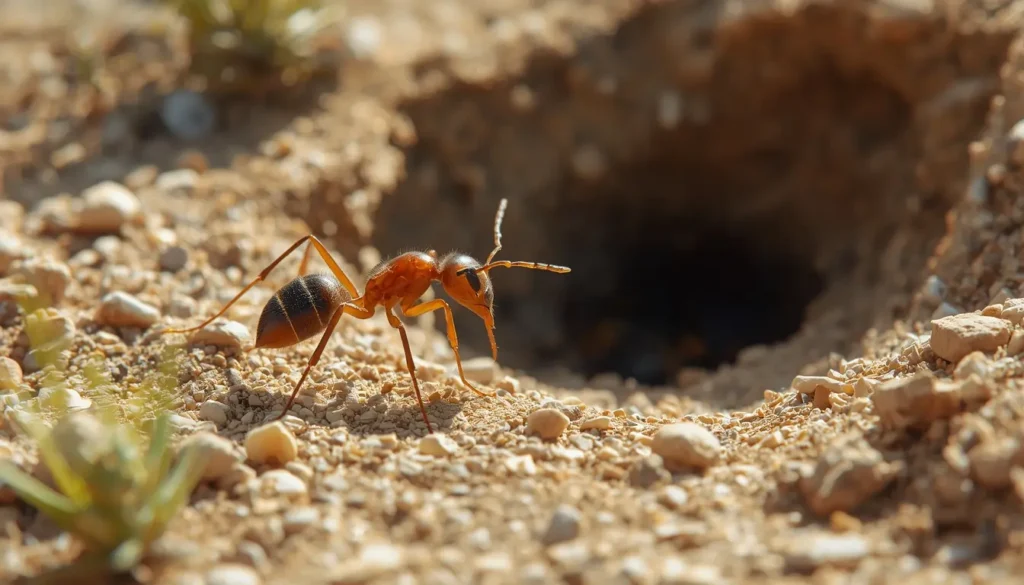
Follow the deserts. Honeypot ants turn up only in arid, dry, or desert-scrub country, because their whole strategy is an answer to boom-and-bust food supply. Where rain is unpredictable and nectar comes in short bursts, storing the good times pays off. Where food is steady, it does not, and repletes never evolve.
In North America, Myrmecocystus ranges across the deserts and dry woodlands of the American Southwest and Mexico. In Australia, Camponotus inflatus lives across the arid center and south, around Uluru, the Musgrave Ranges, and the mulga scrub, nesting deep in sandy soil where it tends root aphids and visits nectaries.
Depth is a theme. Honeypot nests often plunge far underground, with the precious replete chambers kept deep where the temperature is stable and the humidity buffered. It is the same logic that governs any ant nest: put your most valuable assets where the surface weather cannot reach them. For honeypots, the most valuable asset is the repletes themselves.
Why store food in living ants?
It sounds wildly inefficient to immobilize dozens of workers as jars. In the desert, it is genius.
A desert colony faces long stretches with almost nothing to eat, broken by brief pulses of plenty when flowers bloom or aphids swarm. A honeypot colony harvests those pulses fast and stashes the surplus in repletes, then lives off that reserve for months. The living jar has advantages a clay pot never will: it will not spoil, it can be defended, it can be moved, and it can even adjust what it stores.
This is not a recent experiment, either. The strategy is ancient. Researchers describing the first fossil replete, preserved in amber, showed that ants were already storing food in living workers back in the Eocene, on the order of 35 million years ago. Repletism has been keeping desert colonies alive since long before humans existed to marvel at it.
There is even a term for a replete near the end of a long dry season. A “deplete” is a replete whose crop has been largely drawn down but whose stretched body has not shrunk back, a jar that has given nearly everything it had. It is a small, vivid picture of a colony surviving on its own stored reserves right to the edge.
Do repletes ever move again?
A replete’s role is usually for life, but it is not a death sentence. As a colony draws down a replete’s crop over a long dry season, the ant slowly empties into the deplete described above, and a partly emptied replete can regain some movement. Repletes are long-lived by ant standards, hanging in their chambers for many months.
The grim exception comes in true famine. If a colony’s stored reserves run out, it can consume its own repletes, digesting the last of the workers it once filled. Even then the logic holds: a replete exists to keep the colony alive, whether by giving up its honey a drop at a time or, at the very end, all at once.
Can you eat honeypot ants?
Yes, and people have for millennia. The swollen repletes are essentially a bead of honey in a living wrapper, and across the world’s deserts humans learned to dig for them.
In Australia, the repletes of Camponotus inflatus are a celebrated bush food. The abdomen bursts with a sweet, faintly tangy liquid, and the honey itself has been studied and found broadly similar to honeybee honey, though less sweet, runnier, and more acidic, with real antioxidant activity. In the arid interior, where natural sugar is scarce, that mouthful of sweetness was a genuine prize.
In Mexico, the North American Myrmecocystus repletes are gathered the same way and eaten as a traditional treat, the “hormigas mieleras,” or honey ants. The pattern repeats wherever honeypots and people overlap: find the nest, dig carefully, and harvest the living honey.
I want to be clear for keepers reading this: harvesting wild repletes is a skilled, traditional practice tied to specific places and cultures. It is not a reason to dig up a wild colony for novelty.
Honey ants at the heart of a living culture
For many Aboriginal Australian peoples, the honey ant is far more than a snack. It is deep culture. The ants carry names across many languages, including Yarumpa and Yerrampe in Arrernte, Tjala in Pitjantjatjara, and Tjupi in Luritja, and they have been harvested and shared for thousands of years, valued both as food and as a traditional remedy for sore throats and colds.
They also belong to the Dreaming. The honey ant features in the Honey Ant Dreaming, part of the Tjukurpa, the body of law, story, and spiritual connection that ties Central Desert peoples to their country. The Honey Ant Dreaming site in Central Australia is shared among the region’s Indigenous groups, and the ant stands as an ancestral being, not merely a resource.
That significance shaped art history. The town of Papunya takes its name from a honey ant Dreaming, and in 1971 a group of Aboriginal men there, working with teacher Geoffrey Bardon, painted a Honey Ant Dreaming mural on the school wall. That mural sparked the Western Desert painting movement and the collective Papunya Tula, whose name itself evokes honey ant Dreaming.
The dot paintings now recognized worldwide trace back, in part, to this small desert ant. When you eat a store-bought jar of honey, you taste a commodity. When these communities speak of honey ants, they are speaking of law, land, and lineage.
Keeping honeypot ants
For ant keepers, honeypots, and especially Myrmecocystus, sit firmly in the advanced tier. They are among the most coveted ants in the US hobby and among the most likely to defeat a new keeper.
The challenges are built into their biology. They want deep vertical space, dry heat, and long stretches of stability, which is hard to fake in a small formicarium. Colonies grow slowly, and the repletes that everyone wants to see only form once a colony is large and well fed enough to bank a surplus. Rushing that is the fastest way to lose the colony.
Feeding leans heavily on sugars: nectar substitutes, honey water, and sugar solutions, plus insect protein to raise brood. A carbohydrate-rich diet is what lets workers fill repletes in the first place, so a steady sugar supply during the growth season is not optional. Founding usually starts, as with most ants, from a single queen in a simple setup before the colony is ready for anything larger.
One more word on sourcing. In the United States, moving ants across state lines is federally restricted, and collecting from the wild carries its own rules, so responsible keepers acquire colonies legally and locally rather than digging up wild repletes for a quick thrill. A honeypot colony is a years-long commitment, not a curiosity to excavate and abandon.
My honest keeper’s take: honeypots reward patience and punish impatience like few other ants. If you want a colony that does something in a month, look elsewhere. If you want to watch a living pantry slowly assemble itself over a year, and you can source a colony ethically and legally for your region, few ants are more rewarding.
The bottom line
Honeypot ants take a simple problem, how to survive a desert’s boom-and-bust, and answer it with one of the strangest adaptations in nature: a caste of workers turned into living jars of honey. The same solution evolved again and again across continents, it is tens of millions of years old, and it feeds not only the colony but, for thousands of years, the people who share the desert with them.
Learn to see past the novelty of the “ants with big bellies,” and honeypot ants become a window into convergent evolution, desert ecology, and human culture all at once. That is a lot of weight for an insect the size of a grape to carry, and it carries it hanging quietly from a chamber ceiling, waiting for the dry season.
FAQ
What is a honeypot ant?
A desert ant with a caste of workers, called repletes, that store liquid food in their swollen abdomens and share it back to the colony when food is scarce. Several unrelated ant genera do this.
What is a replete?
A worker that has been fed until its crop and abdomen balloon with stored liquid. It becomes immobile, hangs from the nest ceiling, and acts as a living food and water reservoir for the colony.
What do honeypot ants store in their bodies?
Mostly nectar, honeydew, insect juices, and water. In some species, different repletes store different things, such as sugar-rich amber fluid versus a protein- and lipid-rich milky fluid.
Where do honeypot ants live?
In arid and desert regions worldwide, including the deserts of the US Southwest and Mexico (Myrmecocystus) and arid Australia (Camponotus inflatus and others). They nest deep underground.
Can you eat honeypot ants?
Yes. The repletes are filled with a sweet, honey-like liquid. Aboriginal Australians have harvested honey ants for thousands of years, and Myrmecocystus repletes are eaten as a traditional food in Mexico.
Why are honeypot ants important to Aboriginal Australians?
They are both a prized bush food and a sacred subject of the Honey Ant Dreaming. The town of Papunya and the Papunya Tula art movement are named for honey ant Dreaming.
How big do honeypot ant repletes get?
It varies by species. In the Australian honey ant, ordinary workers are 5 to 8 millimeters, while a full replete can swell to around 0.7 inch (17 mm), most of it stored liquid.
Are honeypot ants rare?
The ants themselves are common in their desert habitats, but they are secretive and nest deep, so they are hard to find and study. Several genera and many species exist worldwide.
Can you keep honeypot ants as pets?
Yes, but they are an advanced species. Myrmecocystus needs deep space, dry heat, patience, and steady sugar feeding, and repletes only form once the colony is large and well fed.
Do honeypot ant repletes die?
Not from becoming repletes. They live for months or longer as living storage and can slowly empty and partly recover. In a severe famine, a starving colony may consume its own repletes as a last resort.
How long can honeypot ants store food?
Months. Repletes are built to carry a colony through long dry seasons, holding their stored nectar and water until the next pulse of food, which in a desert can be a long wait.