
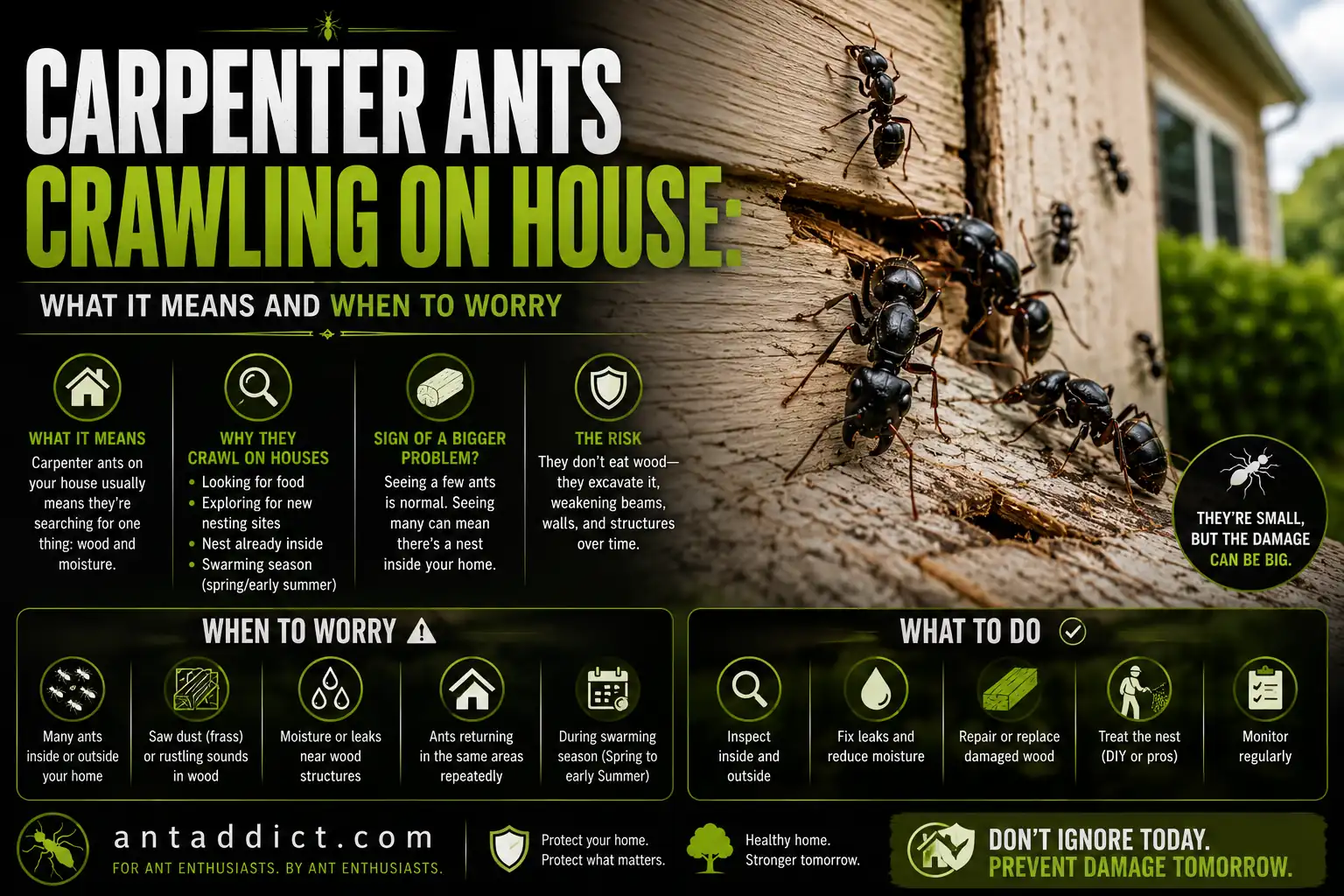
Carpenter Ants Crawling on House: What It Means and When to Worry
Last reviewed: June 2026. Behavior and identification details are drawn from first-hand keeping and the university extension sources linked inline and listed below. This article is educational and is not a substitute for professional pest control.
Carpenter ants crawling on house siding, walls, or floors do not automatically mean you have an infestation inside. Carpenter ants forage up to about 100 feet from their nest, mostly at night, so a few workers on your siding or in your kitchen are often foragers from an outdoor nest in a nearby tree, stump, or woodpile. What actually tells you the risk is the number you see, where you see them, and the time of year. A handful in summer usually means outdoor foragers, while many ants, recurring sightings, ants active indoors in winter, or winged ants inside point to a nest in or near the house. Either way, carpenter ants are a sign of damp or decaying wood nearby.
If you have spotted a few large black ants marching along your foundation or across the kitchen floor and your stomach dropped, take a breath. The pest-control ads want you to believe every sighting is a five-alarm emergency. The biology says something more useful and less scary.
After six years of keeping and studying ants, I can tell you that “carpenter ants crawling on the house” is a question with a calm, specific answer once you know how these ants actually live. It helps to first confirm you even have carpenter ants and not a look-alike, which the guide to the types of carpenter ants covers.
This guide covers where they are coming from, how to tell a few harmless foragers from a real nest, why the season matters more than you would think, and exactly what to do next.
Do carpenter ants crawling on house walls mean an infestation?
Not by itself. A carpenter ant on your house is a clue, not a verdict.
The reason is simple: carpenter ants are long-range foragers. A single worker will travel a long way from its nest to find food, so the ant you are looking at may live nowhere near your walls. Its home could be a rotting stump across the yard, and your house is just a stop on its nightly route.
That is why entomologists are careful here. As Michigan State University Extension notes, the mere sight of these ants is not by itself proof of trouble; what matters is how many you see, where, and at what time of year. So the honest answer to the scary question is: seeing them means you need to investigate, not that you already have an infestation in your walls.
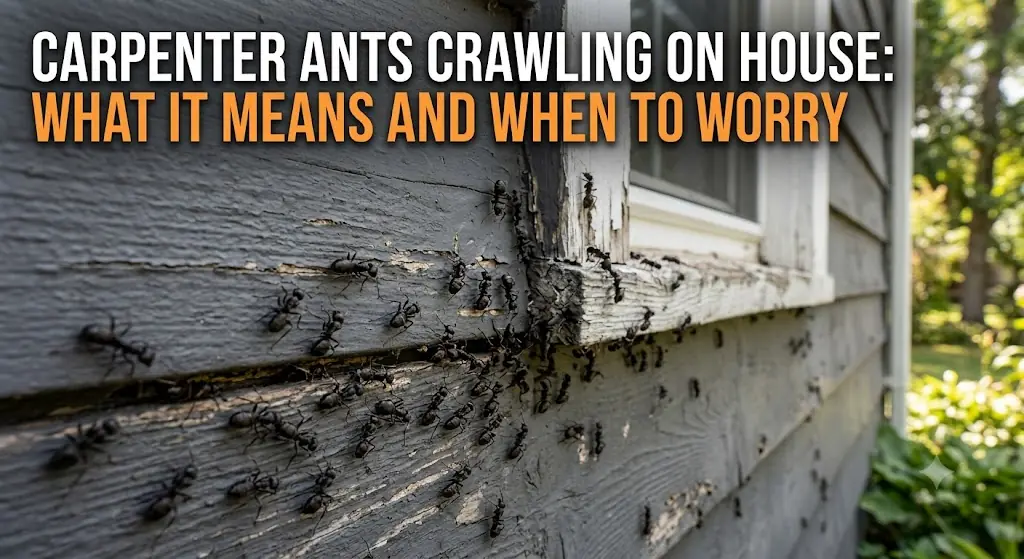
Where are the carpenter ants on your house coming from?
To read the situation, it helps to know how carpenter ants organize themselves, because it explains why the ants you see may not live where you think.
Carpenter ant colonies run on a parent-and-satellite structure. The parent colony, which holds the egg-laying queen and the young brood, is very often outdoors, in a dead tree, a stump, a woodpile, or landscape timbers. From there, the colony may set up satellite nests, groups of workers with no queen, in other spots, which can include voids inside a house.
So the ants crawling on your house could be coming from any of three places: an outdoor nest, with workers simply foraging their way onto and into your home; a satellite nest tucked in a wall void or damp framing; or, less often, a full parent colony inside damaged, moist wood. Telling these apart is the whole game, and the clues are in the details below.
Why are carpenter ants foraging on my house at all?
Two things pull carpenter ants toward and into a house: food and moisture.
For food, carpenter ants are not after your wood. They forage for sugars and protein, aphid honeydew outside, and indoors, sweets, grease, pet food, and crumbs. A house is simply a rich foraging ground, and the ants follow scent trails through the smallest gaps to reach it.
For moisture, carpenter ants are strongly drawn to damp, decaying wood, which is where they prefer to nest. Ants concentrating around a particular window, door frame, bathroom wall, or roofline can be a hint that there is damp wood there, the very condition that could let them nest.
This is why carpenter ants around a home are often read as a sign of a moisture or decay problem, not just an ant problem, and the same damp conditions attract other moisture-loving ants too.
Are a few carpenter ants a problem, or just foragers?
Here is the distinction that answers most people’s real question. A few ants and a lot of ants mean very different things.
If you see the occasional carpenter ant, say one to a handful over a few days, especially in the warmer months, you are most likely watching foragers from an outdoor nest. They are scouting and food-gathering, not living in your walls. It is worth paying attention, but it is not evidence of an indoor infestation.
If you see carpenter ants regularly and in numbers, day after day, in multiple rooms, or streaming along a defined indoor trail, the odds of a nest in or very near the structure go up sharply. Consistent indoor traffic suggests the nest is close enough, and possibly inside.
Remember, too, that the ants you see are a small fraction of any colony. Foragers are only a slice of the workforce, so steady indoor sightings can indicate a much larger hidden population.
Why does the time of year matter so much?
This is the single most useful clue, and almost nobody outside the extension services explains it. The season changes what a sighting means, because of how carpenter ants overwinter.
Outdoor carpenter ant colonies go dormant through a cold winter. When temperatures drop, an outdoor nest is not sending out foragers, the colony is holed up and inactive until spring. So if you are seeing active carpenter ants crawling inside your house in the dead of winter, in a cold-winter climate, they cannot be commuting from a dormant outdoor nest. They are almost certainly living somewhere warm: inside your heated house.
That is why finding carpenter ants indoors in winter or early spring is a much stronger sign of an indoor nest than finding them in July. In summer, a few ants are easily explained as outdoor foragers. In January, active ants indoors point inward.
The spring version of this signal is even louder: winged carpenter ants, called swarmers, appearing inside your house. Swarmers emerging indoors are reproductives from a mature nest, and their presence inside is one of the clearest signs of an established indoor colony.
How can I tell foragers from a nest inside?
Put the clues together and you can usually place yourself on the spectrum from “harmless foragers” to “nest inside.” Here is the quick diagnostic.
| Clue | Points to outdoor foragers | Points to a nest inside |
|---|---|---|
| Number | A few, occasional | Many, daily, multiple rooms |
| Season | Summer | Winter or early spring |
| Frass (sawdust-like debris) | None | Small piles near woodwork |
| Winged swarmers indoors | None | Yes, especially in spring |
| Rustling sounds in walls | None | Faint crackling when quiet |
| Trail | Wandering, in and out | A defined line to one spot |
The two strongest single signs of an indoor nest are frass, the coarse sawdust-and-insect-parts debris carpenter ants push out of their galleries, and swarmers indoors. If you find either, treat it as a likely nest and read the guide to carpenter ant holes for what the frass and galleries look like.
Here is the part everyone skips: the carpenter ant highway
The reason a single sighting is so hard to judge comes down to a piece of biology the panic articles never mention: carpenter ants run a nocturnal highway.
Carpenter ants are primarily night foragers. Workers leave the nest not long after sunset and follow chemical scent trails, laid down by scouts, out to food and back.
Those trails can run a very long way, up to roughly 100 feet, threading along tree branches, fences, utility lines, and foundation cracks straight into a house. The ant on your counter at 10 p.m. may be at the far end of a trail that leads all the way back to a stump across the yard.
This is also the key to finding the real source. Because the traffic peaks after dark, the smartest move is to wait until after dark, cut the lights, and watch the ants by flashlight.
Follow the moving line toward the point where it disappears into a wall or slips back outdoors, and it will point you to the nest, whether that sits in an indoor void or out at a tree. You are reading the highway from the far end on purpose.
Understanding this removes most of the fear. The ants are not mysteriously appearing from inside your walls; they are commuters on a trail, and the trail has two ends.
Are carpenter ants crawling on the house damaging it?
Foragers crawling on your siding are not damaging anything. Carpenter ants do not eat wood, and workers out searching for food are just passing through.
Damage only happens where the ants nest, by excavating galleries in the wood they live in. Only an established nest inside your home is a real structural concern, and even then the damage builds more slowly than termite damage does. So ants merely crawling on the house are a warning to investigate, not proof of damage. The damage question is really the nest question, which the clues above help you answer.
What should I do if I see carpenter ants on my house?
Here is the calm, sensible order of operations.
First, observe before you react. Note how many you are seeing, in which rooms or spots, and at what time of year. A quick count over a few days tells you a lot.
Second, look for the strong signs of a nest: frass piles near woodwork, winged swarmers indoors, and defined indoor trails. After dark, watch a trail by flashlight to see where the ants slip in and out.
Third, deal with moisture. Because carpenter ants want damp wood, finding and fixing leaks, poor drainage, and damp framing removes the conditions that let them nest, and is the single most useful preventive step.
Fourth, if you confirm or strongly suspect an indoor nest, especially in winter or with swarmers or frass, bring in a licensed pest professional. Locating a nest, which may be an outdoor parent colony feeding an indoor satellite, is genuinely tricky, and treatment is best done right. If you are only seeing occasional summer foragers, sealing entry points and cutting off food and moisture is often enough to keep them out.
When should I call a professional?
Call a licensed pest professional if you see any of the clear nest signals: carpenter ants active indoors in winter, winged swarmers emerging inside, frass appearing near woodwork, or large and persistent numbers of ants indoors. These point to an established nest that is hard to locate and treat without experience.
For a few outdoor foragers in summer, you can usually start on your own with exclusion and moisture control, and escalate only if the signs grow. When it comes to structural wood and your home, though, there is no shame in getting a professional inspection to be sure.
The bottom line
Carpenter ants crawling on house siding or indoors are a signal to investigate, not an automatic sentence of infestation. Because these ants forage up to about 100 feet from the nest and travel mostly at night, a few workers are frequently just foragers from an outdoor colony passing through. The number you see, the place, and above all the season tell you whether a nest is likely inside, with winter activity and indoor swarmers being the loudest warnings.
Read the clues, follow the nighttime trail, fix any moisture, and call a professional if the nest signs are there. Do that, and a scary handful of ants on the wall becomes a manageable, well-understood situation rather than a panic.
FAQ
Does seeing carpenter ants in my house mean I have an infestation?
Not necessarily. Carpenter ants forage up to about 100 feet from their nest, so a few are often workers from an outdoor colony. Number, location, and season determine whether a nest is likely inside.
Why are carpenter ants crawling on my house?
They are usually foraging for food or drawn to damp wood. Houses offer sweets, grease, and pet food indoors, and carpenter ants are strongly attracted to moist or decaying wood where they can nest.
How many carpenter ants is a problem?
A few occasional ants, especially in summer, usually means outdoor foragers. Seeing many ants daily, in multiple rooms, or along a defined indoor trail suggests a nest in or near the structure.
Do carpenter ants on the house mean there is a nest inside?
Not always. The nest may be outdoors in a tree, stump, or woodpile, with workers foraging onto the house. Frass, indoor swarmers, winter activity, or heavy indoor numbers point to a nest inside.
Why do I see carpenter ants in winter?
Outdoor colonies go dormant in winter, so active carpenter ants indoors during cold months usually cannot be outdoor foragers. They point to a nest living inside your heated home, which is a strong warning sign.
Are carpenter ants crawling on my house causing damage?
Foragers passing over your siding cause no damage. Carpenter ants do not eat wood; damage happens only where they nest by excavating galleries, so damage is a question of whether there is a nest, not of ants merely crawling by.
When are carpenter ants most active?
They are primarily nocturnal, leaving the nest around sunset and foraging into the night. Seeing many during the day, or spotting a defined nighttime trail, can indicate a large or nearby colony.
How do I find where the carpenter ants are coming from?
Wait until after dark and watch the trail by flashlight, since that is when the ants are busiest. Follow the moving line toward the spot where they slip inside, and it will lead you toward the nest, in a wall or back out to a tree or stump.
What attracts carpenter ants to a house?
Food and moisture. Indoors they seek sweets, grease, and pet food, and they are strongly drawn to damp, decaying wood around leaks, poor drainage, and condensation, which is also where they prefer to nest.
Should I worry if I only see one carpenter ant?
A single ant is usually a forager and not proof of an infestation, but note the season and watch for more. One ant indoors in winter, or alongside frass or swarmers, is more concerning than one outdoor forager in summer.
How do I stop carpenter ants from coming into my house?
Seal entry points, keep food sealed and surfaces clean, trim branches and remove woodpiles touching the house, and fix moisture problems. Removing damp wood and food cuts off the reasons they come in.
Do I need an exterminator for carpenter ants I see crawling on the house?
For occasional summer foragers, exclusion and moisture control are often enough. For winter activity, indoor swarmers, frass, or heavy numbers, a licensed professional should locate and treat the nest.
