Ant Spider: What It Really Is and What You Actually Saw
Last reviewed: August 2026. Claims in this guide are drawn from first-hand ant keeping and the peer-reviewed and reference sources linked inline and listed below. For identifying or removing a spider in your home, consult a licensed pest control professional.
An ant spider is not one animal. “Ant spider” is a catch-all people reach for to describe several very different things: spiders that disguise themselves as ants, a real family of spiders that hunt and eat ants, an actual ant that happens to look like a spider, and the plain question of whether the little creature in front of you is an ant or a spider at all. This guide sorts out which “ant spider” you actually mean, and answers the real question behind each one — including one of the most jaw-dropping cons in the whole animal kingdom.
If you searched “ant spider,” you had one of a few very different situations in mind, and the internet’s answers are a mess because they blur them together. One page shows you a jumping spider, the next shows you a spider that eats ants, and a third quietly shows you an ant. Let me untangle it.
After six years of keeping ants, I’ve spent a lot of time staring at things marching along a trail and asking, wait — is that even an ant? More often than you’d think, it isn’t. This guide walks through each meaning, tells you how to know which is yours, and links out to the fuller guide where one exists, so you can jump straight to the answer you need.
What people mean by “ant spider”
Before anything else, here is the quick sort. Match your situation to one of these, then read that section.
| If you saw… | You probably mean | Jump to |
|---|---|---|
| A “six-legged” ant with a waist, jerky movement, and waving front legs | An ant-mimicking spider | Below |
| A spider hunting, grabbing, or eating ants | Ant spiders (Zodariidae) | Below |
| A long-legged “spider” that turned out to move in a colony like an ant | A spider ant (Leptomyrmex) | Below |
| You genuinely can’t tell whether it’s an ant or a spider | The identification test | Below |
None of these is a single species named the “ant spider.” They are four different questions wearing the same nickname. Sorting them is most of the battle.
Ant-mimicking spiders: the master con artists
If you were watching what you thought was an ant and something felt off — it had a waist but the proportions were wrong, it waved its front legs like antennae, it moved in a jerky stop-start way, or you counted the legs and got eight — you were almost certainly looking at an ant-mimicking spider. This is the meaning most people are after, and it is the most remarkable of the four.
The behavior has a name: myrmecomorphy, from the Greek for “ant form.” It is not rare, either. More than 300 spider species disguise themselves as ants, and they have evolved this trick independently across many unrelated spider families — a textbook case of convergent evolution, where the same solution keeps getting reinvented because it works that well.
The most famous of these mimics belong to the genus Myrmarachne, whose name literally fuses the Greek words for “ant” (myrmex) and “spider” (arachne). These are jumping spiders, family Salticidae, and there are 188 described species of them, found through the tropics from Africa to Australia, with a handful reaching the New World. They are the spiders people mean when they type “ant spider” into a search bar.
Here is what makes the disguise so good. A spider and an ant are built completely differently, so the mimic has to fake its way around basic anatomy:
The spider’s body gets an elongated shape and a pinched “waist,” creating the illusion of an ant’s three-part body out of a spider’s two parts. The coloration shifts to match the local ant — Myrmarachne species run anywhere from black to yellow depending on which ant they are copying. And crucially, the spider solves the antennae problem. Ants have antennae; spiders do not. So the mimic lifts its front pair of legs off the ground and waves them in the air, faking the constant antennal twitching of a real ant.
The 100-millisecond illusion
For a long time, people assumed these spiders simply walked on six legs like an ant and held the front two up permanently. In 2017, researchers proved that wrong, and the truth is far more impressive.
A team led by Paul Shamble, then at Cornell and later a fellow at Harvard, filmed the ant-mimic Myrmarachne formicaria with high-speed cameras and published the results in Proceedings of the Royal Society B. What they found is that the spider actually walks on all eight legs — but it raises its forelegs to mimic antennae only during tiny pauses, each lasting roughly 100 milliseconds. That pause is short enough that a watching predator’s eye never registers the “missing” legs, but long enough to sell the antennae. The spider also weaves along winding, ant-like paths instead of the aimless wandering of an ordinary spider.
In other words, the con is not a costume — it is a performance, timed to the exact limits of a predator’s visual system. When the team showed predatory spiders animations of ants, ordinary spiders, and these mimics, the predators lunged at the ordinary spiders and completely ignored the mimics. The disguise held.
Why fake being an ant? Two very different reasons
This is the part that trips people up, because ant mimicry serves two almost opposite purposes depending on the spider.
The first is defense, known as Batesian mimicry — wearing the costume of something dangerous so predators leave you alone. Ants are aggressive — they bite and sting, many taste terrible, and a lot of predators have learned to avoid them entirely. A soft, edible spider that looks like an ant borrows all of that protection for free. The effect is real and measurable: in one experiment, hand-raised birds ate the ant-mimic Synageles venator happily until they had their first encounter with real ants and the nauseating formic acid that comes with them — after that, they refused the spider too, even though it would have been a perfectly good meal. The disguise alone saved it.
The second reason is the sinister one: aggressive mimicry, sometimes called Peckhamian mimicry — wearing the costume of your prey so you can get close enough to eat it. Some ant mimics use the disguise to walk right up to ants and pick them off, or to move safely through ant territory hunting other prey. The same face that says don’t eat me to a bird says I’m one of you to an ant, right up until the moment it isn’t.
That double life is the whole trick. The disguise is both a shield and a weapon, and which one it is depends entirely on who’s looking.
A tell worth knowing: the males give it away
One quirk is useful if you like to identify what you’re looking at. In Myrmarachne, the males grow enormous forward-projecting jaws — chelicerae — that can be as long as the rest of the head and body. They look dramatic, and oddly, they sometimes lack venom glands entirely, functioning more as display and combat tools than weapons. But those giant jaws also ruin the disguise: a male with them looks far less like a slim ant than a female does. Naturalists who photograph these spiders often note that the females are the more convincing mimics, while the big-jawed males read, at a glance, as some strange two-headed ant. If the “ant” you’re looking at seems to have an extra set of jaws jutting forward, you’ve almost certainly found a male ant-mimic spider.
Ant spiders (Zodariidae): the ones that actually eat ants
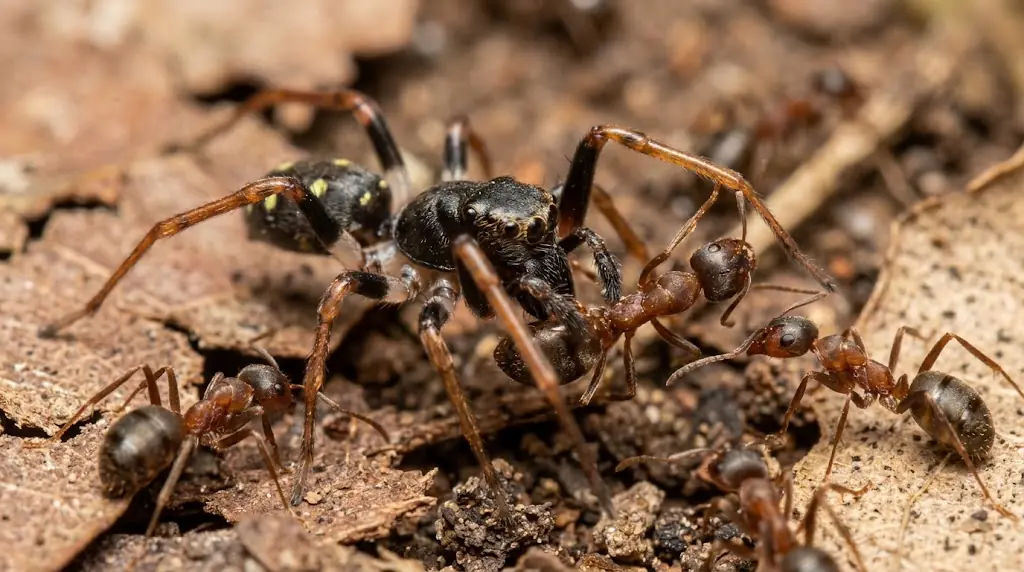
Now the second meaning, and the one that has the best claim to the literal name. There is a real, formally recognized family of spiders called ant spiders: the Zodariidae. These are not mimics wearing a costume. They are specialist hunters that make their living eating ants.
The family is large — around 90 genera and more than 1,325 species as of early 2026 — and they live throughout the warm parts of the world: South America, Africa, Madagascar, Australia, New Zealand, Arabia, and the Indian subcontinent. Many of them live right alongside ants, mimicking ant behavior and even, in some cases, copying the colony’s chemical signature so they can move among their prey undetected. The genus Zodarion is the extreme case: as far as researchers can tell, these spiders eat nothing but ants.
So when a homeowner or a naturalist describes “a spider that keeps catching the ants,” this is very likely what they mean. It is worth knowing that these spiders are harmless to people — they are small, they are not aggressive toward humans, and their entire evolutionary attention is pointed at ants, not at you. For an ant keeper, though, they are a genuine reminder that a colony’s world is full of things specifically designed to eat it. Ants are so abundant and so nutritious that an entire spider family evolved to make a living on them alone — one of the many predatory pressures that shape how ant colonies defend themselves.
Spider ants (Leptomyrmex): when the ant is the one in disguise
Here the confusion flips completely around. Sometimes the thing people call an “ant spider” — or “spider ant” — is not a spider at all. It’s an ant that looks like a spider.
The clearest example is Leptomyrmex, the aptly named spider ant of Australia and nearby regions. These are real ants, but with long, thin legs and a slender, elongated body that gives them an unmistakably spidery, daddy-longlegs silhouette. According to the Australian Museum, they run about 6 mm long, raise their abdomen and move quickly when disturbed, and — my favorite detail — their long legs let them walk across the surface of water, so they’re often the first ants out foraging after rain. They live in relatively small colonies and include workers that store liquid food in swollen abdomens.
I mention them because they are exactly the kind of thing that sends someone to a search bar. You see a leggy, fast, spider-shaped bug marching in a line with dozens of identical bugs, and your brain snags: spiders don’t do that. Correct — spiders don’t. What you found is an ant that simply happens to be shaped like a spider, and the giveaway is the behavior. A colony marching in a coordinated trail is an ant thing, not a spider thing.
The identification test: ant or spider?
If you strip away all the names, a huge share of “ant spider” searches boil down to one practical question: is this thing in front of me an ant or a spider? Because the mimics are so good, you cannot trust a glance. You have to check the anatomy. Here is the field test I use, in order of reliability.
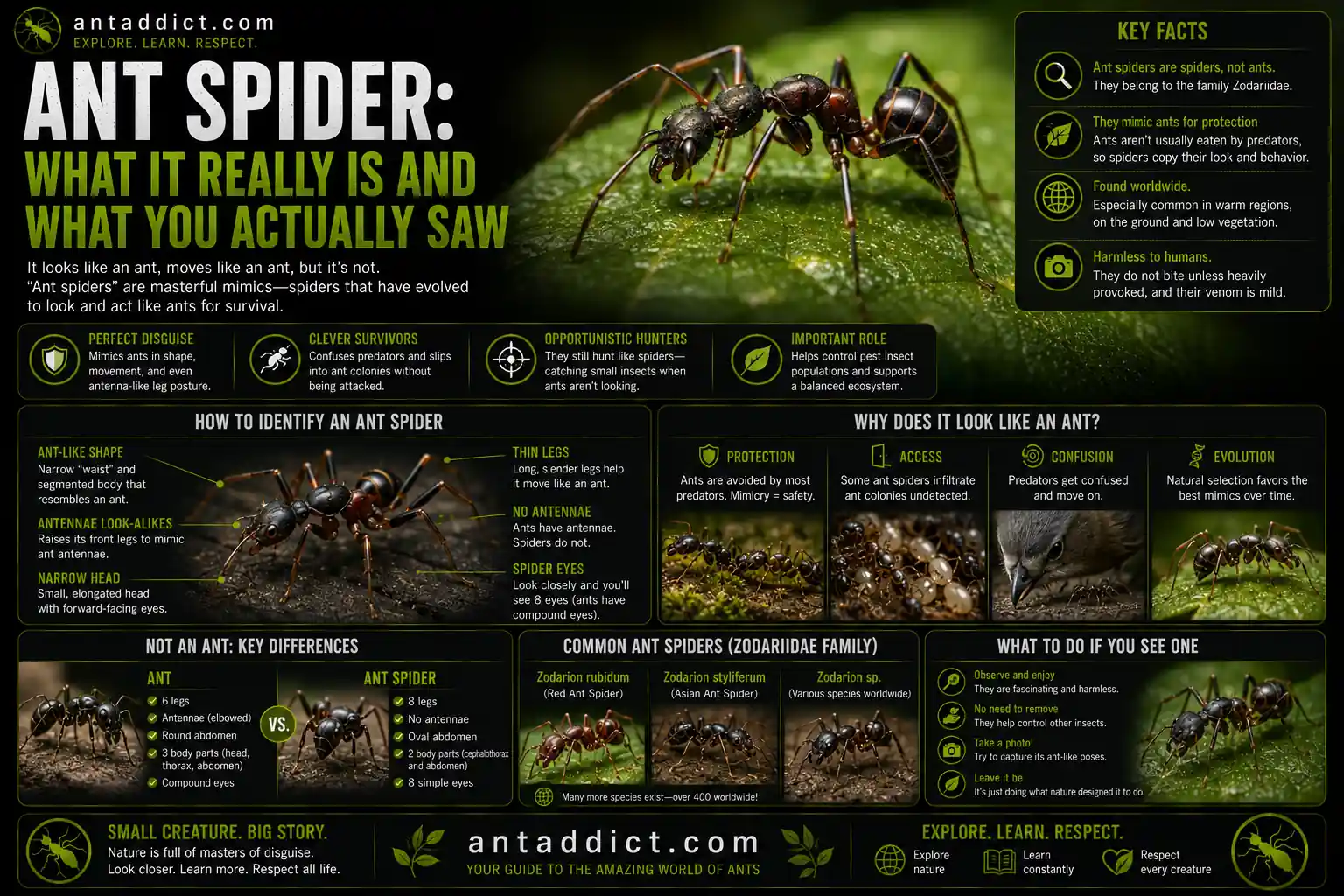
Count the legs. This is the single most reliable check. Ants have six legs. Spiders have eight. A mimic will try to hide this by holding its front pair up like antennae, so count the legs that are actually walking — if there are eight on the ground, or six walking plus two waving, you have a spider.
Look for a true waist versus body segments. An ant’s body has three obvious parts — head, thorax, and a distinct segmented abdomen, usually with a visible node or “hump” at the waist. A spider has just two parts: a fused head-and-thorax (the cephalothorax) and the abdomen. Mimics fake a third segment with clever coloration and a pinch, but under a hand lens the two-part spider body usually shows through.
Check for real antennae. Ants have genuine, elbowed antennae that move constantly and independently. Spiders have none — which is precisely why mimics resort to waving their legs. If the “antennae” are only ever up when the animal is paused, and disappear the moment it walks, they’re legs.
Look for pedipalps and eyes. Spiders have a pair of short pedipalps near the mouth (oversized in male jumping spiders) and typically a cluster of simple eyes, often with two large forward-facing ones in jumping spiders. Ants have compound eyes and chewing mandibles instead.
Watch the movement. Ants tend to move in purposeful, trail-following lines, often many individuals together following a scent trail — the same pheromone system that organizes all ant foraging. A lone “ant” moving in jerky, darting stop-and-go bursts, especially one that suddenly jumps, is almost certainly a jumping spider mimic. Ants don’t pounce.
Run those in order and the disguise falls apart fast. Legs first, then the waist, then the antennae — that’s usually all it takes.
Here is the part most pages miss: why so many things pretend to be ants
Step back and something striking emerges. Look at the whole picture — spiders that mimic ants for protection, spiders that mimic ants to hunt ants, spiders that specialize in eating ants, ants that get mistaken for spiders — and you notice they all orbit the same fixed point. The ant.
Ask why, and you get the deeper answer. Ants are one of the most successful groups of animals on Earth: staggeringly abundant, chemically defended, aggressive in numbers, and avoided by a long list of predators who’ve learned the hard way. In evolutionary terms, being an ant is an incredibly good deal — so good that more than 300 spider species, scattered across the spider family tree, have independently evolved to look like one. Imitation really is the sincerest form of flattery, and ants are the single most imitated insects in nature.
That is the theme running under all of this. An “ant spider,” in almost every sense of the phrase, is a story about how much power an ant colony projects into the world around it. Predators evolve to specialize in ants because ants are everywhere. Prey and impostors evolve to look like ants because looking like an ant is armor. The ant sits at the center, and everything else — the mimic, the hunter, the look-alike — is shaped by it.
There is no species called the “ant spider.” But there is a profound gravitational pull that ants exert on the animals around them, and once you see it, you can’t unsee it. The disguise, the hunt, the confusion — all of it is a monument to how much the rest of the small-animal world has to reckon with ants.
What to do, depending on which “ant spider” you have
To close the loop, here is the practical takeaway for each meaning.
If you saw a “six-legged” ant that felt wrong — waving front legs, jerky movement, a jump — you found an ant-mimicking spider. Count the legs to confirm, and know it’s harmless and genuinely worth admiring.
If you saw a spider hunting or eating ants, you’re most likely looking at a true ant spider from the family Zodariidae, a harmless ant specialist.
If you saw a long-legged, fast, spider-shaped bug marching in a colony, you probably found a spider ant like Leptomyrmex — an ant in a spider’s silhouette.
If you simply can’t tell what it is, run the identification test: count the walking legs first, then check for a two-part versus three-part body, then look for real antennae.
The bottom line
“Ant spider” is not a species — it is a question with four different answers hiding inside it. Most often it means an ant-mimicking spider, a small-time con artist that fakes ant anatomy well enough to fool birds and ants alike. Sometimes it means the real ant spiders, the Zodariidae, that hunt ants for a living. Sometimes it means a spider ant, an actual ant built like a spider. And sometimes it’s just the honest confusion of not knowing which of the two you’re looking at.
Figure out which one is yours and the confusion clears instantly. And whichever it is, the most interesting truth stays the same: half the reason these creatures exist in the form they do is that being an ant, or being mistaken for one, is one of the best survival bets an animal can make.
FAQ
Is an “ant spider” a real species?
No. “Ant spider” is an informal catch-all, not a single scientific species. It usually refers to ant-mimicking spiders (like Myrmarachne), to the true ant spiders in the family Zodariidae that eat ants, or to a spider ant — an actual ant that looks like a spider.
What is an ant-mimicking spider?
It’s a spider that has evolved to look and behave like an ant, a trait called myrmecomorphy. More than 300 spider species do this, most famously the jumping spiders of the genus Myrmarachne, which fake an ant’s waist, coloration, and antennae.
Why do spiders pretend to be ants?
For two opposite reasons. Most do it for protection (Batesian mimicry), since predators avoid aggressive, bad-tasting ants. Some do it to hunt (aggressive mimicry), using the disguise to get close to ants or to move safely through ant territory.
How do ant-mimicking spiders fake antennae if spiders don’t have them?
They lift their front pair of legs off the ground and wave them in the air like antennae. High-speed footage shows they walk on all eight legs and only raise the forelegs during brief pauses of about 100 milliseconds — too quick for a predator’s eye to notice the difference.
How can I tell an ant from a spider?
Count the legs first: ants have six, spiders have eight. Then check the body — ants have three parts and elbowed antennae, spiders have two parts and no antennae. A “six-legged” ant that waves its front legs and sometimes jumps is almost certainly a spider.
Are ant-mimicking spiders dangerous to humans?
No. They are small, shy, and not aggressive toward people. Most cannot meaningfully bite a human, and some male Myrmarachne even lack venom glands in their oversized jaws. They are far more interesting than they are dangerous.
What are the true “ant spiders” (Zodariidae)?
Zodariidae is a real spider family of around 1,325 species, commonly called ant spiders because many specialize in hunting and eating ants. The genus Zodarion appears to feed on nothing but ants. They are harmless to people.
Do ant spiders actually eat ants?
The Zodariidae ant spiders do — that’s their specialty, and some live among ants, even copying the colony’s chemistry to avoid detection. Ant-mimicking jumping spiders are a separate group; some of those eat ants too, while others use the disguise mainly for protection.
What is a spider ant?
A spider ant is a real ant that looks like a spider, most famously Leptomyrmex from Australia. It has long thin legs and a slender body, moves fast, and can even walk on water — but it lives and forages in a colony like any other ant.
Why do males of ant-mimicking spiders look strange?
Male Myrmarachne grow very large forward-projecting jaws (chelicerae) used for display and fighting. These jaws make males look less like a slim ant than females do, so females are usually the more convincing mimics.
Do ant-mimicking spiders build webs?
Most of the famous ant mimics are jumping spiders, which don’t build snare webs to catch prey. They hunt actively and use silk mainly for shelters and safety lines. Their disguise, not a web, is their main tool.
How many spiders mimic ants?
More than 300 species across many unrelated spider families, which is why ant mimicry is considered a striking example of convergent evolution — the same disguise evolving over and over because it works so well.
Is the thing in my house an ant or a spider?
Count the legs walking on the ground. Six means ant, eight means spider. If you see six legs plus two waving in the air, or if it darts and jumps, it’s an ant-mimicking spider — harmless, and honestly one of the coolest things you can find indoors.